One-on-One
Bob Hurley; Marty Smith
Season 2024 Episode 2688 | 27m 13sVideo has Closed Captions
Bob Hurley; Marty Smith
Steve Adubato and his Co-Host Mary Gamba are joined by Coach Bob Hurley, President of People's Park Foundation, to talk about the recreational opportunities at the fields at Liberty State Park in Jersey City; Then they talk with Marty Smith, ESPN Host and Author of "Sideline CEO" about the connection between sports, leadership, and delegation on a successful team.
Problems playing video? | Closed Captioning Feedback
Problems playing video? | Closed Captioning Feedback
One-on-One is a local public television program presented by NJ PBS
One-on-One
Bob Hurley; Marty Smith
Season 2024 Episode 2688 | 27m 13sVideo has Closed Captions
Steve Adubato and his Co-Host Mary Gamba are joined by Coach Bob Hurley, President of People's Park Foundation, to talk about the recreational opportunities at the fields at Liberty State Park in Jersey City; Then they talk with Marty Smith, ESPN Host and Author of "Sideline CEO" about the connection between sports, leadership, and delegation on a successful team.
Problems playing video? | Closed Captioning Feedback
How to Watch One-on-One
One-on-One is available to stream on pbs.org and the free PBS App, available on iPhone, Apple TV, Android TV, Android smartphones, Amazon Fire TV, Amazon Fire Tablet, Roku, Samsung Smart TV, and Vizio.
Providing Support for PBS.org
Learn Moreabout PBS online sponsorship- [Narrator] Funding for this edition of One-On-One with Steve Adubato has been provided by Kean University.
Where Cougars climb higher.
Atlantic Health System.
Building healthier communities.
The North Ward Center.
New Jersey Sharing Network.
Wells Fargo.
The Healthcare Foundation of New Jersey.
PSE&G, committed to providing safe, reliable energy now and in the future.
PSC.
Where your story is our business.
And by The New Jersey Economic Development Authority.
Promotional support provided by Northjersey.com and Local IQ.
Part of the USA Today Network.
And by BestofNJ.com.
All New Jersey in one place.
- This is One-On-One.
- I'm an equal American just like you are.
- The way we change Presidents in this country is by voting.
- A quartet is already a jawn, it’s just The New Jawn.
- January 6th was not some sort of violent, crazy outlier.
- I don't care how good you are or how good you think you are, there is always something to learn.
- I mean what other country sends comedians over to embedded military to make them feel better.
- People call me 'cause they feel nobody's paying attention.
-_ It’s not all about memorizing and getting information, it’s what you do with that information.
- (slowly) Start talking right now.
- That's a good question, high five.
(upbeat music) - Hi, everyone, Steve Adubato.
I'm about to introduce you to a segment we did over on Lessons in Leadership with the legendary coach, Bob Hurley, wrote this book a few years ago called "Chasing Perfect".
Bob Hurley over at St. Anthony's in Jersey City.
The school doesn't exist anymore, because they frankly couldn't stay afloat financially.
But Coach Hurley 50 years coaching on the high school level, what he learned as a coach, what he learned about young people, the importance of having recreational and sports activities in urban communities like Jersey City.
The coach talked about that.
By the way, his son, Danny Hurley, University of Connecticut, he was there when they won the NCA National Championship, Coach Hurley and the entire Hurley family.
It's a fascinating interview with not just a great coach, a great leader, a terrific guy from over in Jersey City.
Coach Hurley.
Lessons in Leadership is honored to have one of the greatest coaches on any level, one of the greatest leaders on any level when it comes to the sport of basketball.
He is Bob Hurley, Coach Bob Hurley, President of People's Park Foundation, author of this great book, "Chasing Perfect", Bob Hurley and the legendary coach at St. Anthony's in Jersey City for how many years there, coach?
- I was there total of 50 years, Steve.
I was varsity coach for 45 years, and then the freshman JV coach for five for that.
- Let's do this.
I would be remiss if I did not ask you, since this is a leadership show, we'll also use that on some of our other platforms.
Of all the many leadership lessons that you have learned and that you've taught others, the most significant lesson that translates from basketball to every other aspect of life we learned from John Wooden and other great coaches who wrote about basketball and leadership as well.
- Yes.
- I know there are many, but what jumps out at you that will be helpful to our audience?
A great leadership lesson.
Please, coach.
- Well, I just think it's probably something along the lines of what Malcolm Gladwell espouses, Steve, that to become good at something, you really have to invest a tremendous amount of time.
And in this microwave society now, people don't understand how to grind something out to become successful.
So, Malcolm Gladwell would say, to become a master of something, you're gonna put about 10,000 hours in it to become good at.
And if you're in the basketball world, perhaps you're Steph Curry and no one is recruiting that kid as a high school kid and be sheer effort and time and doing the right things becomes two time MVP in the MBA with one scholarship to college.
- Awesome.
Hey, coach, we'll come back to leadership in just a second, but the President of the People's Park Foundation, tell everyone what that is as we put up the website, please.
- Yes.
Well, a group of us got together here in Jersey City, because the Liberty State Park is at a point where they're going to clean up all of the contaminated area.
And now these hundreds of acres are gonna be turned into something.
The people that have controlled the park for a long time wanted the entire park to be just a natural preserve, basically remain like it is right now.
And as someone who has raised children in Jersey City, I have grandchildren who come to the house now, and know the plight of all of the local coaches, educators, police, I know that we need more of an opportunity for young people.
So, what we're striving to do, and we've had a lot of success, is to put the brakes on it being solely passive recreation.
And we're gonna get about 15% of the park now is gonna be turned into multi-practice, multi-purpose practice fields, tennis courts, things that you know young people can use and it'll greatly benefit the 30,000 kids that are in the Jersey City schools.
- Good stuff.
Mary, jump in.
- Yeah, definitely.
Bob, you're talking about that park.
It's such an inspiration.
Talk about that connection between sports and leadership, especially for our children.
Steve and I both have kids, as you did, that went through the whole sports thing.
Everything from baseball to softball, ice hockey, you name it.
What is that- - Mary, hold on.
I still have, we still have a 13-year-old daughter, best athlete in the family.
- That's why I said softball.
Somebody hit a home run the other day and it wasn't me.
I hit a home run about 40 years ago when I played softball.
But yeah, (Bob laughing) so that's why I did put softball into the equation.
So, children, I should say.
- Thank you.
- But yeah, Bob, talk a little bit about that connection and the lessons and why our kids need sports for discipline, et cetera.
- Particularly, sports has always had a place of importance.
Teaching so many lessons in life with kids, being on time, being prepared to work, learning to work together, so many different things.
But post-pandemic, we had years where our kids were in the house.
They became just consumed with information they would get on their phones and iPads and things.
And we started a foundation in Jersey City, the Hurley Family Foundation, when St. Anthony closed.
And we were back working with young people and we could see the value we were getting here.
Kids were doing better in school, they were getting themselves involved in more activities, clearly staying away from influencers that are not good.
And then, we kept looking at it and saying, well we have so many kids here, our facilities have to be better so we can reach more kids.
And I can use the example of my own children going to Bayonne Park as kids to run there, to do things there, and not using other parks.
Now, I live in downtown Jersey City.
I have two grandkids at the house.
And they'll say to me, "Hey," they're half a day of school, "pop, can we go to the park?"
And we will literally drive through Liberty State Park to go all the way back to Bayonne Park, because there's basketball courts, there's a running track, there'll be a food truck someplace.
A variety of things they can do.
And, uh... we shouldn't have to travel all the way to Bayonne to do that.
A recent example, my grandson is a freshman at St. Peter's Prep and he played Ferris High School the other day in a JV soccer game.
And the two schools, which are about eight blocks apart in downtown Jersey City, had to go to Bayonne Park to play.
And that shouldn't be.
We should have more opportunities for kids.
We want the kids to have so many opportunities that they're not gonna walk away from something, 'cause they feel like they're being treated like a second-class citizen.
And for our teams locally here, Mary, when a team from Jersey City travels someplace to play, they think they've gone to like professional stadiums, because their lack of facilities we have right here.
And that's not fair.
- Hey coach, let me try this.
You mentioned your grandchildren, and by the way, have your children accomplished anything much in the world of basketball?
(laughs) - Well, you know what, the biggest thing they got, the two oldest, I have three, my best students- - So, Bobby, Danny, and- - And Melissa, who's a teacher here in Jersey City.
- Okay.
Right.
- By far our best students.
But they worked hard in basketball.
And my wife and I said, if you work hard, you'll be able to determine what colleges you're gonna be able to go to, because we're not going to be able to just write a check for any school in the United States.
Your success in sports and doing well in school will dictate that.
So, Bobby was able to get a scholarship to Duke University and Danny was able get a scholarship to Seton Hall.
And because of their involvement in sports, like so many other kids, it's an avenue.
- And PS, Danny was the coach, is the coach of the University of Connecticut.
And how'd they do this year?
- They had a surprisingly good year Steve.
(Mary laughing) And I can tell you that when the NCA tournament began, we were hoping for some success, because there's a lot of pressure coaching college.
And then, for three weekends, we were on a magical mystery tour.
It was unbelievable.
My grandson, who I just mentioned, I think he missed 10 days of school in those three weeks.
And he's a very good student.
And no one at his school, none of his teachers, the principal, nobody said anything, because they saw him on television doing things that they certainly would've liked to have done themselves when they were younger.
- And then, not only got to the dance, but UConn, congratulations to them.
I happened to be a Seton Hall Pirate fan.
And so, we watched UConn win that national championship.
- Yes.
- Mary, jump back in.
I got a few more for the coach, but jump back in.
- Yeah, definitely.
I'm just sitting here, I got goosebumps.
And one thing that I wanna talk a little bit about, and it goes to everything you're saying was just trying to build that park in Jersey City.
Talk a little bit about grit.
Steve and I, this is something newer that over the last three years, the pandemic, Steve always has that book right to pull out.
Talk about grit and your views on that.
When we're talking about sports life, business, leadership, share your thoughts on grit.
- Yeah, I think, and sports, it's a great way to just try to learn many, many less lessons in life.
In basketball, simply, if I'm not a good foul shooter, I can talk about it, I can have a sports psychologist talk to me about it, I can get advice from awful lot of people, or I can take a ball and I can go out and I can shoot until I feel more comfortable shooting free throws.
And the more I do something, the better I get.
So, I think, unfortunately, old school and sports coaching is repetition.
And it's very difficult now to get kids to repeat a particular thing over length of time, 'cause they're so used to going from one thing to another very quickly.
But the basis for a lot of success is building a fundamentals, and anything that we do, when I'm strong with my basic fundamentals in business, in school and sports, I can expand it as it would be logically a time to do that.
So, so important.
And I gotta handle all the obstacles.
Major league baseball players in the Hall of Fame make out 7 out of 10 times.
And how do you respond to those times after you failed?
Mike Krzyzewski would say to the Duke players all the time, move on to the next play.
Just go on to the next play, because it's gonna be a lot of failure.
- That guy, Bob?
- Wow.
(Mary laughing) The timing of this, amazing.
- Hold on.
Mary.
- I can't tell you the props that he has there, Bob.
(Bob laughing) I can't.
- The two of the greatest coaches and leaders of all time.
Coach K would say what?
Go ahead.
Coach K would say what?
I got it.
It's the Other way.
- He would say, move on to that next play.
Don't linger.
Let the thought of what happened linger in your head as you move on, because the failure is something you just have to deal with.
It's part of life.
- But, Bob, before I let you add, I gotta do this.
In our leadership seminars, Mary and I know, I know as I say this all the time, that our goal is not perfection.
Our goal is progress.
And I'm always pushing progress, improvement.
That there is no perfection.
You got "Chasing Perfect".
Coach, is there such a thing in leadership and in life as quote, perfect?
- Well, I think what you do is if you chase perfect, you may wind up accepting excellence.
So, if you're shooting free throws and you're Steph Curry and he's made the one day, how about this number?
He took 103 point shots one day and he made 97.
He made 97 three-point shots.
Now, most people would not pick up a ball for a while, but Steph Curry shoots out of season, he makes 500 shots a day.
And during the season, he makes 200 a day.
So, it's that pursuit of like the, you're being your best version is what I think the great ones have in them.
- Coach has it right.
You can talk about all the sports psychologists and the whole new different ways of coaching and playing, but there is no substitute for putting in the time.
Hey, Coach Bob Hurley, to you and your family, we say congratulations on a national championship.
- Thank you so much.
- And beyond that, thank you for so many years of coaching and leading and mentoring so many young men at St. Anthony's, prepping Jersey City, and making a difference in the lives of so many.
Thank you, coach.
- Thank you so much, Steve.
- Stay with us.
We'll be back after this.
- [Narrator] To watch more One on One with Steve Adubato find us online and follow us on Social media.
- Hey everyone, Steve Adubato here.
More importantly, I'm about to introduce you to a segment that we did on our "Lessons in Leadership" program that I wanna share with our broader audience.
It's written by Marty Smith, a book written by Marty Smith, "Sideline CEO: Leadership Principles from Championship Coaches."
Marty Smith's works over at ESPN, been a broadcaster there for about 15 years.
Marty talked to the greatest coaches in college sports, Nick Saban down in Alabama, a whole range of other coaches across the country.
And he really tried to ask them, "What's the connection between coaching and leadership?
How's it different coaching today in college sports with the transfer portal?"
What it is, kids can leave very quickly, go other places.
Coaches could have done that or did do that before and left the kids they recruited high and dry.
Name, image, likeness, athletes getting paid for their name, image, and likeness.
Whether you agree or not, that's what it is.
So the question is, what's it like leading and coaching in college today, in college sports today?
Well, Marty Smith talked about it and that's why we wanted to share it with you.
"Lessons in Leadership" is pleased to welcome Marty Smith, ESPN host and the author of "SideLine CEO: Leadership Principles from Championship Coaches."
Marty, good have you with us.
- It is such a blessing to be here.
I appreciate y'all offering me the platform to share about it, thank you.
- You got it.
First off, how'd you get into broadcasting?
- Dumb luck.
(Mary laughing) I studied print journalism in college 100 years ago before I had all this gray hair, and was a print reporter and columnist for about the first six or so, seven years of my career.
And then, in the fall around '05, '06, I got a phone call from ESPN and I was in the NASCAR world at that time, and they were putting together their broadcast team for re-injecting themselves into the NASCAR world.
And they called me and said everyone with whom they spoke in the garage area said my name, that I knew the race drivers well and I had a really good pulse of what was going on news-wise, and that they would like for me to consider maybe coming to ESPN and being a broadcaster.
And I thought they had the wrong number.
(Steve and Mary laughing) I thought they were calling my friend Marty Snider, who's a tremendous broadcaster, told them I would give them his number if they wanted it.
- Yeah.
- And they ultimately said, "No, man.
Just think about it."
And guys, I'm a guy who, I would rather crash and burn and fail because I tried, knowing that I couldn't, than wonder 30 years from now if I could've.
And so, I jumped in with both feet and now, I'm 18 years into my ESPN television life and full of gratitude every day for the opportunities that affords me.
- Well said.
Let me ask you this, Marty.
In the book, "Sideline CEO," you talk to all these coaches, including Nick Saban, University of Alabama.
I will admit that I do not root for, along with millions of others, (Marty and Mary Laughing) I do not root - All right.
- for the roll tide folk.
- No judgment.
- No judgment.
Tom Izzo, Michigan State.
- Whoo-whoo.
My son goes there.
- Mary's got a kid.
- All right.
- And Kim Mulkey at- - You got him surrounded.
- Yeah?
- Yeah, yeah.
Kim.
Okay, can we start with Kim Mulkey?
- Whoever you want.
Yes, sir.
- Passion, fiery, intense.
- Yep.
- Question.
As college sports evolve and change, name, image, likeness, transfer portal, et cetera, Coach K, I got a lot of props here.
I got some stuff on Coach K talking about how he had to evolve as a coach, as the game evolved, as players evolved, as the rules evolved.
Does Kim Mulkey need to change or is she just gonna be the way she is and that's it?
Go ahead.
- She has changed.
And in fact, she told me in the pages of "Sideline CEO" that what she believes is arguably the greatest endorsement of her coaching life is that her players laud her for staying current.
She continues to evolve, and you can be an absolute badass.
You can be demanding.
We as human beings want to be coached.
We want structure and we want those principles by which we are led, but we also want the individualism that we can be our authentic selves within that scope.
And she told me in the book that her players love that she allows for all of that.
And she is flamboyant, and she is passionate, and she is gritty, and I love every bit of that.
Just because you have that approach doesn't mean that you aren't evolutionary at the same time.
And if you're not evolutionary, you're gonna die.
Classic Eckhart Tolle.
- Change or die.
- Correct.
- The status quo- - Evolve.
I don't know if change and evolve are the same thing.
- Okay, I don't wanna play word games.
You differentiate, go ahead.
- I think evolution is continuing to grow yourself within the core principles of who you are.
Changing is altering the core principles.
- Hold on one second, Mary, as you jump in here.
Elvin Badger, our director told me about a year ago, "Steve, you came in with a crappy attitude.
You started the day off."
He's tired of me talking about this and he challenged me, and he said, "When you come in like that, it ruins the rest of the production day."
And I had to, other than being angry with him, but there is no better director, so I couldn't fire him.
So, (Marty laughing) I had to change.
Marty, I had to change.
I wasn't, I had to literally say, "That behavior - Did you change - is not okay."
- or did you evolve?
- Go ahead.
- Did you change the core way that you do your job?
- I changed the core way I approached my job with a- - You evolved as a human being.
- All right, Mary, jump in, 'cause I don't wanna put- - I am loving it.
I wanna have you on with us like all day long.
I am just grinning from ear to ear, but I agree.
But I wanna go back to something you said that just kind of rang true with me a little bit, talking about the authentic self.
How can there be an authentic self but also have a team culture, right?
Tom Izzo, I know obviously out of all these coaches, I'm not a huge sports person, obviously I've got my Yankees and the Giants and I watch them.
You know, it hurts.
But as far as Tom Izzo goes, (Marty chuckling) from what I see here, he's like the genuine real deal.
But how did- - He is, he is.
- Yeah, but how do you encourage your individual teammates to be authentic while also being a team?
How does that go hand in hand?
Don't they kinda- - I think, that's a great question.
I think that you have to establish a culture, which the culture is the energy that everyone in the building is walking around in every single day.
But it's incumbent upon the leader of that culture to meet everyone where they are emotionally, as an individual.
And if you do that and you allow, look, there's rules.
You can't just be, you know, it can't be the Wild West in terms of your personality or your authenticity.
You have to fit within that structure.
But at the same, like, I would say, you know, kind of guardrails are important in order to establish and sustain excellence.
But look at Deion Sanders right now in Colorado.
Like, what, he walked into an irrelevant culture and flipped it immediately with his personality, with the fact that he injected hope and belonging not only into the program, into the university, into the state of Colorado, but into every single kid that's on that roster.
- Yeah.
You can't not watch it.
I mean, plus his, you know, eyeglasses are always really cool, so.
(laughs) - Biggest story in sports.
- Exactly.
- And it doesn't matter that as we do this program at the end of September, they're three and one, it doesn't even matter where they end the, where they wind up at the end of the season.
But to me, - Correct.
- Deion Sanders is an extraordinary example of a dynamic, fiery, passionate, take-no-prisoners leader who said, "Listen, we're gonna start from scratch."
When people said, "I can't start."
No, he started from scratch.
No matter what happens, it's a dramatic improvement.
I'm gonna come back to something, Marty.
Do you believe that coaching as a leadership paradigm, that coaching players on the college level is dramatically different because of name, image, and likeness and the transfer portal, in that you invest in someone, just like we lost a couple of talented people in the last few years.
Gone, right?
But in college sports, it looks like, it feels like that person could leave immediately and you invest in them.
And how the heck do you build a team with a future with very little stability?
Because someone can go like that.
Go ahead.
- It's a great point, and I think that most coaches at the Power Five level specifically are still trying to figure that out.
I think it's a- - Well, at the top, that's the most elite level.
So, go ahead.
- Yeah, I'm sorry.
Yeah, at the top of college football, it's permeated most of college football because let's say you're a young person who just missed on Power Five, and you've had a great career in the Group of Five, and your dream has always been to go to the top level.
You now have the opportunity to do that because you're a developed player.
But I think that, again, going back to kind of the culture that Nick Saban, for example, is the standard.
- At Alabama.
- Is the standard.
He's created a culture where he makes it about the player.
"Do you want to go to the NFL or not?
Do you want to do whatever it takes every single day and have the self-accountability to demand greatness of self in order to achieve the dreams that you have?
I can give you the way.
I can show you, but it's on you in order to do it."
And so, the answer to your original question is yes, they've had to change.
Yes, it's different.
Yes, they're still working through the vast differences of kids can just leave.
But then, there's the rebuttal on the other side of that is coaches have always been able to just leave.
- That's right.
- So- - Which leaves those kids, those young men and, or women.
- Young men, right.
Young men.
- And women who played, that's it.
"Where's my coach?
You recruited me.
You talked to my parents.
You told 'em - That's right.
- you'd take care of me.
Now you're gone because you got a better deal?"
- That's right, and- - Tough stuff.
- It is interesting though, this is the most transformative moment in the history of NCAA athletics because of NIL portal, conference realignment, all those things happening at the same time.
- That's right.
- And I do believe that the players deserve the right to benefit from their name, image, and likeness but let's be real here.
What it was established to be was to benefit off your name, image, and likeness.
What it has become is pay for play.
- Yep.
I tell you what.
Mary, let's make sure we use this segment on the public broadcasting side too, because - Oh, this is... - there are societal issues, leadership issues, sports issues, cultural issues, financial, a lot going on.
The author is Marty Smith.
By the way, foreword, by Tim Tebow.
Fascinating.
Not just athlete, but just a really interesting guy.
- A great man.
- "Sideline CEO: Leadership Principles from Championship Coaches."
Marty Smith, thank you so much, our friend, and we look forward to having you on again.
- So grateful that you guys gave me the time.
I appreciate it.
Love your spirit, thank you.
- You got it.
"Lessons in Leadership," see you next time.
- [Narrator] One-On-One with Steve Adubato has been a production of the Caucus Educational Corporation.
Funding has been provided by Kean University.
Atlantic Health System.
The North Ward Center.
New Jersey Sharing Network.
Wells Fargo.
The Healthcare Foundation of New Jersey.
PSE&G, PSC.
And by The New Jersey Economic Development Authority.
Promotional support provided by Northjersey.com and Local IQ.
And by BestofNJ.com.
- [Young Girl] I was diagnosed with Cystic Fibrosis when I was two.
It's hard to grow up with CF.
But I have an awesome care team at Goryeb Children's Hospital.
Helping me do the things I want to do, like play lacrosse.
And now, I've been recruited to play in college.
- Where you go for pediatric care matters.
- [Announcer] Atlantic Health System, because every moment is a moment that matters.
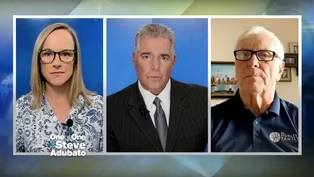
The Connection Between Sports, Leadership, and Philanthropy
Video has Closed Captions
Clip: S2024 Ep2688 | 13m 49s | The Connection Between Sports, Leadership, and Philanthropy (13m 49s)
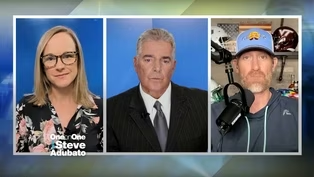
Marty Smith Discusses Trust, Delegation, and Beyond
Video has Closed Captions
Clip: S2024 Ep2688 | 12m 51s | Marty Smith Discusses Trust, Delegation, and Beyond (12m 51s)
Providing Support for PBS.org
Learn Moreabout PBS online sponsorship
- News and Public Affairs

Top journalists deliver compelling original analysis of the hour's headlines.

- News and Public Affairs

FRONTLINE is investigative journalism that questions, explains and changes our world.












Support for PBS provided by:
One-on-One is a local public television program presented by NJ PBS