
Bolton says Iran war critical for stability in Middle East
Clip: 3/3/2026 | 6m 59sVideo has Closed Captions
Bolton says Iran war justified and critical for 'peace and stability' in Middle East
John Bolton was the national security advisor in President Trump's first term. Since then, he has emerged as one of the president’s most vocal critics. He has also maintained that eliminating the Iranian regime is the only way to end the nuclear threat. Bolton joined Geoff Bennett to discuss Trump's decision to strike Iran.
Problems playing video? | Closed Captioning Feedback
Problems playing video? | Closed Captioning Feedback
Major corporate funding for the PBS News Hour is provided by BDO, BNSF, Consumer Cellular, American Cruise Lines, and Raymond James. Funding for the PBS NewsHour Weekend is provided by...
Support provided by:

Bolton says Iran war critical for stability in Middle East
Clip: 3/3/2026 | 6m 59sVideo has Closed Captions
John Bolton was the national security advisor in President Trump's first term. Since then, he has emerged as one of the president’s most vocal critics. He has also maintained that eliminating the Iranian regime is the only way to end the nuclear threat. Bolton joined Geoff Bennett to discuss Trump's decision to strike Iran.
Problems playing video? | Closed Captioning Feedback
How to Watch PBS News Hour
PBS News Hour is available to stream on pbs.org and the free PBS App, available on iPhone, Apple TV, Android TV, Android smartphones, Amazon Fire TV, Amazon Fire Tablet, Roku, Samsung Smart TV, and Vizio.
Providing Support for PBS.org
Learn Moreabout PBS online sponsorshipGEOFF BENNETT: For an additional perspective, we turn now to John Bolton, the national security adviser in President Trump's first term.
Ambassador Bolton, it's good to have you on the program.
You have consistently maintained that eliminating the Iranian regime is the only way to end the nuclear threat.
Is this specific military action by the U.S.
and Israel, is it justified, in your view?
JOHN BOLTON, Former U.S.
National Security Adviser: It's totally justified.
Whether it's carried out in a successful way on many different aspects is open to question.
But, to me, the case to eliminate this, not only proliferation-minded barbaric regime, but to eliminate its international terrorist threat, is ample justification for doing what the president has announced.
I don't think you need to make an argument that the threat is imminent.
The threat is bad enough as it is.
Judgments of imminence can be wrong.
I think we're perfectly entitled to do it.
I think it is a war of choice, as most wars are.
And I think it's something that, if it were explained to the American people, they would support.
That hasn't happened yet, and that's one of the things that troubles me.
But the objective of overthrowing the regime is critical, because the regime has consistently shown it will not abandon its pursuit of nuclear weapons and it will not abandon its use of terrorism and its support of terrorist proxies.
If anybody wants peace and stability in the Middle East, this regime has to go.
GEOFF BENNETT: On this being a war of choice, as you said, you heard Senator Warner say that the U.S.
is following Netanyahu's timing on this, which is what Secretary Rubio suggested yesterday before seeking to clarify it today.
Is the U.S.
driving this strategy, or is the U.S.
being drawn into Israel's longstanding campaign against Tehran?
JOHN BOLTON: Look, even I don't think Donald Trump got suckered by Bibi Netanyahu.
Trump knew full well in his first term how Netanyahu felt about the need to overthrow the regime.
I certainly did my best to try and convince him.
This argument has been out there for a long time.
I'm sorry it took this long finally for somebody to take action.
I think the world would have been a lot safer place if we had done it 20 years ago.
But the idea that somehow we were tricked into this doesn't give Trump enough credit.
GEOFF BENNETT: Regime change in the Middle East, as you well know, has been messy, to say the least.
It's been prolonged by instability, sectarian violence, civil conflict.
Does it appear that the Trump administration has a plan for what comes next in Iran after the military action?
JOHN BOLTON: No, and I don't think it's possible to have a plan.
I think, from the U.S.
point of view, we want the regime gone, because almost any other conceivable regime is going to be better than this one.
The likely outcome is that, if you can fracture the regime at the top, turn Revolutionary Guard general against Revolutionary Guard general against ayatollah, the opposition and elements of the regular military, not the Revolutionary Guard, the regular military, can be brought over.
And you could end up with, in the interim, some kind of military government that would then allow a consultative process for the Iranian people to decide what comes next.
If you say the prerequisite to regime change is knowing that you have got a 500-page plan for what comes next, then you're basically saying you don't believe in regime change.
When we changed our regime, when the founding fathers signed the Declaration of Independence, they didn't have a post-monarchy plan either, and somehow we muddled through them.
GEOFF BENNETT: Can airpower alone accomplish regime change without a costly ground commitment?
JOHN BOLTON: Well, the purpose of the airpower, if it's applied correctly, is to destroy the instruments of state power, particularly the Revolutionary Guard, the Quds Force, and the Basij militia,the instruments of state power that threaten the United States and its friends and allies in the region, Israel and the Gulf Arab states, and that also oppress the people of Iran.
By destroying these instruments of state power, you weaken the ability of the regime as it collapses to retaliate and inflict injuries abroad, and you weaken its ability to repress dissent among its own people.
This also says to leaders of the regime their days are numbered, as one facility after another is destroyed, and says to those people who are potentially able to come over to the side of the opposition that maybe they'd rather not go down with the ship in this case.
And it also tells the opposition that, belatedly, at least, help is on its way.
GEOFF BENNETT: Given what you just said, then, how do you assess Iran's response, the way it has responded with strikes and coordinated missile attacks against multiple Gulf states?
JOHN BOLTON: I think they're making a series of terrible mistakes.
They have a finite number of missiles and drones.
Presumably, we and the Israelis are systematically trying to destroy them.
If I were in their shoes, I would have focused all of my retaliatory attacks on American military bases in the Gulf and Israel.
I wouldn't have spent a single missile or drone attacking civilian targets in the Gulf Coordination Council members across the Gulf.
They have now turned those Arab states from governments that hoped the regime would go, but didn't want to be involved, into governments that now have to be involved.
I think it's just signing -- adding additional signatures to their death warrant.
GEOFF BENNETT: Lastly, should the U.S.
have anticipated better the need for a large-scale evacuation of Americans in the region?
I mean, was there a breakdown in contingency planning?
JOHN BOLTON: Well, I don't think we know enough from the outside to answer that question.
I think the bigger question is why there was a lack of preparation over a period of time, not to talk about the specifics of the operation, but to make the case for regime change.
And I think the answer to that is, within the Trump administration, the isolationists, led by J.D.
Vance, were doing everything they could to avoid this.
And that has, in effect, substantially impaired the president's ability to make his case politically.
So these are hard times for the MAGA isolationists.
And all I can say is, too bad for them.
GEOFF BENNETT: Former Ambassador John Bolton, thank you for your insights, sir.
We appreciate it.
JOHN BOLTON: Thank you.
Delroy Lindo on his Oscar-nominated performance in 'Sinners'
Video has Closed Captions
Delroy Lindo on the cultural impact of 'Sinners' and his Oscar-nominated performance (6m 44s)
Iran hits American diplomatic targets in Middle East
Video has Closed Captions
As U.S. escalates attacks, Iran hits American diplomatic targets in Middle East (6m 4s)
News Wrap: Lutnick will testify in House Epstein probe
Video has Closed Captions
News Wrap: Lutnick will testify in House investigation into Epstein (6m 14s)
Noem defends aggressive immigration enforcement tactics
Video has Closed Captions
Noem defends aggressive immigration tactics amid bipartisan criticism (3m 40s)

Tehran faces 4th day of strikes from U.S.-Israeli forces
Video has Closed Captions
Tehran endures 4th day of intense bombardment from U.S.-Israeli forces (3m 36s)
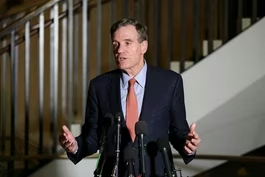
'This is a war of choice’ by Trump, Sen. Warner says
Video has Closed Captions
'This is a war of choice' by Trump and Netanyahu, Sen. Warner says after Iran briefing (6m 50s)
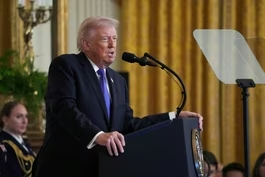
Trump pushes back at conservatives critical of Iran war
Video has Closed Captions
Trump pushes back at conservative voices critical of Iran war (5m 15s)
Providing Support for PBS.org
Learn Moreabout PBS online sponsorship
- News and Public Affairs

FRONTLINE is investigative journalism that questions, explains and changes our world.

- News and Public Affairs

Amanpour and Company features conversations with leaders and decision makers.












Support for PBS provided by:
Major corporate funding for the PBS News Hour is provided by BDO, BNSF, Consumer Cellular, American Cruise Lines, and Raymond James. Funding for the PBS NewsHour Weekend is provided by...