
Bonehenge Whale Center & Seagrove Pottery
5/7/2026 | 26m 46sVideo has Closed Captions
A sanctuary for marine research comes to life, and a Seagrove potter continues a family legacy.
Remains from the sea and hand-thrown clay create spaces for learning and growth. In Beaufort, a stranded sperm whale named Echo inspires the creation of the Bonehenge Whale Center, a sanctuary for marine research and rebirth. In Seagrove, fifth-generation potter Nicole Kluba honors her family legacy while forging her own path rooted in community.
Problems playing video? | Closed Captioning Feedback
Problems playing video? | Closed Captioning Feedback
Best of Our State is a local public television program presented by PBS NC
Bonehenge Whale Center & Seagrove Pottery
5/7/2026 | 26m 46sVideo has Closed Captions
Remains from the sea and hand-thrown clay create spaces for learning and growth. In Beaufort, a stranded sperm whale named Echo inspires the creation of the Bonehenge Whale Center, a sanctuary for marine research and rebirth. In Seagrove, fifth-generation potter Nicole Kluba honors her family legacy while forging her own path rooted in community.
Problems playing video? | Closed Captioning Feedback
Where to Watch Best of Our State
Best of Our State is available to stream on pbs.org and the PBS app.
Providing Support for PBS.org
Learn Moreabout PBS online sponsorship- [Announcer] This program is made possible in part by generous support from Dogwood Health Trust, a private foundation based in Asheville, North Carolina focused on dramatically improving the health and wellbeing of all people and communities in the 18 counties in the Qualla Boundary of Western North Carolina.
- Coming up on "Best of Our State."
Learn how a volunteer effort to assist a beached whale became a treasured home of maritime research and conservation.
Then to the red clay roots of the Piedmont, where generations of makers have shaped the land into something lasting.
We dip into the treasured stories for a look at all the beauty and character of North Carolina.
Hello, I'm Elizabeth Hudson, editor-in-chief of "Our State" magazine and your host.
Whales move through a world we could never survive in, following invisible highways written in currents and stars.
When one strands on our shore, it feels less like an accident and more like a message from the deep.
- I've had dozens of specimens come through this graveyard.
So I like shallow sand burial.
It's been in the ground two years and one month, it's time to exhume it.
Within two months, we'll carefully dig the bones out, keep them organized for reference, but also possibly to build a display.
There are other indentations in the ground.
The biggest one is where goose beaked whale was buried.
As soon as that came out I put a manatee in there.
They're the small ones, the ones that we can pick up and move.
Anything bigger than 15, 18 feet, we're likely to bury on the beach.
[calm music] To a New Jersey surfer, North Carolina is the promised land on the east coast.
I figured out how to leave high school a semester early by volunteering for Cape Lookout National Seashore.
That was a great opportunity.
Served me well, and felt like I scored.
But when I met my future wife, she was very interested in marine wildlife as well.
North Carolina Marine Mammal Stranding Network that my wife directs today was being developed.
And so we were on the water every day and we started to respond to reports of dead and dying whales and dolphins on the beach.
And we find out that some of these things that come ashore in North Carolina, you can't find specimens, skeletons of these animals in a museum or an academic institution.
I said, "Well, let's save this one."
We decided to bury our first dolphin carcass.
Two years later we exhumed it and we built our first skeleton out of it.
And then we got on a roll.
2004, a live sperm whale came ashore at Cape Lookout.
We went out and by the time we got there it had died.
The size is impressive.
It was 33 1/2 feet, and during the necropsy someone said, "Keith, this is in your backyard.
It's an endangered species.
You could make a display out of this and it would tell so many stories."
I had a four wheel drive truck out there.
It couldn't budge it.
Park service had a backhoe, it couldn't drag it.
But we spent a little over a week and cutting away more flesh, making it light enough, could drag it up to the grave.
We bagged and marked all the bones separately, dumped the pieces in.
The bone prep in the sand took a total of four years.
The method works great, and it draws the grease outta the bones better than any other method, but it takes patience.
As it became evident we might save the bones for a display, we didn't have a place to do this work.
And the volunteer, Bruce McCutchen, whose chair I'm sitting in, said, "I've got a little space on the wood.
Let's get some volunteers to build a shed on my property.
How long will you need it for and how big does it need to be?"
So I'd say a 40 foot long shed, and I think I can finish this work in three years.
And he said, "Keith, you got it."
Custom made for doing nothing but building a 33 1/2 foot sperm whale skeleton.
And a lot of people who have done this sort of work or even hadn't, but wanted to learn, just got involved.
It gives me goosebumps to be back in here.
It's just, it was just such a joy to be part of this volunteer led effort.
And there's a bunch of volunteers who were just motivated.
The whole thing inspired 'em, and a lot of people came through here, school groups, school buses.
So the artwork helped me explain what body parts, what skeletal components we were working on.
It's a privilege coming here every day.
It just taught me a lot about community support and volunteerism.
We installed Echo at the maritime museum, and the whole project, which I was sure wasn't going to work, was very much successful, and people were fascinated, and so we saw, "Oh wow, there's a demand for this?"
The idea got launched, could we like build something permanent to support the work with running water?
[calm music] And we met with bureaucrats and supervisors and volunteers.
They said "It can work, and we're gonna do it."
Bonehenge isn't a museum, there's like trip hazards, and sharp things and fragile things within reach.
But this is a cool workshop.
What I do in here, for better and for worse, is address conservation issues and focus on very sad stories.
And so we're saving these specimens that have a conservation message.
If plastic in the stomach killed it, you know, if entanglement killed it, I'm gonna have something to tell that story if I can.
[calm music] Our Marine Mammal Stranding Network got a call, "I am standing next to a live breathing dolphin."
When our team got there and I could tell it was not a dolphin, it was a Gervais' beaked whale.
The goal for the necropsy is to learn about the animal and possibly reveal the cause of the stranding, possibly the cause of death.
Look in the stomach, look at all the organs.
Take tissue samples, teeth for aging, you know, lungs for parasites.
Things I don't understand, but the veterinarians are masters at this.
But the oh wow moment was the entrance to the fore stomach and it had something blocking it that we pulled out is literally this.
But this is all it took.
One time a woman said, "Keith, people use balloon releases for grieving."
I pointed to the picture of the dead whale and I told her that this makes some of us grieve.
If it weren't for those good people that do the necropsies, we wouldn't know about cases like this.
I need help letting people know that these balloons don't go to Heaven.
So a live sperm whale came ashore in North Carolina.
What I wanted was to estimate the age of this whale.
Weird thing about deep divers, they lack upper jaw teeth, and that's the case with sperm whales.
Now this is the original tooth from that socket.
I cut it, and if you look carefully, lines are revealed.
We think those lines correspond to years of growth, like rings in a tree, and it enabled me to estimate that this was a 23-year-old whale when it came ashore and died.
If it's not a toothed whale, the other group of whales are baleen whales.
They lack teeth.
And the baleen is only in the upper jaw and inside the lower jaw and the throat, when they're feeding is literally tons of water and terrified fish.
It's easy to say, "Whales do this, whales do that."
But they're as different as elephants and shrews.
Whales that are swimming out there, they see opportunities and barriers that we're not even close to recognizing.
Well, I'd like you to look at this.
The red dot is a tagged right whale, and it's doing what's predictable, a northbound migration.
The blue are ships.
Just feel free to wince with me every time you see a blue slash intersect the red dot, which is the whale.
These are just the ships that want to donate their location and time and identity for this study.
It made it.
And it's amazing anything does.
[calm music] And this is the biggest thing that will ever be in here.
Pitfall is a skeleton of a 37 foot 3-year-old humpback whale that came ashore on North Duxbury Beach, Massachusetts in 2001.
The necropsy revealed that she had been hit by a ship.
The ship strike snapped her upper jaws off her face.
It broke, I mean this is like an oak tree.
The veterinarians told me she probably died instantly.
We have just about completed the skull.
We're starting to mount the vertebrae on this pipe that will support them.
Starting to mount the ribs.
The flippers of this girl will be 12 feet long.
And so that is an accurate mock-up, and that will be our guide.
There's a couple other ship strike whales on exhibit places and they did a beautiful job covering up all the damage.
And I didn't want to make this look pretty.
[calm music] I am trying to figure out a way to not be such a bummer.
I think I have this disease called disenoceanphobia, fear of being away from the ocean.
I just made that up.
That was a joke.
[cheerful music] I have something positive to share with you and it actually gives me goosebumps to be able to say this.
We have documented 35 species of cetaceans in North Carolina.
What's the big deal about 35?
Well, this isn't a competition, I'm not bragging, I would love to be proven wrong, but that's more than any other state.
So I want anyone who comes into the Bonehenge whale center or comes to a presentation or sees an exhibit to be aware of that incredible diversity.
We can produce things to teach people and people can learn.
Meet Kanga.
We created this so that educators can take the box to venues, festivals, schools, and it'll be the complete skeleton of a bottle nose dolphin.
And compared to humans, what's similar and what's different?
In the flippers of a dolphin are the same bones we have in our arms, including phalanges arranged into five digits.
Not many places people get to see that.
[cheerful music continues] It's just so incredible that a sperm whale would strand on Cape Lookout and alter everything in my life.
[calm music] I want 'em to know, not just that this is a sperm whale skeleton, "Oh look, isn't that cool?"
Want 'em to know where it stranded and when, and just use the skeleton to help tell more of a story.
The story of this endangered species.
Why is it endangered?
Do they still exist on Earth or are they extinct?
Can we still see them in North Carolina?
And wow, isn't that cool?
'Cause the answer is yes.
I mean, I'm an environmentalist.
I care deeply about protecting marine life.
I want people to know how much we have to lose.
[calm music continues] [calm music] - In the Piedmont, hands have reached into the same Carolina soil for generations, drawing out clay and shaping it into bowls, jugs, and plates meant to be used every day.
In places like Seagrove, tradition doesn't stand still.
It shifts, adapts, and waits to see what the next pair of hands will create.
[cheerful music] - Being here in Seagrove, it's really important to me to be able to carry on the family tradition.
I make pottery here on the same road as all of my ancestors and my family members did.
I just really feel like it helps me connect to my work better, in a way.
It's unbelievable that I'm able to turn to the same clay that my grandpa went out in the woods on our property and dug up over 20 years ago.
- You can't get any more local of a product than clay coming straight out of the ground into a potter's hands, being refined, and then being made into a wonderful work of art.
I think it's something special, it's something unique, and it is something that quite literally is a part of North Carolina.
[cheerful music continues] - My name is Nicole Kluba.
I'm a fifth generation potter here in Seagrove.
I've been doing pottery full-time for a little over two years now.
I do what I call functional works of art.
So I make mugs and cups and plates and that kind of thing, but I like to decorate them in a way where it could just be a piece of art to put in your house and just enjoy every day.
All of my pieces are inspired by nature, gothic imagery, and I specialize using the sgraffito technique, which is where you apply a slip on top and then you carve through and then that contrasted color of the clay pops through so you have a good contrast.
This is definitely my favorite part of the process.
Just, I don't know what it is about carving, but I really enjoy it.
I think one of the main things is like the contrast between the two and being able to see the design come to life.
But not only that, I really think that it's a relaxing process.
It's not something that I have to stress out about.
I can just sit here and work at my own pace, which is really nice.
All of my family members and ancestors before me all did pottery here in Seagrove as well.
The thing I have the most memories of is being, like going over to my aunt and uncle's house.
Me and my cousins would hang out in the pottery shops or I'd go out there and kind of make like little pinch pots or like little handbuilt animals.
I always loved pottery growing up, but it was always just a hobby.
And then, you know, I graduated from high school and it was time to get a real job, so to speak.
At 18 I started working as a 911 dispatcher and I did that for two years and then I worked in law enforcement for about three years, and I really enjoyed it and I enjoyed my time doing it.
But while I was doing it, even though I did love it and enjoyed it, it just felt like it wasn't what I was supposed to be doing.
So whenever I finally decided that I wanted to get back into pottery, you know, it felt like a weight off my shoulders and it felt like, you know, this is where I needed to be.
I had gotten a pottery wheel used, I got a really good deal on it.
So I set it up in our kitchen.
So I'd be slinging clay everywhere.
I had pots all over the kitchen table, but it was what I had to do to get started.
So, and then my husband and my father-in-law, they built me my workshop here.
So this whole last year it was amazing being able to have people come out to the shop and, you know, meet so many new people, have so many people interested in wanting to see my work.
So it's just been a really great experience.
[calm music] Over here, where the shop is now, we have 23 acres.
My grandpa used to own a lot of property going down the whole road.
What I remember most of him doing was he would dig up blue clay and he sold it to a bunch of the local potters.
[calm music] [calm music continues] It's very special being able to work with the same clay that my family worked with, especially the blue clay.
It's wild clay that you find usually near like where a lake used to be or some kind of water source.
It's literally when you dig it up, it's like a dark blue gray color, and it's not something you see very often.
It's a very plastic clay, which is something that you want when you're looking for pottery clay.
So this provides a lot of opportunity for me to be able to work with wild clay from the property and being able to incorporate that history of my grandfather and my other family members.
[calm music continues] Just being able to put my hands in and make pots outta the same clay that I know they were using.
I feel like it just kind of helps tie everything in together in a perfect way.
[calm music continues] [calm music fades] [calm music] So I'm at the North Carolina Pottery Center today here in Seagrove, and I'm here checking out one of my great great grandfather's churns that he had made back in the late 1800s, early 1900s.
His name was Stephen Richardson and he was a potter here in Seagrove.
He made a lot of the more like primitive work, you know, like the churns, the jugs, you know, the functional pieces.
- To have a local potter come in and look at a piece that one of their ancestors made.
There's just something special about that.
My name is Lindsey Lambert.
I'm the executive director of the North Carolina Pottery Center here in Seagrove, North Carolina.
Seagrove has particularly since the early 1900s, had this real mystique kind of associated with it and with the clays in the area, and it's been an unbroken tradition.
Those early potters would hire other potters to work with and for them as journeyman potters or apprentices.
Also family members.
That generational talent is an important part in particular because it just highlights how strong that tradition and bond to North Carolina and the clay and the soil is.
[calm music] Nicole is one of our younger potters in the Seagrove area.
She's been here a few times before.
She's taken a look at her ancestors' pot in the display case, but I think we're going to do something a bit more special this afternoon.
She doesn't necessarily know it yet, but we're going to get her hands on that pot of her ancestors.
I'm actually going to have the case open and we're going to let her hold it for the first time.
This is a circa 1900 and it's really nice five gallon butter churn, and here you go.
What do you think?
- Thank you so much.
It's crazy being able to, you know, hold a piece that my great great grandpa made so long ago.
And I mean, it just, it makes it really special.
Especially, you know, so many generations of being Seagrove potters.
It's just really important to me to keep the tradition going while adding like my own twist on things, but keep the tradition alive and help to honor them, 'cause I know that they were, you know, some of those people that really helped shape Seagrove to be what it is today.
- You know, I think that he would be really happy to know that you are making pottery today, and I think he would be really proud of what you're doing.
- Well thank you.
I sure hope so.
I like to think that he is as well as my great grandpa and my grandpa and my other ancestors that's all made pottery.
'Cause that's one of the big things with me making pottery now, is I want to try to keep those names alive.
'Cause I know that, you know, they don't have a very huge name in Seagrove as potters, but I feel like they still, you know, did a lot for the community, and they deserve to be recognized as well.
- I hope it inspires her even more than that background already has.
You know, I hope it kind of kicks her into overdrive in terms of motivation with her own work and growing her own work.
- It's really special to me to know that I will be, you know, a part of the future of Seagrove as well.
'Cause obviously I have a whole career to go in this.
[calm music] Last February, we purchased three acres across the street and it had a little cabin on site.
The property that we purchased actually used to be my grandfather's property, and it got sold off.
We're gonna have my gallery and my workshop over here as well as we'll have a extra addition built on for like the kilns and everything.
'Cause this is gonna be, you know, a huge step in my business as far as growing.
It's gonna be, you know, obviously I have a lot more space and freedom to create over here.
I feel like I have more resources.
It's really special to me knowing that, you know, the forever home of my business used to be my grandfather's land where he was living at, where he, you know, started his business of, you know, digging up the clay and selling it.
That just makes it all the more special.
- It's important that we have some younger potters in the Seagrove area working, continuing to build that tradition, creating these wonderful pieces, not just of art, but these stories that go with the pieces.
Seagrove is open for business.
It has been for a couple hundred years and hopefully for the next couple hundred as well.
- [Nicole] I really hope that, you know, more younger potters continue to come to Seagrove and start their careers up.
I'm very excited to see the changes and kind of be a part of that and helping pave the way for the future.
[calm music continues] [calm music] - My parents' birthdays fall six days apart.
Dad's May 1st, Mom's May 7th.
Aside from exchanging modest cards signed simply "Love, Phil" or "Love, Susie," I don't remember big parties, fancy dinners, or traditional gifts.
Back then, I thought my parents weren't into gift giving, but looking back, I see they folded small acts of thoughtfulness into daily life.
After my dad retired, he took over grocery shopping and packed my mother's lunches, salami on rye, a small bag of chips, and even a toothpick, all carefully wrapped in plastic.
And always two Oreo cookies for something sweet.
They spent weekends working the yard together.
My dad hammering a bird feeder he made just for her, my mother weeding the hosta garden.
After a simple lunch, he'd pull out the ice cream bowls and scoop butter pecan for her and chocolate for himself.
Tiny gestures that added up to a contented life.
After my dad died, my mother and I began taking trips together each May.
Last year in Hendersonville, the two of us rocking on a cottage front porch, breathing in the honey scented blooms with the Blue Ridge Mountains beyond the fog, my mom looked off into the distance, nodded her head, and said, "Your daddy sure would've liked it here."
That evening for her birthday, I gave her my card.
"Love, Elizabeth."
And though it was her birthday, I'm the one who closed my eyes and made a wish.
[upbeat music] [upbeat music continues] [upbeat music continues] - [Announcer] More information about "Our State" magazine is available at ourstate.com or 1-800-948-1409.
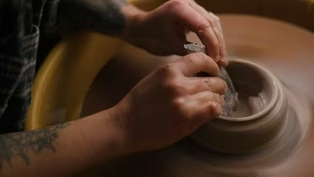
Preview | Bonehenge Whale Center & Seagrove Pottery
Video has Closed Captions
A sanctuary for marine research comes to life, and a Seagrove potter continues a family legacy. (20s)
Providing Support for PBS.org
Learn Moreabout PBS online sponsorship













Support for PBS provided by:
Best of Our State is a local public television program presented by PBS NC