One-on-One
Bonnie Watson Coleman; Curtis Sliwa; Craig Coughlin
Season 2021 Episode 2420 | 28m 15sVideo has Closed Captions
U.S. Rep. Bonnie Watson Coleman; Curtis Sliwa; Asm. Craig Coughlin
U.S. Rep. Bonnie Watson Coleman shares her experience at the Capitol Riots and the importance of diversity & representation in government administrations; Curtis Sliwa discusses Gov. Cuomo’s leadership and the long-term implications of the Trump presidency; Asm. Craig Coughlin talks about NJ’s fiscal picture, the importance of supporting food banks, and the legalization of marijuana in NJ.
Problems playing video? | Closed Captioning Feedback
Problems playing video? | Closed Captioning Feedback
One-on-One is a local public television program presented by NJ PBS
One-on-One
Bonnie Watson Coleman; Curtis Sliwa; Craig Coughlin
Season 2021 Episode 2420 | 28m 15sVideo has Closed Captions
U.S. Rep. Bonnie Watson Coleman shares her experience at the Capitol Riots and the importance of diversity & representation in government administrations; Curtis Sliwa discusses Gov. Cuomo’s leadership and the long-term implications of the Trump presidency; Asm. Craig Coughlin talks about NJ’s fiscal picture, the importance of supporting food banks, and the legalization of marijuana in NJ.
Problems playing video? | Closed Captioning Feedback
How to Watch One-on-One
One-on-One is available to stream on pbs.org and the free PBS App, available on iPhone, Apple TV, Android TV, Android smartphones, Amazon Fire TV, Amazon Fire Tablet, Roku, Samsung Smart TV, and Vizio.
Providing Support for PBS.org
Learn Moreabout PBS online sponsorship- [Narrator] Funding for this edition of One-On-One with Steve Adubato has been provided by PSE&G, committed to providing safe, reliable energy now and in the future.
New Jersey Sharing Network.
NJM Insurance Group.
Serving New Jersey's drivers, homeowners and business owners for more than 100 years.
Delta Dental of New Jersey.
Everyone deserves a healthy smile.
Operating Engineers, local 825.
Fedway Associates, Inc. IBEW Local 102.
Lighting the path, leading the way.
Eastern Atlantic States Regional Council of Carpenters.
And by St. Joseph's Health.
World-class care, just around the corner.
Promotional support provided by Insider NJ.
And by ROI-NJ, informing and connecting businesses in New Jersey.
- This is One-On-One.
- I'm an equal American just like you are.
- The jobs of tomorrow are not the jobs of yesterday.
- Look at this.
You get this?
- Life without dance is boring.
- I don't care how good you are or how good you think you are, there is always something to learn.
- Do you enjoy talking politics?
- No.
- People call me 'cause they feel nobody's paying attention.
- Our culture, I don't think has ever been tested in the way it's being tested right now.
- That's a good question, high five.
(upbeat music) - Hi, I'm Steve Adubato, and I wanna get right to this.
We are honored to be joined by the honorable Congresswoman Bonnie Watson Coleman who represents the 12th Congressional District, and is a real leader in the United States House of Representatives.
Congresswoman, thank you so much for joining us.
- Thanks for having me, Steve, it's good to see you.
- This is part of a whole series of programs we're doing on several subjects that you can touch on.
One is confronting racism and all of its forms, the other one is democracy at a crossroads.
So let's start with the latter, January 6th, The Insurrection.
I've heard you talk about on a whole range of national broadcasts, your experience that day, A, and B the longterm implications you believe for our democracy.
Please, Congresswoman.
- My experience that day was sort of in the dark, a lot.
Started out really early in the morning, having to leave my apartment because there were bombs behind it, because I lived next to the, I'm one of, in Washington, to the RNC.
Went to my office building, to go to my brand new office in the Cannon Building, stepping in here, and they told me, you gotta get out of here, it's too close.
So, I went down into the tunnel, encountered a whole bunch of people, My husband was with me as well as the staff person, because we were evacuated from our apartment.
And so I said, well, let's go to the Capitol.
Because we'll be safe there, and there are fewer people there.
Famous last words, went there, was going down the hallway, I was going to go down to the attending physician's office, encountered a police officer, and he said, I don't think you wanna go down there, and you've heard they're coming in.
And I'm like, "What are you talking about?"
Because I knew that there was demonstration outside.
I did not know that it was pressing inside.
So I said, "well, I just need to go down that hole into the left wing."
kind of shrugged his shoulders and walked away from me.
So I figured, this can't be too serious, if he's going in the opposite direction, so I continued down and encountered another police officer and he said, "Ma'am, you can't go down there."
I looked up and I could see the police officers struggling with people in really bright reds and things of that nature.
So, went to my left and went down the hallway and doors opened up and they said, "come and shelter in here.
Which is what I did.
And I stayed in there for a couple of hours, in a small setting with my husband and my staffer, and a nurse, for the attending physician's office, said we only saw what was happening on the outside - Right - because we had a little television but not what was happening on the inside.
Ultimately, they came and got us.
We went to another holding room, went into that room, there were a lot of members and staff, some without masks.
- They did not, Congresswoman?
- Some without masks.
Yes.
- How close were they?
- Well, I had one young lady that was sort of almost standing over me, having a conversation with someone behind me.
And I had to tell her to put her mask on, twice.
And then some other members, they were farther away, but they were in the same room and they refused the mask that one of my colleagues was offering them in a very nice way.
So, we stayed there until things kind of cleared up, made our way to another room in the Capitol, and ultimately upstairs on the second level, I was in the whips office waiting for things to completely calm down.
And that's kind of it in a nutshell.
- But other than the fact that you were somewhat compromised or your health, we wanna make sure that you were healthy, and you contracted COVID after that, you asked some colleagues and staff, refused, speaks for itself, the bigger picture longer-term implications of that insurrection from your view, Congresswoman, are?
- Democracy is fragile, that we can't take it for granted, it was definitely threatened over the last four years, and it culminated in what I consider to be an insurrection, that is scary, we live in very scary times right now, where there's a lot of anger and hatred, that I think has been sort of fomented by the former president, and that we have to be very careful.
That we have to be in both a stage of diligence, watchfulness, at the same time, we've got to be in a state of healing.
Democracy is a messy form of government.
You know what?
Everyone has a right to express their individual concerns, everyone has the right to demonstrate, etcetera, but it raised its ugly head.
The threat to democracy raised its ugly head.
As well as the threat of racism in our country.
In the long term we have a long way to go.
But we'd better actively work in both policy, conversation, and legislation to make sure that we are fortified in so many ways.
- So along those lines, it's the transition to our Confronting Racism series.
Part of that series is we are profiling African-American leaders who frankly have made a huge difference not just in the African-American community, but beyond.
In New Jersey and in the nation.
A couple things about Congresswoman Bonnie Watson Coleman.
Not only are you the first black woman to represent New Jersey in the United States Congress, can I also say that your dad, the great John Watson, you learned from him, but so did I.
As a very young member of the legislature, he was a mentor of mine as you well know.
You're the first black woman to serve as a majority leader in the state assembly and the first African-American woman, to be the chair of the democratic party in the states.
Many, firsts, however, beyond your accomplishments, confronting racism means what to you, Congresswoman?
- For me, it was an everyday experience.
As I worked in the executive branch of government for 28 years, I experienced it even when I worked for the division on civil rights.
And I filed a complaint against the attorney general.
because, - I remember that.
- Oh, okay, So, I encountered that and being a first, in several offices, in these several departments, at certain levels, being alone, being kind of, people weren't too sure about me, why I was there, whether or not I deserve to be there.
So, being questioned as to whether or not I was prepared to be in spaces, from executive office spaces to even legislative spaces, is something that I experienced personally.
When I decided I was gonna run for my dad's seat, I wasn't encouraged by someone who I thought should have been very encouraging to me because he both knew me and knew my dad very well.
And so he should have had high expectations.
but I had to go about and prove myself.
So, for me being black and being female, Steve, means, I always had to prove myself in every endeavor that I undertook.
- When it comes, Congresswoman, to race relations and all the tension, and all the polarization, and all the, whatever, how hopeful are you that we can make meaningful progress and being able to talk back and forth and learn more about each other, the things we don't understand?
Particularly about each other's respective experiences, disproportionately those in the African-American community who have suffered for so long.
- I think it's good that we're talking about it more, I think that it is good that we're entertaining legislative initiatives and we're entertaining reparations, legislation and resolutions and things of that nature, but you and I both know that talk is key.
So, I'm glad to see this administration, this brand new administration in Washington, as well as the administration here in New Jersey, being diverse, and recognizing that out of the diversity of this country and out of the diversity in their administrations, will come greatness, it's just a very dangerous time, we see a lot, firsthand, that we never saw before, - Right.
- Because people are filming everything, I think that that has really struck people in a very personal way when they saw George Floyd, in particular, Ahmaud Arbery situation, as well as others, Tamir Rice, many others .
- The list is way too long, - The list is way too long, but what I think it has done, it has stunned the sensibilities of people who thought they were our allies but maybe hadn't spoken up or stood in our space with us enough.
- United States Congresswoman Bonnie Watson Coleman from the 12th Congressional District.
Many firsts, but even more importantly continuing to make a huge difference.
Congresswoman, thank you so much.
You honor us by your presence.
- Thank you, Steve.
Thank you for having me.
- Our pleasure.
I'm Steve Adubato, we'll be right back.
- [Narrator] To watch more One on One with Steve Adubato find us online and follow us on Social media.
- Welcome folks, we are joined by a colleague, a good friend in the media Curtis Sliwa.
77 WABC every day from noon to three, how you doing Curtis?
- I've had better days, I'll tell you why, because I've transitioned from WABC, remember, on talk radio for 30 straight years so I'm addicted to talking into the microphone.
And now all of a sudden I'm talking at the pigeons, the birds, the trees, and a lot of voters out there to get them to vote for me to become mayor in 2021 so I've had to transition.
It's an addiction talking on radio.
So I'm weaning myself from that Steve, I'm weaning myself from that.
- I hear by the way, Curtis is a candidate for mayor.
We will also work to have mayor de Blasio and also check out MetroFocus, they're covering the mayoralty as well.
But we have Curtis on to talk about a whole range of issues.
Curtis, let me ask you this as we tape on the 9th of March it will be seen later.
What are most people who call into the station with your show, wanting to talk about?
- Locally, it's crime, quality of life issues, the homelessness, the emotionally disturbed, the pushings on the subways.
Everything having to do with the neutering, making the police impotent, reactive instead of proactive.
So that's locally.
Nationally, people are still sort of getting down from that Trump mountaintop without jumping off and committing suicide.
So they're beginning to try to figure out where is the former president going?
What is the direction of the Republican party?
Obviously most of the callers to WABC tend to be conservative, tend to be Republicans or Libertarians.
So I think a lot of it is focused on that and obviously the beginnings of President Joe Biden's administration, with all the stimulus money.
And obviously a lot of our listeners are wondering, "Why are we giving money to people who don't need money, "I thought money should go to the people "who really need the money?"
- Hold on Curtis, wait, wait and this is again, this program is about policy and issues that matter.
Curtis.
Now, are you saying, or are you saying that many of your listeners are asking why is so much of the $1.9 trillion stimulus package as we speak right now in the house, it may pass, let's just assume that.
You're saying most of it not going to those who need it?
- No, no.
I mean look at it.
There's so much money that is going to people who have already been gainfully employed, they're getting a stimulus check.
Now, I can't conceptualize that, maybe you can help me with that Steve.
I understand those who are down and out, who don't have a job, whose unemployment (indistinct) the small businesses that have been forced to close, who are on the verge of closing.
Why would you be sending money to people who've been gainfully employed.
In fact, according to the stats have been banking their money because there's almost been nothing to do with their money because they've been chained to a radiator or an air conditioner at home for the past year ever since the lockdown, how does that make any sense?
- So, that's so interesting because the Democrats will argue that in order to get this passed, they needed to have, they don't call it pork, they don't call it fat, but there are definitely pieces of the $1.9 trillion not directly going to vaccines, not directly going to teachers, not directly going to cities and states and people and small businesses and not for profits.
We'll see how that plays out.
Hey Curtis, let me do this, again because we are taping on the 9th of March, the other thing I'm surprised you didn't mention this and we're not the show to check out every day what's going on with Andrew Cuomo, the Governor of New York.
You smile right away, because?
- What a hot mess he is and the chickens have come home to roost.
Steve-- - What does that mean?
- I've been dealing with first Mario Cuomo, the father, I've been dealing with Andrew the Cuomo and his brother Chris for a long, long time.
And boy, they have created an enemies list, look at it once, check it twice, it's huge.
So now then Andrew Cuomo has wounded himself by lying about the number of patients who passed away in the nursing homes.
By the way had he apologized about that he probably would have been forgiven and given a pass.
Murphy in New Jersey he didn't speak as much but he's also just as guilty-- - In fact Curtis, I'm gonna disclose, I was on Curtis's show, we actually spoke about leadership and crisis communication and I said, not in this role but as an analyst that I thought he should acknowledge that a mistake was made and own it.
And not only that they made the decision to send them back in the nursing homes, people who were sick, but then the undercount which appears to potentially be intentional, Curtis?
- Papered over, intentional, it's a coverup.
And for that Andrew Cuomo has been wounded badly but you know, he's not alone.
What is the last time you actually heard an elected official from either party take blame for a decision that they made?
They're pretentious, they're omnipotent, and especially with Andrew Cuomo, let's face it.
Many people on the far left, they put him up on a pedestal, he was embraced by Hollywood, he got an Emmy award.
How do you write a book in the middle of a pandemic crisis about leadership?
And now that book is it even gonna be sold because it's such a joke.
And then naturally all the sexual harassment issues from a guy who was constantly saying when others were being criticized for possible acts of sexual harassment like judge Kavanaugh, I can go through all list, "Off with their heads, off with their heads, "no chance, no public hearing-- - "No due process."
- Right.
So it's sort of like, again, again all these officials are guilty of this, "Do as I say but not as I do."
So he's in a battle for survival but I'd like to where any of his friends are.
Now, one person he was very loyal to from the very beginning of the campaign, never hesitated, never vacillated to his credit, is President Joe Biden.
I think if he begins to distance himself, ever more rapidly then it's the end, it's the end of Andrew Cuomo.
Question.
What do you believe Curtis the long-term implications will be of the Trump presidency not only on this nation, but on the Republican party, what do you see?
- It's really hard to know because the further he is away from the upper center of Republican political activity, he can certainly continue to have an impact, but remember, does absence make the heart grow fonder or do some new leaders emerge?
Now one issue clearly that's emerging that is to former president Trump's strength is the issue on the border.
Joe Biden has basically started to open up the borders.
- Illegal immigration.
- A lot of people, even moderate Democrats are beginning to scratch their head and say, "Wait, we don't let normal commerce "and traffic go across the borders because of the pandemic.
"Now we're allowing immigrants to cross the border, to stay here, to disappear and hopefully show up for a court hearing?"
We know that that's a policy that obviously Trump is going to exploit and the Republicans are going to exploit.
It's just a question, if Nikki Haley goes her own way, Marco Rubio, Tom Cotton, some of those who profess to be loyal to Trump now may see an avenue towards the presidency because let's face it, there are a lot of Republicans in leadership who would hope that former president Trump just stays in Mar-a-Lago, plays a lot of golf and leaves them to the RNC business.
- If you wanna hear more from Curtis Sliwa check out 77 WABC every day from 12 to three.
As always Curtis Sliwa thanks for joining us my friend, we'll talk soon.
- Oh wait, hey.
(indistinct) - What?
- Website, curtissliwaformayor.com Notice, taking the beret off, you're the first to see this.
Without the beret.
- Thanks my friend, we'll talk soon.
- I'm Steve that's Curtis, we'll be right back.
(laughs) - Thanks Steve - [Narrator] To watch more One on One with Steve Adubato find us online and follow us on Social media.
- We are now joined by the New Jersey Assembly Speaker, Craig Coughlin.
Mr. Speaker, good to see you.
- Nice to see you Steve, how you been?
- I'm doing all right, you?
- I'm doing fine, family is well.
What else?
After that it's all gravy.
- Yeah, What are you gonna talk about, state finances?
By the way I asked Senator President Sweeney the same question.
And Jon Bramnick, the Republican Assembly Leader.
How would you describe the state's fiscal picture right now?
- Hopeful.
I think we, you know, we have seen some really good positive things in terms of revenue numbers.
They're better, much better than we had anticipated.
I think we did a good job at balancing out the way we handled the concern about the reduction in revenue that was anticipated.
It didn't materialize to the same level, but we're very conservative about it.
We spread it out so that we didn't try to tax our way out of it.
We didn't try to spend our way out of it.
We didn't try to borrow our way out of it.
We did a combination of all of them.
And I think that has positioned us well for the recovery that's inevitable and, I hope, is right around the corner.
- Speaker Coughlin, there's a middle-class tax rebate in this budget.
- Yes.
- What is it exactly?
- Well it's a $500 rebate to people with families with children, depending on your income eligibility.
$75,000 is the level if you're a single parent.
150 if you're two parents, and you'll get a $500 rebate.
And it'll come at a really good time, because kids are getting ready to go back to school.
It was part of the things that led us to be able to pass the millionaire's tax.
We wanted to make sure that we stuck up for working middle-class New Jerseyans.
And I think we've accomplished that.
And that's what that is.
It affects more than 750,000 families in the state of New Jersey.
- Now your a co-sponsor of a bill that would appropriate $10 million from the Cares Act to the Department of Agriculture for food banks in New Jersey, talk about that.
- Look, we faced a huge crisis in New Jersey with regard to people who have lost their job.
People who go hungry every night.
Too many people in the state of New Jersey.
And that was something I've spoken about since I was fortunate enough to become the speaker, is trying to address that.
And this is another step in that, you know, sadly so many New Jerseyans have lost their jobs as a result of the pandemic.
More than, I think, the most was about 2 million people that are estimated to do that.
Oftentimes those people are searching for food.
Imagine if you had, every day, your first job, instead of trying to figure out your future and instead of trying to find a job.
Instead of trying to figure out how to get through this pandemic, you had to worry about feeding your family.
Think of how debilitating that is.
Think of what that does to your psyche.
And we see some of those stories, the little girl who was in Monmouth County, who was in school and was crying because she was hungry.
I've heard stories of a woman who would call the helpline and they brought some food out.
They found she had water, seltzer, in her refrigerator.
That was it.
So we have to make a big commitment to doing that.
The $10 million, it's a start.
And the governor put $25 million in the budget, because we recognize how important it is.
If you can't feed your, look, we are a great state.
And you're not a great state if you can't feed your people.
And that's why the commitment is so important, because it matters that much.
- Sorry for interrupting Mr. Speaker.
By the way you can talk about the millions and billions, et cetera, in the budget and your eyes can glaze over.
But as the speaker just laid out, we're talking about real people, real problems, real issues.
And that is the role of government is to reach out and be helpful, because some people are struggling.
- I want to make sure I get you on this, talk to you on this.
The vaccine rollout, we're taping down the 23rd of March and seeing after that.
How do you believe we are doing, Speaker?
Well, I think our distribution network is in a good place, is in good shape.
And that what we lack is the volume of vaccine.
You know, when you talk to folks, what they do is they struggle to get appointments.
And they struggle to get appointments because there isn't enough vaccine to accommodate everybody.
But when you talk to folks who then go and get the vaccination, you find out that they run efficiently.
That, "I was only in and out", "I had to wait like 15 minutes and boom, I was on to it".
I think, and look, Johnson and Johnson, when they come out in big form, and I understand that's going to be within the next couple of weeks.
So by the beginning of April people may be seeing this.
It should hit the market in a big way.
And when we do that, when we effectively don't need the list anymore because there's just enough vaccine for everybody to do it, I think that the distribution network will light up like a Christmas tree, and we'll be able to get to the target goal in short order.
- If I could, quickly on this, Speaker Coughlin, and I asked the Senate President the same question.
On the legalization of marijuana as we speak right now, there are some challenges, some issues particularly around what is the appropriate role of police departments in dealing with underage kids smoking marijuana out in public.
And whether they can be pulled over or not, and what's at risk, and you don't call the parents.
And I don't know what's going to get changed or not as we speak.
- It is.
- It is.
Go ahead.
- Yeah, it is.
And look, what we did, we sorted through, and this has been a challenge, right?
The whole process we've done.
We did a number of really large things in this.
There's a seismic shift in social policy, a seismic shift in creating a new industry.
And we had to then figure out how we were going to accomplish what we set off to do, as part of this was to achieve some social justice.
One of the things that we have to do, and I like to call it the 'Intellectual Rubicon', is cross over the notion, guys like my age, who grew up understanding that marijuana was, or believing that marijuana was a drug, à la cocaine, or something like that.
It's not anymore, right?
That's what the people of New Jersey said overwhelmingly.
It's not, it's more akin to alcohol than it is to some serious drug.
And so, how we adjust for that, and one of the things that that led us to was, how do we handle people who are underage?
Well, how would we handle if they had a beer?
Kind of thing.
Walking down the street.
And now we've made them identical to the way you handle it.
And I think that has caused us to go through and make some changes and we still need to refine.
And I think that's what you'll see us do.
We have a voting session that's coming up just a couple of days from now.
And I think we will change that and make that right.
- So people-- - And by the way-- Say that again?
- Parents will be notified on the first account-- - By the way, NJ Spotlight News every night will monitor this situation, report on it.
And that's where you'll find out when it's happening.
Assembly Speaker Craig Coughlin, I want to thank you so much for joining us.
Best to you and your family.
Thank you, Craig.
- I'll see you at a Rocket game, at a basketball game.
- That's a big fan, I'm not going to say for home, okay?
(laughs) - Good to see you Steve.
- Good to see you, I'm Steve Adubato, catch you next time.
- [Narrator] One-On-One with Steve Adubato has been a production of the Caucus Educational Corporation.
Funding has been provided by PSE&G New Jersey Sharing Network.
NJM Insurance Group.
Delta Dental of New Jersey.
Operating Engineers, local 825.
Fedway Associates, Inc. IBEW Local 102.
Eastern Atlantic States Regional Council of Carpenters.
St. Joseph's Health.
And by these public spirited organizations, individuals and associations committed to informing New Jersey citizens about the important issues facing the Garden State.
And by Employers Association of New Jersey.
Promotional support provided by Insider NJ.
And by ROI-NJ, (upbeat music) - [Narrator] Being a kid is all about playing, laughing, and having fun.
Doing what they do best, from rolling in leaves to building a snowman.
But when illness or injury slows your little one down, you want the best pediatric care possible.
Turn to the experts at the St. Joseph's Children's Hospital to get your super hero feeling super again.
St. Joseph's Health.
Helping kids be kids.
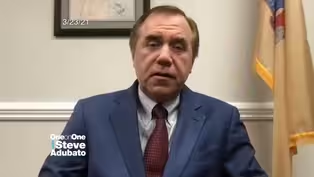
Asm. Coughlin on New Jersey's Fiscal Picture
Video has Closed Captions
Clip: S2021 Ep2420 | 8m 30s | Asm. Coughlin on New Jersey's Fiscal Picture (8m 30s)
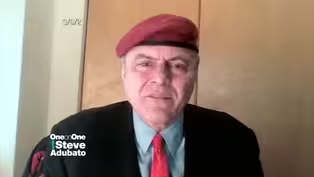
Curtis Sliwa Weighs in on Gov. Cuomo and Trump's Legacy
Video has Closed Captions
Clip: S2021 Ep2420 | 9m 38s | Curtis Sliwa Weighs in on Gov. Cuomo and Trump's Legacy (9m 38s)
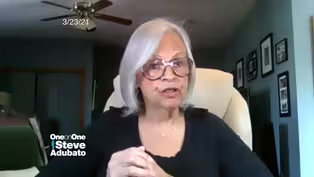
US Rep. Bonnie Watson Coleman on Her Capitol Riot Experience
Video has Closed Captions
Clip: S2021 Ep2420 | 10m 56s | US Rep. Bonnie Watson Coleman on Her Capitol Riot Experience (10m 56s)
Providing Support for PBS.org
Learn Moreabout PBS online sponsorship
- News and Public Affairs

Top journalists deliver compelling original analysis of the hour's headlines.

- News and Public Affairs

FRONTLINE is investigative journalism that questions, explains and changes our world.












Support for PBS provided by:
One-on-One is a local public television program presented by NJ PBS