State of Affairs with Steve Adubato
Bonventre / Hoffman & Gill / Fuscarino
Season 9 Episode 6 | 27m 58sVideo has Closed Captions
Kelly Bonventre; Jeanette Hoffman and Brendan Gill; Christian Fuscarino
Kelly Bonventre, Assistant Director of Community Services at NJ Sharing Network, discusses her passion for organ & tissue donation. Jeanette Hoffman, Republican Strategist, & Brendan Gill, Democratic Strategist, talks about the key topics in the 2025 NJ gubernatorial race. Christian Fuscarino, Executive Director of Garden State Equality, addresses the impact of President Trump’s executive orders.
Problems playing video? | Closed Captioning Feedback
Problems playing video? | Closed Captioning Feedback
State of Affairs with Steve Adubato is a local public television program presented by NJ PBS
State of Affairs with Steve Adubato
Bonventre / Hoffman & Gill / Fuscarino
Season 9 Episode 6 | 27m 58sVideo has Closed Captions
Kelly Bonventre, Assistant Director of Community Services at NJ Sharing Network, discusses her passion for organ & tissue donation. Jeanette Hoffman, Republican Strategist, & Brendan Gill, Democratic Strategist, talks about the key topics in the 2025 NJ gubernatorial race. Christian Fuscarino, Executive Director of Garden State Equality, addresses the impact of President Trump’s executive orders.
Problems playing video? | Closed Captioning Feedback
How to Watch State of Affairs with Steve Adubato
State of Affairs with Steve Adubato is available to stream on pbs.org and the free PBS App, available on iPhone, Apple TV, Android TV, Android smartphones, Amazon Fire TV, Amazon Fire Tablet, Roku, Samsung Smart TV, and Vizio.
Providing Support for PBS.org
Learn Moreabout PBS online sponsorship- [Narrator] Funding for this edition of State of Affairs with Steve Adubato has been provided by Bergen New Bridge Medical Center.
Horizon Blue Cross Blue Shield of New Jersey.
EJI, Excellence in Medicine Awards.
A New Jersey health foundation program.
The Fidelco Group.
The New Jersey Education Association.
PSE&G.
Powering progress.
Rowan University.
Proudly serving New Jersey for 100 years.
New Jersey’s Clean Energy program.
Lighting the way to a clean energy future.
And by The New Jersey Economic Development Authority.
Promotional support provided by New Jersey Monthly.
The magazine of the Garden State, available at newsstands.
And by CIANJ, and Commerce Magazine.
[INSPRATIONAL MUSIC] - Hi everyone, Steve Adubato.
We kick off the program with a terrific leader in the world of organ and tissue donation.
Kelly Bonventre is Assistant Director of Community Services at the New Jersey Sharing Network, our partners in the initiative to create greater public awareness around organ and tissue donation.
Kelly, how you doing today?
- I'm doing great, Steve.
Thank you so, so much for having me here today.
You are such a huge friend of donation, and we're so thankful for your support and our relationship.
- Well, we all are trying to do the best we can to create, as I said, greater public awareness.
It's about ten years that you've been with the Sharing Network.
Describe your role, A and B, why you got into this and you're so passionate about it?
- I would be happy to.
So, yes, I am approaching my ten-year anniversary, and this is my third role with the Sharing Network.
I served on our foundation for a few years, and then I actually served as a hospital services manager on the front lines of donation so I could learn more about the clinical process, be involved in the actual donation approaches with our donor families, supporting our clinical team, supporting our donor families.
So I could really, it was a huge learning opportunity for me and I could really bring that knowledge back and then serve in the role that I am now serving in as the Assistant Director of Community Services, in which I oversee our public education team and our communications team.
And that really speaks to my heart, because I know and value how important that piece is to the donation process.
If we don't educate our public, and if people don't know about the Sharing Network and we don't dispel the myth and misconceptions about organ and tissue donation, we're not gonna be able to do the work that we do and save more lives.
So that really feeds my soul, and I became involved in organ and tissue donation because I read a poem when I was 19 years old called "To Remember Me."
- I got it in front of me.
- Yes.
- "To Remember Me"?
- Yeah.
- Robert N. Test wrote this.
You were 19 years of age?
- Yes I was.
- What was it about this poem that triggered for you to make an important decision in your life?
- It just touched my heart in such a deep place that it moved me to go to the Motor Vehicle the very next day and register to be an organ donor.
And it made me want to do this work.
To me, it showcased what donation makes possible, and it put donation in such a beautiful light that I had never even thought about or considered.
And once I read those words on the page, it's got me to where I am today.
I still use that poem in my programs.
It sits on my dresser at home in a frame.
It was just something that, to me, captured the essence of what donation makes possible.
- Do you mind if I just read a section?
there's so many sections of this poem that got my attention.
Robert Test writes in this poem "To Remember Me," "Give my blood to a teenager who has been pulled from the wreckage of his car so he might live to see his grandchildren play.
Give my kidneys to one who depends on a machine to exist from week to week.
Give my bones, every muscle, every fiber, every nerve in my body, and find a way to make crippled children walk."
Why does that still get to you?
- It still does, and I think it always will because we can do something to help those people.
I just feel that this was my calling, this was my passion, and I am blessed to do this work every day knowing the difference that it makes in other people's lives.
Not just the recipients, but also to the donor families.
Donation is a gift to our donor families as well as it is to our recipients.
And instead of having this horrible loss to mourn because they have lost a loved one, they now have these beautiful lives to celebrate that their loved one made possible.
So it really is such a win-win on both sides, and it is what beats my soul every day to be able to do this work.
- Yeah our website's coming up right now steveadubato.org Check out the interviews that my colleague Jacqui Tricarico has done at the Sharing Network the 5K.
It's a great event.
Everyone comes together to participate, not just in that competition.
It's not a competition, it's an event to raise money for organ tissue donation.
Check out those interviews that we've done.
Hey, Kelly, tell us what Give Back Beyond the Yes is.
What is that program?
- So we really want to establish our presence in our communities, and we're always asking for something, right?
We're asking people to listen to us, to be educated about donation.
At the bedside, we are asking people to say yes to donation.
So we want to give back to the community that we're asking so much from.
So we give back in a multitude of ways.
Our public education programs are really a big focus of what we do in the public, and hoping to give back in a way that if people are educated about donation, they are more apt to say yes when asked the question.
And then we do three Live Healthy & Move events that are planned for August.
We have one in Paterson, we have one in Plainfield, and we have one in Newark.
And those events are designed to reach our communities of color to give back to them, to help them understand the importance of living healthy lives, to hopefully get them up and moving, like live.
So we have the Zumba team that comes, we have a double Dutch team that comes, showing that exercise can be fun.
We do a hospital screenings at those sites.
We have our hospital partners there, screening for blood pressure.
We have the National Kidney Foundation there with us.
A lot of our partners are there to give back to that community.
We have a community garden there that gives out fresh fruits and vegetables, as well as our team there with our information.
And one of the highlights of those events is we do over the summer at the Sharing Network headquarters with our staff a school supply drive, where we are collecting school supplies from kindergarten through- - It's terrific.
- 12th grade.
And we give out those supplies at those events.
- All right, before I let you go, one to ten, your passion for the work you do at the New Jersey Sharing Network is a what?
- A ten plus plus plus.
- That'll work.
And Kelly, keep doing what you're doing with your colleagues at the New Jersey Sharing Network.
Great stuff, looking forward to seeing you at the 5K.
- Thank you so much, Steve.
And thank you again for being such a friend and supporter of donation, and being on the front lines with us.
- We're partners.
- Thank you.
- It takes more than a village, got it stay with us folks.
Stay with us folks.
We’ll be right back.
(grand music) - [Announcer] To see more State of Affairs with Steve Adubato programs, find us online and follow us on social media.
- Hey, folks, we have them back.
Jeanette Hoffman, Republican strategist, President of Marathon Public Affairs, and also, Brendan Gill, a Democratic strategist and President and CEO of the BGill Group.
Good to see you folks.
- Thanks, Steve.
- Thank you.
- All right, come on, let's bring the energy folks, (Jeanette chuckles) because there is a gubernatorial election in New Jersey.
First in June, I don't want to get into horse race stuff, and then in November, there'll be the real election.
Jeanette, let me ask you this.
The top two, go three, three top issues, let's see if Brendan agrees, that now will just dictate the election, but more importantly, the next governor's gonna have to face on behalf of the people in New Jersey.
Please, you first, Jeannette.
- Overall, affordability, energy, because our energy bills are going up by 20% this summer on the electricity side, and then to property taxes, right?
It's always property taxes, Steve.
We have the highest property taxes in the entire country and they just got higher under Governor Murphy.
So those three issues together, that's what everyone's going to be talking about on the campaign trail, Republican and Democratic.
- Brendan, your turn.
- I don't disagree with Jeanette, Steve, on affordability and the issue of energy right now.
It's a hot topic, obviously, with the potential increases that are coming.
But an increasingly new issue that is emerging in real time, particularly in the Democratic primary is, how you're going to deal with and fight and/or stand up, depending on what of those buckets you're in to the president and the national situation.
So we're seeing an increase on the voters minds, particularly in the Democratic primary, on the issues that Jeanette just touched on for sure as well.
And I don't think there's a big difference on those issues between both sides of the aisle on this, but there is one particular difference right now on the Democratic side, which is what are you going to do and how are you going to handle the current president of the United States?
- Jeanette, is that an issue for the next governor?
Okay, the campaign is one thing, okay.
Again, you check out the whole range of programs, talking about where things are in the race, the latest poll, just not who we are and what we do.
But Jeanette, do you actually believe as Brendan just laid out, that the next governor will have to figure out what he or she will need to do to fight or not fight the Trump administration on policy issues?
- Well, I think there's always a back and forth between the state and the federal government, having to work together or to fight back, depending on whether the policies make sense or not.
So I'm not sure where we're gonna be, come this campaign season, come the fall, but right now, look, you saw President Trump saying he's going to reinstate the SALT tax deduction.
I think that's a good thing.
I think you heard Governor Murphy saying, "I want to work with the president to do that."
- Jeanette, hold on one second.
To clarify, right now, it's capped at $10,000, your deduction for your state and local taxes.
And President Trump is saying he's open to what, Jeanette?
- He's open to getting rid of that cap because that really punishes New Jerseyans, New Yorkers who have higher property taxes, who have higher deductions than that.
So he's looking to eliminate that cap for New Jersey, New York residents.
He was the one that instated that cap, let's not forget.
- That right - But he said he would work with New Jersey and New Yorkers to get that back.
So that's one thing that, we should be working with our federal government to do.
And the other thing is to get rid of that congestion pricing.
- Brendan, I mean, why can't whoever becomes a governor saying, if that happens, big if, if that happens and the SALT deduction is not capped any longer at 10 grand and now there's no cap, why shouldn't the next governor say, "Thank you, Mr.
President?"
- Well, I think even right now, you see Governor Murphy taking a little bit of the other approach.
He's been very clear where he says, "I'm gonna work with the Trump administration when I think it's in the interest of the state, and I'm gonna stand up when I think it isn't."
But what we're also seeing is what the additional, what I'm gonna call chaos more broadly, that's coming out of Washington, that this is not just a democratic primary voter issue, this is becoming an unaffiliated voter issue as well.
So if you talk about the issue of medic- let's just use Medicaid.
- Sure, let's talk about it.
Explain that to folks.
Brendan.
What's at stake?
- I mean, what's at stake right now is the new programmings, when you're talking about birthing, healthcare coverage, senior assisted living.
In a state of 9 million people, Steve, 2 million people in the state of New Jersey use Medicaid in some capacity.
Think about that number.
2 million in a state of 9 million.
So if you start talking about cutting programming within that program, that has a serious impact on the state of New Jersey.
If you start talking about cutting the Department of Education, for example, we have about 20, at least accounted for about 25 to $30 million from the federal government that goes into the state budget that covers education issues.
If you're talking about just federal money alone, when we start talking about cuts, in a state budget of roughly $80 million, roughly 30 billion comes from some type of federal funding source.
So these issues become increasingly important to people, whether it's job training, whether it's healthcare.
- Brendan, hold on one second.
I'm gonna give Jeanette.
Jeanette, can you do the Medicaid issue first?
- Sure.
- Brendan's saying 2 million out of 9 million affected by it, if in fact the Feds cut Medicaid.
Go on that first.
- First of all, Steve, that is a big if because the speaker and the president have said, "We're not cutting Medicaid programs for beneficiaries.
What we're going to do is," - - Speaker Johnson and President Trump.
- Right, correct.
"we're going to cut waste, fraud, and abuse."
And if you don't think that there is waste, fraud and abuse in Medicaid, you have another thing coming.
We've seen such fraud, I mean, go back to Bob Menendez and his friend Salmon Melgen who got convicted of Medicaid fraud right there.
The Government Office of Accountability showed just last year, under the Biden administration, millions and millions of dollars of fraudulent payments that went out in Medicaid and Social Security.
So there's plenty of places to cut.
What we don't wanna see, and what our Republican members of Congress have even said that they won't vote for is cuts to Medicaid beneficiaries and programs.
- And you're confident the President and the Speaker of the House are not looking to do that, Jeanette?
- Well, I don't speak for them, Steve.
- No, are you confident that that's not their agenda?
- That is what they've said, and I can take them at their word.
So those, and that would be politically damaging to them.
And listen, you know, even Steve Bannon, who's a very controversial figure, and not someone I, you know, really support, but he has said, a lot of MAGA people are on Medicaid.
This would be politically - - That's right.
- damaging to Republicans and independents and invariably to Democrats alike.
So, I just wanted to stop Brendan right there.
It is a very big if.
- Big if, go ahead Brendan.
- But it's a big if, but that's what sums up the problem right there.
President Trump right now has the lowest approval rating of any president in the history of polling at this point in time in his term.
So that's just a fact.
The fact on Tuesday.
- Well, the, hold on, Brendan, respectfully, the Democrats' public approval rating based on an MSNBC and CNN poll is much worse.
Is that fair to say as well?
- That's absolutely fair to say.
- Talking about Congress, Democrats in Congress.
The reputation in among the public is horrific.
- True, Steve, but I'll push back on that and tell you that right now - - Sure.
- in the generic ballot, Democrat versus Republican, House of Representatives ballots, Democrats are up by 13 points in the generic ballot.
I'm not saying - Finish your point, Brendan, I'll come back to you, Jen.
Finish your point, Brendan.
- I'm not saying that we don't have some work to do on our brand as a Democratic party.
Do not get me wrong, and the overall numbers have been low.
I just wanted to come back to this to sum it up, Steve, is that the real, when we talk about the issues, which is where we started, like what are the issues - - That's right.
- that'd be on the minds of voters in this governor's race, I think because of how Donald Trump handles himself, because of the constant kind of new information, chaos, whatever you want to call it, coming out of Washington every day, if it continues where we are right now, his leadership, his presidency, and how the potential governor's gonna deal with that will be an issue.
- So Jeanette, Brendan is saying, President Trump himself and his leadership is a huge issue for the next governor.
Go ahead.
- Brendan would love for this election to be about federal issues, but it's not.
This is New Jersey.
This is a governor's race.
This is a referendum on Governor Murphy and his past eight years, taking us from a budget of 35 billion to 56 billion, increasing spending by $23 billion with nothing to show for it.
Increasing property taxes, increasing energy rates by 20% this June.
This state has come become more and more unaffordable for new Jerseyans to live.
- But Governor Murphy did that alone, Jeanette?
- And the Democratic legislature.
So if you wanted to lump them in, Steve, by all means, I mean this is a Democratic legislature that's controlled the state for a very long time, that assembly is also up on the ballot.
You know, you can talk about federal issues on what Trump might or might not do, but governor's race is a referendum on the past decade of leadership.
And it's going to be all about what we can do for New Jersey residents to make their lives better and make their lives more affordable.
- 30 seconds Brendan.
- I actually agree with Jeannette.
That's gonna be a big part of the campaign, but the national platform of Donald Trump is gonna tie directly into those issues and the decisions that Trump makes will affect those issues.
But where you stand with Trump will matter.
- Jeanette, can we agree that there are state issues and what the federal government does or does not do also impacts, not only who the next governor is, but the 9 million people in the state.
Is that a fair assessment?
- You are, absolutely.
And listen, people are looking for the cost of goods and services to come down.
They're looking for gas prices to come down, which they already have been because President Trump is prioritizing energy independence.
But if the tariffs, which is not something I agree as a free market person, makes things more expensive, that will be an issue.
I agree with Brendan on that.
But also, you know, the cost of living in New Jersey, Governor Murphy just introduced a budget that raises taxes by $1.2 billion in New Jersey.
- Jeanette, I gave you the last word, and I know Brendan's got 10 seconds.
Jen, Brendan, 10 seconds more.
I gotta go.
- Listen, Jen, I'm glad the Republicans are finally on the fiscal health bandwagon.
It's taking a while to get you there, but I'm glad you've finally agreed with the Democrats have to do to clean up the messes you leave.
Have a good day, everybody.
(all speakers chuckle) (Jeanette's voice gets cut off) - Take this offline.
To Brendan and Jeanette, thank you so much.
We appreciate it.
Well done.
- Thanks for having us.
- I'm Steve Adubato.
Stay with us.
More conversation on the way.
(grand music) - [Announcer] To see more State of Affairs with Steve Adubato programs, find us online and follow us on social media.
- We're now joined by Christian Fuscarino, who is Executive Director of Garden State Equality.
The website is up Christian, good to see you again.
- Steve, thank you so much for having me on.
It's good to see you.
- You got it.
Let's go through this, all right.
President Trump, Executive order January 20th.
We're taping this at the end of March, will be seen later.
Executive order states that the federal government only recognizes two genders, male and female.
The State Department removed X, gender option on passports.
Why is that an issue?
- Well, why it's an issue for the president that he felt the need to address it on day one, I'm not sure, but it's certainly caused a lot of chaos in the community and for federal and local government workers that need to look at identification and know who they're speaking with.
Because now we have documentation in some situations where it doesn't match the gender of the person that they're speaking with.
And so what this really is at its base is an erasure of the transgender identity.
It's an erasure of an entire group of people, and we haven't seen this type of behavior since Nazi Germany.
- Lemme ask you this.
And if I can get a yes or no, it'd be helpful.
The vast majority of Americans in every poll I've seen, believe that trans men should not be competing, and I'm not saying this is the most pressing issue, but it's out there.
But trans men should not be competing in women's sports.
You say?
- Well, trans women are women and they are competitive NCAA players that have been competing all across the country.
- Right, these are men who transition women.
I apologize, my mistake, Christian.
- Yeah.
- They've been competing for a long time, but, The president, and he is not alone in this, argued they should not be.
That it is unfair to women, born women, to compete against men who have transitioned to be, to become a woman.
You say?
- I'm not really sure why something that is a non-issue has become such a priority for the president, other than for him to try to deny a small group of Americans their basic human rights.
Here in New Jersey, we've had a law on the books since 2009 that have allowed trans girls to participate in girls sports.
And we know that at that young age, sports is an important lesson for experience, to learn, to participate in the world.
We've had no issues in New Jersey, and so I would really encourage the president and the rest of the nation to look to our state where we've had inclusive laws and policies that have protected young trans people to see that this is something that doesn't need be changed.
- Christian, if the women, girls and women who are in those sports believe it's unfair, how is it not an issue because you don't think it's an issue?
If it's an issue to them, is it then not defacto an issue?
If they think it's unfair.
- I'm not sure who thinks it's unfair, but what we know from a sports competitive advantage, that there is no advantage for trans women participating in sports.
In fact, the small group of trans women that even participate in women's sports are not, you know, taking home every gold medal across the country, every national championship.
So we know that there is no significant advantage, and we know that through studies.
That's why the NCAA's policy was inclusive of trans women participating in their sports, because they had the scientific data and they saw that there was no competitive advantage.
- The president signed an Executive order banning transgender citizens from enlisting in the US Armed Forces.
Pentagon memo revealed that service members quote, that have a current diagnosis or history of gender dysphoria will be processed for separation from military service.
You say?
- Oh, Steve, I can't imagine a worse group of individuals to attack than those who sign up to defend our basic freedoms in our country.
These are individuals that are not required to serve, but go out of their way to ensure that they're able to keep the protections that we have in this country and to defend democracy around the globe.
And so why we would deny that group of people the right to serve in our military is beyond me.
It's un-American.
And my heart goes out to every trans service member who's currently serving, who doesn't know how many days left in their service there are.
- You know, you and your colleagues have engaged in this trans healthcare campaign.
What exactly is it?
And was that part of the lobbying effort?
We're actually taping on the 18th of March.
I believe yesterday you had a lobbying day in the State House.
Tell us what they, are they connected, Christian?
- We've got some great protections in New Jersey, we have New Jersey Law against Discrimination.
We have a legislature that has backed numerous bills that have brought protections to the transgender community.
And we have a number of executive orders that protected, transgender New Jerseyans.
We wanna really codify those executive orders in the law, especially now with what we're facing at the federal government.
- What does that mean?
Explain to folks what codifying means.
- Yeah, so executive orders that are issued by the governor of New Jersey have an immediate effect on the individuals that that executive order is, in this case, helping transgender New Jerseyans access healthcare.
And so we wanna codify that by turning it into a law.
We have the legislature's support, and we hope that we can get that bill signed before the end of the Murphy administration.
- Let me ask you this, in an effort to try to avoid being self-serving, but in the mid eighties, I think you know, well before your time in the state legislature, as a member of the legislature, I sponsored legislation that was called the Gay Rights Bill.
And all it did was say that you couldn't discriminate against people in housing and employment based on sexual orientation.
It took seven years for that legislation to become a law.
Are we going backwards?
- I think that we just need some political courage in the legislature.
And part of Lobby Day in Trenton was going around and showing legislators that there are many New Jerseyans that support this type of legislation and bringing in individuals who will be directly impacted by these laws.
So we had a lot of young people share their experiences with legislators, and we are hopeful that that will give them the courage to get behind these bills and make sure that they're on the governor's desk before his term with the uncertainty of what could potentially happen in this gubernatorial election.
- You hopeful?
- You know, at the end of the day, what I know about New Jerseyans is that we may disagree on many issues, but the majority of New Jerseyans believe in equality.
We've seen that over the last 20 years of this organization existing.
And so, you know, whether you're Republican or you're Democrat, what we've seen is New Jerseyans just respecting and loving their neighbors no matter who they are or how they identify.
- Christian Fuscarino, Executive Director of Garden State Equality.
Thank you, Christian.
- All right, thank you Steve for having me on, be well.
- You got it.
We'll see when we'll have you again, I'm Steve Adubato, that's Christian Fuscarino.
We'll see you next time.
- [Narrator] State of Affairs with Steve Adubato is a production of the Caucus Educational Corporation.
Funding has been provided by Bergen New Bridge Medical Center.
Horizon Blue Cross Blue Shield of New Jersey.
EJI, Excellence in Medicine Awards.
The Fidelco Group.
The New Jersey Education Association.
PSE&G.
Rowan University.
New Jersey’s Clean Energy program.
And by The New Jersey Economic Development Authority.
Promotional support provided by New Jersey Monthly.
And by CIANJ, and Commerce Magazine.
- The New Jersey Board of Public Utilities offers programs to help New Jersey residents save money and energy so we can all participate in making a cleaner and healthier New Jersey.
Our Free Comfort Partners program helps income qualified residents create a more comfortable home with energy efficient upgrades, which can help reduce your bills.
And our community solar program can help you save on your utility bills, even if you don't have an appropriate roof for solar.
Learn more at NJ.gov/BPU.
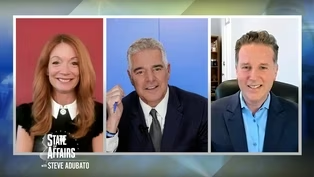
A bipartisan discussion about the 2025 NJ Gubernatorial Race
Video has Closed Captions
Clip: S9 Ep6 | 11m 52s | A bipartisan discussion about the 2025 NJ Gubernatorial Race (11m 52s)
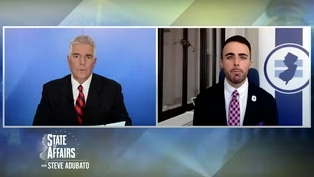
How Garden State Equality is protecting LGBTQ+ rights in NJ
Video has Closed Captions
Clip: S9 Ep6 | 8m 35s | How Garden State Equality is protecting LGBTQ+ rights in NJ (8m 35s)
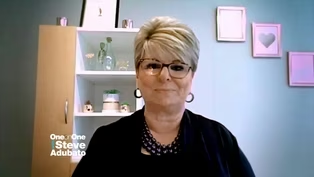
NJ Sharing Network's commitment to giving back
Video has Closed Captions
Clip: S9 Ep6 | 8m 18s | NJ Sharing Network's commitment to giving back to the organ donation community (8m 18s)
Providing Support for PBS.org
Learn Moreabout PBS online sponsorship
- News and Public Affairs

Top journalists deliver compelling original analysis of the hour's headlines.

- News and Public Affairs

FRONTLINE is investigative journalism that questions, explains and changes our world.












Support for PBS provided by:
State of Affairs with Steve Adubato is a local public television program presented by NJ PBS