
Boundless | El Futuro
5/5/2022 | 26m 46sVideo has Closed Captions
Public art honoring Black troops in the Civil War and immigrants’ hopes for the future.
Near the end of the Civil War, the United States Colored Troops fought a pivotal battle in Wilmington. Stephen Hayes creates a sculpture to honor their legacy and serve as a touchstone for years to come. Also, Cornelio Campos paints a colorful mural with the Latinx community in Durham to convey their immigrant struggles and hopes for a brighter future.
Problems playing video? | Closed Captioning Feedback
Problems playing video? | Closed Captioning Feedback
Visibly Speaking: NC's Inclusive Public Art Project is a local public television program presented by PBS NC
Boundless | El Futuro
5/5/2022 | 26m 46sVideo has Closed Captions
Near the end of the Civil War, the United States Colored Troops fought a pivotal battle in Wilmington. Stephen Hayes creates a sculpture to honor their legacy and serve as a touchstone for years to come. Also, Cornelio Campos paints a colorful mural with the Latinx community in Durham to convey their immigrant struggles and hopes for a brighter future.
Problems playing video? | Closed Captioning Feedback
How to Watch Visibly Speaking: NC's Inclusive Public Art Project
Visibly Speaking: NC's Inclusive Public Art Project is available to stream on pbs.org and the free PBS App, available on iPhone, Apple TV, Android TV, Android smartphones, Amazon Fire TV, Amazon Fire Tablet, Roku, Samsung Smart TV, and Vizio.
Providing Support for PBS.org
Learn Moreabout PBS online sponsorship[piano intro] - [Announcer] "Visibly speaking" is a production of PBS North Carolina in association with the Z. Smith Reynolds foundation.
[soft music] - [Man] Most people don't know us and we have an important story that people wanna hear.
- [Woman] He knew that this was sacred ground.
- [Man] There's so much history here, and if we don't capture it, this will be lost history.
[soft music] - [Anne] We held a dream of an actual public artwork on the site and ventured forth with a grant proposal.
- That was our first little pitch at this to see if they would even consider us.
Well, guess what?
We got it.
We got it.
- [Man] If you are proud of something make it big as you can, wide as you can, and as large as you can.
- [Woman] We're the only people who know our story.
No one can tell it the way we can.
[soft music] - [Woman] This project brought together more folks of a United heart and desire than anything that I can remember, 'cause art does do that.
[soft music] ♪ - [Man] Forward march ♪ Oh freedom ♪ ♪ Oh freedom ♪ ♪ Oh freedom ♪ ♪ Over me ♪ - We were very generously given nine and a half acre site here at Cameron Art Museum by the Cameron family.
[soft music] Bruce Cameron, our great benefactor, he knew that this was sacred ground.
They were the breastworks, the revetments traversed a five mile course through his family's property.
He knew it was tied to the American civil war.
And so it was very much, thanks to Dr. Chris Fumbolt.
He researched.
He knew that that had been thrown up hurriedly by the confederacy to try to continue to hold Wilmington.
[soft music] And that's all we knew when we were given the land.
We knew we were continuing to be stewards of an art collection, but to be stewards of a historic civil war site we were charged with finding out more about that story.
[soft music] We did our first reenactment of the Battle Of Forks Road in February of 2006.
- Awesome.
Thanks, guys.
- [Anne] That's when we met the reenactors - On the reenactment weekends, we do the full, not only just the attire, but also the actions.
Fire!
[gun fires] - [Anne] Our new living historians have been our teachers.
- [Woman] Is that shot outta the cannon?
- [Reenactor] Yes ma'am.
[cannon bangs] - [Anne] We learned about the Ohio 5th that actually fought here.
[gun fires] [soft music] - I came representing my relative Jonas Blanning who fought with the first USCT on the first invasion of Fort Fisher.
And also I fought in representing the 5th USCT colored troops from Ohio.
Within the black community, the stigma of the civil war still runs deep.
It's a tough topic to discuss.
That's why I do what I do continue to tell the story, the effort, the part that my relative played during the civil war.
[gun fires] [upbeat music] - I've spoken to so many people who lived here their entire lives and no one had ever even heard of the USCT.
- We engage the state of North Carolina to seek recognition for the United States Colored Troops who fought so bravely for the freedom in the Wilmington area.
[crowd cheering] - And see, I knew nothing about the US Colored Troops.
See, I didn't study it.
We didn't have it at school.
- One of my teachers, she said, "Anne the reason you don't know these stories is because we didn't know these stories."
[soft music] - When we were doing the research, what we were looking for in particular was the ones who fought in the Battle of Forks Road.
You would look for their name, and the muster in document, that's the date they went in and the muster out.
- As we now know, over 2000 United States colored troops soldiers fought here for their freedom.
- This is Southern soil and it's a union victory.
It was fought entirely on the front lines by US Colored Troops.
This is a most unusual and critically important tale.
[soft music] The sound of their boots is in that road, and this is the only living vestige of it.
- [Marvin] When they started to understand what this particular piece of land meant, they saw the opportunity to be able to help this community and the entire Cape Fear area understand the importance of American history.
[soft music] - Our deputy director, Heather, has held a dream for 16 years of an actual public artwork on the site and ventured forth with a grant proposal to the mighty Z. Smith Reynolds Foundation.
The project captured their imagination and we were awarded what became the seed money for a much more ambitious project.
[soft music] We knew we wanted to work with a North Carolina artist and we knew we wanted to work with an African American sculptor, and Steven Hayes, his name came up.
[soft music] - It is a important for a creator.
I call myself a creator, to continue growing and not be stagnant.
I wanna show evolution.
I wanna show growth in my artwork.
- [Anne] When we saw Steven's thesis work.
When he was a student at Savannah College of Art and Design that's when we knew it would be our honor to work with Stephen Hayes - I did an installation called Cash Crop.
It's been out for 10 years now.
It's been moving around to different museums and colleges.
It's about the transporting them goods from the past and the present.
It comes from me not learning much about the transporting of people from one place to another.
I'm talking about transporting of people as goods and commodity.
So I ended up making 15 statues, one represents a million, and chained them all to a palette.
The palette represents today, and how we outsource our goods from sweat shops in third world countries.
- [Heather] And Stephen is very interested in the way African American bodies are portrayed.
That's really important to him and his work and it really resonated with us.
- [Anne] And knowing his method, his mode of production being casting, that brought a possibility.
And we had been working with the US Colored Troops reenactors and learning more about the descendants.
All of that set Stephen on fire.
[soft music] - [Stephen] This is my first time doing this in front of a crowd of people.
So I might be a little nervous.
- [Man] No, it's aight.
You cool.
- [Stephen] Any point you feel like you need to get up out of there go ahead and give me a thumbs down.
It's okay.
But you'll be alright.
I'll been here with you the whole way through.
- I really had no idea this is what he was wanting to do.
- [Heather] He wanted to cast the faces of descendants and the reenactors and also African American military veterans for the sculpture.
- He told the guys, he said, "You can breathe, but don't move."
He had a bucket of water and it looked like- - Left eye - Paper mache.
He would press it to get the contours of their face, [soft music] Every little wrinkle, and just their personality.
[soft music] - [Anne] There was such a bond of trust because it's a scary place that he takes his subjects Because bit by bit [soft music] their engagement with where they are in the actual world is lessened and they have to just abandon to it.
And then embody, "You are this member of the Ohio 5th or the 1st and you are going headlong into this heavy barrage, what is the expression on your face?"
And carry that into this sculpture.
[reenactors chanting] - [Stephen] I feel highly honored to be able to personally sit with some of the descendants of these guys who actually marched and fought for the simple freedom of their bodies to be equal.
Everybody have their own story to tell.
♪ They made us soldiers ♪ - Yes sir.
- Yes they did.
♪ The soldier for the door.
♪ - Yes sir!
[soft music] - [Man] Remember now, the war was halfway through before US colored people were allowed to participate in the war.
- [Anne] The word was out, if you can make it through the swamps, past the dogs, past the guns, you can begin to rebuild your life as a free man, free woman, and you can sign up for service.
- [Man] Fire!
[gun fires] - [Anne] To serve, not only the United States government, but to begin to seek freedom of yourself.
- [Simone] These are real Americans who are not free so they're fighting for their freedom.
[soft music] - So I casted to their faces.
Now I am at the point where I'm building the sculptures [soft music] building the soldiers, building the bodies, placing the clothes making the clothes fold in different directions, and creating a body inside of the clothes.
[soft music] - [Heather] Our reenactors really kept us focused on historical accuracy.
Civil war soldiers were given two boots and they were interchangeable.
You could wear the same shoe on either foot.
- And it's the sound of the boots that captivated Stephen Hayes the most.
And it's also the boots that led us with Stephen to the homage, to the Shaw Memorial.
Robert Gould Shaw, astride his horse with the regiments of the Massachusetts 54th and 55th marching alongside him which was one of the very first USCT regiments ever.
It commemorates the march down Beacon Street where they boarded transport ships heading south to Fort Wagner, where 50% of the regiment lost their lives.
[upbeat music] Our roots in this country are very Eurocentric with our sculptural works, particularly military.
It was always the commanding officer, and if possible astrode a horse, and that commemorated it badly.
- [Heather] What Stephen decided to do was to take that racial hierarchy out of the picture.
So we're focusing on the action and the agency of the United States colored troops.
- There'll be a total of 11, nine soldiers together.
They'll be in Rows of three.
This right here is gonna be the Flag Bearer or the Color Bearer.
And he'll be in the front with the drummer boy marching.
[soft music] - The Foundry that we worked with, Carolina Bronze in Seagrove, North Carolina, we have one of the most significant bronze foundries on the east coast, which is so fortunate for all of us.
There's so much artistry on so many different levels with this.
And it's so complex with the phases of the plaster the lost-wax, the ceramic molds, onto the molten bronze [soft music] ♪ Before I be a slave ♪ ♪ I'll be buried in my grave ♪ ♪ And go home to my lord ♪ ♪ And be free ♪ [upbeat music] - [Man] The Battle of Forks Road was a battle that really you could say actually ended the war because it broke the supply line.
[upbeat music] That's what this was all about supplies being able to come through Fort Fisher, Wilmington and to the urban parts to the south basically Robert E. Lee's army.
- Robert E. Lee said himself, "I cannot hold the army of Northern Virginia of Wilmington Falls."
And we know this is the one path that the Confederates knew was the only way the union troops were going to be able to advance because it was flanked by swamp.
[soft music] It was heavily, heavily fortified, artillery behind the revetments of cannon and musketry.
- If I don't get back down Virginia way, tell them that I...
I fought hard.
- I fought hard!
- Yeah!
- Tell them that I fought strong.
- I fought strong.
- Yeah!
- Tell them that I died facing my enemies.
- [Man] Facing the enemy!
[soft music] - Accounts typify this as a near suicidal assault four of those regiments on the front lines which were entirely USCT and the foremost frontline, the Ohio 5th.
And that's what these men marched into for the freedom of their people, their families, their communities, themselves.
30-some odd hours later, they prevailed.
The Confederates had left.
That's battle of Forks Road.
and it took us a long time to clearly see that [soft music] - You all right, big guy?
- I'm all right.
- It's good to see you, man [people chattering] - And they come very rarely, you getting a wow moment for your community.
And for me, this is one of those wow moments to witness what we see here on the grounds today.
[audience applauding] - These men helped to define what it means to be an American.
They were part of a generation that told the world what this country was gonna stand for.
- At a time of national reckoning regarding what is commemorated in the public square, honoring the incredible history of the US Colored Troops at the Battle of Forks Road is timely and vital to understanding ourselves as North Carolinians.
[audience applauding] - [Man] All the young kids that are coming through school now will have an opportunity to be able to walk up to this and see portions of history that are really truly full.
- This is not me, this is my brother.
That's why we...
It's a resemblance.
- They wanna know not only George Washington and Thomas Jefferson make up the history of the United States.
They are people that look like them, especially for black kids.
So now that's what they see.
- This project brought together more folks of a united heart and desire than anything that I can remember 'cause art does do that.
- [Heather] Yes, it is about the legacy of the USCT but it's also about how the legacy of the USCT lives on through these men.
♪ Our country, tears of deep ♪ ♪ Sweet man of liberty ♪ ♪ For thee we all should see ♪ ♪ Land where our father died ♪ ♪ Land of the pilgrim pride ♪ ♪ And from every mountain side ♪ ♪ Let freedom ring ♪ [soft music] ♪ [soft music] ♪ [birds chirping] [relaxing music] [speaking in foreign language] [soft music] ♪ - Art is very important as a way for us to communicate our dreams.
Our community mural is a display of happiness and a display of wellbeing.
And that's what we want to transmit through this mural.
[soft music] ♪ - Art has a way, it just helps people with their expression.
Here's a place where we can use art therapy in a public environment and bring together people who can start to dream and start to think beyond their current realities and memorialize some of their roots, some of their histories.
And that becomes a very beautiful moment for their mental health and for their moving past and and move forward and being together, but also healing [soft music] ♪ - El Futuro is all about wellbeing for our community, and the mural is an extension of what we stand for.
[soft music] [soft music] ♪ - Culture plays a huge role in how we perceive mental health.
As a Latina myself, mental health wasn't something that we talked about and especially in the Latinx community.
And in a way we're, I think, allowing a space to destigmatize mental health and allowing a space for us to say that it's okay for us to talk about mental health and it's okay for us to seek services when we need to and it's okay to talk about things that most of the times we try to keep.
in our house [speaks in foreign language] [speaking in foreign language] [soft music] - Mental illness is in the family, substance abuse is in the family in our genes.
And when it comes up, it's really hard to know who to turn to.
And especially if you're in a new culture, a new environment.
A lot of people come to the United States, come to North Carolina and they have a lot of aspiration to get ahead economically, to get jobs, to get an education, to grow family relationships here.
But a lot of families move together, they come here and they wanna see a brighter future.
And our name of our organization is El Futuro because we're very in line with that.
[soft music] - The mural is reflecting all the dreams from our community.
It's not an idea that we just had and we made it happen.
There's a lot of community input.
We went knocking doors on our neighbors.
We went reaching out to them also to invite 'em to come to the [speaks in foreign language] because it was important.
This mural is for them.
It's for our community, it's for our immediate neighbors to feel welcome.
[soft music] ♪ - We heard about public art and we thought that would be pretty interesting to incorporate that at El Futuro but maybe that would have something through the art do something that would help to really foster community, foster connections, bring people together in a way that they don't feel.
When they're uprooted from communities.
and they leave those rich social fabrics behind, come here and work multiple jobs, or in this very cold environment for them how can we start to reconnect people?
Because we know that that's a very positive impact on health and especially mental health.
[speaking in foreign language] [soft music] ♪ - At first, it was just a blank space of beer bottles and trash, and it just looked terrible, but we envisioned more.
We thought, "Well, we could maybe do a therapeutic garden."
Concurrent with that, We heard about this opportunity for the mural.
And as we started to vet this with neighbors and people in the community, we realized the power that it could have in our community.
This community especially has been fragmented by the new immigrants coming in and also by old sections that have been gentrifying.
So this mural has brought the community together to do something together in a way that we had not anticipated [soft music] [speaking in foreign language] - It's such a welcoming space.
And especially with the Latinx community nowadays not feeling very welcome in a lot of spaces, and the fact that we have a space for them not only to come here, but to be outdoors in a space that got fresh air and that there's trees and that there's water, and that there's this beautiful mural with these beautiful colors, so they know that this space is for them.
[soft music] That sense of coming together, that we can come from all different walks of life that we can come from all different places, speak different languages, for me, I just find a sense of joy that comes over me when I look at that mural, and a sense of nostalgia.
I'm from New York and there's a part of the Lady Liberty, and that gives me just that sense of like I have a little bit of home as well here.
- It's this desire of helping, this desire of reflecting your dreams because that's what the mural is.
[relaxing music] Can't wait for everybody to come and see it and being part of that and feel that happiness that the mural is displaying [relaxing music] ♪ [relaxing music] ♪ ♪ - [Announcer] "Visibly Speaking" is a production of PBS North Carolina in association with the Z. Smith Reynolds Foundation.
[relaxing music]
Video has Closed Captions
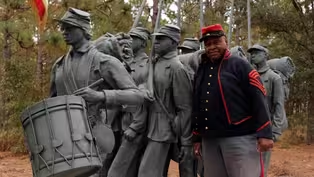
Clip: 5/5/2022 | 16m 38s | A sculpture honors the US Colored Troops, which won a crucial Union victory in Wilmington. (16m 38s)
Video has Closed Captions
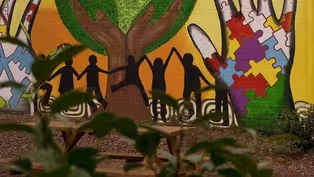
Clip: 5/5/2022 | 8m 53s | A community mural depicts the hopes of Latino immigrants in Durham. (8m 53s)
Providing Support for PBS.org
Learn Moreabout PBS online sponsorship

- Arts and Music
The Best of the Joy of Painting with Bob Ross
A pop icon, Bob Ross offers soothing words of wisdom as he paints captivating landscapes.












Support for PBS provided by:
Visibly Speaking: NC's Inclusive Public Art Project is a local public television program presented by PBS NC