
Bowling Green Woman Helping Defy Dementia
Clip: Season 5 Episode 6 | 5m 14sVideo has Closed Captions
Bowling Green woman leads effort to help Kentuckians defy dementia.
Now to efforts to improve brain health in Kentucky. As we age, the chances increase for developing dementia. But there are things you can do at any age to lower your risk. Laura Rogers has more on how a Bowling Green woman is helping people defy dementia as part of KET's ongoing series The Next Chapter.
Problems playing video? | Closed Captioning Feedback
Problems playing video? | Closed Captioning Feedback
Kentucky Edition is a local public television program presented by KET
Bowling Green Woman Helping Defy Dementia
Clip: Season 5 Episode 6 | 5m 14sVideo has Closed Captions
Now to efforts to improve brain health in Kentucky. As we age, the chances increase for developing dementia. But there are things you can do at any age to lower your risk. Laura Rogers has more on how a Bowling Green woman is helping people defy dementia as part of KET's ongoing series The Next Chapter.
Problems playing video? | Closed Captioning Feedback
Where to Watch Kentucky Edition
Kentucky Edition is available to stream on pbs.org and the PBS app.
Providing Support for PBS.org
Learn Moreabout PBS online sponsorshipNow to efforts to improve brain health in Kentucky.
As we age, the chances increased for developing dementia.
But there are things you can do at any age to lower your risk.
Our Laura Rogers has more on how a Bowling Green woman is helping people defy dementia.
This is part of Kate's ongoing series, The Next Chapter, that explores the rewards and challenges of growing older.
Her circle and then.
In her late 60s, Tanya Kirby of Allen County.
Maybe a little absentminded at times.
My family is forgetful.
It runs through the generations.
My little sister and I used to always call my mom forgetful George.
It comes with the territory.
For those who juggle so many responsibilities.
Women live with so much on them now.
They try to run a home.
They try to raise their family.
They try and hold down a job.
And for many adults, they're doing all of that while also caregiving for aging parents.
I had children that I was taking to daycare, and then I also had a father that I was the primary caregiver for.
Ginny Jacobs is a speech language pathologist who has worked in various health care operations.
Now the founder of Defying Dementia, I. Work with people who have been diagnosed with dementia that are living with dementia.
I work with people who are caring for those that are living with dementia.
Before his passing, her father had advanced Parkinson's disease, which led to dementia.
Having the experience with my dad.
You know, I lived it as a caregiver.
I cared for someone who was living with dementia, and it was hard.
Jacobs offers guidance for those who want to be proactive.
Doing what they can to support a healthy brain.
Having an assessment done can only tell you things to work on and improve, rather than things you need to fix later or it's too late to fix.
Brittany Dawson suggested such an assessment for her parents back in the winter, when they were staying with her during an ice storm.
I approached them both as, hey, this is part of aging.
This can help you take some preventative measures.
And we did, and we're glad we did.
You go to the dentist every year.
You go to your doctor every year.
Why not check on your brain?
Tanya Kirby was relieved to get a good report.
But there was one thing.
My mom called me and said, I don't have dementia, but I need my hearing checked.
I was like, okay, we can get that taken care of.
Hearing loss is something Jacobs sees often in her practice, and just one thing people can tackle to help them live a healthier, happier lifestyle.
Typical assessment.
It's going to start with a lot of questions about what your day to day life looks like.
We're going to ask questions about how you sleep.
We're going to ask you what you eat.
We might even ask you what order you put your clothes on in the morning.
Jacobs doesn't just work with the aging population.
She has clients in their 30s who want to get ahead of their brain health.
He says it actually begins in childhood.
If we start with a good foundation of preschool, formalized preschool, that gives us a larger cognitive reserve.
Jacobs will do a baseline assessment with clients to see where they stand with their cognitive health.
But sometimes just getting them in the door may be a challenge.
There's such a stigma associated with talking about your brain health and your cognitive health.
And I think there's also this stigma around it that there's nothing that you can do.
But she says that's not true.
Just like with physical health, eating nutritious foods is good for your cognitive health.
Over processed, sugary foods, they lead to diabetes, or they lead to inflammation in your body and also in your brain.
The inflammation, the gunk that builds up in your mind and your brain.
It makes it harder for us to understand, to process information.
It's also important to be physically active.
Getting good exercise like walking and lifting weights.
Don't skip leg day.
That's huge.
We want to focus on strength training and incorporating strength training into our exercise routine.
And one of the biggest points she made to me.
Having an active social life.
Volunteer your church.
Volunteer at the Humane Society.
Be a part of a book club.
Interact with people, talk.
Be a part of something and stay connected.
These are all steps Tonya is taking to define dementia.
Anytime you can be a little more proactive and get ahead of the problem to start doing things to slow it down, the better off you're going to.
Be and the more likely you'll be equipped with a healthy mind and memory.
For Kentucky Edition, I'm Laura Rogers.
Thank you Laura.
A lot of valuable information there.
Miss Tanya says she and her family also keep a shared family calendar to help with efficient communication and plans.
That's one of Jenny's many pieces of advice included here, with other tips for keeping your mind sharp.
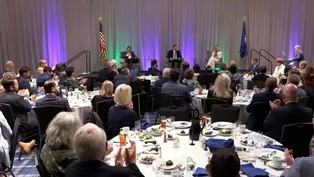
Candidates for 6th Congressional District Participate in Forum
Video has Closed Captions
Clip: S5 Ep6 | 5m 35s | Candidates for Kentucky's 6th Congressional District make their pitch to voters. (5m 35s)

Where Opioid Settlement Money is Going in Kentucky
Video has Closed Captions
Clip: S5 Ep6 | 2m 42s | New dashboard breaks down where opioid settlement money is being spent across the state. (2m 42s)
Providing Support for PBS.org
Learn Moreabout PBS online sponsorship New Episode
- News and Public Affairs

Top journalists deliver compelling original analysis of the hour's headlines.
 New Episode
- News and Public Affairs

Today's top journalists discuss Washington's current political events and public affairs.
 New Episode
 New Episode

 New Episode


 New Episode
 New Episode

Support for PBS provided by:
Kentucky Edition is a local public television program presented by KET