
Brandon McKoy; Carolyn M. Welsh; Joe Bertolino, Ed.D
5/25/2024 | 26m 58sVideo has Closed Captions
Brandon McKoy; Carolyn M. Welsh; Joe Bertolino, Ed.D
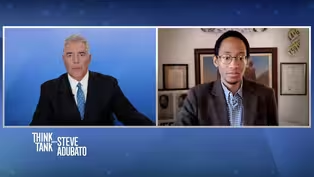
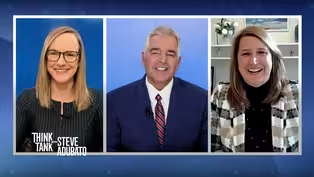
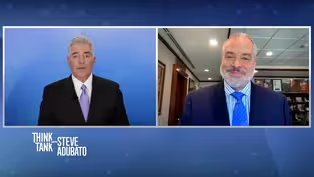
Brandon McKoy, President of The Fund for NJ, highlights their support for news organizations around NJ. Carolyn M. Welsh, President & CEO of NJ Sharing Network, talks about the important work of the NJ Sharing Network. Later, Joe Bertolino, Ed.D., President of Stockton University, discusses the affordability of higher education and how the university is protecting free speech.
Problems playing video? | Closed Captioning Feedback
Problems playing video? | Closed Captioning Feedback
Think Tank with Steve Adubato is a local public television program presented by NJ PBS
Brandon McKoy; Carolyn M. Welsh; Joe Bertolino, Ed.D
5/25/2024 | 26m 58sVideo has Closed Captions
Brandon McKoy, President of The Fund for NJ, highlights their support for news organizations around NJ. Carolyn M. Welsh, President & CEO of NJ Sharing Network, talks about the important work of the NJ Sharing Network. Later, Joe Bertolino, Ed.D., President of Stockton University, discusses the affordability of higher education and how the university is protecting free speech.
Problems playing video? | Closed Captioning Feedback
How to Watch Think Tank with Steve Adubato
Think Tank with Steve Adubato is available to stream on pbs.org and the free PBS App, available on iPhone, Apple TV, Android TV, Android smartphones, Amazon Fire TV, Amazon Fire Tablet, Roku, Samsung Smart TV, and Vizio.
Providing Support for PBS.org
Learn Moreabout PBS online sponsorship- [Narrator] Funding for this edition of Think Tank with Steve Adubato has been provided by NJ Best, New Jersey’s five-two-nine college savings plan.
Holy Name.
The New Jersey Education Association.
PNC Foundation.
New Jersey’s Clean Energy program.
Lighting the way to a clean energy future.
PSEG Foundation.
Robert Wood Johnson Foundation.
Working for a more a healthier, more equitable New Jersey.
IBEW Local 102.
Lighting the path, leading the way.
And by Delta Dental of New Jersey.
Everyone deserves a healthy smile.
Promotional support provided by NJ.Com.
Keeping communities informed and connected.
And by Insider NJ.
[MOTIVATIONAL MUSIC] - Hi everyone.
Steve Adubato.
We wanna welcome back to the program, Brandon McKoy, who's President of a foundation called "The Fund for New Jersey".
Brandon, good to see you again.
- Good to see you, Steve.
Thanks for having me.
- You got it.
We're gonna put up the website for "The Fund for New Jersey".
Describe for everyone what it is and what you're focused on and why.
- Well, The Fund is a foundation that provides support to organizations and leaders who are working in to realize a New Jersey that can work for everybody, making sure that we have high quality communities, high quality assets, and that we are moving towards and strengthening honestly, a multiracial democracy, want to have a strong civil society here in the state.
And so really interested in making sure that people are aware of what's going on in their community and that they have the tools needed to be active participants.
The fund cares deeply about the public being informed about the issues that matter and where our government is or is not on those critical policy issues.
What is the role of the foundation community, the philanthropic community, when it comes to supporting media that promotes public awareness vis-a-vis its connection to a healthy republic slash democracy?
- Oh, I think it's significant.
Obviously, the past 10 to 15 years, we've seen a significant shift in sort of the economics of media and the ability of newsrooms, newspapers to be able to continue to operate and employ investigative journalists, investigative reporters, people who are really digging into things that may not be the most popular or top of mind interesting for the vast majority of people, but are very, very, very important.
And so I think philanthropy has a major role in providing support to institutions, to news organizations so that they can do this important work.
And as we're still trying to figure out what is an economic structure or sort of a business structure that works for media long-term, philanthropy can at least help ensure that organizations are able to do what they gotta do.
And that we're not having these tremendous gaps in coverage.
Though I will say in New Jersey, I think we do suffer tremendous gaps in coverage and there's more that needs to be done.
- And to that on, let me disclose that "The Fund for New Jersey" is an underwriter over at NJ Spotlight News, a great organization, one of our media partners and one of our radio media partners, WBGO, New Jersey Public Radio.
Lemme try this.
Top three issues, policy issues that The Fund cares deeply about that does not get enough attention, not only in the media but among just in public discourse.
People are not talking about it, but these three issues matter deeply, particularly to those who are most vulnerable in our state and nation.
But let's talk to New Jersey right now.
- I would say one is taking seriously the fact that we are a state that is smack dab in the middle of the most active economic market in the world.
And at least part of our responsibility in that, is moving people quickly and reliably and efficiently.
And so there has been plenty of conversation, of course, about transportation, public transportation and otherwise, but the fact that it is still a conversation tells you how literally we've actually affected change and been been able to tackle the problem.
And so taking that more seriously, taking very, very seriously the fact that we gotta be able to get people to New York, to Philadelphia and to other parts of the state without it being such a hassle for them and get people from those cities into New Jersey.
That's one.
I think the fact that we are a coastal state, and this of course comes up, but the threats of sea level rise and flooding to municipal finance, which you might say, "Well, what are you talking about?"
For shore communities, if they're gonna start flooding out and we're not doing enough to prevent that or mitigate that, banks are gonna maybe make different decisions around mortgage opportunities.
Insurance companies are gonna make different decisions around coverage.
And so what does that mean for those communities?
And we know that certain amounts of sea level rising flooding are sort of already baked in to our future, take that seriously and start playing out the dominoes, and what do we need to do to limit the damage and ensure that people are not experiencing tremendous harm because we have not done enough on the front end to tackle this issue.
So that's the second.
And then thirdly, I would say is more so celebrating the fact that we are a gateway for immigrants into this nation.
For immigrants are a major part of Main Street business.
I think up to a quarter of Main Street businesses are owned by immigrants, if not more.
They're a major part of our culture.
New Jersey is incredibly diverse from a population standpoint in a way that many other places are not, especially relative to our size.
And that creates its own dynamics and scenarios.
But that's a tremendous strength and there's not enough conversation about how do we continue to take advantage of that strength and how do we make sure that we are including immigrants into our state and into our civic life and making sure that they can succeed.
- Brandon, a quick follow up on that.
Go back to media coverage of the migrant crisis.
Okay.
If in fact we continue to see video, pictures, visuals of urban communities across this nation, including in New Jersey where the narrative is the migrant crisis is hurting our cities, is hurting taxpayers, it's the government, federal government and state governments need to change dramatically immigration policy.
How does that relate to, and how does that connect to your description of how rich the immigrant history is of our country and our state vis-a-vis where we are right now?
- Yeah, I mean, I think framing things as a crisis without sort of talking about what are the options to make sure that we are succeeding is a very myopic viewpoint, a very narrow viewpoint.
It also can be a dangerous viewpoint depending on how you go about it, and put people in dangerous situations that we don't need to be seeing.
We don't want to encourage negative behavior and possible violence.
To be quite frank with you, I think, states doing more to work together, these are not issues that end at borders, these are regional issues, as you said, national issues.
And so New Jersey and New York doing a better job of working together, New Jersey and Philadelphia doing a better job of working together.
- How about Texas and New York?
Texas and New Jersey where a governor says, "Yeah, put him on a bus."
- Yeah, and I would say that is not the most responsible decision.
And you're sort of making things worse.
And rather than having these sort of, for lack of a much better term, catty engagements with each other realizing these are people, these are not political props.
These are folks that are fleeing very awful situations, often war or famine or otherwise, and taking seriously what is our responsibility and what can we do to actually help?
And we have a strong history of incorporating and welcoming immigrants into this nation.
This is not something that we cannot do.
It's really a matter of political choice.
And I don't even wanna say courage, but responsibility.
- Yeah, and finally, to Brandon's point, how the issues are framed, not for or against, it's not my place to express an opinion, but when you frame things as for or against immigration or immigrants, migrants versus how best to deal with these complex issues, it changes the discussion and very often policy decisions made in Washington and Trenton.
Brandon McKoy is the President of "The Fund for New Jersey".
Brandon, I wanna thank you so much for joining us.
Wish you and your team all the best.
- Thanks Steve.
- You got it.
Stay with us, we'll be right back.
To watch more Think Tank with Steve Adubato, find us online and follow us on social media.
- Recently, together with my colleague Mary Gamba, over on "Lessons in Leadership," we sat down and spoke with Carolyn Welsh, who's the President and CEO of New Jersey Sharing Network, our longtime partners, in fact, one of the underwriters of our programming, particularly around organ and tissue donation.
That's what the Sharing Network is all about, organ and tissue donation.
With Carolyn, we talked about developing leaders in a not-for-profit organization, raising money in these challenging times for a not-for-profit organization.
And as always, the importance of organ and tissue donation.
Hi everyone, and welcome to "Lessons and Leadership," Steve Adubato, my colleague, Mary Gamba.
We kick off the program, we are honored to be joined by our good friend, Carolyn Welsh, who is President and CEO of the New Jersey Sharing Network.
Good to see you, Carolyn.
- Hi, Steve, hi, Mary.
- So Carolyn, the Sharing Network is the official what in New Jersey as it relates to organ and tissue donation?
- So New Jersey Sharing Network is the Organ Procurement Organization designated for the majority of New Jersey to serve the constituents waiting for a lifesaving transplant.
Where are we today with the number of people waiting for an organ?
- So in New Jersey alone, there's approximately 4,000 people waiting for a lifesaving organ transplant.
- 4,000, go to the website, not the website, the hashtag, 'cause this just got my attention, donation needs diversity.
Of the 4,000, a disproportionate of them are Black or brown.
- Yes, so 67% of people waiting in New Jersey are people of color that need a lifesaving organ transplant.
- Carolyn, why are those numbers disproportionate to the population?
- So a lot of things go into, you know, disease process and what puts people in need of an organ transplant.
So some of that is definitely genetic and reasons why that there would be a disproportion.
- Hmm, and before Mary jumps in, I wanna bring this back to leadership.
So for you as a leader, and you know, we've talked about leadership a lot, but I'm curious about this, the biggest change, or improvement, if you will, on your part as a leader in the last couple years, you know, taking over Joe Roth's extraordinary job as the leader of the Sharing Network, succeeding Joe, for you in the last couple years, your biggest area of growth as a leader is?
- I think patience is probably something that's rough for me.
- We don't know anything about that, do we, Steve?
(all laughing) - That's how we get along, right?
So New Jersey, right?
It is just fast pace of life, everything we do is fast.
So I think an important role and change for me becoming President and CEO and leadership that I've really focused and worked on is patience and listening.
- Love it.
Mary, I'm not that good at either one of those.
Go ahead, Mary, jump in.
- Yeah, no, that's okay.
We're all a work in progress, that's for sure.
And as President and CEO, Carolyn, I would love to talk a little bit about developing your people.
Obviously you're a woman leader, you're developing women and men on your team.
Talk about your approach to developing people at the New Jersey Sharing Network.
- Sure, so I'll be celebrating my 25th anniversary in March of being here.
So it's not new in that aspect, but coming into this role and leading the team and developing people, we really focused in the last 18 months, two years, to promote within, understanding our industry and understanding our state and understanding the people we serve is very important.
And I take pride in really knowing something personally about each person that works here.
We have over 200 employees, so it's not even just the leaders that I think that my focus is developed on.
Every person that does this work chooses this work, because it is sacrifice in your life to give up your own family time, personal time, to dedicate yourself to this work.
But developing people, not only in their work, but in their life, is very important to me.
I feel that developing them as people helps them to be able to do this work with passion and dedication and a sense of urgency.
- Quick follow up on that, Carolyn.
So if someone says, "Come on, business, leadership, "and business leadership in an not-for-profit organization," be it yours or ours, the Caucus Educational Corporation, or even what we're doing now, "Come on, it's not personal, it's just business."
You say what to that?
- Without curse words from New Jersey?
(all laughing) - This is why we love you.
I wanna have you on every single episode.
- We'll say, "BS, BS."
- It's BS, it's not true.
- Yeah.
We're in a different world right now.
And by looking at what motivates people, what energizes them, what refuels them, resilience is a big word that, you know, now in leadership that's coming out, and organ procurement organizations right now, going into 2024, we're sustaining changes to our regulatory measurements, which, listen, we all wanna save more people's lives, so if those components are gonna make us better, we're gonna do everything we can to do that.
But to be resilient, you have to know your people.
If you don't know them, you cannot help them when they need the help.
You have to recognize when they're off their game, and work, when they're off their game, people's lives are at stake.
So you have to kinda know what's going on with them personally, and just the world around us, you know, not to go into all of the different things around, but anything that's happening in our world affects the people that work here.
And, you know, what is their religion?
What their race?
What is their gender?
What are their belief systems?
What motivates them to wanna do this work?
I have a good memory, so I also can tell you that majority of the people, I was in their interviews and in the room with them, and I really try to do that connection.
It helps you when you're doing this lifesaving work to connect with people on a personal level.
So BS is the long-winded answer.
- Mary, you get one.
- I was gonna say, I have one other question.
- Yeah, jump back in.
- Yeah, I was gonna say one other question, because I do feel that there is then that link between that connection, but also trust.
And we're not just talking about trust on our team, but you're telling these families when you go in and one of their family members unfortunately is dealing with end of life, you need to get the trust of those family members if that family member hasn't already made that decision for them.
Talk about the importance of trust in the process.
- Yes, I think you hit it spot on.
One of our strategic anchors is obtaining the public trust and maintaining that.
And part of that is, you know, start with, who works here?
If we build trust there, they need to then go out and build trust with the community.
So we have community specialists, we have education professionals that are out in the field talking proactively about organ and tissue donation and building that trust in the medical community, and knowing at the time of someone's, you know, unfortunate passing, that this opportunity doesn't get asked to every person.
It's less than 1% of people that die in a hospital that will get asked if they would like to have their person be an organ donor.
We don't have the opportunity to get it right the next time.
So building trust has to be quick, it has to be genuine.
And if you're not genuine with your people here, how can I expect them to be genuine in the public when they're talking to people at, you know, the worst time that someone could be faced with a question?
- That's Carolyn Welsh, talk about a genuine leader who cares and makes a difference every day with her team at the New Jersey Sharing Network.
Our good friend, Carolyn Welsh, the Trustee of the Caucus Educational Corporation, our not-for-profit entity.
Carolyn, thank you so much for joining us, we appreciate it.
- Thank you for having me.
- You got it.
We'll be right back.
To watch more Think Tank with Steve Adubato, find us online and follow us on social media.
- Now, joining us for the first time, it will not be the last, is Joe Bertolino, President Joe.
Dr. Bertolino is the President of Stockton University down in South Jersey.
Good to see you, President Joe.
- Good to see you.
Thanks so much for having me, Steve.
Appreciate it.
- You got it.
Describe the university.
- Describe the university.
We are a public regional university here in South Jersey, about 8,600 students.
40% of our students are Pell eligible.
40% of our students are from underrepresented groups, and the vast majority of our students are commuters who come from New Jersey, the South Jersey region in particular.
Like many public regional institutions, I'd say that we are a work, an institution that serves the working class, really.
Most of our students come from working-class families.
That's who they are, and that's what we're about, so.
- And the affordability issue, President Bertolino, huge, disproportionately an issue for your students, correct?
- It is, it is.
The fact that 40% of our students are Pell eligible, I think- - Describe Pell.
It's a financial aid program.
- It is a financial aid program.
So students who fall below a certain threshold essentially are more eligible than others for six to $7,000 in additional aid on top of whatever other state or federal aid or Stockton aid they may receive, so it's pretty significant.
I think it speaks to the mission of our institution and who we are and who we serve.
So we're really providing an education for students and communities that otherwise may not be given the opportunity, so it's important to us.
- President Joe, because you asked me, people are like, "Why is Adubato calling him President Joe?"
I didn't come up with that.
You are called that on campus.
Is that true?
- I am.
I am.
- And is it also true, is it not a fact that you, (laughs) that you move around the campus?
You are seen, you are engaged, involved in very actively in the community of Stockton.
Please, talk about it.
- Very much so.
Actually, this is probably, my students in my community would say, "Well, this is a special day because Joe's wearing a tie."
More often- - You usually don't?
- I usually, I'm not a jacket and tie guy if I can help it.
I'm out and about on campus and in the community all of the time.
It's not unusual for students and faculty and staff to know who I am.
I'm highly visible.
And it drives my staff crazy, quite frankly, following the schedule, because I have a very bad habit of stopping along the way from one point to the next.
So, I think the staff has learned to adjust to build in extra time.
'cause they know I'm gonna stop and speak to as many individuals as possible, especially students.
- How dare you talk to students?
Let me try this thing, Joe.
- Go ahead.
- D,E and I, diversity, equity, and inclusion, not just a policy or a slogan.
It is very real for you.
You're the first openly gay president of a university in this state, if I'm not mistaken.
That matters to the issue of diversity, equity, and inclusion.
Talk about that.
- It does matter, but shout out to my good friend, Richard Helldobler, who's the president of William Paterson, who's- - I apologize for that.
- an openly gay man.
But, yeah, this is actually, it's interesting.
This is actually my third college presidency.
And so returning here to South Jersey has been particularly important.
But during my entire both pre-presidential and presidential experience, my focus has been on what we call here the five pillars.
And that is my expectation as president is that every member of our community is treated with dignity, respect, kindness, compassion and civility.
And for me, that's the root of justice, but it's also I think rooted in a value system of an ethic of care.
And so, while there are debates raging about DEI around the country, I don't think it's unreasonable for us to expect our community to care about one another, to focus on treating people with dignity and respect and to engage in conversations and dialogue and listening and trying to understand one another.
I mean, that's the heart of higher education.
It's what we do.
- So, President Joe, since you brought it up, this is where I want to go.
We're taping this at the end of April.
Be seen later.
College campuses, let's just put it this way, it's gonna be very interesting to see how college presidents across this nation deal with the question of free speech and protecting students, not just their rights, but their personal safety.
How the heck, and anyone who thinks, "Well, it's not gonna be on my campus," okay, good for you.
Well, it looks like these are real issues for people who care deeply.
How the heck do you balance, Mr. President, free speech, academic speech, student free speech, and the safety of other students or all students?
- All students, all students and the community- - That's right.
- of all of the individuals that are here- - That's right.
- Not just on campus, but the community that we serve.
Look, it's certainly not an easy time to be a college or a university president.
I've been at this now for 12 years, and I think this is probably the most challenging timeframe for serving as a university or college leader.
I'm really proud of the work that we've been doing here at Stockton.
I think right after the horrendous acts of October the 7th occurred, my immediate response was to bring the community together here at Stockton and really to engage a conversation about what has happened, the pain that individuals on all sides of these issues are experiencing.
My job is to ensure that we are taking care of all of our students, all of our community, regardless of what side of an issue that they believe in.
And more importantly, to make sure that the health and safety and wellbeing on all fronts for all of our community members is being cared for.
So, I think one does that by clearly articulating what I mentioned earlier, our five pillars, if you will.
And secondly, providing opportunity for individuals to share their perspectives, do so in a way that falls within the parameters of the rules and regulations, being consistent across all groups, and then providing opportunities for people to learn, listen and engaged.
We've done that here.
There have been protests here.
Of course there have been.
But you probably haven't heard a lot about them because they've been civil, they have been educational in nature.
We actually brought students in our community together from multiple sides of this issue and other issues, and folks sat for hours at tables within our campus center engaged in dialogue.
That didn't mean that people left agreeing with one another.
That wasn't the point.
- That they listened to each other.
- Listened to each other.
And as educators, that's our responsibility.
How are we providing a space and a safe space for students- - That's right.
- to be able to express themselves and for students to also listen to others and learn and share.
And I think we've done that very well here, and I'm really proud of what we've done.
- You've been listening to and watching Dr. Joe Bertolino, President of Stockton University down in South Jersey right outside of Atlantic City.
President Joe, don't let this be the last time you join us, okay?
- I would love to come back.
Anytime.
- You got it.
I'm Steve Adubato.
That's President Joe.
We'll see you next time.
- [Narrator] Think Tank with Steve Adubato is a production of the Caucus Educational Corporation.
Celebrating 30 years in public broadcasting.
Funding has been provided by NJ Best, New Jersey’s five-two-nine college savings plan.
Holy Name.
The New Jersey Education Association.
PNC Foundation.
New Jersey’s Clean Energy program.
PSEG Foundation.
Robert Wood Johnson Foundation.
IBEW Local 102.
And by Delta Dental of New Jersey.
Promotional support provided by NJ.Com.
And by Insider NJ.
Hey, kids, PBS Kids and Delta Dental want you to have a healthy smile.
So here are some tips for you to remember.
Number one, eat plenty of crunchy fruits and vegetables.
Number two, brush your teeth after eating sugary snacks or drinking sodas.
And number three, drink lots of water to wash away food particles.
When your teeth are happy, all of you is happy.
From PBS Kids and Delta Dental.
Have a healthy smile.
How This Foundation is Supporting Local Media Around NJ
Video has Closed Captions
Clip: 5/25/2024 | 9m 2s | How This Foundation is Supporting Local Media Around NJ (9m 2s)
NJ Sharing Network CEO Discusses Leadership and Resilience
Video has Closed Captions
Clip: 5/25/2024 | 8m 53s | NJ Sharing Network CEO Discusses Leadership and Resilience (8m 53s)
President of Stockton University Talks Free Speech & Safety
Video has Closed Captions
Clip: 5/25/2024 | 9m 54s | President of Stockton University Talks Free Speech & Safety (9m 54s)
Providing Support for PBS.org
Learn Moreabout PBS online sponsorship
- News and Public Affairs

Top journalists deliver compelling original analysis of the hour's headlines.

- News and Public Affairs

FRONTLINE is investigative journalism that questions, explains and changes our world.












Support for PBS provided by:
Think Tank with Steve Adubato is a local public television program presented by NJ PBS