This Is Minnesota Orchestra
Brea(d)th
Season 5 Episode 6 | 1h 56m 40sVideo has Closed Captions
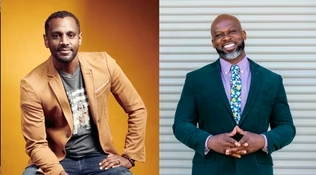
Brea(d)th by Carlos Simon and Marc Bamuthi Joseph, and Wynton Marsalis’ Tuba Concerto.
Composer Carlos Simon and librettist Marc Bamuthi Joseph embrace the aspiration of racial equity through music-centered community healing in Brea(d)th, a new commission by the Minnesota Orchestra. The program also features Wynton Marsalis' Tuba Concerto with Principal Tuba Steven Campbell and Coleridge-Taylor's Petite Suite de Concert. Johnathan Taylor Rush conducts and William Eddins hosts.
Problems playing video? | Closed Captioning Feedback
Problems playing video? | Closed Captioning Feedback
This Is Minnesota Orchestra is a local public television program presented by TPT
This Is Minnesota Orchestra
Brea(d)th
Season 5 Episode 6 | 1h 56m 40sVideo has Closed Captions
Composer Carlos Simon and librettist Marc Bamuthi Joseph embrace the aspiration of racial equity through music-centered community healing in Brea(d)th, a new commission by the Minnesota Orchestra. The program also features Wynton Marsalis' Tuba Concerto with Principal Tuba Steven Campbell and Coleridge-Taylor's Petite Suite de Concert. Johnathan Taylor Rush conducts and William Eddins hosts.
Problems playing video? | Closed Captioning Feedback
How to Watch This Is Minnesota Orchestra
This Is Minnesota Orchestra is available to stream on pbs.org and the free PBS App, available on iPhone, Apple TV, Android TV, Android smartphones, Amazon Fire TV, Amazon Fire Tablet, Roku, Samsung Smart TV, and Vizio.
Providing Support for PBS.org
Learn Moreabout PBS online sponsorship- We are live at Orchestra Hall in Minneapolis with performances, interviews, and more.
- Music is exuberant.
- Beautiful and uplifting.
- Joyful and profound.
- Exhilarating.
(energetic orchestra music) - This is Minnesota Orchestra.
(energetic orchestra music) (audience applauding) - There we go.
Getting in the news.
(audience applauding) Well, good evening.
(audience applauding) Good evening, everyone.
Welcome to Orchestra Hall.
It's great to see such a wonderful and enthusiastic audience.
I am Bill Eddins, your host for this evening's concert.
We have an interesting and varied concert for you tonight.
One which features three pieces written by composers of the African diaspora in Britain and in the United States.
This concert begins with the "Petite Suite" by Samuel Coleridge-Taylor, who was of course named after the famous poet.
Samuel Coleridge-Taylor was a talented musician, born from an English woman and a Creole man from Sierra Leone.
Coleridge-Taylor was fortunate enough to find early champions in music, including none other than Sir Edward Elgar.
His music became very popular in the UK and also in the United States, and he was even hosted at the White House by a gentleman named President Theodore Roosevelt.
Considered a genius amongst his peers, Coleridge-Taylor was the youngest delegate to the Pan-African Conference in 1900.
The "Petite Suite" was written in 1911, just a year before his untimely death, and it is representative of his lighter music.
The concert continues with a tour de force, the "Concerto for Tuba" written by Wynton Marsalis played by the Minnesota Orchestra's principal tuba, Steven Campbell.
(audience applauding) Wynton remains the only musician to win a Grammy for best jazz and best classical albums in the same year.
Reflective of his immense talent and unique ability to cross the lines between genres and styles.
Indeed he and his colleagues of the jazz at Lincoln Center Orchestra with a featured soloists right here at this year's Minnesota Orchestra season opening concerts, a weekend of concerts, I was ridiculously privileged to conduct.
Wynton's almost preternatural dynamism is evident throughout this work.
This is not jazz, this is not classical.
It is simply the musical musings of a composer and performer whose ears are always open to new ideas.
We conclude the concert with the world premiere of "brea(d)th" by composer Carlos Simon and librettist Marc Bamuthi Joseph.
And it is unusual in that both composer and wordsmith are listed as co-creators.
This work commissioned by the Minnesota Orchestra is inspired by George Floyd and asks America to consider an equitable future.
The peace embraces larger questions about race and race relations throughout American history.
Members of the Minnesota Chorale, Twin Cities Choral Partners, and the South African Musical Group 29:11 will join Marc Bamuthi Joseph and the Minnesota Orchestra onstage.
I am delighted to welcome my colleagues Carlos Simon and Marc Bamuthi Joseph and all of you to Orchestra Hall for the world premiere of "brea(d)th".
(audience applauding) As I said, we begin the concert this evening with Coleridge-Taylor's "Petite Suite de Concert."
Our guest conductor, Jonathan Taylor Rush is associate conductor of the Baltimore Symphony and also artistic director of the Baltimore Symphony Youth Orchestra.
Thank you for coming this evening and here now is our Concert Master, Erin Keefe.
(audience applauding) ("Petite Suite de Concert") (audience applauding) ("Le Caprice de Nannette") ("Le Caprice de Nannette") ("Le Caprice de Nannette") ("Le Caprice de Nannette") ("Le Caprice de Nannette") ("Le Caprice de Nannette") ("Le Caprice de Nannette") ("Le Caprice de Nannette") (audience applauding) ("Demande et réponse") ("Demande et réponse") ("Demande et réponse") ("Demande et réponse") ("Demande et réponse") ("Demande et réponse") ("Demande et réponse") ("Demande et réponse") ("Demande et réponse") (audience applauding) ("Un Sonnet d'amour") ("Un Sonnet d'amour") ("Un Sonnet d'amour") ("Un Sonnet d'amour") ("Un Sonnet d'amour") ("Un Sonnet d'amour") ("Un Sonnet d'amour") (audience applauding) ("La Tarantelle frétillante") ("La Tarantelle frétillante") ("La Tarantelle frétillante") ("La Tarantelle frétillante") ("La Tarantelle frétillante") (audience applauding) - That was the "Petite Suite" by Samuel Coleridge-Taylor, played by the Minnesota Orchestra under Jonathan Taylor Rush.
That last movement borrowing a dance form that goes back many centuries, the Italian tarantella.
(audience applauding) Coleridge-Taylor wrote that suite in 1911, he died just a year later of pneumonia at the age of 37.
Jonathan Taylor Rush is making his Minnesota Orchestra debut.
He's not quite 28 years old and he is doing well.
Nice to hear him tonight.
We are live at Orchestra Hall in Minneapolis.
I'm Melissa Ousley in the MPR radio booth and Bill Eddins is taking good care of those of you watching on Twin Cities PBS or the Orchestra's website.
And Bill, since we have a few minutes for this stage change, I thought I would check in with you about this next piece because it's a concerto for tuba and orchestra.
- Yes, it's a very interesting piece.
It's one of those rarities in the business.
A Concerto for tuba doesn't come along very often, but as you know, Carol Jantsch, the principal of tuba player of the Philadelphia Orchestra commissioned this from Wynton.
She got into the to Philly when she was only 21 years old and she's an incredible player, and he knew that and so he wanted, he said he wanted to get down in the bass class.
- Right exactly.
- So (laughs) here we go.
- So he agreed to write it for this monster player.
Steve Campbell is the monster player tonight.
We'll hear him in a few minutes.
And I've heard there's sort of this fraternal order among tuba players, and I should back up and say that a lot of times we associate certain personality types with instruments.
Like for example, a violin player has a very different personality from a tuba player and we'll just say the tuba players are more laid back.
Is that right?
(Bill laughs) - There is something about all the low frequencies.
- Yes, yeah.
- Bass players, tuba players.
- What's up with that?
- They're odd enough that we're not gonna go there, okay.
(Bill and Melissa laughs) But many years ago, I was associate conductor in Chicago and I got to do a world premiere of a "Tuba concerto" with Gene Pokorny, who's the fabulous principal tuba of the CSO.
And afterwards, he had a party at his house, and it was just like gathering of tuba players from all over the country and all over the world.
My best memory was meeting the guy who works in, used to work in all the LA recording sessions.
And so he was close encounters guy, the mothership and he was also jazz.
- Oh wow.
(Bill imitates jazz sound) - You know that was him.
(Bill and Melissa laughs) - That's amazing.
What a story.
Well, I am really looking forward to hearing this down in the bass clip "Concerto for Tubist and Orchestra," and yeah, you mentioned Carol Jantsch is the person who asked him to play it.
She was 21 at the time, I think she's actually in her 30s now and she premiered it just a couple of years ago.
- Yeah, as I said, she's an incredible player.
I've had the the chance to work with her a couple of times and she's not the biggest person on the face of the planet, but man, she sits behind the tuba and she starts playing and it's just an incredible sound.
- And I read on Wikipedia, she won some kind of tuba throwing contest.
- (laughs) I did not know that.
- Okay, (Bill laughs) we'll have to check that out.
Thank you, Bill.
I appreciate your time.
- No worries.
- Steven Campbell is the soloist tonight.
He's been been principal tuba with the Minnesota Orchestra since 2005.
And Steve told me one of the hardest things about playing a concerto is adjusting to his location on the stage, instead of in his natural habitat as he describes it, back row of the orchestra, he's way up front, so it feels different and it sounds very different.
So that's a huge adjustment.
You'll also notice some unusual techniques in this concerto, which runs many different genres.
There's gospel and jazz and classical bebop, and in the first movement, (audience applauding) you'll hear a technique called multiphonics.
And that's when Steve plays one pitch while he sings another.
That movement is called up.
(audience applauding) (Melissa laughs) Here he is now taking a bow here at Orchestra Hall in Minneapolis and shaking hands with Concert Master Erin Keefe.
So buckle your seatbelt.
Last movement by the way, very fast.
This is a "Concerto for Tubist and Orchestra" by Wynton Marsalis.
The conductor is Jonathan Taylor Rush.
(♪ Tuba melodies ) (♪ Tuba melodies ) (♪ Tuba melodies ) (♪ Tuba melodies ) (♪ Tuba melodies ) (♪ Tuba melodies ) (♪ Tuba melodies ) (♪ Tuba melodies ) (♪ Tuba melodies ) (♪ Tuba melodies ) (♪ Tuba melodies ) (♪ Tuba melodies ) (audience applauding) ("Boogaloo Americana") ("Boogaloo Americana") ("Boogaloo Americana") ("Boogaloo Americana") ("Boogaloo Americana") ("Boogaloo Americana") ("Boogaloo Americana") ("Boogaloo Americana") ("Boogaloo Americana") (audience applauding) ("Lament") ("Lament") ("Lament") ("Lament") ("Lament") ("Lament") ("Lament") ("Lament") ("Lament") ("Lament") ("Lament") ("Lament") ("Lament") ("Lament") ("Lament") (audience applauding) ("In Bird's Basement") ("In Bird's Basement") ("In Bird's Basement") ("In Bird's Basement") ("In Bird's Basement") ("In Bird's Basement") ("In Bird's Basement") ("In Bird's Basement") ("In Bird's Basement") ("In Bird's Basement") ("In Bird's Basement") ("In Bird's Basement") (audience applauding) - The "Concerto for Tuba and Orchestra" by Wynton Marsalis played by Steven Campbell, the principal tuba, the Minnesota Orchestra.
If you didn't know it was Wynton Marsalis you would've known it was Wynton Marsalis just by some of that music in there.
It's amazing.
He just seems to bring so much of Americana to the music that he writes.
I swear there was a Woody Woodpecker reference in there in that last movement, and I know it wouldn't be the first time that something like that has crawled into one of Wynton's pieces in his swing symphony.
There is definitely a reference to "I Dream of Jeannie."
But the wonderful "Concerto for a Tuba and Orchestra," Steven Campbell is coming back on stage.
(audience applauding) He's been the principle of tuba player here for more than two decades.
(audience applauding) He usually finds himself in the back row, but this time, he's out front (audience applauding) accepting the applause of this wonderful group of people here tonight at Orchestra Hall in Minneapolis.
(audience applauding) John Rush is the conductor.
He is the associate conductor of the Baltimore Symphony and the director of the Baltimore Youth Symphony Orchestra.
Well, you know, tuba players are different.
In the wild, they are usually seen alone holding down the lowest end of the brass section, but you get them together and you will meet some fascinating people with incredible stories about music, their lives, and the travails of schlepping around an oversized hunk of brass that including its case can weigh up to 50 pounds.
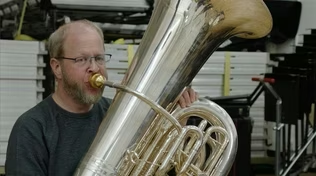
Let's hear a bit about Steve Campbell, principal tuba, the Minnesota Orchestra, and what he has found fascinating about working on Wynton's concerto.
(energetic tuba music) - Hey, how are you?
Hey, can I get a breakfast sausage sandwich?
Thanks.
The role of the tuba in the Orchestra is multifaceted.
The main role is to be the support of the brass and the full orchestra.
(dramatic orchestra music) I know that I'm supposed to be a tuba player because I love playing the big fat, we call 'em footballs, whole notes.
And I love just laying down that carpet for the orchestra to sit comfortably on.
(dramatic orchestra music) Growing up in a musical family was very lucky for me that, you know, my dad being a band director and a tuba player, I knew that from a very young age before the mouthpiece would even fit on my face that I wanted to play the tuba.
I initially wanted to play tuba and be a band director just like my dad, but I fell in love with playing and went that route.
I do teach at the University of Minnesota and have taught pretty much my whole professional career.
And I think it's really important for musicians to pass the torch, so to speak.
The challenges of playing the tuba day to day when I go to the orchestra or I go to teach, I have soft case that you wear like a backpack.
People look at you funny and they ask you what, they ask you, "What's on your back?"
And I used to say, "It's my grandma," (energetic orchestra music) The sound of the tuba, in some pieces, you might not necessarily notice it's there unless you're really listening for it, but you'd definitely notice it if it was gone.
(energetic orchestra music) The tuba is what I like to call kind of a character actor.
You never know what you're gonna be asked depending on the composer, sometimes you're gonna be an extra horn, sometimes your fourth trombone, sometimes you're solo tuba depending on how the composer wrote for the instrument.
How the tuba works, it's just like all the other brass instruments, we have the mouthpiece and we buzz our lips, (mouth buzzing) buzz right through the mouthpiece and then the instrument, just like a trumpet, trombone, or French horn works as an amplifier.
(bright tuba music) It takes a lot of wind or air or breath to play the instrument.
So I do a lot of breathing exercises.
(breathing deeply) (dramatic orchestra music) So a lot of what we have to do is, especially if I'm thinking about being the foundation of the Orchestra, I need to have a straight and very steady tone.
(energetic orchestra music) I have to be able to change my sound, change the color of my sound to fit in with what's being asked of me by the composer.
(energetic orchestra music) The tuba that I played on the concerto is my F tuba, otherwise known as a bass tuba.
The F tuba has a little bit brighter sound and the contra bass tuba is just a deeper richer tone.
(gentle tuba music) A lot of the jobs that I do in the Orchestra calls for just this rich deep tone.
And so this is the instrument I use the most in the orchestra.
(gentle orchestra music) Our solo repertoire is lacking, although there is a lot of rep through other tubist in the country that have commissioned a lot of music.
But to put it in perspective, the first concerto I played with the orchestra several years ago, Ralph Vaughan Williams' "Tuba Concerto" was written in 1950.
And to have a piece written in 2021 by someone such as Wynton Marsalis is just a real honor and I'm really excited and glad to have gotten the opportunity to do it so soon after it was written.
(dramatic tuba music) Every movement is very storytelling.
They're kind of, I think of them more as like little pictures in time.
And the last movement is entitled in "Bird's Basement."
Bird meaning Charlie Parker.
So it's all bebop and that's a whole another language.
I've just been listening, listening, listening to Charlie Parker, Dizzy Gillespie.
And so that's been a real fun part of putting this together is becoming aware of musicians and music that I wasn't aware of before and just learning how to speak that language.
(bright music) You can really tell when a group is playing for you that they truly enjoy each other's company.
(bright music) The Uptown Brass with the members of the orchestra, it's Charles Lazarus, Doug Carlsen, Michael Gast, and Doug Wright and myself.
We've been together basically this for 18 years since I've been here.
When we started doing the common chords concerts, where we go immerse ourselves into a community like we just did in Austin, Minnesota, where chamber music groups will go out for three or four days, and then the full orchestra comes out and plays.
It's inspiring to perform because rehearsals are just rehearsals.
There is a different feeling to musicians when we play and when you know who you're playing for, that's really important.
(dramatic orchestra music) I think that people getting to know the musicians that we're just like anybody else, we just happen to do this.
I always like to say, and I remind myself of this, that I have the best seat in the house.
So I can sit there and just listen to my colleagues and I listen to the different lines, whether it's the violas, oboe, basses, or harp or even timpani, percussion.
I listen to what they're doing, (dramatic orchestra music) and they feed my soul with great music.
(dramatic orchestra music) (audience applauding) - The world of the Tuba is seen through the eyes of Steve Campbell.
So no orchestral instrument is more focused on breath than the tuba, simply because it takes so much breath to power such a large instrument.
To breathe is the first and last thing we do as humans and that is why there is such an inbuilt horror to the words I can't breathe.
The murder of George Floyd was the catalyst for our final piece in the program, "brea(d)th" the libretto considers bread as in value, breath as in life force, and breadth as in the radius of American promise.
Now I'm joined now by Jeanelle Austin, executive director of the George Floyd Global Memorial.
Jeanelle, will you come join us?
- Hi.
- Hey, good evening.
How are you today?
- I'm well.
Thank you for having me.
- No worries, welcome to Orchestra Hall.
- Thank you.
- And welcome to our audience out there in TV Land.
- Hey, friends.
(Bill laughs) - So how are you finding the collaboration between the Memorial and the Minnesota Orchestra?
What has this taught you?
What does this mean?
- Well, the George Floyd Global Memorial, we exist to preserve and conserve stories of resistance to racial injustice and we have an estimated 5,000 offerings or historical artifacts that we've preserved.
And last year, the Minnesota Orchestra invited us to exhibit during the concert series of "Seven Last Words of the Unarmed" And since that time we've been able to sustain and maintain a relationship that looks less like transaction and more like neighbors.
And so it's been a very beautiful relationship, and next week, we are going to invite them to George Floyd Square to perform "brea(d)th" All of next week, it's what we're calling Rise and Remember Ubuntu.
Ubuntu means I am because we are.
We want to focus on this, this idea of coming together and being together in community and celebrating.
Everyone is invited to come and pay respects, but also to experience Black joy and Black music and art and all the different ways that we express ourselves through art.
It's gonna be amazing.
In the space of origin where that piece was created.
- Excellent, excellent.
I might show up.
- Please do.
- Listen, I just curiosity, very quickly, can you give me an example of one of those exhibits that you have at the Memorial?
- Absolutely.
So right now we are exhibiting Voices of the Unheard.
We went into the classrooms of Anoka High School and the classrooms of Harvest Best Academy and we met with 120 students and asked them to pick the pieces of protest art that they connected with.
And now we have an exhibit at Chicago Avenue Fire Arts Center that have about 200 pieces of voices of the youth to say, these are the stories that I resonate with right now in this moment as I think about the fight for justice.
- Wonderful.
So the next generation is well represented.
- Absolutely.
- Excellent.
Now speaking of previous generations, you are a previous generation musician I've heard, right?
- Yes.
- So this resonates, so to speak, with you very closely.
- Absolutely, so I used to play the tenor saxophone.
I started in fifth grade and played through high school.
I inherited it from my father.
So he played the tenor sax and when he passed it on to me, he took on the alto.
- Oh, so there are musicians throughout your family?
Oh, yes.
- Wonderful.
Well, thank you so much Jeanelle for being here today.
- Thank you.
- I really appreciate you and enjoy this premier "brea(d)th".
- Thank you.
- Tonight, all right.
- Thank you.
- Thank you.
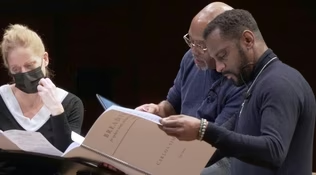
So not too long ago, composer Carlos Simon and librettist, Marc Bamuthi Joseph came to Minneapolis to do an early reading of their new work with the Minnesota Orchestra.
I served as conductor.
Hearing the piece for the first time was a powerful experience for many of us.
Let's learn more about the making of this world premiere.
(energetic orchestra music) - We had an amazing workshop reading of our piece, "brea(d)th".
This is a rare opportunity that composers don't usually get when you're commissioned.
Usually it's like you get the commission and then the premiere, and that's it.
(energetic orchestra music) - That's what you're looking for.
- Yeah.
- But with this particular opportunity, I actually got a chance to hear the piece before you know, (laughs) and it's great 'cause I can change stuff now.
(laughs) Do you want a little bit more rhythmic some action?
I see what you're saying.
- Correct.
- "brea(d)th" is a piece for spoken word orchestra and chorus that remembers George Floyd, the ancestor, thinks about American promise and yearns for an equitable American future.
It's a piece that is composed in four movements that follows an arc located in the word breath, B-R-E-A-D-T-H with the D in parentheses.
Breadth to mean bread as in give us this day our daily bread, breadth as in breadth, the sustaining force of life, and breadth as in the breadth of the promise, the breadth of the task.
Do you remember 2020?
Do you remember its breadth?
- This is not the first piece that I've written in response to the injustice.
In fact, I wrote my first piece in 2014, Trayvon Martin was murdered.
A piece called "Elegy," a car from the grave.
(gentle orchestra music) Years later to see George Floyd suffer these same injustices.
It just felt like, what are we doing?
It was hard for me to see, 'cause there was no progress.
It was actually getting worse.
(gentle orchestra music) So when the Orchestra asked me to write the piece, I almost said no.
I felt like I had done what I was supposed to do and it wasn't doing, you know, nothing was happening.
Then Bamuthi came into the picture and sort of gave me some spark of hope.
I think we could do something different here.
I think we can say something different other than focusing on this moment, the tragedy.
So hopefully, this piece says something different, and hope for change.
What's the breadth of the task- - Yeah.
- After this?
- We wanted to make a work that didn't kind of micro locate us in time or space.
One corner for 10 minutes in May of 2020.
We wanted to think about the breadth of an entire life and how that life fits in with the continuum of American lives and how those American lives intersect with a long history that goes back before Columbus, back before a constitution and extends forward beyond the rigors and the tragedy of the pandemic.
How does music serve as both an oracle and point of intersection but also as a bridge from a troubled American past to an aspirational American future?
- Bamuthi.
- Hi, man.
- Yeah, brother.
- Well, this particular project I knew that I wanted Bamuthi to be front and center.
Having him in front of the orchestra would give the peace something, give it life.
- Back to the wind so our spirit might hear it and vibrate amidst, incarnate and back again, reciprocal.
- The choir is important element here because he's saying small phrases that mean a lot.
So I wanted to use the chorus in a way that they accent or repeat those small phrases over and over again.
- It's also symbolically important.
Our artistic path encompassed the mining of experiences and expertise and training to codify and organize words and codifying and organized notes and melodies.
But the experiences that we were mining besides our personal biographies were also the experiences of the American community.
Maybe most specifically the community in the Twin Cities, but the global community.
It was one of those rare moments in time where we were all experiencing a thing together.
Yeah, there's power in having a community of voices, but there's also kind of symbolic consistency of having a community of voices participate in the ritual and execution of the music.
So it's also really important that this reading was open to the community and that so many members of the local community that inspired the work, people that we consider ourselves energetically accountable to.
Basically the landscape of stakeholders was present and was able to engage in the discovery of the work as we were making discoveries too.
Before the sun rose that day the corner was already cursed.
- The music and the word definitely struck my heart.
Definitely as a person of color in America and Minnesota.
It was very like heart wrenching and listening to everything.
- You know this is the thing that most of us have lived through.
Like not only the pandemic but the uprising and it feels like it was just all portrayed really well, really emotionally.
(audience applauding) - One of the things that we've been talking about is the lack of inevitability of any of our lives or of the direction of our country that people make the thing.
So you don't wanna just prepare yourself to listen 'cause there's a lot of like rich stuff to listen to, but I think you also want to prepare yourself to dream and maybe that's also what the work does is it invites collective and community dreaming of what comes next.
- I'm struck by something in the artist statement of the co-creators that they are asking America to consider an equitable future.
The making of and the reason behind "brea(d)th".
I have a personal connection with this subject.
The protests for social justice in response to the murder of George Floyd were my third set of uprisings.
I was in Miami 1989 and in LA 1992, and I could tell you some stories that you simply would not believe.
Then in 2020, what was the most frustrating thing for me was that I again found myself smack in the middle of social unrest that happened sparked by the same issues from 30 years ago.
Despite all the social progress over the ensuing decades, there remained and remains a stubborn portion of society that treats the concept of equality as an affront to their way of living.
The irony is that during the LA riots, I was a young conductor about to conduct the LA Philharmonic in a community concert in South Los Angeles.
I was struck by the incongruity back then as I am now and I even had an op-ed piece published in the LA Times, which I recently tracked down.
The depressing thing is that what I wrote then is still relevant today.
What is inspiring though is that there is another generation willing to make the same point today I tried to make 30 years ago, I just wish they didn't have to.
In their artist statement, Carlos Simon and Marc Bamuthi Joseph also write in part: Our commitment was to make a work that emanated from and responded to a local experience while recognizing the hollowing hope that vastly stretches across the body of African America.
In a moment, we will welcome the librettist and spoken word artist, Marc Bamuthi Joseph to the stage with conductor Jonathan Taylor Rush to conduct the Minnesota Orchestra.
They will be joined by the Minnesota Corral, Twin Cities Choral Partners, and the South African musical group 29:11.
The choral work is prepared by my colleagues Kathy Romey, Shekela Wanyama, and Brendon Adams.
This is the world premiere of "brea(d)th".
("brea(d)th") (audience applauding) ("brea(d)th") ("brea(d)th") ("brea(d)th") ("brea(d)th") ("brea(d)th") ♪ Give us this day ♪ our daily bread - We pledge co-llegiance to the facts that United States of America is racially healing in public.
So you could understand how some in this nation wonder.
God could dignity be afforded to all ♪ Give us this day ♪ our daily bread The breadth of the task the asking for bread, the expiring breath, The black odor of dread ♪ Give us this day ♪ our daily bread Give us this day respect for the breadth of the ask with an expiring breath he called for a dead woman several years past.
♪ Give us this day our daily bread ♪ Give us this day respect for the ghost.
♪ Give us this day And the murmurs of a man with a speck of bread singed like the Lord's prayer, singing in his chokeheld throat, sitting flat like a scar, sustaining like bread.
A grown man ticking like a trumpeter's fingers playing valves that only exist in his head.
The breadth of the loss and the bitter and the lonely.
The breath of a winded man whose allies have left to struggle alone.
Go homey.
Go on.
♪ Give us this day our daily bread ♪ Give us this day the breadth of repair, the breadth of the labor, the held breath of the witness watching life progress to death.
I too, am a witness, shook my head, tried to make some sense this miracle of political bread.
The manna that is the folklore of American promise and the breadth of our common belief in the premise of justice for all.
The falling breath (gentle music) of a man whose heart is failing.
The rising blood of a people with scotch tape and ancestral will keeping their American Hearts from breaking.
Breaking the breath, fasting with water and incessant prayer for bread.
Give us this day the breadth of what's due.
What would you kneel for?
Assume the posture of casual prayer, a genuflection while levitating buoyed by the neck of a man you are actively robbing of air, armed robbery of breath over some bread and the wide genocidal breadth of our country's racial timeline, our country's daily bread, our injurious history written enlightening, the animating factors that authorize violence.
Give us this day a shot at peace.
A day when you don't have to function, knowing the night before a young woman was state sanctioned murdered in her sleep.
Lord, the breadth of the task.
♪ Give us this day our daily bread ♪ Give us this day, one more breath, Lord, solemnly hear the underlying desperation of the ask.
Give us this day our bread enough to feed our ancestors when we pay them respect.
Give us this day the breadth of our American stake.
♪ Give us this day our daily bread ♪ ♪ Give us this day our daily bread ♪ ♪ Give us this day our daily bread ♪ ♪ Give us this day our daily bread ♪ Restore the debt of stolen breath.
(dramatic orchestra music) ("Breath") A soul to keep.
Breathe in relief.
The night is fruits.
The moon is sweet.
Take a piece.
Swallow the satellite beyond your reach.
The night is dream, but I'm not asleep, not woke, just awake.
I breathe in what I see.
I breathe in the night.
It smells strangely of fruit to me.
Breathe in the chemical shift when I walk by the police.
(dramatic orchestra music) The smell of all the probabilities played out on all of the screens.
Breathe in the scenes.
Breathe in the night and imagine the time you felt most free.
When in your life have you felt most free?
(dramatic orchestra music) I sing America's longest notes I sometimes forget to breathe.
When I do, my cultural differences haven't been tucked into the skirts of the queen.
I am free to access an infrastructure of hope.
Breathe in the night.
The moon is ripe with juice.
It smells like autonomy, smells like fruit beginning to bruise and rot.
Breathe in.
It's a lot.
Breathe out.
Let it go.
Imagine yourself living, knowing you only have one breath left before your soul.
Let's go.
Breathe in mortality.
It is an inevitability and as such, shouldn't one's last breath be made with dignity, but breathe in the idea that death is a lie.
That energy, not a human shell is the actual tell of a life.
Life is death as a vision, as a lived permission inception of an intuition of what to cosmically expect.
Life is just a set of lips to whisper, born to kiss our names back to the wind so our spirit might hear it and vibrate a mitzvah, incarnate and back again, reciprocal energy, spirit and flesh.
These words rolling off my tongue.
The first breath of afterdeath in my lungs after life.
I'll just go back to where I came from.
Breath is drum.
Breathe in, lights and smoke.
Breath is drum.
Breathe in the midnight sun where life never sets.
Breath is drum.
Ancestors know no death.
Breath becomes the way ancestors pay at the gates.
In heaven, breath is bread.
The first breath of afterdeath in my lungs after life, I just go back to where I came from.
Breath is drum.
Breathe in light and smoke.
Breath is drum.
Breathe in the midnight sun where life never sets.
Breath is drum.
Ancestors know no death.
Breath becomes the way ancestors pay at the gates in heaven.
Breath is bread.
(gentle orchestra music) (gentle orchestra music) (audience applauding) ("Elegy") ("Elegy") ("Elegy") ("Elegy") ("Elegy") ("Elegy") ("Elegy") ("Elegy") ("Elegy") ("Elegy") ("Elegy") ("Elegy") ("Bread") ♪ What does the night ♪ say to you ♪ Before you lay your head down ♪ ♪ Does the night confide its prideful truth ♪ ♪ Before the night falls ♪ Does the pride fall too ♪ Or does the pride ♪ of the night rise - Before it was a corner, it was a boundless plane that never considered the square edges of man's myopia.
Over time, the edges encroached and brought with them paper and value.
Before it was a constitution, it was a handwritten note presented to a native woman as legal tender.
She held it to the light, squinted twice and laughed at the myopic man who tried to pass a counterfeit bill.
(energetic orchestra music) Before the sun rose that day, the coroner knew.
Before the sun rose that day, the coroner knew.
Pride comes before the fall.
American avarice too.
American pride consumes like a starving cub, hungry for food, if not justice for all America then how do you choose who wins America?
Does somebody invariably lose?
Before the sun rose that day, the corner already knew.
The corner had seen it before.
The block knows before the news.
The block knows who America is likely to choose before the sun rises.
The night tells America's truth.
What does the night say to you before you lay your head down?
Does the night confide its prideful truth?
Before the night falls, does the pride fall too or does the pride of the night rise like a hand in salute?
What does the knight say to you?
Before you lay your head down, does the knight confide its prideful truth?
Before the night falls, does the pride fall too or does the pride of the night rise like a hand in salute?
Before the sun rose that day, the corner already knew.
Before the sun rose that day, the corner already knew.
(dramatic orchestra music) (dramatic orchestra music) Before there was a cost, there was bread.
Before there was socially determined health, we collectively cared for the sick and honored the dead.
Before there was qualified immunity The laws and loyalty to community provided enough force to protect the peace.
Before the man was taken for some bread, he had access to memory of sharecropping in North Carolina, of making music in church, of 13 sisters and brothers, of challenges with sobriety, of a life before the fall.
Before the fall, there was bread.
Before the sun rose that day, the corner was already cursed and blessed.
Weight of the body Wait for true equity Wavering feet Equally bruised legs Of course there is before Much has happened to us, but we, the people are more than ill will be done our kingdom once was and shall come.
Give us this day our bread.
Before the fall came a duty to keep our ancestors fed.
What is the equity owed to the people before American bread The people for whom the parchment of American purchase is counterfeit.
God bless American bread and the hands that have prepared it.
May the bounty be baked into 24 demands, seasoned by 2,000 seasons true to our native land.
Before the sun rise tomorrow, may we feast on the bread that bought us one more day to try to get it right.
May we feast on the bread that bought us one more day to try to get it right.
- May we feast on the bread.
- To get it right.
- May we feast on the bread that bought us one more day.
- May we feast on the bread that bought us one more day.
to try.
- May we feast on the bread.
- To get it right.
(dramatic orchestra music) ♪ May we feast on the bread ♪ That bought us one more day ♪ To get it right ♪ May we feast on the bread ♪ That bought us one more day ♪ To get it right ♪ To get it right (dramatic orchestra music) (dramatic orchestra music) ("Breadth") ("Breadth") ("Breadth") ("Breadth") ♪ So much work has been done ♪ Who does the work that's still left ♪ ♪ So much work has been done ♪ Who does the work ♪ that's still left ♪ So much work has been done ♪ Who does the work ♪ that's still left The breadth of the tasks.
In 1619, Jamestown, enshrined a color-based American caste It took 244 years before Black people were enshrined a voting place in the franchise.
1868, the 14th amendment was ratified.
Jamestown to citizenship.
244 years in between 244 years from 1868 will be the second decade of the next century.
By the time there is a parity of Black enslavement and Black political agency, no one in this room will be alive.
And that is the breadth of the task.
To create the equal positive effect of that historical debt.
The debt of 12 generations of humans who were not permitted to be who they could have been, that is the breadth of the sin.
Caste is the infrastructure of our divisions.
It is our country's pre-existing condition.
If a person has high blood pressure, it's not a surprise if they suffer a heart attack.
Why are we surprised by the way law enforcement disregards the dignity of Blacks?
The breadth of the task is to make a future that remembers the breath of the stolen.
To think of joy as an economy to consider its theft with interest.
Consider the breadth of a man at the very end of a life.
He breaks no law that requires the death penalty but that is what he receives.
Consider at the time of his death there is a viral disease that literally sees no color, sees us for what we actually are.
As the same, as an interconnected species.
It took a blind organism to make the planet stop, and notice the breadth and depth and late spring carelessness by which American law presides over Black death.
The breadth of a life.
The breadth of the lives of folks on the block, who didn't have activist intentions and the breadth of the local activists who supported them with intention.
The breadth of our intention to learn the cost of the debt.
Our intention to earn back what was lost with his breath the breadth of the people who ain't out here for bread, who are healing the city who the city often forgets.
♪ So much work has been done The breadth of our intention to learn the cost of the debt ♪ Who does the work that's still left ♪ our intention to earn back what was lost with his breath.
The breadth of the people who ain't out here for bread who are healing the city, who the city often neglects Do you remember 2020?
Do you remember its breadth?
I found myself transported to the root of the American experiment.
Beyond anger, or grief, what led so many of us to gather in those moments?
What are the ties that bind us together?
The breadth of common hope that we could be better than this, that with clear eyed understanding of our social pathologies, there existed a pervasive doe eyed idealism underneath.
There was a reason why we demanded better of our country, because we collectively knew we were capable of better, that like a teacher's most gifted student after failing several critical tests, we collectively knew that we could be more accurately defined by our promise than by our failures.
The promise of what's possible That's the breadth of the task.
To make possible the breadth of the promise.
♪ So much work has been done ♪ Who does the work ♪ that's still left The promise of what's possible that's the breadth of the task To make possible the breadth of the promise.
(energetic orchestra music) (audience applauding) (audience cheering) (audience applauding) (audience cheering) (audience applauding) (audience cheering) (audience applauding) (audience cheering) (audience applauding) (audience cheering) (audience applauding) (audience cheering) (audience applauding) (audience cheering) (audience chattering)
Preview: S5 Ep6 | 30s | Brea(d)th by Carlos Simon and Marc Bamuthi Joseph, and Wynton Marsalis’ Tuba Concerto. (30s)
Creating Brea(d)th with Simon and Joseph
Video has Closed Captions
Clip: S5 Ep6 | 7m 4s | The creative partners behind the new piece brea(d)th discuss the process of their work. (7m 4s)
Principal Tuba Steven Campbell
Video has Closed Captions
Clip: S5 Ep6 | 6m 37s | Principal Tuba Steven Campbell discusses the tuba before performing Marsalis' Concerto. (6m 37s)
Providing Support for PBS.org
Learn Moreabout PBS online sponsorship

- Arts and Music
The Best of the Joy of Painting with Bob Ross
A pop icon, Bob Ross offers soothing words of wisdom as he paints captivating landscapes.











Support for PBS provided by:
This Is Minnesota Orchestra is a local public television program presented by TPT