Keystone Edition
Breaking Barriers, Building Businesses
5/13/2024 | 26m 59sVideo has Closed Captions
Laws around LGBTQIA+ protection vary statewide. What are your protections in PA?
Laws around LGBTQIA+ protection vary statewide. What are your protections in PA? What's it like being a LGBTQIA+ business owner? How can businesses foster an atmosphere of inclusivity?
Problems playing video? | Closed Captioning Feedback
Problems playing video? | Closed Captioning Feedback
Keystone Edition is a local public television program presented by WVIA
Keystone Edition
Breaking Barriers, Building Businesses
5/13/2024 | 26m 59sVideo has Closed Captions
Laws around LGBTQIA+ protection vary statewide. What are your protections in PA? What's it like being a LGBTQIA+ business owner? How can businesses foster an atmosphere of inclusivity?
Problems playing video? | Closed Captioning Feedback
How to Watch Keystone Edition
Keystone Edition is available to stream on pbs.org and the free PBS App, available on iPhone, Apple TV, Android TV, Android smartphones, Amazon Fire TV, Amazon Fire Tablet, Roku, Samsung Smart TV, and Vizio.
Providing Support for PBS.org
Learn Moreabout PBS online sponsorship- [Narrator] Live from your public media studios, WVIA presents "Keystone Edition Business," a public affairs program that goes beyond the headlines to address issues in Northeastern and Central Pennsylvania.
This is "Keystone Edition Business."
And now, moderator Steve Stumbris.
- Hi, I'm Steve Stumbris.
The landscape of business is ever changing, and that includes increasingly diverse customers, products, services, and entrepreneurs.
Yet, even today, there are many who do not feel welcome, or who are actively discriminated against in businesses, including many in the LGBTQ community.
Do you know what it means to be an ally, or the best ways to support your favorite LGBTQ-owned business?
If you have questions, you can email us at keystone@wvia.org, or tag us on social with the #keystonebusiness.
WVIA News Reporter Sarah Scinto discusses LGBTQ business in Northeast Pennsylvania.
(air whooshes) - [Sarah] In Northeastern and central Pennsylvania, a growing number of LGBTQ entrepreneurs are making their mark on the local business scene, contributing to economic diversity and fostering inclusive spaces.
Scranton, Wilkes-Barre, and the Poconos are seeing a rise in LGBTQ-owned businesses.
These businesses are not only owned by members of this community, they also offer safe spaces for the community to gather, connect, and celebrate their diversity.
Terminology for this community has evolved over the years, and the even more inclusive acronym, LGBTQIA+, is also frequently used today.
It stands for lesbian, gay, bisexual, transgender, queer or questioning, intersex, and asexual.
The plus represents diverse gender and sexual identities, and acknowledges that language is constantly evolving.
As Northeast Pennsylvania strives toward greater inclusivity, these businesses serve as beacons of acceptance and progress, demonstrating that diversity is not only celebrated, but also economically viable in the region.
For more resources for the LGBTQIA+ community, head to wvia.org.
For "Keystone Edition Business," I'm Sara Scinto, WVIA News.
- I'd like to introduce our panelists here to share their perspectives.
First, Jacob Kelley is the CEO and founder of Mx.
Kelley Queer Education, LLC.
Next, Brianne Croteau is the CEO and lead consultant of Croteau Creative Strategies.
And Drew Popish joins us as the Northeast regional director from the office of Governor Josh Shapiro.
Thank you all for joining us tonight.
I want to remind our viewers, if they have any questions, please ask at keystone@wvia.org.
Drew, Bri, Jake, thank you so much for being here tonight.
I'm looking forward to this conversation.
I know we have already gotten off to a fast start.
And I'm sure that we will have a great time and also share some great information and education with our viewers.
Jake, I'd like to start with you as an educator.
Well, we heard Sarah talk about the acronym, and that has evolved a lot over the years.
Back in the '80s, it was LGBT.
And there's more.
Can you expand on that and help us like come to a better understanding of this broad community?
- Yeah, absolutely.
So I first wanna acknowledge that LGBT is the acronym that actually helps reflect diversity among sexual orientation, gender identity, and even sex or gender expression.
And within that, you know, there's lesbian, gay, bisexual, transgender, queer, even questioning, intersex, asexual.
There's other identities like pansexual, two-spirited, and others that are not necessarily fully represented in that acronym.
However, I think it's important to address why language is evolving, because even in history or queer history, there's an understanding there are other words that were used and derogatory words to hurt our community.
And our community is like, "No, we don't want that.
We are going to give the words that appropriately acknowledge who we are in ways that help us identify and use those languages to move forward."
And so when we see that expansion in this acronym, it's because we are continually evolving and understanding ourselves even more over time.
- Now, one of those words that's at times in that acronym and in the title of your business, queer, has been a pejorative.
Talk about how that is evolving, how some parts of the community embrace it.
Tell us more about that.
- Yeah, so I actually made a very conscious decision to put queer into my business and call myself a queer educator because I want to reclaim that power of queerness.
And it is not a negative thing.
Being LGBT or being queer is not a bad thing to exist within or to even represent.
And when I think about myself and my business, like, queer art forms have been a pivotal moment in my life, especially as a drag entertainer.
So queer, I didn't want it to be a word that we should shy away from or be shunned from.
And I do know that can cause some tension 'cause there are generations that think of the word maybe more negatively.
But I think for me, in my experiences, reaffirming, like, we're queer, I'm queer, I exist, I should be here, like, we're queer and we're here, like, that is just an understanding of what I want and how I want my business to be represented.
- Thank you very much.
- And I think that you had a good point.
Like, queer is sort of the collective, in a sense, or can be used as a collective.
So when you have the different, you know, identities and different parts of the acronym, to say, you know, "I'm part of the queer community" is, I think, a unifying thing.
- [Jacob] Mm.
Thanks.
- Bri, I've heard you speak in the business community about authenticity.
So authenticity, personal, professional, a business's brand being authentic to that of the business owner.
Can you talk about how that, well, especially relates to a queer business owner, LGBTQ, a member of that community?
As a business owner, talk a little bit about that authenticity, how to present.
- Sure.
I think that to me, anytime we can be as authentic as possible, it's just gonna be more successful.
It resonates better.
You have better connections with people.
Authenticity allows for vulnerability, connection, a trust, which you need even just as a brand, and you want, you know, repeat business.
People have to understand who you are.
They have to find some relatability to you and your values and your mission.
And then they have to trust that you'll be able to deliver it.
And I think the more authentic you are, the better that comes across.
Something we talk a lot about is the authenticity of being an ally, I guess we would say.
So especially in June, you see a lot of pride stickers, pride flags.
And I think there is a sliding scale with that.
On the more corporate side, like we talked about, I think there's a little bit more work that a company has to do to show that it is in fact an ally.
In the small business community, sometimes just putting a flag outside is a major, it's a major stance.
It's a statement, because small towns may not always be the safest place to do that.
So it sort of depends, I think, on where you are and how large of a corporation or business that you are.
'Cause even just a small little flag could mean a lot in a small rural community.
- So a large corporation putting that on their national ad campaign for June 1st for Pride Month can feel disingenuous, but seeing that- - Without something to back it up.
Without real effort or connections or collaborations with organizations or charities or, you know, just general missions to help support and empower LGBTQ people.
- I think for me, in this type of conversation, if you're not authentic in why you are doing something or have the ultimate truth of what you are doing, if it doesn't arise with your brand, that organicness, that authenticness isn't there, and then it becomes performative.
And performative can feel fake, it can feel disingenuine.
It can literally have the opposite effect and exclude people because it doesn't feel real.
And we want it to feel real.
That's half of the reason why when we say we're living our authentic life, we're doing it unapologetically.
And at least as a business owner, that's what I want people to feel.
And so when I see corporations just put that flag up, I'm like, "How much does that actually connect with authenticity of your own brand and who you are?"
- Mm-hmm.
And I think it's risk too.
You know, to be a small entrepreneur or a business or, you know, be connected to, you know, a branch of a government and to come out and say, "I, you know, am an ally, or I am a member of this community," that's a risk.
That's a risk to your brand, to your just general being, because you just don't know how it's gonna be perceived.
Whereas, you know, you look at a larger corporation and there is a safety net.
You know, there's not even a person necessarily who represents that brand.
Whereas, you know, you have Jacob as the brand.
You know, so it's a very different risk situation, I think.
- I wanna talk about that in the context of Central and Northeast Pennsylvania.
Yes, it can be a risk for a small business owner to be truly authentic, to put that flag on their storefront in a community that may not be at a stage where it's ready to be welcoming.
Examples, observations of that from any of you?
- I think for myself, the empowerment of what a flag can do, or the symbolization, when I think about what harm can come from just being open and out, so to say, in that level.
Have I seen that here in Northeastern PA?
Yes.
Would I say that encapsulates all of Northeastern PA?
No.
So I do wanna make those two very strong right parallels, because what I have to say is just honesty.
But I don't just put a flag out.
Queer is in my business's name.
The work that I do is specifically around LGBTQA empowerment and training.
And so if someone is not fully ready to take the responsibility of actually stepping into wanting to accept people, wanting to understand people, and wanting to represent more than just a flag, but actually get to know the people, that is a risk, because discrimination happens, prejudices happens.
Horrible situations can come up and arise.
And I am not too comfortable right now to talk about what my personal journey has gone, but I can assure you that prejudice is out there.
And when you get some hateful emails and messages and reviews just for the simple fact of existing and not actually in the depth of what I'm doing, it speaks.
It speaks.
- Yeah.
Yeah.
- And, I mean, I notice, I'm sure all of us can say, you know, if you drive through a town, and it doesn't have to even be in here, but any town, and I see a flag, it's a statement.
It's a statement of support, one way or another.
And if I'm driving through and I see businesses and homes that have some kind of, you know, pride-oriented flag, and I will say most of the ones I see are probably allies.
Because it is a little easier for someone who's an ally and doesn't have that personal connection to put a flag up, especially if you're an older generation that, you know, you did not come up feeling entirely comfortable broadcasting, you know, your identity to people.
But when I see those flags, it definitely creates a sense of, "Oh, I feel safe enough here.
I think I might wanna get out and explore."
Which then directly affects the economics of the downtown 'cause I'm gonna come in, I'm gonna stop, I'm gonna get my family, we're gonna walk, we're gonna shop.
Because it feels like a place where anybody is included, not just me.
But this is a welcoming space, and that is important.
- And I love how that actually can translate to good business.
It just can make economic sense to be welcoming and inclusive in your business.
Now, Drew- - We do shop.
We do shop.
We shop as well, just like everyone.
(laughs) - Drew, I wanna bring you into this conversation.
Please, please.
So you have perhaps an even broader view, involved in state issues, coming from the governor's office.
One thing that I thought was interesting is that Pennsylvania has a commission on LGBTQ affairs.
Can you tell us about that?
What kind of issues, what kind of initiatives are you involved in and is that commission involved in?
- Sure, I would love to.
So the LGBTQ+ Advisory Commission, it was established in 2018 under Governor Wolf through an executive order.
And then in June of 2023, it was reestablished under Governor Shapiro.
And that advisory commission, what it is, in simple terms, is it is led by an executive director, Ashleigh Strange.
And they are doing a phenomenal job.
And they work day in and day out, I mean, around the clock, working with all different representations of the LGBTQ+ community.
Hearing all different issues that they face, and, you know, whether it's positive things or also negative things, and how they can establish a better connection with the governor's office.
'Cause it is an extension of the governor's office.
And then what Ashleigh does with all the information that she gathered, I'm sorry, they gather, is prepare almost like a policy-like briefing for the governor.
And it gets to inform how to make policies that will actually better enact real change for the commonwealth and LGBT community.
And we also have many other advisory committees, but this one was just established in 2018.
And the work they're doing is pretty, it's pretty eyeopening, even for me, you know, as a gay person,.
You know, I'm pretty ignorant to a lot of things, because if you don't face something head on yourself, you might not know about it, right?
And so just talking to the executive director and just hearing the different things that are happening, it's very eye-opening for me.
And all of this is an educational lesson for me.
Just being here today is an educational lesson for me.
Just hearing both of you speak so eloquently about what you're doing in the work and why it's so necessary and so needed.
I think it's so important because a lot of times I think there's a difference between hateful discrimination and just ignorance, right?
And a lot of times people are just ignorant.
And I find myself ignorant at times with certain topics, especially when you were speaking to, like, pronouns, right?
It's hard for a lot of people to grasp that.
Now, to me, it's not.
Tell me what you want me to call you and I'll call you that.
Like, it's really that simple for me.
And at times, if you misgender someone, and it's not with malicious intent, and it's just a simple mistake, and they say to you, "Just so you know, my pronouns are they/them, he/him, she/her," whatever, then, from there, it's like, "Okay.
Now, thank you for letting me know, and I will make sure that I am cognizant of that."
But I think a lot of times it requires education, it requires work.
And sometimes people are afraid to educate themselves on certain issues because it requires self-reflection.
And sometimes with self-reflection, we don't always like what we find.
And I think that that's a super, oh, yay.
It's a super important thing to really, because I don't believe, I mean, I'm not a complete, you know, idiot.
I know that the hate's out there.
I know discrimination's out there.
But I do a lot of times think that some of it comes from pure ignorance.
They don't know.
But they have to be willing to want to know.
They have to be willing to wanna learn.
And that's a very important part of it.
- Yeah.
Like, it's almost asking, like, where's the effort?
And are you willing to put in the work and/or the effort into so simplistic ways of understanding someone that's different from you?
- Right, right.
- And a lot of times it has to be personal before that desire happens.
And I've met and talked to a lot of people who really just, I wasn't sure exactly what they wanted to talk about, but it ended up really just wanting affirmation and saying, "You know, I have, you know, a grandchild, I have, you know, a niece, a nephew, and this is what I'm doing."
And they just need somebody impartial to say, "Yes, you're doing well.
You're doing."
And that kind of starts the journey.
A lot of people don't wanna make a mistake and a misstep.
- Yeah.
And also, it leads into the consciousness of fear of when we're wrong, which is, in this case, would be a fear of offending someone.
I like to lean into someone with good intentions, that they are doing their best to respect me and/or others.
And so a lot of times when I'm educating, I'm finding out that individuals are just like, "I didn't wanna get it wrong.
I didn't wanna say something offensive."
But I always tell people, don't lean into your fear, then.
Don't lean into your fear of being wrong or even that reflective piece.
Lean into respect.
Lean into that, holding yourself accountable, that I'm going to put the work in to respect someone.
And the outcome changes, and then your mindset, and then how you approach these situations or approach people that you don't know.
Because it's not just the LGBTQA+ community that type of mindset effects.
It's all of them.
It's all the ones we're not a part of, whether that's related to your race or your age or your ability.
Like, the mindset of what you can learn from one community, you can eventually apply it to others as well.
- Yeah, I think.
- If you ask a name, you can say, you know, "Hi, what's your name and your pronouns?"
And you can follow it up.
Just as easy as that.
- It's not that hard.
It's actually simple.
- No.
- And speaking of also with education, there's so much education that needs to be, you know, we're responsible within our own community of learning too.
I'm a prime example of that.
I have so much to learn when it comes to our own community because I just do.
I mean, I'm only 35 years old, but when I hear the word queer, to me, it immediately stems to the '80s and '90s.
And I'm like, "Don't you dare call me the word queer."
But then understanding why it's necessary.
So now I'm comfortable with it.
You know what I mean?
I don't care.
But I'm thinking, if I'm a person within this community, and I'm hearing this word, and I'm confused, what is someone who's not in the community, who's not necessarily an ally, doesn't know someone in the community, what do they think?
You know, how do they process this?
But it takes education of our own community.
And that's a historic thing throughout our community there.
I mean, I remember...
I mean, I don't remember.
I wasn't there.
But I mean, even with Stonewall and in that whole movement, I mean, our transgender community was not allowed.
They were not invited to the party.
They were not invited to the movement.
And it was gay and lesbian.
It was something that was not welcomed.
And they had a fight to be a part of their own community.
That, to me, is like- - And history.
- Right, right.
So I mean, I think there's still so much work that needs to be done outside of our community, but within our own community, that we also have to support each other.
We have to support each other.
We have to not, you know, pin each other against each... You know, there's more than enough room in this commonwealth, this country, for all of us in this community.
- Well, I wanna give our viewers a chance to learn about another small business owner who is creating a space for community and how these spaces that welcome everyone are vitally important.
WVIA met with this entrepreneur who's making being inclusive and welcoming their business.
(air whooshes) (gentle music) - Inclusion is about us being a part of a community and belonging.
A sense of belonging.
I mean, there was a time, I'm 61, there was a time where this lifestyle was pretty much not even, we didn't wanna discuss it.
My family, when I was young, they're like, "Well, we don't talk about that kind of stuff."
Everybody here, there's a whole big inclusion here.
To me, that's what it's about for me.
Nobody's left out.
Everybody belongs here that comes through those gates.
We can't get enough of it.
If I get my partner to race up here to bring me up here, that's a good thing.
And he wanted no part of this when I first came here.
He does karaoke now.
He talks to people.
It's been a fun, fun past couple years.
(laughs) He drive me into it, but I've learned to enjoy it.
(laughs) (upbeat music) - Camp Out Poconos is an all-inclusive, 21-plus, members-only campground.
(upbeat music) Camp Out Poconos offers, you know, nightly accommodations, whether you're a tenter.
We have cabins that you can rent nightly or weekly or for the weekend.
Or you can just come and check out our campground for the nightlife.
Our entertainment covers every aspect, from live piano to singing, to karaoke, to live bands, a pop-up drag show, to sporting events.
And we'll be providing all the entertainment for the pride celebration in Downtown Stroudsburg.
- Well, I think it's important for people who identify as LGBT, they would have the opportunity to get out there and be in the community at a place such as Camp Out.
You know, there's a lot going on here that caters to the inclusivity and a supportive environment.
- Camp Out Poconos is all inclusive.
That covers everybody from gay, lesbian, bisexual, trans, gender questioning, whatever the case may be, and the allies.
As long as you're a friendly person and you have an open mind, you're more than welcome, and you'll certainly make friends here.
- I figured there's people from 21 up to 80 here.
There's different genders.
There's a little bit of everything going on here.
And there's just so much fun, so much to do here.
So many fun people.
I mean, people, if it's their first time here, if I see them alone, you know, you just make sure you go over and say hello.
And that's what everybody does here.
We just love this place.
I mean, this is home.
We started our home, and we feel we're safe here, and we just... You know, people will come and go over the years, but I'm glad to be a part of this.
And I just can't thank you people enough for what you've done for us.
Thank you, buddy.
- Thank you.
Thanks, Chuck.
- Thank you.
(air whooshes) - Well, Jake, coming back from that, we heard about Camp Out as a safe space.
How important is that?
And what's built into that idea of inclusion and a safe space?
- Yeah, so safe spaces is just about understanding how we create a trustworthy environment where people could just be who they are in both a psychological and physical realm.
And I think that business does exactly that, in how we shape language and empathy.
And so I know for myself, that is actually the reason why I started my business, to actually make mixed queer education a service that educates people so they know what they're doing, they know how to grow specifically to make their own business LGBTQA inclusive and/or their own understanding of more around what queer education can be like, much like what we talked today when someone asks, you know, they need education.
Well, there is a literally business that helps this specific education out there.
(laughs) So.
(group laughs) - Bri, I know your creative work and your professional work has come together in, well, creative arts and performing arts.
Talk about that as part of what the LGBTQ community has brought to the world.
Creativity, artistic expression.
Why is that an important part of the community and part of your business and your professional activity?
- Sure.
I think, you know, diversity/inclusion is good business in general, because the more people you can pull together, get ideas, make connections, educate.
I mean, the arts is a lot about education.
We just sort of mask it in this immersive experience.
And I think from a safe space point of view, the creative arts and sort of these creative spaces, especially in small towns, is where that starts.
There is an openness.
The creativity, the culture is really sort of the genesis of where a lot of this stuff comes from.
And that's also where you spin off and you have small creative entrepreneurs, and they kind of build out into the downtown infrastructure.
So I really encourage people of all ages to come to as many events as possible because that's where we build this awareness.
- Do you have any drag shows that you're organizing coming up?
- We might have a few.
A few collaborations in the works.
- A few collaborations in the works.
I look forward to that.
Drew, briefly, you've seen a lot of change in public policy in your years as a public servant.
What are one or two of the high points that have happened?
- Sure.
Yeah.
I mean, well, I also want to add, before I even get into this.
So in 2026, we are upon our 250th anniversary of our country, right?
2020 there was a Supreme Court ruling that a business owner cannot discriminate against, you know, an employee based on their gender identity or whom they choose to love.
In 2020, that's what it took.
There's still no law on the book in the State of Pennsylvania right now that prevents discrimination when it comes to housing, when it comes to public transportation and public access.
And right now there is a piece of legislation called the Fairness Act, and it's House Bill 300.
And it passed in the House of Representatives, and the governor is asking that the Pennsylvania Senate passes this bill and gets it to his desk so he can sign it into law so we don't have discrimination, and we have an actual law protecting LGBTQ people instead of proposing laws that hurt them.
- Thank you very much.
I'd like to thank each of you- - Thank you.
- for being here as a panelist tonight.
I'd like to thank our viewers for joining us.
For more information on this topic, please visit wvia.org/keystonebusiness.
Remember, you can watch this episode anytime online or on the WVIA app.
I'd also like to thank a special advisor for tonight's episode, Holly Stumbris.
I'd like to appreciate you for being your authentic self in the world and sharing that with me.
For "Keystone Edition," I'm Steve Stumbris.
Thanks for watching.
(upbeat music)
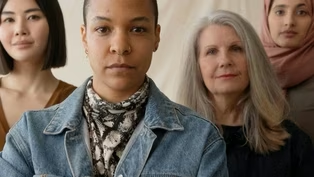
Breaking Barriers, Building Businesses - Preview
Preview: 5/13/2024 | 30s | Watch Monday, May 13th at 7pm on WVIA TV (30s)
Providing Support for PBS.org
Learn Moreabout PBS online sponsorship
- News and Public Affairs

Top journalists deliver compelling original analysis of the hour's headlines.

- News and Public Affairs

FRONTLINE is investigative journalism that questions, explains and changes our world.












Support for PBS provided by:
Keystone Edition is a local public television program presented by WVIA