Breaking New Ground: Women of the Saginaw Valley
Breaking New Ground: Women of the Saginaw Valley
Special | 59m 49sVideo has Closed Captions
Hear the stories of pioneering women who fought for equal rights and broke the glass ceiling.
Hear the stories of pioneering women who fought for equal rights and broke the glass ceiling.
Problems playing video? | Closed Captioning Feedback
Problems playing video? | Closed Captioning Feedback
Breaking New Ground: Women of the Saginaw Valley is a local public television program presented by Delta Public Media
Breaking New Ground: Women of the Saginaw Valley
Breaking New Ground: Women of the Saginaw Valley
Special | 59m 49sVideo has Closed Captions
Hear the stories of pioneering women who fought for equal rights and broke the glass ceiling.
Problems playing video? | Closed Captioning Feedback
Where to Watch Breaking New Ground: Women of the Saginaw Valley
Breaking New Ground: Women of the Saginaw Valley is available to stream on pbs.org and the PBS app.
Local production scene on Delta College Public Media are made possible with support from viewers like you.
Thank you.
(calm music) - [Leslie] Since the beginning of time, women have been saddled with two roles in society, wife and mother.
Their inferior status left them without the rights and opportunities naturally granted to men.
- It's very important to know about women's history because, until just recently, history was, literally, that; it was his story.
- [Leslie] Despite the overall lack of support from the male population, women banded together and persevered, fighting for health, safety, and most importantly, equal rights.
- It was very important for women to gain equal rights.
Women were citizens of the country.
They contributed to the building of this nation.
- [Leslie] Women who settled here in the Saginaw Valley, standardized education and health care, and took the entertainment industry by storm.
They gained footing in the business world, busting through the so-called glass ceiling.
- The Civil Rights Act, that gave women freedom from discrimination, passed in the mid 1960s.
So, in the 1970s, women were increasing their gains on the legislative front.
We gained freedom from pregnancy discrimination, credit, equity.
In the 1980s, that continued, but also it began the more formal backlash against women's rights.
- [Leslie] Reaching the status women have today has been an uphill battle that they continue to climb.
Several women from here in the Saginaw Valley led the fight, breaking new ground and paving the way for women today, and in the future.
(classical music) - It has only been in the past few decades that the role of women has been a topic of discussion.
And while we can't highlight all the women in the Saginaw Valley, there are some who have made a significant impact.
Most of what we know about women who were the first to arrive here, comes from their own journals and diaries.
(flute music) It was believed by Native Americans that woman was created to share the burden of man.
According to journals kept by early missionaries, Native American women cleared and planted farm fields.
While the crops were growing, the women and young girls were charged with keeping the fields free from weeds.
Men were in charge of hunting.
And women were tasked with making clothes and cooking.
- The role of women is to get married, have children, raise them, and, of course, outside the home, we didn't work.
Men of that time went out and fished and hunted, and went out in the forest and tried to make a living for their families.
- [Leslie] When European men arrived in the Michigan territory, it was Native American women who helped them adapt to the wilderness.
Over the years, their roles have changed, but they are still well respected in the community.
- The role of women in our communities is that we are the carriers of the culture.
So, we know, we're pretty much groomed from birth that, not only should we be able to do things as we're learning them, but we should be able to teach them to others because it is our place to instill those values, our value systems, our arts, the foods, the dances, everything.
That we play that role of making sure that it's valued in the next generations enough that it's carried out by the others and that they are taught the skills that they, too, can do that.
- [Leslie] It was land agents, cruising for timber stands, who first came to the Saginaw Valley.
Along with them, they brought their wives.
These women documented their trials and tribulations in diaries and journals.
- Women who kept diaries, in my opinion and experience, were educated.
They already had a connection to the world beyond the home, because they were interested in the community.
- [Leslie] Azubah Jewett was one of the first white women to arrive in the Saginaw Valley.
In 1831, she settled in Saginaw County with her husband Eleazar Jewett, and established a home on Green Point, an area where the Saginaw and Shiawassee rivers meet.
Amanda Larkin's story is similar Amanda Larkin and her husband, John, arrived in Midland in December, 1852.
John Larkin was looking to make it big in the lumber industry.
Their first order of business was to build a house, which was a two-story log cabin on the banks of the Tittabawassee River.
It was reported that she had not seen the face of another white woman for months after her arrival in Midland.
- Amanda Larkin is important to Midland County history because she was one of the first people to come here when the village was established.
She and her husband, John, came here in 1853 and immediately knew that the village that they would found would have social issues.
Because of her background and her ability to look at the Midland community, and the Village of Midland, and seeing needs, she became very important in knitting the Women's Christian Temperance Union Society, which was an anti-drinking group throughout the nation.
Her two adopted children were actually the results of marriages and family situations that were horrific.
She brought those children into their own lives, she and John's.
They adopted them legally.
But she also fostered many children herself, and place children in other homes in the area.
She realized that if Midlanders didn't do it, who would?
- [Leslie] Life was not easy for pioneering women.
Myra Seely was born in New York in 1850.
Her family moved to Saginaw in 1867.
She met and married Edwin Parsons in 1871.
Myra's accounts of settling what is now Linwood, can be found in the book, "Recipe for a Community."
In here diary from 1883, Myra writes about surviving a cold winter.
- [Reader] "We fixed papers up to nearly all the windows "to keep ourselves and our house warm."
- Myra Parsons and her husband arrived in northern Kawkawlin township, before there was a village.
Their neighbors were scattered.
And the home they built was a bed and breakfast for travelers, so we have accounts of interesting people stopping by.
But, in time, she had seven children, most of them born without doctors, without anesthesia, in the house.
She always had in mind the larger community, partly, I think because of her education, which linked her to it.
We hae an extraordinary record from Myra on the development, almost day by day, of the Village of Linwood.
- [Leslie] The autobiography Mary Sagatoo wrote in her later years, told the story of her life on the Saganing Indian Reservation.
Mary had married Joseph Cabay, a Native American who was from the reservation.
Shortly after their marriage, Joseph died of tuberculosis.
Two years later, Mary married Peter Sagatoo, Joseph's cousin.
Much of the money Mary and Peter earned was used to build the Saganing Indian Church and minister to the people of that community.
It was only through her words that we know of the struggle she faced in the late 1800s.
- We need to keep the records be of the women writing about their experiences, so few have come down through history.
I think it's understandable that historians that to have the record.
We have to have accounts that go day by day.
- Imagine moving your family from a metropolitan area, where you had easy access to the comforts of life, to an area with nothing.
That's what early settlers who came to the Saginaw Valley had to face.
Many had to clear the land before even building a house.
And once the home was established, the next order of business, at least for the pioneer women, was educating the children.
People like Myra Parsons, who settled in an area where there was only a handful of residents, and who had been educated themselves, passed their knowledge onto their children within the walls of their home.
In a January 21st, 1884 diary entry, Myra Parsons wrote of the frustration of teaching her sons - [Reader] "I spent the evening teaching the little boys.
"Oh, the perversity of the little heads that won't learn, "won't remember what I tell them."
- [Leslie] The following year, a schoolhouse was built in Linwood, providing children of the area a much needed place to learn.
- I think the peak in Myra's life was the Linwood School.
Her family gave the land.
She was the architect of the building.
The teachers, she hired.
The textbooks were picked by Myra.
She ordered school furniture.
And the big point, I think, about the Linwood School, it quickly became an extension for Myra's own living room.
Now, there was a Board of Education, but they stepped aside.
Here are men who stepped aside knowing nobody could do the job in education that Myra could.
- [Leslie] As schools opened throughout the Saginaw Valley, men and women were hired as teachers.
Even through they did the same job, they were treated much differently.
Men were paid, on average, $40.00 per month, women $35.00.
Men were allowed to marry and continue to work in the classroom.
But once a woman got married, her career was over.
By 1870, three of every five teachers in the classroom were women.
One of those women was Alice Freeman Palmer.
She was born in New York in 1855 Her first teaching job was in Wisconsin.
At the time, Saginaw was a booming, lumbering town, and was in need of a strong figure to make the school system sustainable.
In 1877, the Saginaw schools appealed to the University of Michigan for help.
To the surprise of the Saginaw school board, the university decided to send a woman.
Alice Freeman was moved and hire as principal of Saginaw High School.
She was paid $700.00 per year.
The man she replaced, who remained on staff, was paid $1200.00 that same year.
Alice Freeman Palmer left Saginaw in 1879 to teach Greek at Wellesley College.
Then, at the age of 26, Alice Freeman Palmer was selected to be President.
The first woman to be appointed to the job.
She remained President for six years, where she pushed her students and faculty to higher levels.
This college appointment was a turning point for all women in education.
While Alice Freeman Palmer was breaking ground in the field of higher education women in the Saginaw Valley were paving the way for better education for local schools.
Leola Wilson became involved in the Saginaw School District in the 1960s, when her children began going through the system.
Her involvement started with the Parent Teacher Association at Potter Street School.
When the Saginaw School system approved open enrollment, it was Leola's daughter who was one of the first African American students to attend Arthur Hill High School in 1968.
- One of the things that occurred when Rhonda was involved in integration of schools in Saginaw City.
And her experiences at North helped her to be able to be pretty well adjusted by the time she was, entered 10th grade at Arthur Hill High School.
She was active.
She became involved in student council.
She ran into many problems because we were in our high school, at that time, and competition is always there, and it's even more so because of past history and associating along the color line.
- [Leslie] It was Leola's triplet sons who caused her to step up her involvement in education.
The need for a stronger learning environment for children with special needs became a goal.
Leola Wilson was appointed to the Saginaw ISD Board, where she remains active and is the liaison between the Saginaw ISD and the state of Michigan.
She was also one of the people who helped push for the establishment of the Millet Learning Center.
- Education is such a difficult issue for people to understand, because education leads to, can lead to, total integration.
Employment, housing, any issue you think about, education opens the door for that.
- [Leslie] Improving education for everyone was the goal of retired principal, Joy Baker.
Mrs.
Baker was the first African American teacher, and principal, in the Bay City School System.
But getting there wasn't easy.
She didn't get her degree until after the birth of her children.
- I moved back home to complete my degree because it was an achievement that was an expectation.
My mother was well educated, my grandmother, great-grandmother, and it was a family tradition that, not only the men were educated, but the women, also.
- [Leslie] Once she got into the school system, Joy Baker was there for the kids.
Mrs.
Baker retired from the school system in 2003, but continues to be active in the community.
She believes education is the key to success.
- One of the values in my life was from generation to generation, education and religion.
Those two were tantamount in our family.
You served God and you worked yourself silly in school in order to excel.
School was very serious, it was not a plaything.
- [Leslie] Changes continue to take place in all levels of education.
At the administrative level, it still remains a male dominated field.
The American Council on Education reported, in 2006, that 23% of college presidents in the United States were women.
Delta College President, Dr.
Jean Goodnow, is one of them.
Dr.
Goodnow accepted the position at Delta in 2005, the first time a woman has held the post in Delta College's history.
- I have always loved education.
And I think that's one of the reasons why I went into it, is because, as a child I loved reading and I loved school.
And so it made sense to me to pursue a profession in education.
I've had some wonderful teachers and instructors along the way.
Some of the major challenges that community college presidents face today, certainly evolve around resources.
It is much tighter than it used to be.
The challenge of sustainability, I think, in our world today, is something that is very important.
And to keep our curriculum updated to meet the needs of our evolving world.
- The formation of women's clubs was part of the educational and social process for ladies in the Saginaw Valley.
They discussed various topics and current events.
And some of those current events were social issues that impacted their community.
The need to take a stand also left women leading the charge for issues that they believe needed attention.
- Women's clubs in this area really got going at the end of the 19th Century.
And these would have been organizations that got together, for social reason, but also because they were one of the few outlets for women to show their knowledge and also to study, and to support culture in the area.
- [Leslie] Several organizations specifically for women formed throughout the Saginaw Valley.
They ranged from local groups to nationally known organizations.
While membership in many of the original clubs has declined over the years, other opportunities for women emerged.
- Women's clubs have changed quite a bit over the years because there are so many more opportunities for women now to be involved in the workplace, of course, or going to school and advanced education.
So, even though women's clubs have declined somewhat, there are still a lot of women's clubs available in this area.
- [Leslie] Whether they are part of a group or willing to go it alone, women have had to stand strong against social issues they feel need attention.
Sister Ardeth Platte came to Saginaw in the 1960s and helped establish St.
Joseph's Education Center, a precursor to today's alternative schools.
Providing a place for the under-educated wasn't the only path she traveled.
Her concerns about the city got her to an elected seat on the Saginaw City Council.
- In 1973, I agreed that I would run.
And I would try, mainly, to be a voice for the poorest, for the disadvantaged.
I lived on the Eastside community from 1966 to 1973, at that time, and I felt that I owed that to the people.
[Leslie] Sister Ardeth remained on the Saginaw City Council for 12 years.
Her passion for peace led her to form the Michigan Faith and Resistance Movement.
Protestors were deployed to to Wurtsmith and K. I. Sawyer Air Force Bases to protest the existence of nuclear weapons at the facilities.
Both bases eventually closed in the 1990s.
So, we felt deeply about the danger to the people of Michigan because they become key targets.
Secondly, because of the contamination from those bases that flow out into the Great Lakes, the biggest, the largest body of fresh water surrounding us.
- [Leslie] Sister Ardeth Platte continues to push for peace across the globe.
Her efforts have not pleased the government.
And because of a staged protest in Colorado, she spent two years in a federal prison.
In the Missile Silo Action, Sister Carol, Sister Jackie, and I, cut a lock on a cattle fence.
Then we entered into that gate and we cut another padlock on a missile silo gate.
We opened that up and entered in.
It was a very symbolic act; it was a liturgy.
We stood on the missile silo, we sang our religious songs, and we waited for the military to come so that we could tell them exactly what we had done, and what they should do in order to eliminate the threats of these nuclear weapons.
- [Leslie] Sister Ardeth's protest against nuclear weapons coincided with the efforts of Midland native, Mary St.
Claire.
Mrs.
St.
Claire was concerned about the waste that was projected to be generated from a proposed nuclear facility in Midland.
Her efforts to gain attention to the problems stretched over the entire Saginaw Valley.
- Mary St.
Claire was my mentor.
Mary St.
Claire worked with us women, and men, to teach us about nuclear power.
And so she brought us together, frequently, to teach us about what was going on in the building of the nuclear power plant in Midland, and what would happen to that building because it was built on salt caverns.
- [Leslie] During the construction, the nuclear facility, funded by then Consumer's Power, was found to have structural deficiencies and was costing three times the amount it was budgeted.
In 1985, Consumer's pulled the plug on the project.
Mary St.
Claire's efforts drew national attention.
- Now, her role in Midland history is a very controversial one, because she stepped against the grain of popular thought.
She was perceived as looking at ways to stop the growth of Midland, and those, I don't think were ever here intentions.
Her intentions were to provide a safe community for herself, her family, her neighbors, and friends.
- Proper care for the sick and injured was a challenge for those who settled in the Saginaw Valley.
And often someone who had been around doctors, and were willing to administer care, were called in for help.
Many of those who responded were women.
Elizabeth Rogers arrived in Bay City in 1837.
For 13 years, she was the only practicing physician in the area.
Myra Seely Parsons, who had helped establish the community of Linwood, often helped deliver babies and take care of the sick, until a doctor could arrive from Bay City.
As the population increased, and lumbering was a way of life, concern arose for those who were sick or injured.
It was the Daughters of Charity of St.
Vincent de Paul who established St.
Mary's Hospital in 1874.
With it, they brought the idea of early health insurance.
A logger purchased a certificate at the beginning of the season.
If they were injured in the woods, the man was guaranteed health care at St.
Mary's.
Over the years, other women in the Saginaw community continued to see the need for better health care.
Despite the doubts of their husbands, 24 affluent women formed Saginaw General Hospital in 1889.
The same events took place in other communities.
In Bay City, the Sisters of St.
Mercy established the first semi-public hospital in the home of N. B. Bradley.
Over the years, the hospital expanded rapidly.
The nuns ran Mercy Hospital for before it became part of Bay Medical Center.
Organized health care was late in coming to Midland.
Nora Porath is credited with founding the first hospital in Midland.
Her house on Gordon Street provided health care for the community.
Finally, in 1940, the community came together and decided to build a public facility.
The land where the hospital now stands, on Orchard Street, was donated by Grace Dow.
Mid Michigan Medical Center opened its doors in 1944.
Even though women were instrumental in making sure health care was available, their role in the system was that of a nurse, men were doctors.
Over the years, the gender gap has narrowed.
Men and women work the same roles.
Dr.
Stephanie Duggan specializes in emergency medicine.
My interest in medicine really developed out of a love for science.
My original thought was to become a veterinarian, but I realized that that would be my hobby and not my life passion.
So, when I decided to become a physician, I started looking at the physicians in town, and they were pediatricians.
And I said, "can I shadow you?"
And I was shadowing the head pediatrician, and he was asking me why I wanted to spend that long in school, it really wasn't necessary.
And if I like science so much, perhaps I'd wanna be a teacher.
Because he really felt that I had the qualities to be a really good wife someday.
And I listened, but I also felt I could be a good wife and a good physician.
- [Leslie] As the Director of the Emergency Department at St.
Mary's Towne Center, Dr.
Duggan also helps educate up and coming physicians.
Dr.
Duggan also overseas the education and care of her three children.
There's nothing to compare being a mom.
I was a career girl; nothing was going to change my career path.
And then my oldest daughter, Danielle, was born and I was a completely different person.
I didn't understand the impact having a child has on your life and what that does to your balance.
I was fortunate, in 2008, to be named the Michigan College Physician of the Year for Emergency Medicine, and, largely, that award is based on your community service, and anything innovative that you've done to help patient care in the Emergency Department.
I was the originator, but it did without the huge team in the Emergency Department to donate a book to every child 10 and under that comes to the Emergency Department.
- [Leslie] Dr.
Duggan is dedicated to her family, her job and her patients.
She believes women have really changed the face of health care.
- When we come to work, it's not that we expect to have everything laid out for us.
We are taught from the get go, as young kids, we're caregivers, we wanna help people, we wanna make things better.
We're taught to learn compromise not necessarily aggression.
It's very different.
No matter how we try and raise our kids, that message, I really believe, comes across.
And not only does the message come across, but that's part of who I am.
- [Leslie] Even though women make up most of the workforce in the healthcare industry, managing the operation was typically handled by men.
Over the years, women have risen to the administrative ranks.
Alice Gerard graduated from the nursing program at Delta College in 1978.
She joined Bay Medical Center and worked in the Coronary Care and Intensive Care Units.
She helped establish the hospital's Cardiac Rehabilitation Program.
- The Cardiac Rehab Center and Bay Regional Medical Center, when I was a staff nurse working in critical care, I thought that we had a deficit in being able to educate our patients in a formal manner.
So I asked the CEO, at the time, of the hospital to consider creating a Cardiac Rehab program so that we could educate our patients and exercise our patients a little bit better than we had been after they go home, after they've had a heart attack.
- [Leslie] While working those long overnight shifts, Alice Gerard finished a Bachelor of Science degree.
Shortly after completion, she became a nursing supervisor, where she was in charge of staffing the afternoon shift of a 494 bed hospital.
She moved her way up the ranks at Bay Medical Center, and on her way, obtained a Masters Degree.
- Pursuing my education was so important to me because my philosophy is that you should never stop learning.
And I actually teach that to my children, and to encourage all of our staff to become as educated as possible.
- [Leslie] The education has paid off.
Alice Gerard went on to be the Director of Nursing, and then Vice President of Patient Care.
In 2006, she was appointed Interim President and CEO of Bay Medical Center, and was given the post permanently five months later.
- I don't really consider myself a pioneer because I just do the best job that I can.
By the late 1800s, women made their marks in health care, business, and education.
Many earned a living and paid taxes, yet they still weren't allowed to cast a vote or hold political office.
It was women like Susan B. Anthony and Elizabeth Cady Stanton who traveled the country, leading the nation's women to lobby for that ability to vote.
- Elizabeth Cady Stanton and Susan B. Anthony were really the forerunners in the Women's Rights Movement.
They worked as a team, and I think it was important, that that showed that women could work together to accomplish something.
One was the writer, one was the person who gave the speeches.
They both came from different types of lives.
One had children, one was single But they worked together for a cause that was important to both of them.
And I think it showed other women that they too, could work on something that was important to them.
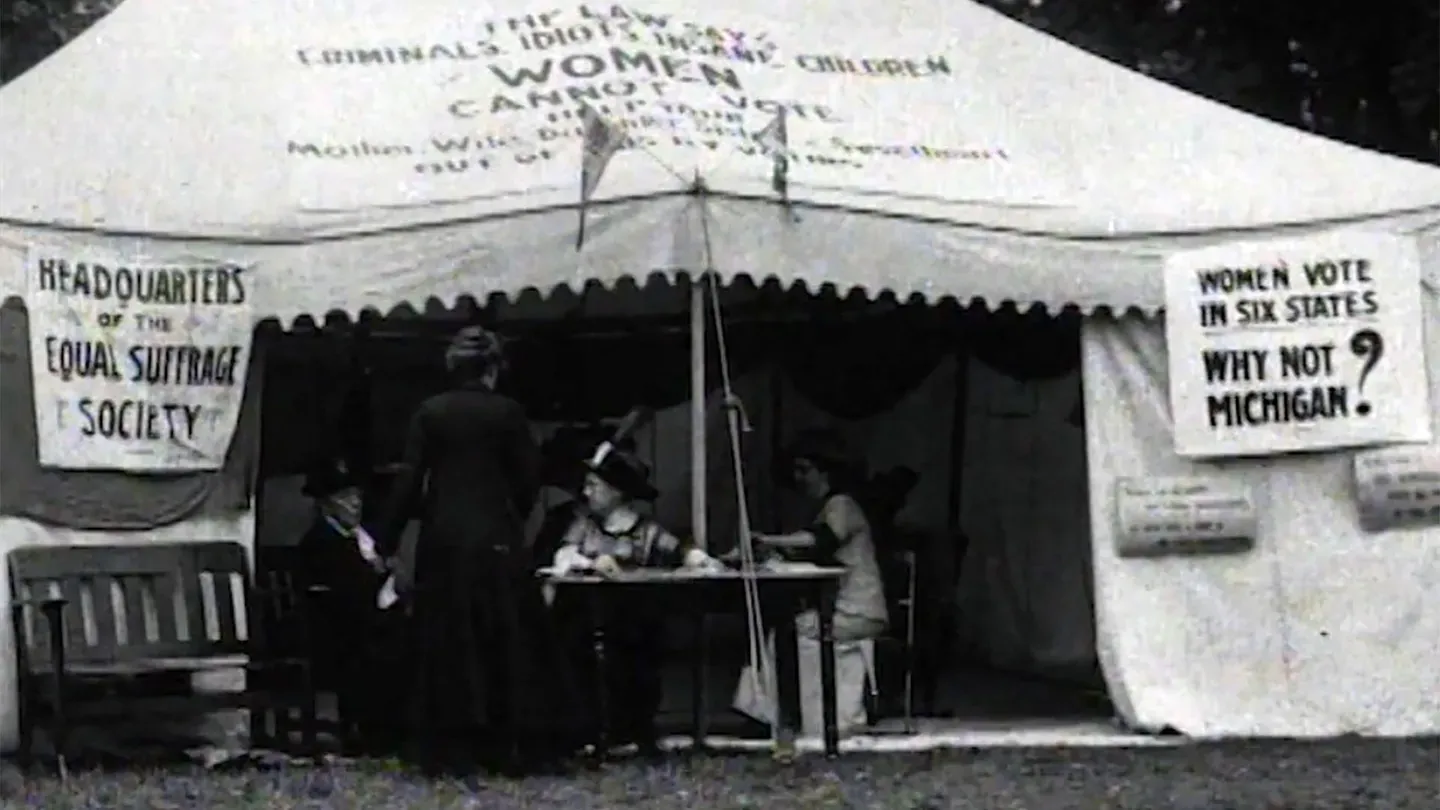
- [Leslie] In Michigan, the push came in 1870, when the Michigan State Suffrage Society formed at the Hamblin Opera House in Battle Creek.
Michigan women saw the defeat of the first equal suffrage amendment to the state constitution in 1874.
Following the loss, the State Suffrage Society waned with only local societies in existence across the state.
In 1884, those small forces converged in Flint and formed the State Equal Suffrage Association.
Mary Doe of Saginaw was instrumental in its organization and was appointed President.
Joining her in the fight for equal rights was friend, May Stocking Knaggs.
- May Stocking Knaggs became a statewide leader in the suffrage movement.
And May Stocking Knaggs was, of course, interested in extending the role of women in the community.
But the best way to ensure that was to see to it that women got the right to vote.
- [Leslie] By 1888, May Knaggs was appointed to the Bay City Board of Education, one of the first women to serve on that board.
- May would have wanted to be in a governance position because she knew she could do as good a job as any man in the office.
She probably knew many of these.
She very possibly had more education, general education, and attention to educational issues that at least would equal the men, if not be superior.
- [Leslie] In 1912, a push to put the Suffrage Amendment on the Michigan ballot was organized.
There were also groups looking to stop it.
The anti-suffrage movement was concerned that giving women the right to vote would lead to prohibition.
- This was such an emotional issue.
There was not regulation, at that time, of the liquor industry.
So liquor industry representatives would have been adamant in trying to slow down this movement because it effected their living.
- [Leslie] The 1912 campaign failed by 726 votes and women in Michigan had to wait.
By 1907, Michigan women who owned property could cast votes in tax related elections.
It was the issue of clean water that brought them to the voting booths in Midland.
The city wanted to construct a municipal system.
According to the Midland Republican, the water system was approved and 14 women, who were part of a local organization took part in the voting process.
And we know, from looking at the names, that these names include nine women from the Monday Club.
So, nine of the 14 were actually from the Monday Club.
And even though we don't have direct proof that they got together and talked about it, it's pretty clear that must have happened.
Because Midland only had a population of 4,000 people at the time.
As a result, two weeks later, 60 women voted on another issue.
And so this really did break the dyke for women in Midland to vote on issues.
- [Leslie] By 1920, every state in the Union had ratified the 19th Amendment, giving women the right to express their opinion in the voting booth.
They cast their first ballot in the November 2nd, 1920 presidential elections.
With the right to vote came the need for education.
Organizations, such as the League of Women Voters were established throughout the country.
- The League of Women Voters is a very important organization It was started right at the end of the 19th Amendment being passed.
So it is kind of the follow up group from that Women's Suffrage Movement.
And they do a lot of education of the public.
They really cover a lot of areas that are connected to voting and elections.
And they are very nonpartisan.
- [Leslie] Not only were women casting votes, they were also holding public office.
Audra Francis was the first woman to be elected to the Saginaw City Council in 1953.
She served on the council for 12 years.
Her career didn't end there.
Audra Francis continued to be active in the Saginaw community.
In 1972 she was elected Chair of the Saginaw County Commission, the first woman to hold that post.
Gaining equal rights for all people has been the goal for Leola Wilson.
Leola joined the NAACP in 1968, after Saginaw schools opened their enrollment.
Since then, she has continued to get involved with local issues such as fair housing.
- Probably my most unique contribution came about with Habitat for Humanity.
I was a case worker for a Department of Social Services.
And they wanted someone from that department to be involved.
One of the things Habitat led to, was at least being able to have decent, affordable housing.
- Leola Wilson is the President of the NAACP chapter in Saginaw.
In 2008 she was named Michigan NAACP President of the year.
And she continues to push for equal rights for everyone.
Someone made the statement, when they had a problem some years ago, and it was, if you remember, Mr.
King saying, "why can't we just get along?"
And, if we could understand, especially in our country, that equal rights hinders us from moving on and from being fair to everyone.
- [Leslie] It was the 1970s that saw a push for equal rights for all women, including in the work place.
The Equal Rights Amendment, which would have been the 27th amendment to the Constitution, passed both the House and the Senate in 1972.
In the first year, 22 states ratified the amendment.
Then the progress slowed.
Women opposed to the amendment began speaking out.
- I think two reasons why some women opposed the Equal Rights Amendment.
The first reason was fear.
Whether because that's the way they saw the world or because others in the conservative movement helped them to define the Equal Rights Amendment as something that would threaten their way of life.
The other reason was ideology.
Women such as Phyllis Schlafly, for example, a leader in the Anti-ERA Movement, was a conservative activist far before the Equal Rights Amendment.
They saw ERA, the Feminist Movement, the Women's Rights Movement, as being a part of the Liberal, or Progressive push to change the traditional way.
And they were doing very well under the traditional way.
- [Leslie] When Ronald Reagan took office and the equal Rights Amendment was taken off the Republican Party platform, Gloria Woods got involved with the National Organization for Women.
- I actually started being an activist before I became a member of the Women's Movement, and a member of the National Organization for Women.
But I did participate in demonstrations for open housing in our immediate area.
I was also a participant in the Anti-War Movement.
I was a peace counselor, a draft counselor.
And participated in some national demonstrations.
- [Leslie] Gloria Woods has lived in the Saginaw Valley all her life.
One of the things that concerned her, growing up, was the job market for men and women.
- I looked at these men wanted, women wanted jobs.
And I ended up getting a job at a fast food organization.
I worked for them for about three years while I went to Delta.
I did very well there.
I worked in a couple of different locations for them.
And as I sat for my exit interview, the manager was telling me how much he appreciated my work, how sorry he was to see me go.
It was a very nice interview, I felt very good about it.
And then he said something I'll never forget.
He said, "too bad you're not a man; "you'd make a great manager."
And, frankly, I was floored.
- [Leslie] The fight for equality continues for women across the country.
But things have improved.
- And I think the main difference that I see between when we were really pitching our battle for the ERA, which we ultimately lost, and today, I would say that the majority of the fears of both men and women who opposed the ERA have not come to fruition.
- [Leslie] In the world of politics women are making inroads.
In 2009, Michigan is one of the seven states in which a woman is governor.
Jennifer Granholm was the first female elected to the position in 2003.
Debbie Stabenow is one of 17 women in the United States' Senate.
Sometimes, one of the loudest voices in politics can be behind the scenes.
Margaret Rieker, who is known as Ranny in the Midland Community, spent 16 years working for the Republican National Committee.
Eventually she was appointed Vice Chairperson for the Republican National Committee.
One of her crowning glories during her tenure was bringing the 1980 Republican National Convention to Detroit.
- I think that maybe the Republican National Convention, in Detroit, was one of the best showcase events that Detroit has ever had.
Bringing the site committee in, looking at all of the things involved, hotels meeting room space, posts, everything that goes into it.
And obviously Cobo and the whole City of Detroit got involved.
I think it's important for everyone to get involved in politics.
But, probably particularly women because we have so much at stake And sometimes our needs are different from the needs of men.
Our interests and concerns are probably different in many cases.
I hate to talk about some kinds of gender difference.
But I do think that we tend perhaps, to look at some of the softer things as well as the hard things.
And we have to have that need for care and compassion as well as knowing how to read figures and make things work (laughs).
- [Leslie] After the 1984 election, Ranny Rieker exited the political arena and took on the challenge of running the Harry A. and Margaret D. Towsley Foundation, which was set up by her mother, and then the Herbert H. and Grace A. Dow Foundation which was established by her grandmother.
We look at the role of the Dow Foundation as being an element for change, that we try not to simply react, but rather to empower people to go on and make their lives better.
- Even in the pioneer days of the Saginaw Valley, women had played a significant role in the military, it wasn't easy.
They had to make their own way in a male dominated field of service.
One of the earliest roles played by women in the Great Lakes, were lighthouse keepers.
Lighthouses were built in remote areas to provide safe passages for ships.
The men in the Coast Guard who were in charge of maintaining the beacons were allowed to live in the facility with their families.
The sudden death of her husband made Catherine Shook the first female keeper in the Great Lakes.
She maintained the light at Point aux Barques in 1849.
Shook and her eight children took care of the light for two years before the Coast Guard replaced her.
Julia Toby Brawn assumed duties at the Saginaw Light Station in 1873, following the death of her first husband.
After marrying George Way in 1877, she was demoted to Assistant Keeper.
Julia Toby Brawn Way was relieved of her duty when the position was eliminated in 1882.
Over the years, women from the Saginaw Valley served in the military, mostly in the role of nurse.
- [Narrator] When speed meant life, evacuation took place by Plane.
Because of these flying hospitals, men are alive today who otherwise would have died in the jungles of Burma or on the beaches of Normandy.
Each patient was thoroughly checked before the take off, then watched over constantly, and checked again when the plane landed.
- [Leslie] The role of the Army nurse became even more important during World War II.
Lieutenant Aleda Lutz was one of the thousands of women who served as a nurse during the war.
Her specialty was flight care aboard the massive C47s which evacuated wounded soldiers to Army hospitals.
On December 28th, 1944, Lieutenant Lutz died when the C47 she was a passenger in went down, killing all on board.
She had flown 196 missions, evacuating over 3,500 men.
Lieutenant Aleda Lutz was the first woman to be killed in a military zone.
In 1945, a US Army hospital ship was named in her honor.
In 1988, the US Department of Veteran's Affairs announced a hospital in Saginaw would be named, as well, in her honor.
During World War II, over 300,000 women served in the Army and Navy in non-combative roles, such as clerks and nurses.
It wasn't until 1948 that women were able to enlist in military service thanks to the Women in Service Integration Act.
Today, 14% of all active military personnel are women.
Lieutenant Colonel Elizabeth Peters enlisted in the Army following her high school graduation in 1983.
- I decided to join the military after high school because, quite frankly, I had no place to go.
Once I completed Basic, I went off to my individual training school down in Huntsville, Alabama, for what is known as Explosive Ordinance Disposal, or the Army bomb squad.
- [Leslie] Following her specialized training in Huntsville, she was transferred to a unit in Europe.
- I arrived at the 75th Explosive Ordinance Disposal in Bremerhaven, Germany.
I think I was a little surprise to the unit members there, because I was the first female they had ever seen.
While they were surprised, they were not unaccepting.
It was just different for them because, primarily, EOD is a male dominated profession.
You truly don't see that many women that want to do the job.
- [Leslie] Following her service, Colonel Peters graduated from Saginaw Valley State University.
She also joined the Army Reserves.
Colonel Peters saw a stronger opportunity in the Michigan National Guard.
- I had heard rumors that there was a bomb squad unit opening its doors here at Camp Grayling, Michigan.
And back in 1987, I made some calls.
And once they found out they had a qualified bomb tech, they opened their doors and said, "come on up here.
"We need you."
- [Leslie] Lieutenant Colonel Elizabeth Peters has risen to one of the highest ranks in the Michigan National Guard.
It was hard work and dedication that led her to new opportunities.
- I got to this position because opportunity was provided to me.
And when those doors opened, I tried to enter.
And once I got into that next position, whether it was Captain, or Major I certainly had to work very hard, I had to prove myself, and I had to take care of my people, and my equipment.
And because I took care of people, the next door was opened - The woman's place, according to some, was in the home, but not all women had men to care for them.
They had to make their own living.
And jobs most suitable for women in the 1800s were caregivers, housekeepers, or teachers.
It took a strong woman to break out on her own and take on non-traditional roles in the business world.
Maggie Cunningham arrived in Midland in the 1860s.
As an orphan, she had to learn to survive on her own.
After working for a few years as a clerk, Maggie ventured out on her own.
- Maggie Cunningham is one of my favorite people in local history.
She was an early business woman, which was very usual for her day and time.
In the 1870s, she bought a hotel/ restaurant and renamed it Maggie Cunningham's Restaurant and Hotel.
She was a woman that was about four feet, by four feet, by four feet, according to local legend.
But she also had a lot of power behind her.
And when she would hear of families going through terrible circumstances, or maybe the spouse was beating up the rest of the family, or there was tremendous in-house abuse going on, she was known to just drive her wagon up to their house, break in the front door, grab the wife and children, fend off the husband who was ranting and raving, take that family back to her hotel, give them a place to stay, safely, and regroup.
Often she let them stay there for days, sometimes for weeks.
And sometimes she helped them move on in their lives to better circumstances.
And what Maggie Cunningham really did is start Midland's first home for battered families.
- [Leslie] Even though she had a PhD, getting a job in the chemical industry during the 1920s was a challenge for Sylvia Stoes - There was no job at that time for a PhD chemist who was a woman at Dow Chemical.
And Wesley, who became her husband, took Mrs.
Herbert Dow to church on Sundays.
And when he had the chance, he told Mrs.
Dow about his fiancee and that he wasn't able to marry her because there was no job for her in Midland.
The first thing he knew after that, was that Herbert Dow, himself, came to see him and ask about this lady to which he was engaged.
And said, "it's okay by me.
"You bring her here, you marry her, and we'll give her a job."
- [Leslie] Sylvia was the first female chemist to work at Dow Chemical.
Sylvia Stoesser's greatest achievements in the lab was her role in the development of polystyrene.
During her 11 years at Dow Chemical, Sylvia had her name on 29 patent At a young age, Dr.
Stephanie Burns had a goal to become a chemist.
In 1982, Dr.
Burns earned her PhD and went to work at Dow Corning.
In 2004, Dr.
Burns was appointed Chief Executive Officer at Dow Corning.
the first woman in the company's organization to hold that post.
It only takes one.
In this case, it took one woman to pave the way in the field of engineering.
Margaret McNally was the first woman to graduate from the University of Michigan's School of Engineering.
Following her graduation, she went to work for her father's contracting company, McNally and Hobeck in Saginaw.
During the construction of the Pennsylvania Turnpike, Margaret McNally was in charge of paving over 25 miles of highway.
Her photo appeared in a 1940 edition of Life Magazine.
War was one factor that brought women out of the home and into the workforce.
While men were on the battlefield, women were in the plants.
Michigan's Arsenal of Democracy put 140,000 women to work during World War II.
Saginaw's gun plant was just one of the many facilities converted to produce wartime materials.
Rosie the Riveters, as they were called, worked tirelessly.
But when the men came home from war, they went back to the shops, and women went to the home.
Those fortunate enough to stay in the workplace faced many challenges, including the lack of equal pay, and sometimes respect.
They continued to work on the assembly lines or get jobs in the front office as secretaries.
Rarely was there a woman in charge.
Barbara Mahar Lincoln took over Mahar Tool Supply Company at a time when women didn't run manufacturing businesses.
In 1978, Barbara's husband, whose father founded the company, unexpectedly died.
- After my husband's passing, when I assumed the helm of Mahar Tool Supply, I was amazed at how much I had learned by osmosis, just sitting around the kitchen table with family discussions on the business, time after time.
We also did a lot with our customers and our suppliers, and I was very surprised at how much I really knew and how many people I really knew.
But I had advisors who helped me for the first year and a half, or I would never have been able to do it.
- [Leslie] Mahar Tool Supply is an industrial distributor of metal removal products such as grinding wheels, sandpaper, and cutting tools.
Besides being in charge of a corporation for over 30 years, one of Barbara's biggest achievements was being chosen by the First Lady, to host a stop on the 2004 campaign trail.
- Laura Bush chose Mahar Tools specifically, because we were a woman-owned business who handled industrial supplies in Saginaw, Michigan.
- [Leslie] Even though Barbara inherited the role of CEO, she has established herself, and her company, as a force in the field of industrial supplies.
She feels it's important for women to continue striving to break through the so-called glass ceiling.
- The glass ceiling, breaking through that, is really important for women.
And the glass ceiling is a statement that actually came out in the '80s.
And they were using it specifically for women.
It's an invisible barrier.
But now it applies to all kinds of people in different walks of life.
- While she wasn't the first woman from the Saginaw Valley to make it big, Madonna stirred up the entertainment industry beginning in the 1980s.
But it was a woman from Saginaw who's unique style made her a big star during the age of silent film.
- Oh, don't talk nonsense.
There ain't gonna be no murder.
Not while I'm here to protect you.
- [Leslie] Marie Dressler was born in Canada, but her family moved to Saginaw in 1883, where her father was a music teacher.
She started acting at a young age and broke into the movie business in 1914 in the film "Tilly's Punctured Romance," playing opposite Charlie Chaplin At the time, she was called one of the all-time great comedians.
She was unlike any other woman of the time.
She was older and larger.
Marie Dressler once said, "I'm to homely for a prima donna, "and too ugly for a soubrette."
The day after her 63rd birthday, Marie Dressler won an Academy Award for her role as Min in "Min and Bill."
A year later, Dressler passed away from cancer.
Other women have left their mark in the world of arts.
Elaine Baker, the daughter of Bay City attorney, Oscar Baker, and the sister-in-law of Joy Baker.
After graduating from Central High School, she studied voice at Michigan State University.
- Elaine was a grande dame, entertainer, singer.
She had this flair for music.
And she wanted to be like Marian Anderson.
But they knew that in the United States there was only one Marian Anderson.
Her parents sent her to Julliard.
She had this beautiful voice.
But America wasn't ready for another Marian Anderson.
They had one, and that was enough.
So they sent her abroad to learn, to study music.
And she found that abroad, in Germany especially, they truly admired her and her voice.
And she was just magnificent.
- [Leslie] Irene Warsaw's writing talents were awarded with her poems being published in nationally known newspapers and magazines.
The Kawkawlin native also published two poetry books, "A Word in Edgewise," and "Warily we Roll Along."
Evelyn Shelagowski also grew up in Kawkawlin and started painting at a young age.
Her paintings have been exhibited across the country.
Many of her works can still be seen in Bay County.
The Saginaw Valley can boast some other ground-breaking events done by women.
Anne Edson Taylor shocked the world when she was the first person to go over Niagara Falls in a barrel in 1901.
Hilda Mueller made waves when she entered boat racing.
Hilda started racing boats in 1929.
Between 1930 and 1932, she had won two national championships and set nine world records.
- Women have been an integral part of history.
Oftentimes, their efforts were not acknowledged or recorded.
It wasn't until 1987 that a revolution to celebrate Women's History was declared for the month of March.
There are many organization which are looking to preserve the history of women and educate the public.
One of the first places in the nation was right here in Lansing, Michigan.
The Michigan Women's Historical Center opened in 1987.
It's also the home of the Michigan Women's Hall of Fame.
- We did our very first induction in 1983.
And since that time, we have inducted over 200 women.
That includes contemporary women women who are still living, and historic women.
So we believe that we have really returned to history.
- [Leslie] The Hall of Fame showcases many of the women in the state of Michigan who have made an impact.
Some of these women are not mentioned in the state history books.
Groups like the Michigan Women's Studies Association is making sure women are given equal time.
- Someone said, what would it have been like if women had been involved from the beginning?
Well, those of us who believe in this, believe the world would be much different.
And for me and for the rest of the Society it keeps them a balanced view of how our culture came into being.
That her story and his story went hand in hand.
- [Leslie] Even though women have made tremendous strides over the years to gain equal footing with men, some struggles still continue.
- We've got the right to vote.
We have better employment opportunities.
But we still don't have equal pay for equal work.
And there is still much work to be done.
- Women are not in the Constitution.
And as long as gender discrimination is not in the Constitution, then courts are free to interpret things very differently.
- I know that, eventually, men and women will have equal rights.
And I say that, not because legislation will be passed, but because as men and women grow together and continue to build our nation, they come to the realization that men and women have to have the same rights.
- What I want women to remember is to appreciate those that came before you, and the doors that they opened, so you can now have the opportunities.
- Women have to be leaders today because women have been graced with compassion, with the capacity for collegiality and participation.
We care about the circle.
- Women have encountered many roadblocks on the path to equality.
Over the years, those who have been determined to engage in change, have succeeded.
But the fight for fairness is not over.
It will take women and men who are willing to break new ground and ensure that all people are given equal status, not just in the Saginaw Valley, but around the world.
♪ Look at me now ♪ ♪ See how far I've come ♪ ♪ I still have a ways to go ♪ ♪ Remember where I started from ♪ Who am I now ♪ ♪ Am I the same or am I someone new?
♪ ♪ Makes no difference, I've got work to do ♪ ♪ I've only just begun ♪ ♪ Maybe I will never know ♪ ♪ The things I wasn't meant to know ♪ ♪ Somethings are simply not worth knowing ♪ ♪ That would only slow me down ♪ ♪ I can't let it hold me down ♪ ♪ I must get up ♪ ♪ I must keep going ♪ ♪ Look at me now ♪ Local production scene on Delta College Public Media are made possible with support from viewers like you.
Thank you.















Support for PBS provided by:
Breaking New Ground: Women of the Saginaw Valley is a local public television program presented by Delta Public Media