One-on-One
Brendan Somerville; Deborah Visconi; Jacquelyn Reardon
Season 2024 Episode 2728 | 27m 11sVideo has Closed Captions
Brendan Somerville; Deborah Visconi; Jacquelyn Reardon
Steve Adubato and Mary Gamba talk with Brendan Somerville, Co-Founder & COO of Oishii, about his passion for vertical farming. Deborah Visconi, President & CEO of Bergen New Bridge Medical Center, discusses the lessons learned as a woman leader in healthcare. Jacquelyn Reardon, Head of US Marketing, Franklin Templeton, talks about the findings of the Voice of the American Workplace Survey.
Problems playing video? | Closed Captioning Feedback
Problems playing video? | Closed Captioning Feedback
One-on-One is a local public television program presented by NJ PBS
One-on-One
Brendan Somerville; Deborah Visconi; Jacquelyn Reardon
Season 2024 Episode 2728 | 27m 11sVideo has Closed Captions
Steve Adubato and Mary Gamba talk with Brendan Somerville, Co-Founder & COO of Oishii, about his passion for vertical farming. Deborah Visconi, President & CEO of Bergen New Bridge Medical Center, discusses the lessons learned as a woman leader in healthcare. Jacquelyn Reardon, Head of US Marketing, Franklin Templeton, talks about the findings of the Voice of the American Workplace Survey.
Problems playing video? | Closed Captioning Feedback
How to Watch One-on-One
One-on-One is available to stream on pbs.org and the free PBS App, available on iPhone, Apple TV, Android TV, Android smartphones, Amazon Fire TV, Amazon Fire Tablet, Roku, Samsung Smart TV, and Vizio.
Providing Support for PBS.org
Learn Moreabout PBS online sponsorship- [Narrator] Funding for this edition of One-On-One with Steve Adubato has been provided by The New Jersey Education Association.
New Jersey Sharing Network.
Delta Dental of New Jersey.
Everyone deserves a healthy smile.
PSEG Foundation.
The Healthcare Foundation of New Jersey.
The Russell Berrie Foundation.
Making a difference.
The Adler Aphasia Center.
Community FoodBank of New Jersey.
And by The Fidelco Group.
Promotional support provided by NJ.Com.
Keeping communities informed and connected.
And by CIANJ, and Commerce Magazine.
- This is One-On-One.
- I'm an equal American just like you are.
- The way we change Presidents in this country is by voting.
- A quartet is already a jawn, it’s just The New Jawn.
- January 6th was not some sort of violent, crazy outlier.
- I don't care how good you are or how good you think you are, there is always something to learn.
- I mean what other country sends comedians over to embedded military to make them feel better.
- People call me 'cause they feel nobody's paying attention.
_ It’s not all about memorizing and getting information, it’s what you do with that information.
- (slowly) Start talking right now.
- That's a good question, high five.
(upbeat music) -Hi everyone, Steve Adubato.
Recently, along with my colleague Mary Gamba, who is the co-host of our series Lessons and Leadership, we had a compelling, interesting conversation with Brendan Somerville, who's the co-founder and COO of a company called Oishii.
They're involved in indoor vertical agriculture.
Fascinating stuff.
It's about agriculture, leadership, vertical farming, if you will, so interesting.
And I tell you what I learned a lot and I think you will too.
Let's check out One-on-One or one-on two in this case with Brendan Somerville.
Hi everyone.
Steve Adubato with my colleague Mary Gamba.
We kick off the program with Brendan Somerville, who is the co-founder and COO of Oishii.
And Oishii, tell us where that name comes from, Brendan and what it means.
- Oishii means delicious in Japanese and it describes our amazing strawberries and tomatoes.
- Now, describe the firm.
Because I called you an agricultural entrepreneur.
Is that a good description?
- I think it is.
So Oishii is an indoor vertical farming company.
We're based here in New Jersey.
We grow strawberries, some of the best in the world, at consistent quantity, quality, and price, pesticide free year round using revolutionary indoor farming technologies.
- Brendan, lemme ask you this, it's vertical farming.
What is vertical farming?
- Sure.
So for us it's actually indoor vertical farming.
So we grow indoors, which allows us to decouple from the outside climate.
That enables us to grow 365 days a year.
And vertical means inside of our farms we're able to grow many levels.
So unlike an outdoor farm that has just kind of one level on the ground, we're able to increase our yield through stacking levels indoors.
So it's much more space efficient.
- So Brendan, your background as a Marine, how did you pivot?
How did your interest go from being a Marine and doing that?
Where did this interest in the, because you also, it wasn't just strawberries and tomatoes.
Talk about the, you know, how you went from point A, point B and now to point C, - But Mary, hold on, it wasn't just the Marines.
Not that there's just the Marines.
He was an intelligence officer in the Marines.
So go ahead.
- Well, yeah, thanks for the question.
You know, the thread that I think ties everything together is being mission driven.
For me to have to have the why behind all of my work.
And in the Marines it was pretty clear, right?
It's service to country and also service to fellow Marines.
And agriculture technology, really the problems that we're solving are also bigger than ourselves.
So our vision is we want to create a future with sustainable, climate resilient agriculture.
So I needed to be able to have something that I'm deeply passionate about.
For transition a lot of people think the military and entrepreneurship are diametrically opposed, and in many facets I think they are, but they intersect in very important ways at the center of the Venn diagram.
I think it's, you know, working in a mission-driven organization, having to deliver against all odds in certain circumstances, and in many cases having much more responsibility at a more junior kind of age than you would in the private sector in both military and entrepreneurship.
So for me, the transition wasn't too difficult.
- But your passion for the military and Marine Corps is clear, you communicate that clearly.
But your passion for agriculture comes from where?
- Yeah, so, you know, when I was actually in military intelligence, I started thinking deeply about cause of conflict and what are civilizations fighting over today?
But also what are we gonna be fighting over in 100 years?
And the deeper I dug, the more conviction I had that food security, driven by a shifting climate, could be a major conflict driver of the next century.
So this was over a decade ago when that conversation around climate change and sustainability wasn't really at the forefront.
At that time there wasn't very many people delivering new technologies for climate resilient agriculture.
So I wanted to tackle a big problem and agriculture was one of the biggest I could find, alongside energy and water, of course.
- Good stuff.
- You're telling us you're an underachiever, then.
(all laughing) So obviously being a Marine, it's all about partnerships, it's all about teamwork.
But really your work and in co-founding Oishii and how you got here, talk about that connection between leadership and partnerships.
Because none of this happens in a vacuum or in a silo.
- Absolutely.
Partnerships are everything.
I think there's two principles that are critically important to a successful partnership.
One, the foundation is trust and integrity.
- Absolutely.
- This partnership, it's like your marriage, right?
You spend more time with your, you know, your business co-founder than you do your family.
And your reputation, your financial future, everything you're building is very closely entwined.
And the second is mission alignment, right?
You have to be very clear about what you're trying to build and all partners to be need to be on the same page.
So I'm lucky, my co-founder Hiroki and I had very purposeful conversations early on.
Were we looking to build a business that we would just, you know, sell very quickly or were we trying to build something for the long term that could create a paradigm shift?
And we both deeply trust each other to make the right decision for the business and not for ourselves.
- And before we let you go, appreciate your comments about trust and partnerships.
But also this.
Your experience in Uganda.
What was that?
Very quickly.
'Cause I was struck by that in your background.
- I started avocado and coffee companies working with small holder farmers in Uganda.
So this was kind of the opposite end of the spectrum from indoor vertical farming in that it was basically no technology.
And really my transition to indoor farming was based on the view that climate change was affecting our growing in these regions, plant disease as well, very quickly.
And my view was, you know, if these small holder farmers aren't gonna have a success in the future unless we build climate resilient agriculture.
So I turn that over to my local business partner on the ground.
I do believe that indoor farming, conventional farming, greenhouse farming, big farms and small holder farmers, we're all here trying to do the same thing, which is grow sustainable food and deliver a profitability while also doing that.
So I stay deeply connected to the entire agriculture ecosystem.
- Before I let you go, before we let you go.
Agricultural leadership, any different from regular old leadership?
- I think the principles really tie together nicely across the board.
For us it's one, leading by example, not asking anybody to do something you wouldn't do yourself, as a leader.
Second is building a culture of teamwork.
We call it one team, one fight, just like we do in the military, inside of Oishii.
And the final is as a leader being at the point of friction.
Identifying what are the challenges in your businesses and that's where you need to be as a leader.
So I think those principles, you know, stand in private and public sector.
- Great stuff.
Hey Brendan, I wanna thank you for joining us.
We appreciate it.
- Thanks, Steve.
Thanks, Mary.
- That's Brendan Somerville, co-founder and CEO of Oishii.
Good stuff.
Stay with us, we're right back.
- [Narrator] To watch more One on One with Steve Adubato find us online and follow us on Social media.
- We're now joined by Deborah Visconi, who's President and Chief Executive Officer of Bergen New Bridge Medical Center.
Deb, good to have you with us.
- Great to be here.
Thank you for having me.
- You got it.
We're gonna put up the website of New Bridge.
Tell everyone what it is and the work that you do, you and your colleagues do every day.
- So, Bergen New Bridge Medical Center, the largest hospital in the state of New Jersey.
We are publicly owned and privately managed.
We are a safety net facility serving the residents and communities of northern New Jersey.
We are 1,070 beds under a one million-square-foot roof sitting on 62 acres of Bergen County property in Paramus, New Jersey.
We have several distinctive service lines that set us apart from many of the hospitals and health systems in the area.
Most notably, we have a very large and prominent behavioral health and mental health service line.
We have a very large and growing and thriving substance use disorder service line.
We have a long-term care division, so we are able to take care of the aging community in our county.
And we have a very large and robust community health network as well as an ambulatory care enterprise that reaches throughout the county of Bergen and beyond.
- Yeah, let me ask you this.
And I also wanna note that Deb Visconi was identified as number two on the 2004 NJBIZ Health Care Power list, so congratulations on that, Deb.
- Thank you very much.
Thank you.
It's really a testament to the work of the team here at Bergen New Bridge, so thank you for that.
- Absolutely.
I often say in our leadership programming that all the credit, when someone at the top of an organization, when that credit gets pushed down, the blame and responsibility, Deb, always goes up.
I just wonder, is that true?
- Well, the credit, but it's really- - But the blame part we have to take as leaders.
- The blame, yes, the blame.
The credit goes to the team.
- Always, always.
Now, let me ask you this, I'm curious about your journey to this position to be the CEO of this very significant healthcare organization in these incredibly challenging times in the hospital and healthcare profession.
Your journey, describe it, how you got to this position.
- Well, I started my career in healthcare as a phlebotomist.
So, I was born and raised.
- Is that blood?
- Yes, that's the people who draw blood, the early morning people that come to your room in the hospital with a flashlight- - That's you.
(laughs) - That was me.
But I was born and raised in Brooklyn, New York.
I come from an underserved family, and one of the things that I saw firsthand growing up was the lack of access to quality healthcare in my community and in particular for our family.
And so I always had it in me to try to change the world to make sure that everyone had equitable access to quality healthcare.
That no one should suffer, be ill or die from not being able to get equitable access to care.
And so that's always was part of who I was growing up.
And so living in Brooklyn, growing up in that area of Brooklyn, New York, and then moving to Queens, eventually wanted to get into healthcare.
My mother wanted me to be a nurse.
I chose a different path.
I chose medical laboratory science, so I am a lab tech by clinical background.
I started as a phlebotomist.
Grew into the lab tech world.
Got on the bench.
Worked in a number of New York City hospitals as a bench tech in microbiology.
Knew that I wanted to continue to progress my career so that I can get to a point where I can make the most difference to the communities that I serve, and went ahead and got my master's degree in Health Administration and was armed in 1992 to take over the world with my new degree, and just grew my career through administrative ranks of serving hospitals in the New York region, primarily.
Eventually moving into the New Jersey market, focusing on service lines and growth and community access to populations around the hospitals that I worked in.
And eventually, I live in Bergen County, New Jersey.
I've been here for 29 years.
Raised my family here.
Eventually this opportunity presented itself to be the leader, the President and CEO of the county owned hospital.
And, you know, I looked at it, and it was presented as a transformational opportunity to take- - What does that mean?
What does that mean, a transformational opportunity?
- So, it had a bit of a sordid reputation.
It wasn't very well-regarded.
- There were real challenges.
- There was quite a few challenges here, yes.
And so the transformation was about making this into a destination hospital in the state of New Jersey and transforming this county asset into the asset that it deserved to be and that the communities deserved.
And so it went from, it used to be run by for-profit.
Now we went from for-profit to not-for-profit and went into creating an asset for everyone in our county and in the northern region of the state for anyone who needs access to care, anyone who needs access to quality care.
We are partners with a clinical affiliate of Rutgers New Jersey Medical School.
We work very closely with some community partners, Care Plus New Jersey and Integrity House, in delivering on that mission to be a destination hospital in the state of New Jersey.
- Deb, let me ask you.
It's so interesting your journey, and also the history of New Bridge before it was named New Bridge and before this transformational opportunity slash challenge came up.
But I'm curious about this.
Because you've been in the healthcare and the hospital world for a couple years, what would you say the most significant long-term impact of COVID was and is on the world of healthcare and hospitals?
- I would say undeniably it's the recognition that health disparities and unequal access to care was something that had always existed, but it was exacerbated by the pandemic.
And I believe that all of us as health leaders have had this responsibility to recognize that, embrace it, acknowledge it, and respond to it, and I think that has been transformative for the industry.
- Before I let you go, during COVID, the worst times, you remember people were celebrating our heroes in healthcare, nurses, physicians, other folks in the hospital community who were just putting their lives on the line every day, extraordinary heroes.
How did we lose that?
- You know, I think that we will always recognize the people who deliver healthcare to their communities.
We will always- - They're still heroes, whether people acknowledge- - They are still- - They're still heroes.
I'm sorry Deb, go ahead.
- They are still heroes, and we may not be standing outside banging on pots and pans and cheering them on, but the communities that we serve and the communities that need us recognize the heroic impact that the professionals have.
- You know, again, for those who act like when that happened in March of 2020 and those many months and years after, that somehow those healthcare heroes are not heroes, you're sadly mistaken.
And when we go into a hospital, you know what those folks do for us and our family members, and so they'll always be heroes.
And to Deb Visconi and your team at New Bridge, I wanna say thank you for your work.
Deb Visconi is President and CEO of Bergen New Bridge Medical Center.
Deb, thank you so much for joining us.
We appreciate it.
- Thank you, Steve.
- You got it.
Stay with us, we'll be right back.
- [Narrator] To watch more One on One with Steve Adubato find us online and follow us on Social media.
- Recently, along with my colleague Mary Gamba, on our sister series Lessons and Leadership, we spoke to Jacquelyne Reardon who's the head of US Marketing at Franklin Templeton.
They did a survey at Franklin Templeton.
It's called The Voice of the American Workplace.
It's a survey about what workers want and need, what their stresses are, what employers stresses, wants, and needs are complex, important stuff as the workplace in America changes by the minute.
at Franklin Templeton, a great organization.
Jacquelyne, great to have you with us, A and B.
A, and B, that promotion, that title, just happened As we’re taping yesterday, correct?
- It did, yeah.
They heard I was going to be on your show, So they said "there’s a promotion".
-That’s awesome.
Hey share for us not only your role, but Franklin Templeton, who has been a big part of our universe for a long time.
- Great, yeah.
Franklin Templeton is a global asset manager, and I have the privilege of leading our US marketing organization.
So we partner very closely with all of the distribution channels that work closely with financial advisors and investors to hopefully secure a better financial future for more Americans.
- And along those lines, to the 529 folks out there, our kids are going to school, college largely because of the 529 plan we established from the beginning when they were born through the folks at Franklin Templeton.
Talk to us, Jacquelyne.
This survey, it's called The Voice of the American Worker.
American Workplace, I'm sorry, Voice of the American Workplace Survey.
Who did you survey and what did you survey them about?
- Yes, so this is the fourth year we've actually conducted this research and we rebranded this year to Voice of the American Workplace.
So it used to be Voice of the American Worker.
- So it's workplace.
- Yeah, it's workplace now because for the last three years we've surveyed employees, and this year we've actually been able to add the employer voice as well.
So we partnered with the Harris Poll to conduct this research and it's really meant to check in with employees about key dimensions of their health, namely financial health, and importantly, identify some of the key resources and benefits that they need from their employer to create a better-- - Are you adjusting your camera, multitasking?
As you're on the air with us, that is so impressive.
(laughter) - I had a light about to fall so.
- That also shows why you're the head of US marketing.
But go ahead, so you talked to workers-- - And employers, exactly.
- What were some of the most significant findings.
- So as you can imagine, this year, it's so exciting that we have both perspectives because every single year we see that employees are stressed out, they're looking for more from their employers, et cetera, et cetera.
But this year we were finally able to compare the two.
So what are employers doing to help support employees and does that match up with what employees need?
And unsurprisingly, there's a disconnect, which is okay, there's some synergies, but there's a lot of misalignment.
And we're hoping that our research can really help highlight some of the key opportunities that employers can spend their next best dollar in the place that's gonna be the most effective for employees to seek financial independence, which that's one of the key findings we find, is that people are seeking financial independence more than they're seeking things like traditional retirement.
Saving for retirement is super important, but so is the full spectrum of financial needs like budgeting, saving for children's future education, creating an income stream later in life, healthcare costs.
So really approaching employees holistically and a more personalized manner to sort of meet their unique financial needs is the huge call to actions for employees today.
- Very important information, Mary, please.
- Yeah, and Jacqui, I had the luxury of looking at the report and we'll put up the website, right?
People can go and read the report, get the summary.
One thing that I was very surprised to hear about is pet insurance.
I'm a huge dog lover.
And I remember we were talking and I said, "wow, what other things were surprising"?
I mean, I wouldn't even think that an employer, and Steve, you and I are gonna talk offline.
Maybe we'll start providing pet insurance to the team members that we bring on board.
But what were some of the other surprises, Jacqui, that you have found from the survey in terms of what employees really want that maybe they didn't want 5, 10, 20 years ago?
- Yeah, I think the pet insurance thing stuck out to me as well.
I think what's not surprising, I'll start with that, is that everyone's stressed out.
The surprising thing are some of the things that employees are seeking.
So employees are absolutely stressed out.
96% said they have some area of concern, but all of their top concerns are financial.
So things like income, maintaining their standard of living, retirement savings, healthcare costs.
So it's not surprising that they're really looking to employers for a more diverse set of benefits.
To your point though, the surprising thing is things like pet insurance, 78% of people are looking for that, 84% are actually looking for student loan repayment assistance, which-- - Wait, how many percent for student loan?
- 84%, so.
- Wow.
- I know that's definitely something that we see in the news a lot.
And we get pings quite a bit for newsletters and webinars, et cetera.
So people are really focused on this whole concept of debt.
And unfortunately it's pretty robust when it comes to student loans as well.
We've done a couple deep dives in debt in our research in the past, and it's definitely a huge roadblock that's keeping many folks, specifically millennials from meeting other key financial milestones like retirement or buying a house, et cetera.
But the most surprising finding is that the number one benefit that people are looking for are personalized benefits.
So 85% of employees are looking for more personalized benefits.
So that's an interesting one because logistically how do we think about rolling something like that out?
How does an employer sort of deal with that and leverage.
But it's something really interesting, I think for us to collectively solve for in the future, so that people are only leveraging the benefits that make the most sense to them, and likely that's gonna, you know, increase the loyalty and retention that they have within their workforce.
- Yeah, lemme follow up on that.
So it's interesting, we talk about what workers, people who are on a team, what they're struggling with, what their wants are, what their needs are, you know, again, they're stressors if you will.
But those of us who are employers, and I'm proud to be someone who works with a team and have, you know, it's frankly the pressure, the responsibility of employing a significant number of people.
It's also a, it's a blessing, it's an honor, but sometimes it's not fun.
And sometimes there is stress and there is pressure.
So here's my question.
What did you find from quote unquote employers that they were struggling with?
Because some of us also struggle with retention of talented employees.
We struggle with, well, you want college tuition to be reimbursed or, but we don't know if you're gonna stay with us.
- Right.
- So then how much can we invest in you?
Well, not to mention balancing the books and making payroll every two weeks and providing all those benefits.
Long story short, what about us?
- Yeah, and it's a really stark picture as well for employers.
They've been dealing a lot with a lot the last couple years.
Like think about the great resignation and then we called it the Great Boomerang.
And it hasn't really gotten much easier since, to your point, they're dealing with turnover.
That's still a big concern.
But the biggest thing that they're dealing with is this increased expectation from their employees.
And we have a great quote in our research that says 82% of employers said that the workforce of today has insatiable employees that continue to ask for more and more.
And that's really challenging because I think most employers are doing their absolute best to align resources in the areas where they think are going to be the most effective for their employees.
But there's a misalignment there.
They're missing the mark and they're not putting the money against the things that are gonna meet, be the most meaningful from their employees.
I think the tough part about that too is you can build it, but will they come?
And there's a lots of employees who are saying, I don't even know that certain benefits exist.
I'm relying on things like email to find out about benefits, which we know is completely flawed.
And then ultimately, even if they know that those benefits are there, they're having trouble even understanding what that benefit is or what the value is to them from a monetary standpoint.
- Listen, employers, employees wants, needs, stresses, and we are ultimately all in this together.
I know that sounds like a cliche, but it's true.
and thank you so much to Jacquelyne Reardon who is the head of US marketing at Franklin Templeton.
We thank you so much for joining us and we learned a lot from just listening to you Jacqui.
Thanks so much, we appreciate it.
- Thank you so much for having me, Steve.
- I’m Steve Adubato.
Thank you so much for watching.
We’ll see you next time.
- [Narrator] One-On-One with Steve Adubato is a production of the Caucus Educational Corporation.
Celebrating 30 years in public broadcasting.
Funding has been provided by The New Jersey Education Association.
New Jersey Sharing Network.
Delta Dental of New Jersey.
PSEG Foundation.
The Healthcare Foundation of New Jersey.
The Russell Berrie Foundation.
The Adler Aphasia Center.
Community FoodBank of New Jersey.
And by The Fidelco Group.
Promotional support provided by NJ.Com.
And by CIANJ, and Commerce Magazine.
Hey, kids, PBS Kids and Delta Dental want you to have a healthy smile.
So here are some tips for you to remember.
Number one, eat plenty of crunchy fruits and vegetables.
Number two, brush your teeth after eating sugary snacks or drinking sodas.
And number three, drink lots of water to wash away food particles.
When your teeth are happy, all of you is happy.
From PBS Kids and Delta Dental.
Have a healthy smile.

The Findings of The Voice of the American Workplace Survey
Video has Closed Captions
Clip: S2024 Ep2728 | 10m 32s | The Findings of The Voice of the American Workplace Survey (10m 32s)
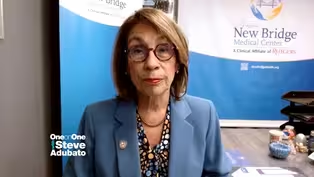
The Greatest Lessons as a Woman Leader In Healthcare
Video has Closed Captions
Clip: S2024 Ep2728 | 9m 29s | The Greatest Lessons as a Woman Leader In Healthcare (9m 29s)
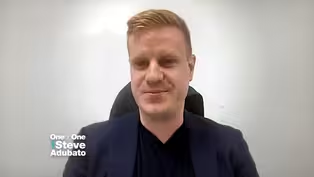
This Agriculture Entrepreneur Highlights Vertical Farming
Video has Closed Captions
Clip: S2024 Ep2728 | 7m 59s | This Agriculture Entrepreneur Highlights Vertical Farming (7m 59s)
Providing Support for PBS.org
Learn Moreabout PBS online sponsorship
- News and Public Affairs

Top journalists deliver compelling original analysis of the hour's headlines.

- News and Public Affairs

FRONTLINE is investigative journalism that questions, explains and changes our world.












Support for PBS provided by:
One-on-One is a local public television program presented by NJ PBS