
Brian Bridges, Ph.D.; Jade Duncan, D.D.S; Vincent Solomeno
8/26/2023 | 26m 23sVideo has Closed Captions
Brian Bridges, Ph.D.; Jade Duncan, D.D.S; Vincent Solomeno
Brian Bridges, Ph.D., NJ Secretary of Higher Education, addresses affirmative action and institutional racism; Jade Duncan, D.D.S., M.Ed., Director of Dental Services at Zufall Health, talks about dental hygiene for our overall well-being; Vincent Solomeno, Deputy Commissioner of Veterans Affairs, highlights the department's mission of providing quality care to veterans in NJ.
Problems playing video? | Closed Captioning Feedback
Problems playing video? | Closed Captioning Feedback
Think Tank with Steve Adubato is a local public television program presented by NJ PBS
Brian Bridges, Ph.D.; Jade Duncan, D.D.S; Vincent Solomeno
8/26/2023 | 26m 23sVideo has Closed Captions
Brian Bridges, Ph.D., NJ Secretary of Higher Education, addresses affirmative action and institutional racism; Jade Duncan, D.D.S., M.Ed., Director of Dental Services at Zufall Health, talks about dental hygiene for our overall well-being; Vincent Solomeno, Deputy Commissioner of Veterans Affairs, highlights the department's mission of providing quality care to veterans in NJ.
Problems playing video? | Closed Captioning Feedback
How to Watch Think Tank with Steve Adubato
Think Tank with Steve Adubato is available to stream on pbs.org and the free PBS App, available on iPhone, Apple TV, Android TV, Android smartphones, Amazon Fire TV, Amazon Fire Tablet, Roku, Samsung Smart TV, and Vizio.
Providing Support for PBS.org
Learn Moreabout PBS online sponsorship- [Narrator] Funding for this edition of Think Tank with Steve Adubato has been provided by New Jersey Institute of Technology.
NJIT makes industry ready professionals in all STEM fields.
NJ Best, New Jersey'’s five-two-nine college savings plan.
Delta Dental of New Jersey.
Everyone deserves a healthy smile.
PSE&G, committed to providing safe, reliable energy now and in the future.
The North Ward Center.
The Fidelco Group.
The Healthcare Foundation of New Jersey.
Wells Fargo.
And by Robert Wood Johnson Foundation.
Working for a more a healthier, more equitable New Jersey.
Promotional support provided by NJ.Com.
Keeping communities informed and connected.
And by Insider NJ.
[MOTIVATIONAL MUSIC] - Hi everyone.
Steve Adubato here.
I'm about to have one of the most important conversations about the current state of higher education, the future of higher education, with a gentleman who knows an awful lot about it.
He is Dr. Brian Bridges, New Jersey Secretary of Higher Education.
Dr. Bridges, thank you so much for joining us once again.
- Thank you, Steve, for having me.
I appreciate the opportunity.
- You got it.
When the United States Supreme Court made the historic decision to change affirmative action forever in this, well, not forever, at least for now, to no longer allow race to be a factor in considering admission to universities and colleges, your first reaction was, is?
- Well, Steve, thank you for the opportunity to answer that question.
We're collectively disappointed in the Supreme Court's decision.
However, while we were disappointed, we were not shocked.
This was not unexpected.
And many of us who've been in the higher-ed space for many years have anticipated this date coming at some point.
We thought it might be another five or 10 years away.
But we were disappointed, but not totally shocked.
- What does it mean from a practical point of view for universities and colleges in the state of New Jersey and across the nation?
Do you believe it'll actually mean when the courts say you can't use race explicitly, specifically, as a factor in admissions?
What do you believe it'll actually mean in our colleges and universities?
- The court has actually taken the country backwards and has jeopardized representation of historically underserved students on campuses across the country.
We know that this also will have an impact on the workforce pipeline for years to come.
And so, it's an unfortunate decision that will have ripple effects for many, many generations and will have an impact, not just on minority students and their families and communities, but on the nation and the economy here at large.
- Secretary, let me ask you this, this case or these cases brought before the United States Supreme Court on affirmative action brought by someone who happened to be white, believes that he represents a fair number of Caucasian parents concerned about this issue, and the Asian-American community involved as well.
What would you say to white and Asian parents of college-aged or soon-to-be, college-aged children who believe that the use of race as part of the criteria for admission to colleges and universities, disproportionately, they perceive benefiting students who are African-American or Hispanic, that it's unfair and discriminatory toward white and Asian students and their families?
You say?
- Well, I would say to that, Steve, is that unfortunately, the history of this country is, and higher education admissions in this country has been unfair for much of its history.
And the efforts of these affirmative action laws are designed to try to balance the playing field a little bit, so that those students can also benefit from participating in a more diverse environment with students from different backgrounds from themselves and allows them to be better prepared for the workforce and the society that they will work and lead in in the future.
So this is an opportunity to help, not only the students who will directly benefit, but the students who will also indirectly benefit by the presence of those other students as well.
- One more quick follow up to that, to those who argue that creating a discriminatory practice toward whites and Asians by disproportionately benefiting students who are African-American and Hispanic, that one effort at discriminate government or government-sponsored discrimination doesn't fix another one, you say?
- Well, I would say, Steve, that when you look at the numbers also that, you know, even with affirmative action in place, most of our most elite institutions still do not have representation of African-American and Latino students to their proportion of the population.
- Devil's advocate, if merit is the only, the primary criteria, grades, working hard, standardized tests, your grade-point average, all that, why would the enrollment figures, particularly at an elite institution, why should they mirror societies if in fact, societies, population, or demographics, if in fact those-- that's the criteria.
- Well, true as you know, that our society has not been based, not been fully meritorious in the way that things have been awarded to, whether it's contracts, whether it's funding in some shape or fashion.
So I'm not saying that.
- Institutional racism is alive and well.
- Yes, yes it is.
So I'm not saying that we need to actually have admissions criteria be at the level of representation in the population, but that those students get a little bit more of a chance to participate.
Otherwise, we will have an economy, as our society continues to become much more diverse, we will have an economy that is not able to fully function at a hundred percent capacity.
- Secretary, we'll continue that conversation on affirmative action with you and other colleagues in the higher-ed community.
Can we shift gears to student mental health?
A huge priority for you and your team in the state of New Jersey.
Talk about student mental health, and why we need to take it more seriously than we are and what we need to do?
Please, secretary.
- Well, thank you for that opportunity because the American Psychological Association has asked to convey that by every measure, student mental health has declined, not just since COVID, but even prior to COVID.
And in May, in New Jersey, thanks to a $10-million investment from Governor Murphy using Federal American Rescue Plan Dollars in last year's FY23 budget, in May, we announced the nation's first, statewide campus mental health initiative spanning both public and private institutions in order to help our institutions bridge the gap and serve their students around this much needed area.
- Up here in northern New Jersey, there's recently a merger that took place between, I don't know if you call it merger or not, Montclair State University, Bloomfield College of Private Entity, Montclair State, my alma mater, my undergraduate work.
They're a publicly funded institution.
The reason I'm asking this question is the economics of higher education.
Do you believe that there'll be more and more consolidation, mergers and ultimately fewer institutions of higher learning in the state of New Jersey and the nation because the economics are just hard to pull off these days?
- You're absolutely right, and congrats on being a Montclair grad.
You know, our country is going through a bit of contraction because the workforce is changing and evolving, and we're seeing some contraction in higher education.
Massachusetts alone, I've talked with the folks up there, they've closed 10 colleges, 10 private colleges in the last five years, and so in Massachusetts alone.
So I think more contraction will happen.
Actually, New Jersey's actually been kind of lucky given the number of institutions that we have, that we've not had more of that happening.
But I think the Bloomfield-Montclair merger is a novel concept.
You don't see that happen as often where- - No.
- a public institution acquires a private institution.
And so, I think that it is a model that other states might look forward to, look at moving forward, because I do think that we will see more of this.
The last five to seven years, there's definitely been an increase in the number of institutions that have closed or merged, or been acquired.
And I think that the Bloomfield-Montclair situation is a bellwether for what might come in New Jersey over the next decade.
- Mr. Secretary, every time you join us, you educate us about a whole range of important issues in higher education.
We look forward to continuing the conversation with you in the future.
Dr. Brian Bridges is the Secretary of Higher Education in the great state of New Jersey.
Thank you, Mr. Secretary.
- Thank you, Steve.
I appreciate it.
Anytime - You got it.
Stay with us.
We'll be right back.
To watch more Think Tank with Steve Adubato, find us online and follow us on social media.
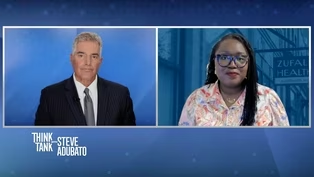
- We're pleased to be joined by Dr. Jade Duncan, who's Director of Dental Services at Zufall Health.
Good to see you, doctor.
- Good to see you too, Steve.
Thanks for having me.
- It's our honor and pleasure.
We're gonna put up the graphic, the website for Zufall Health.
Describe Zufall Health for everyone.
It's a very important organization doing really important work, please.
- Yes.
Zufall Health is a federally qualified health center in New Jersey.
We're in seven counties, and we have been around for just over 30 years.
I think this year will be our 33rd year of existence.
Zufall is here for our community.
We started as a volunteer clinic at one site, and now we're here.
- Yeah, and the dental services aspect of this, the oral health aspect of this, so incredibly important.
Talk about it, please.
- Yes, we believe oral health is primary care.
It's just as important as every other doctor visit that you have.
And at Zufall, we really do integrate care.
So when you come for medical, dental, we're all in the same location.
So that really makes it very convenient for our patients, and we really do value the importance of dental health in knowing that it can impact every other part of your body, and it's very significant.
- Doctor, talk about that.
We've done a lot of programming around oral health, and that whole description, it's not just oral health, but there are so many other health issues, medical issues, connected to our mouth.
Could you give us a couple of examples to make that more real for people.
- Absolutely.
So the mouth is literally the starting point of everything in your body, right?
But most importantly, the research has been happening around periodontal disease and heart disease as well as diabetes.
And we found that people who have uncontrolled diabetes, it presents in their mouth.
Some of the first signs of uncontrolled HIV when they go into AIDS status, it's shown in the mouth.
Signs of possibility of heart disease, again, starts with the plaque that builds up in the mouth and that could travel anywhere.
But most important thing, too, to note is teeth infections.
I think a lot of people just think they have a toothache, and it's not a problem.
It's connected to every single part of your body.
They're connected to your lymphatic drainage system, that those bacterias can go to any portions of your body.
It can cause heart disease.
We've had a big case in Washington, DC about maybe 10, 15 years ago, the Deamonte Driver case, where he got a brain infection, and he died because of an untreated tooth ache.
So yeah, it's a big deal.
- Doctor, access to quality, credible dental care for those of us who sometimes may take it for granted for ourselves, for our families, for our children, that is not the case in a whole range of communities.
Talk about it.
- It is not the case.
We have countless members of our community, especially here in New Jersey, and all over the country, where access to care is very difficult.
Not every state has a dentist office around every corner, but also not every state does as much as New Jersey does to make sure that there's affordable care, or access to affordable care, for a lot of these patients.
What happens is most insurance companies do not have dental for most of these, you know, underemployed individuals may not afford to pay these insurances.
So a place like Zufall is really, really important.
- For Zufall, I mean, for us, we're a nonprofit, grants, support financially from the corporate and foundation community is how we survive and do what we do.
How do you at Zufall?
- Oh, our partners have been phenomenal.
One of our biggest partners, Delta Dental, has been tremendous in supporting our efforts.
We have so many different community partners from private funders who have just been giving of everything that they can to support our efforts.
Delta Dental has been really supportive of two of our biggest endeavors, our Smile for our Heroes event, which offers free services to our veterans, as well as our dental assistant school, which also helps create access to the workforce to really help us solve some of these barriers to access the care.
- And to disclose, Delta Dental and underwriter of our healthcare programming, real quick on this, there's a shortage of dental assistance.
Correct?
- Oh, yes.
- What's happening in that area, please?
- That is a national problem, Steve.
So you can throw a rock at any dental practice, and they will tell you they are having a really hard time finding dental assistance.
I'm not sure.
- Well, what happens when that happens?
I'm sorry to interrupt that.
When that happens, what is the impact on dental patients?
- It's a huge impact, because as a dentist myself, I can't do anything without a dental assistant.
Dental assistants are the heart and life of a dental practice.
They keep everything moving.
They're in charge of everything from infection control, from sterilization, not just what you see them do side by side with your doctor, but they keep that office really happening.
And without an adequate amount of dental assistants available, it limits the amount of patients you can see, so that cuts down access, and it also limits the quality of care you can offer 'cause there are some procedures you just can't do without help.
- And what's happening in that regard to increase the number of, or the pipeline, if you will, of dental assistance?
Please, got a minute left.
- Yes.
Yes.
Well, at Zufall, we have a dental assistant program where you are trained on the job.
You come with no experience, no clinical experience necessary.
And we will teach you from day one how to become a dental assistant.
- Before I let you go, you love what you do as a dentist, as the director of Dental Services at Zufall Health because?
- Because I'm needed, and it's necessary.
And people need help, and I'm here to offer that.
- That is Dr. Jade Duncan.
She's the director of Dental Services at ZuFall Health.
We've had the website up for Zufall throughout this segment.
Find out more about the work they do.
They are a not-for-profit organization providing access to quality, affordable healthcare to all communities who experience barriers regardless of one's financial ability to pay.
Thank you, doctor.
We appreciate it.
- Thank you so much, Steve, for having me.
- You got it.
Stay with us.
We'll be right back.
To watch more Think Tank with Steve Adubato, find us online and follow us on social media.
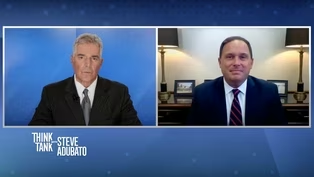
- We're now joined by Vincent Solomeno, Deputy Commissioner of veteran affairs, New Jersey Department of Military and Veteran Affairs.
Good to see you, Vincent.
- Likewise, Steve, thanks for having me on.
- Great, we'll put up the website for the department, and the work that you and your colleagues are doing.
Tell us exactly what that work is please.
- So, our job at the Department of Military and Veterans Affairs is to assist over 300,000 Garden State heroes and their families day in and day out.
In the last 12 months, we've had over 70,000 contacts with our veterans, our service members, and their families.
So, we help them get access to programs, services, and we provide some of those programs and services, and we're honored to do so.
- Talk to us, Deputy Commissioner Solomeno, about the most pressing issues our veterans in New Jersey and the nation are facing please.
- Well, I mentioned the services and the programs that our veterans have earned through their own service in the armed forces.
I see our mission.
And the greatest challenge for our Garden State veterans is connecting them with federal and state benefits.
In this year's state budget, which was recently passed, the governor and the legislature came together to increase the number of state of New Jersey veteran service offices from 14 regional hubs to one in each of our 21 counties.
And we view that as important, not just to get resources and programs to our vets and their families, but also as a great to bring back for the Garden State economy.
So, I see that as job one for the department.
But top of mind always is veterans mental health and resiliency.
And what we are doing, not just as a state government, but as a community to ensure that those folks are properly supported, and get the help that they need if they're in crisis.
- To what degree do you see the global pandemic that our country faced?
We're taping this toward the end of July 2023, 3 years plus well into it.
To what degree do you believe the pandemic exacerbated the mental health challenges of our veterans?
- Well, I think it certainly did.
When you think about the populations that we serve, especially the veterans of Korea, Vietnam, we've got World War II heroes still with us.
And as we saw across older populations in general, this became a real isolation challenge.
But I think what the COVID-19 pandemic also did was help us to begin a conversation about eliminating the stigma of asking for help.
And that's why I'm honored to serve as a chair of the Governor's Challenge to prevent suicide among veterans, service members, and their families.
So, right now we're introducing evidence-based best practices to try and take what we learned during the pandemic, and get folks connected to the treatment and the help that they need and they deserve.
- How did you come into this position, your background previously?
- So, I'm a US Army veteran of Operation Enduring Freedom, lifelong new Jerseyan.
I've served in the Army.
I continue my service in the National Guard as a major.
During the COVID-19 pandemic, I was an operations officer.
I was out there working with my fellow brothers and sisters, soldiers and airmen to help the people of the Garden State.
And when I was asked to join this department and serve in this position, I tell you, Steve, it is the honor of a lifetime.
- I hope it never sounds like a cliche, but Deputy Commissioner Solomeno, thank you for your service.
- Thank you for caring.
And for those veterans who are watching who maybe didn't hear this, welcome home.
- I've been thinking about this for a while.
And I'm not really sure how to approach it, but I wanna put it out there, and have a conversation.
So, we've had many conversations about COVID and the governor's policies, New Jersey policies as it relates to nursing homes and the... You could look at previous interviews we've done with the governor.
Our team will put up the website.
You could see how the governor responded to my questions in that conversation.
But Deputy Commissioner Solomeno, when it comes to veteran homes, what was the problem / issue in our veterans' homes as it relates to COVID?
- Well, I came into my position in January of this year.
Prior to that, I did work in veteran services, but I can say while I was in active duty as a National Guard officer, I was the first soldier who set foot in the Menlo Park Veterans Memorial home.
So, I'm intimately aware with the pandemic's challenges.
And I'm also aware of the thousands of hours of unsung heroes, and the work that they've done in our homes, our frontline caregivers who right now today are doing, I would say, an exceptional job caring for our veterans, our veteran spouses, and our gold star families.
To take a step back, the Department of Military and Veterans Affairs operates the three long-term care facilities at Paramus, Menlo Park, and Vineland.
Our objective is constant improvement, and I think we've seen that borne out.
So, as we look to the future in improving processes and ensuring our people are better trained, the independent centers for Medicare and Medicaid services have rated Paramus just recently as a five star, we can't get more than that, a five star facility in terms of care.
And our facilities at Menlo Park and Vineland are making progress where each month since January, they've been rated five stars in quality measures.
So, our work isn't done.
I mean, this is something that we have to do each day to ensure that our veterans get the best care that they can.
But I do believe the pandemic created a crisis in long-term care facilities, not just within-- - What went wrong?
I'm sorry for interrupting Deputy Commissioner, what went wrong that needs to be improved?
Can we be more specific?
- Well, what went wrong that needs to be improved?
Steve... - Were veterans in those veteran homes that are operated by the state of New Jersey were those veterans treated as they should have been particularly during the early stages of COVID?
- I can speak to where we are right now.
And I can tell you that those veterans are receiving the best possible care that we can.
I can tell you that I was in there just last week, paying a visit in Menlo Park.
And I asked the guys in the room, I said, "Who thinks that this is a great place to live?"
And all of them raised their hands.
Obviously, the pandemic indicated that there was areas where we can improve.
And I'm here proudly today to say that we are improving.
And I'm proud of the work that our folks are doing on the ground each day.
- Deputy Commissioner, I'm sorry for pressing.
Well, I'm not sorry, it's my job.
Could you name one specific improvement?
- Oh, absolutely.
So, we have brought in infection control preventionists within the facilities who are leading teams to ensure that we identify future infectious disease outbreaks, not just COVID-19, but to the future.
We are also in the process of embarking upon the most significant capital improvement for a veterans nursing home, I would argue in the United States, so that our facilities at Paramus and Menlo Park are moving from dual occupancy rooms, double beds to single occupancy, which will greatly enhance our ability to be able to contain a future outbreak, and also to provide a better quality of life for those who call our facilities home.
- 30 seconds left.
Deputy Commissioner Solomeno, the final message to all the veterans and their families watching right now.
Please go ahead.
- Thank you for your service.
And as I indicated earlier, welcome home, if you didn't hear that when you came home, Please know that there are plenty of folks each day who are working to ensure that you receive access to the programs and services that you're entitled to.
And if you think that we can do better, please reach out to us on social media.
Our door is always open, because ultimately our department, the Department of Military and Veterans Affairs is here to serve the folks who've served this great state in this great country.
- Deputy Commissioner of Veteran Affairs, New Jersey Department of Military Veteran Affairs, Vincent Solomeno, again, thank you for your service, and thank you for being with us.
I promise you, we on our end have a lot more work to do in covering, understanding, analyzing, talking about the challenges our veterans are facing.
Thank you, Deputy Commissioner.
- Thank you, Steve.
- I'm Steve Adubato, and that's the Deputy Commissioner.
We thank all of them for their service, and he said it right, welcome home.
See you next time.
- [Narrator] Think Tank with Steve Adubato has been a production of the Caucus Educational Corporation.
Funding has been provided by New Jersey Institute of Technology.
NJ Best, Delta Dental of New Jersey.
PSE&G, The North Ward Center.
The Fidelco Group.
The Healthcare Foundation of New Jersey.
Wells Fargo.
And by Robert Wood Johnson Foundation.
Promotional support provided by NJ.Com.
And by Insider NJ.
Hey, kids, PBS Kids and Delta Dental want you to have a healthy smile.
So here are some tips for you to remember.
Number one, eat plenty of crunchy fruits and vegetables.
Number two, brush your teeth after eating sugary snacks or drinking sodas.
And number three, drink lots of water to wash away food particles.
When your teeth are happy, all of you is happy.
From PBS Kids and Delta Dental.
Have a healthy smile.

Affirmative Action and Institutional Racism in Higher Ed.
Video has Closed Captions
Clip: 8/26/2023 | 9m 34s | Affirmative Action and Institutional Racism in Higher Ed. (9m 34s)
Dental Hygiene and Its Impact on Overall Health
Video has Closed Captions
Clip: 8/26/2023 | 7m 59s | Dental Hygiene and Its Impact on Overall Health (7m 59s)
Providing Quality Care for Veterans in New Jersey
Video has Closed Captions
Clip: 8/26/2023 | 9m 26s | Providing Quality Care for Veterans in New Jersey (9m 26s)
Providing Support for PBS.org
Learn Moreabout PBS online sponsorship
- News and Public Affairs

Top journalists deliver compelling original analysis of the hour's headlines.

- News and Public Affairs

FRONTLINE is investigative journalism that questions, explains and changes our world.












Support for PBS provided by:
Think Tank with Steve Adubato is a local public television program presented by NJ PBS