State of Affairs with Steve Adubato
Briana Vannozzi; Matthew J. Platkin
Season 9 Episode 5 | 27m 59sVideo has Closed Captions
Briana Vannozzi; Matthew J. Platkin
Briana Vannozzi, Anchor of NJ Spotlight News, discusses the crucial role of public media, the changing landscape of journalism, and her passion for the media industry. Then, New Jersey Attorney General, Matthew J. Platkin, addresses the numerous lawsuits against the Trump administration and the role of the Attorney General in protecting New Jersey residents.
Problems playing video? | Closed Captioning Feedback
Problems playing video? | Closed Captioning Feedback
State of Affairs with Steve Adubato is a local public television program presented by NJ PBS
State of Affairs with Steve Adubato
Briana Vannozzi; Matthew J. Platkin
Season 9 Episode 5 | 27m 59sVideo has Closed Captions
Briana Vannozzi, Anchor of NJ Spotlight News, discusses the crucial role of public media, the changing landscape of journalism, and her passion for the media industry. Then, New Jersey Attorney General, Matthew J. Platkin, addresses the numerous lawsuits against the Trump administration and the role of the Attorney General in protecting New Jersey residents.
Problems playing video? | Closed Captioning Feedback
How to Watch State of Affairs with Steve Adubato
State of Affairs with Steve Adubato is available to stream on pbs.org and the free PBS App, available on iPhone, Apple TV, Android TV, Android smartphones, Amazon Fire TV, Amazon Fire Tablet, Roku, Samsung Smart TV, and Vizio.
Providing Support for PBS.org
Learn Moreabout PBS online sponsorship- [Narrator] Funding for this edition of State of Affairs with Steve Adubato has been provided by Eastern Atlantic States Regional Council of Carpenters.
Hackensack Meridian Health.
Keep getting better.
New Jersey Children’s Foundation.
Giving all Newark students the opportunity to achieve.
Kean University.
Where Cougars climb higher.
Robert Wood Johnson Foundation.
Working for a more a healthier, more equitable New Jersey.
New Jersey Sharing Network.
The Turrell Fund, a foundation serving children.
United Airlines.
And by NJM Insurance Group.
Serving New Jersey’s drivers, homeowners and business owners for more than 100 years.
Promotional support provided by Insider NJ.
And by Meadowlands Chamber.
Building connections, driving business growth.
[INSPRATIONAL MUSIC] - Hi, everyone, Steve Adubato.
We kick off the program with the great anchor of "NJ Spotlight News," Briana Vannozzi.
Briana, good to see you again.
- Hey, Steve, thanks for having me on the show.
- You got it.
Listen, part of our mini series, I came up with this media leadership thing, like, "Hey, we, in the media, are challenged.
It's an uncertain time.
Some call us the enemy of the people."
Where do you believe we are in the media, particularly in public media in 2025?
Big picture question, I know, but your thoughts matter greatly to our audience.
- Well, we've been having that conversation for a long time, actually, about what does our future look like and how do we get back to what public media's charge initially was, which was, you know, both filling the void of a small market that otherwise doesn't get coverage by large commercial markets and telling local stories that essentially act as an archive of our history that no one else is going to make or create.
And we often get stuck in this, you know, talk about, is linear media still going to be around?
Does broadcast media, is it going to exist?
And it is and it does.
It's just in different forms, and we have to not pigeonhole ourselves to think about media being this one item.
It's all about our storytelling and about our interviews and about our journalism, honestly, and our ability to package it in the ways that consumers now are doing it.
So yeah, it's a tricky time.
I think it's just a tricky time for media, in general, for, you know, quote unquote, "Legacy media," when the rise of influencers on social media are playing a much more prominent role than they have in the past.
And what that says about your credibility as a citizen journalist versus, say a, you know, seasoned journalist, who's worked for a media outlet.
And we're all sort of figuring it out as we go, but I don't think it's going to go anywhere, but we are going to be changing.
I mean, we have already over the years, right?
I mean, look at how we're filming this right now.
- But being the anchor of "NJ Spotlight News" is different than what it would've been 10 years ago, what it was 10 years ago.
Is this what you thought it would be, Briana?
- Well, first of all, I never thought that I would be doing this, quite honestly.
- You did not?
- I did not, no.
I mean, I didn't even think that I wanted to go into TV until I actually got into TV, and then, you know, met my mentors and started doing this type of work.
And then, as we like to say, you'd get bit by the bug and you see your blinders go up and there's almost nothing else you could see yourself doing.
And I still feel that way.
I cannot imagine not doing this.
That being said, no, I really didn't ever see myself as the anchor.
I think I had a little bit of imposter syndrome, if I'm being really candid with you.
- Hold on, Briana, did you see yourself as a, quote, listen, she's a producer and all of us who are on camera, if we're not producers, we're not doing our job.
Did you see yourself, dare I say, as a behind the scenes, sorry for interrupting, behind the scenes producer of someone else?
- I saw myself as a journalist always.
That's always what I wanted to do.
Whatever form that took was going to play out organically, and it did.
And I've always been one, you know, Steve, to seize whatever opportunity I have.
I saw myself as a journalist and I still see myself as a journalist.
In fact, when I talk to people in my personal life and they ask what I do, I say I am a journalist.
I don't even say I'm, and as we get to talking, I'll say, you know, "I'm the anchor at NJ Spotlight News" on NJ PBS.
- You don't lead with being the anchor?
- I never do, I never do.
I always talk about being a journalist because at my core and at our core, that's what we are.
Yeah, I'm a TV host or presenter, on-air talent, you know, all those terms that we love to use, but really, I'm a writer and a producer, and a storyteller and a journalist.
And so my whole point is that, yeah, that takes different forms.
And so now even our show that we do, our nightly show, it is so different now because it's in conjunction with everything that we're doing for our digital platforms, our multimedia stories that we tell, just the format that we do, because people have a lot of choices and people love to curate their news.
You know, I'm speaking to the choir here.
And fundamentally, we are trying to stay focused on what it is we do best, which is local creation, local coverage, local content that is uniquely ours.
- Along those lines, Briana, for those who do see us, quote, "As the enemy of the people," and folks who think, they think we have an agenda, per se, you never have, you don't.
Explain that to folks.
Your agenda is not ideological.
Your agenda is not partisan.
Your agenda is not with a candidate, with a party.
Explain to folks how you do that.
- Well, first I'll say that's why I, and myself, and a lot of us who work in public media, work here.
That's the number one reason why.
- As opposed to a network that, sorry for interrupting, a media platform that clearly has a point of view and an agenda.
Pick up your point, Briana.
- It's not what we learn as journalists, and it's not, for me, first of all, that's not in my core.
But I have no, this is not to knock any of that, right?
I mean, there are a lot of really good journalists on lots of different platforms, whether or not they have an ideology that I agree with or disagree with.
There's good storytelling happening and there's good reporting happening.
But for those of us who choose to work in public media, this is the reason why.
We don't wanna be beholden to anything.
We don't wanna have that commercialization that is inevitably just the business model of how media organizations need to be run in order to keep the lights on, quite frankly.
But it is a very difficult business model to sustain.
So we do it by having very difficult, very frank editorial conversations.
We do it by making sure that we are not just reaching out to the right voices, but to all sorts of diverse voices, that we're representing the people who we cover, and making sure that our news and our stories are of the people who are in New Jersey, who are our, you know, our audience on all of our platforms.
So it's definitely getting harder to do, I'll say that, because more and more- - The economics are challenging, let's just say that.
- Well, the economics are challenging, and more and more folks want you to fall hard on one side or another.
Although, we know that there is a desire for just straight reporting, but it is a tricky landscape.
I'm not going to sugarcoat that, you know, everyone knows we've gone through layoffs here in our newsroom.
That was a gut punch, honestly.
We're not isolated by any means from what every other media organization has been going through in these last few years, really, since the pandemic.
- Yeah, I take back what I said.
Briana Vannozzi does have an agenda and it's what she just described, serving the people together with her colleagues in "NJ Spotlight News" every night, their needs, their issues, their concerns, their lives.
Briana Vannozzi is the great anchor, whether she leads with that or not in her introduction to people, she's the anchor of "NJ Spotlight News."
Check them out every night and also check them out online as well.
Briana, my friend and colleague, we're all proud of you.
Well done.
- Thanks so much, Steve.
That means a lot, I appreciate it.
- You got it.
That's Briana Vannozzi, we'll be right back.
(grand music) - [Announcer] To see more State of Affairs with Steve Adubato programs, find us online and follow us on social media.
- We're now joined by the Attorney General of the great state of New Jersey, Matt Platkin.
Mr. Attorney General, good to have you with us.
- Thanks so much for having me, Steve.
- I was joking with you right before we went on the air, it is actually the 18th of March, and I said, "Who'd you sue today in the Trump administration?"
And we're joking about it, but here's the question, A., what are the most pressing lawsuits that you have engaged in with other Attorneys General across the country?
And B., why do they matter so much to the State of New Jersey and the 9 million people in the state?
Loaded question, I know, Matt, but go ahead.
- Well, Steve, look, I've said since November 5th, and certainly since January 20th, no one, myself included, is questioning whether the President is duly elected.
He is, he won the election.
And with that comes broad powers, he can pursue the policies that he sees fit for this country.
But every president who has ever been elected in this country has powers that are constrained by the laws of this nation and by the constitution of this nation.
So I said very clearly, if he abides by the law, even if I disagree with him, that's not the test.
It's whether what he does violates our laws, violates the Constitution, and importantly hurts the 9.5 million people who live here, then I have an obligation and swore an oath to step in and protect them.
And that's what we've done over the last two months or so.
Whether it be stepping in to protect the state from trillions of dollars in frozen spending that Congress appropriated, things like Medicaid, funding for our schools, funding for our seniors.
- Well, Mr. Attorney General, Matt Platkin, let's take 'em one at a time.
Let's start with education funding.
- Sure.
- The President has said, along with Elon Musk, "A., our goal is to eliminate the Federal Department of Education."
Not the first one to say that, maybe the first one to do this much in that regard.
"And we're slashing the number of employees and federal aid for certain programs."
Why the lawsuit?
And again, what would those cuts of employees, and federal money, mean to the students in public schools in New Jersey?
- Well, it would be devastating to the students, it'd be devastating to their families, and it'd be devastating to the educators who are paid by federal programs that were put in place by Congress.
And that's the case- - Give us an example.
Give us an example.
- So, sure.
So if you're a parent of a kid with special needs, a parent of a kid with, say, autism, odds are, your student, your child goes to school every day and receives services, including aids and other services that are paid for by the federal government.
The State of New Jersey receives half a billion dollars a year from the federal government to support kids with special needs.
President Trump and Elon Musk would wipe that away without even bothering to go through the legally appropriate route, which is to go to Congress, the same thing Ronald Reagan tried to do when he tried to eliminate the Department of Education, he was unsuccessful.
This president has not tried, despite having majorities in both chambers in Congress, he hasn't tried to get a law passed that does what he wants to do.
And the reason for that is 'cause it's not easy to do that, politically, to take billions of dollars away from kids with special needs.
So instead, what he's doing is he's acting like a king and trying to withhold funding, or fire all these employees who administer these programs, unlawfully.
And that's when, when you're stepping in and hurting kids in my state, and their families who drop them off at school every day, just hoping they get the care that they are legally entitled to, then I have an obligation to step in and protect them.
- Hold on, you actually think that, you believe the President, and Elon Musk, but the President is the constitutionally elected leader of this country in the Executive Branch, you believe he genuinely wants to hurt public school children in New Jersey and across the nation with special needs.
You think that's his agenda?
- That's what he said.
He has said, "I want to end the Department of Education."
His secretary, Secretary McMahon, who he put in place, said very clearly that she wants to end the department that she took an oath to run.
- But they're not targeting those, Matt, they're not... Respectfully, Attorney General Platkin, they never said, "We want to hurt those kids."
Are you saying that, de facto, that is the byproduct of it?
Because they never said, "We're trying to go after those kids or cut their funding."
- Steve, as we laid out very clearly in the lawsuit, when you end the Department of Education, you are hurting those kids because we do not have the capacity to administer those grants.
When you fire thousands of workers, they attempted to fire 50% of the employees for the Department of Education, and it goes beyond.
As horrific as it is for kids with special needs, they gutted the Office of Civil Rights, which protects our daughters from sexual harassment and assault in schools, and they've completely eliminated those offices.
So it is just a fact that the effect of their actions is to hurt residents in our state, including our youngest kids.
- Attorney General, do you think they know that?
Or do you not even care whether they know it or not, because you believe that's the byproduct, and you're looking to stop them?
- I think it would be impossible not to know the impact of their harms.
And they have been talking about this for years, this is not some secret plan.
They put it in black and white in Project 2025, and said one of their goals is to get the federal government out of the education business by ending the Department of Education.
And with that, ending federal funding streams that we rely upon.
- Talk about higher ed.
March 5th, I'm trying to keep track of these lawsuits, Attorney General Platkin, 21 other Attorneys General secured a nationwide preliminary injunction in Massachusetts versus NIH, the National Institutes of Health.
What the heck is this suit?
What does it have to do with the National Institutes of Health, and research dollars, billions of research dollars, that the Trump administration is looking to cut?
Please.
- Well, first off, you know that we filed a number of suits.
We've been undefeated in our suits so far, we've obtained injunctions or restraining orders in every single one of them, just like we were successful in the first Trump administration at an unprecedented rate.
And that's because this administration, the first Trump administration, and now the first two months of this administration has violated the law and hurt our residents at an unprecedented rate.
And that NIH suit is a great example of a cut that devastates both the residents of our state, frankly the residents of every state, as well as their local economies.
- How so?
- Because the NIH has contracts and put grants in place, and the federal government, without following proper legal processes, changed those in ways that would cut their grants substantially.
So what does that mean?
It means, in most states, your largest employer, your university system, gets crushed.
It means that if you're a patient undergoing a clinical trial for cancer or Alzheimer's research, cut, literally without any notice.
It means that kids who go to these schools, relying upon certain services, won't get them.
And they did that without any warning, and they couldn't even explain what it is they're trying to accomplish.
They use the term "DEI" as some sort of catchall, they've done it in K through 12 education, they're doing it in higher ed.
Well, let me be clear, the way they describe it, recognizing Black History Month would mean you lose your federal funding.
The President of the United States had a Black History Month event in the Oval Office.
So by his own terms, he's violating.
And what they've done is given no notice to these huge institutions.
Senator Britt, from Alabama, came out very concerned because the University of Alabama is the largest employer.
- Senator Britt is a Republican?
- She's a Republican from Alabama.
And she's expressed concerns.
So I can't speak to why they are not joining our lawsuits, but I can tell you, the NIH cuts, the Department of Education cuts would devastate our state just like it would devastate all 50 states.
- So, Attorney General, so when they say we're cutting waste, fraud, and abuse, that's what we are doing, and that's what the American public elected the President to do, you say?
- Look, if the effort is to cut waste, fraud, and abuse, I'll be the first to sign up for it.
Everyone should be committed to that, and we are, and frankly, I've taken that on here at home.
But the so-called DOGE effort to cut waste, fraud, and abuse, run by the world's richest man, who receives billions and billions of dollars a year from the federal government in grants and subsidies to his private businesses, which, by the way, he hasn't cut a single one of them, he hasn't cut a single one of his own grants.
- But the President argues that Elon Musk is volunteering to do this, he's not being paid, his business is being hurt, particularly Tesla, so he should be rewarded for, not rewarded, but acknowledged for it, as opposed to being demonized.
You say?
- Again, he hasn't touched a single one of the billions of dollars he receives, he's gutted agencies that have multiple enforcement actions against his company, and he's acting like an oligarch.
Look, if he wants to go after waste, fraud, and abuse, again, I will be the first one to sign up for it.
But gutting, waste, fraud, and abuse does not translate to eliminating the jobs for people who protect our nuclear arsenal or who make sure planes land on time and safely.
That's what he has done.
Is it fair to say that your agenda, as Attorney General, and the things that you wanted to do in New Jersey is being dominated, and frankly, taken over to a large degree by actions of the federal government through the Trump administration because that's the highest priority?
- No, I don't think that's fair to say, Steve.
And I think you just have to look at some of the actions we've taken.
Just earlier this month, one of the largest busts of an opioid manufacturing ring in state history, half a million doses of Fentanyl and other opioids taken off the street.
We've taken on social media companies that have targeted our kids, driven gun violence down to historically low levels, two years running, the lowest level of gun violence we've seen, auto thefts, down 11%, burglaries, driving them down.
My job is to keep our residents safe.
That's what I do every single morning till I go to sleep at night.
That's my job.
And I'll keep them safe from drug dealers and drug traffickers, or human traffickers, or the federal government if they're gonna hurt our residents.
Trust me, I wish we didn't have to file these suits, nothing would make me happier.
But when you're telling families of kids with special needs they're gonna lose their services unlawfully, when you're telling seniors, as happened when Medicaid was frozen, that they may be thrown out of their nursing homes or their Medicaid cards won't be accepted, I have an obligation to step in for them.
This literally happened, when I get a notice saying the Drug Trafficking Task Force, the HIDTA Task Force, which we use to go after the drug cartels- - The what task force?
- The HIDTA Task Force, what we use to go after the drug trafficking cartels that are killing our residents, when that gets frozen, as I received a notice that it was, unlawfully, I have an obligation to step in and protect them.
So this work is just a part of what we do here.
I recognize it gets a lot of attention, it is a part of what we do to keep our residents safe.
- On immigration, illegal immigration, what do you see your role being?
And by the way, we just had the Head of the State Troopers Association, Wayne Blanchard, with us, who argued that it's confusing because the Attorney General has said in the State of New Jersey that the state police should not be interacting with ICE, the federal folks responsible for immigration.
And my question to him, and now to you, is if the federal government, Attorney General Platkin, and the state government law enforcement professionals are not coordinating and working together as it relates to deportation efforts, then what?
- Well, with all due respect to Wayne, the state police haven't said that, and we just issued guidance with the State Association of the Chiefs of Police and the 21 county prosecutors.
- Which says what?
- Reminding them of the rules that have been in place now for seven years, upheld by federal courts, up to circuit courts, including appointees by President Trump, appointees across the ideological spectrum.
Because what the directive does is very straightforward.
It doesn't say what you just said, it says that we want law enforcement officers to focus on the work that keeps people safe.
If you're somebody who's committed a violent crime, or a serious crime, of course they coordinate with ICE to deport you.
- But what- - We prosecute you and hold you accountable here first, and then we deport you.
We do that- - But if ICE moves in.
Sorry for interrupting, but if ICE moves in because they get a directive from the White House, "We need to go into this restaurant," this whatever, "This bodega," "This hospital," this whatever, "We're going in, because we believe that there are gang members there," whatever.
And you say, "Well, no, state police can't help you, because we don't have evidence of a crime."
Is that what you're saying?
- Again, the directive is quite clear.
When we... First of all, that situation hasn't happened, so let's be very upfront.
- What the administration- - You don't think it will?
You don't think it will?
- I can't speak to them.
The administration, frankly, has been very ineffective at doing what they say they're gonna do, which is why they're getting frustrated.
But here's the key point.
We want, if you're a gun violence victim, or a sexual assault victim, or a victim of human trafficking and you've done nothing wrong, do we want you saying you're not gonna call 911 because you might have a family member who you're afraid is getting deported?
Or do we want you to call 911 so we can arrest the people who are hurting you and hurting our communities and hold them accountable?
Or do we want cops in New Jersey spending their time breaking in, and as this administration has said, going into schools and hospitals and churches after nonviolent people who have no criminal history?
- And they've gone into restaurants in Newark, go ahead.
- And with no criminal histories, that's what we think law enforcement should be doing.
The state has said that we want them focused on activities that are gonna keep our residents safe and build trust with our communities.
This is not controversial in the law enforcement community, it's been upheld by federal courts, again, including by appointees of this president.
And frankly, you know, we just issued guidance with the broader law enforcement community that reaffirms it.
So, you know, I think there's been a lot of talk, no one, myself included, has ever suggested that this would be some kind of sanctuary.
If you committed a crime here, you're gonna be held accountable here, and then we're gonna help you get- - But if you're here illegally, is that a crime?
You've done nothing else wrong, you didn't steal anything, you broke no laws other than the fact that you're here illegally.
Is that in fact, Attorney General Platkin, a crime?
- Well, under federal law, it's not, first of all.
And then second of all, let's talk about what we're referencing with these- - We got a minute left, go ahead.
- People who have committed no crime here, who pay taxes here, who run businesses here, who have served in law enforcement, we've stood up for dreamers who are raising American kids here, who have American families here, who pay their taxes here, who have done nothing wrong.
Those are the people that they're trying to demonize.
- But if they haven't gone through the process- - If you've committed a serious crime, there is nothing in state law, or that I have said, or would ever say, that is giving you protection here.
- But is it a crime to have not- - We're gonna hold you accountable, we're gonna hold you accountable, and then you're gonna be removed from this country.
But I think the victims of crimes in New Jersey deserve their justice too.
And what this administration is saying is that they don't.
- We're almost out of time, but I want a yes or no on this if I can get one, and it's tough with a lawyer like you to get a yes or no on this one.
Is it a crime to be here illegally if in fact you did not go through the legal process to become a citizen?
Is that against the law?
- Steve, I answered it.
In most cases, under federal law, it's a civil violation.
- Okay.
- And again, we are focused on driving drug trafficking down, taking on human trafficking, reducing gun violence to historically low levels.
I'm extraordinarily proud of the 42,000 law enforcement officers we have in this state that have done that work to a level that is looked at across the country as a model.
And I think what we've done here is kept our residents safe.
- Matt Platkin is the Attorney General of the great state of New Jersey with 9.5 million residents.
Attorney General Platkin, thank you so much for joining us, we appreciate it.
- Thanks so much for having me, Steve.
- Great.
I'm Steve Adubato, that's the Attorney General.
We'll see you next time.
- [Narrator] State of Affairs with Steve Adubato is a production of the Caucus Educational Corporation.
Funding has been provided by Eastern Atlantic States Regional Council of Carpenters.
Hackensack Meridian Health.
New Jersey Children’s Foundation.
Kean University.
Robert Wood Johnson Foundation.
New Jersey Sharing Network.
The Turrell Fund, a foundation serving children.
United Airlines.
And by NJM Insurance Group.
Promotional support provided by Insider NJ.
And by Meadowlands Chamber.
- Next, please.
Okay, we need a neutral expression.
Sir, you're smiling.
- Oh, am I?
- [Narrator] Over 1 million lives in the US have been saved by organ donations.
So when you choose to become a donor, you're doing something good, which can make you feel really good.
- Next.
(woman sighs) - [Narrator] Register today at NJSN.org.
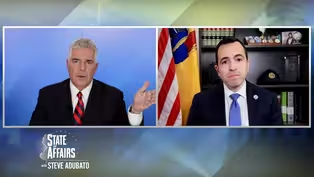
Attorney General Matthew Platkin on protecting NJ residents
Video has Closed Captions
Clip: S9 Ep5 | 17m 42s | Attorney General Matthew Platkin on protecting NJ residents (17m 42s)
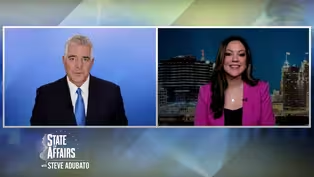
Briana Vannozzi analyzes the current landscape of journalism
Video has Closed Captions
Clip: S9 Ep5 | 10m | Briana Vannozzi analyzes the current landscape of journalism (10m)
Providing Support for PBS.org
Learn Moreabout PBS online sponsorship
- News and Public Affairs

Top journalists deliver compelling original analysis of the hour's headlines.

- News and Public Affairs

FRONTLINE is investigative journalism that questions, explains and changes our world.












Support for PBS provided by:
State of Affairs with Steve Adubato is a local public television program presented by NJ PBS