
Are Solar Panels a Cost-Effective Solution for Energy Usage?
Clip: Season 2 Episode 2 | 6m 2sVideo has Closed Captions
As the dependence on the energy grid increases, can solar energy help reduce energy costs?
On average, Ohio, and the rest of the nation, are seeing their electricity bills rise due to an increase of energy usage of the electric grid by things such as data centers. Chris Heckman, a climate activist in Cincinnati, says solar panels can be a great assistant to decrease our reliance on the grid, plus, it could increase savings and sustainability.
Problems playing video? | Closed Captioning Feedback
Problems playing video? | Closed Captioning Feedback
Brick by Brick is a local public television program presented by CET
Are Solar Panels a Cost-Effective Solution for Energy Usage?
Clip: Season 2 Episode 2 | 6m 2sVideo has Closed Captions
On average, Ohio, and the rest of the nation, are seeing their electricity bills rise due to an increase of energy usage of the electric grid by things such as data centers. Chris Heckman, a climate activist in Cincinnati, says solar panels can be a great assistant to decrease our reliance on the grid, plus, it could increase savings and sustainability.
Problems playing video? | Closed Captioning Feedback
How to Watch Brick by Brick
Brick by Brick is available to stream on pbs.org and the free PBS App, available on iPhone, Apple TV, Android TV, Android smartphones, Amazon Fire TV, Amazon Fire Tablet, Roku, Samsung Smart TV, and Vizio.
Providing Support for PBS.org
Learn Moreabout PBS online sponsorship- All across the United States, electricity prices are going up.
Even here in Ohio, there are reports that show that electricity bills are going up by 10 to 15% this summer.
I spoke to a common activist here in Cincinnati who tells me that solar panels lower electricity costs by drawing energy directly from the sun.
He also tells me that solar panels could alleviate a tax grid and a tax atmosphere as the sun rises in the West end neighborhood.
The energy bills fall in Chris Heckman's 1870s home.
- Our interaction with the grid, it's less energy.
If you were the the power company, if you were Duke looking at our house, you would assume that it's a much smaller house because of the amount of energy that we're using.
- Chris's home is fully electric and his dependence on the electrical grid is less because of the energy his solar panels bring into his net zero home.
- Net zero means that you are generating most of the energy that your house is also consuming.
- During another visit, Chris showed me the battery in the basement of his home that stores some of the electricity generated by the solar panels.
On average, these batteries can cost 10 to $20,000.
- There are lots of companies now that are doing battery energy storage in homes with competition.
Prices are coming down.
- There is even an app to track the amount of energy being used throughout the house.
- So right now you can see that the energy is coming down from the roof and going to the battery to power up the battery and going to the house represented by the windows.
And right now the grid, I'm not using any grid power.
It's at zero - At 3,600 square feet.
Chris pays about $160 a month in electric bills in a house where he, his wife and their two kids stay depending on the season.
He uses about 25 to 60 kilowatts a day, and the solar panels generate anywhere between 10 to 50 kilowatts a day.
But Chris doesn't only wanna sustain his energy usage - As small as our row home is.
We're able to generate about half of the electricity that our home uses throughout the year.
- Chris also wants to sustain the environment - Other than collecting free energy from the sun.
It also doesn't emit any of the gases that cause climate change or cause the, the atmosphere to trap some of the heat that comes from the sun.
It's part of what we call clean energy.
For that reason, and I, I hope that everybody will consider looking into solar for their homes.
For that reason, - Chris believes in this clean energy model so much.
He installed solar arrays on his new residential property called Pleasant Flats.
I'm standing on top of this five unit residential building created by his development company called Pleasant Cake, LLC.
The solar energy will be converted into electricity to meet the specific needs of the residents.
Any access energy goes back into the grid in a process called net metering.
Will the solar array provide like immediate cost savings for the residents that move in - The cost associated with the business running the business?
That'll be lower because of the solar panels.
- The residents will, I guess - By extension.
By extension, - They'll get a - Little bit of, yeah, a little bit of a cut there.
- But Chris tells me there's other ways to save - Solar's really great, but insulation works 24 7, and that is the biggest thing that as far as our residents are concerned, is going to save them the most money.
- Also looking to save the most money are Catherine and Eric Esto in the village of Mainville in Warren County, they put their solar panels on the roof of their horse barn because they have trees that shave the roof of their house.
For the Estos.
Solar panels have been - Very successful.
I've only received one electric bill a year, mid-winter for the extra heating.
So we're quite pleased with the results.
- But there's one thing that propelled them to go solar in the first place.
- We had considered it earlier, like about 10 years ago.
At that time, the payback wasn't sufficient, but with a 30% federal rebate, that was attractive 'cause we got that money back right away.
Well, almost right away.
- By the end of the year, that rebate is going away due to the reconciliation bill.
With all the changes soon to be affecting the solar industry, I reach out to Louis Connell, the director of sales for the solar and installation company, sustainer Energy.
They're the same company being used on pleasant flats using solar for electricity.
Is that the future?
Yeah.
- Why?
The grid burden is only growing, but the supply is not.
Renewables are inevitable because renewables are scalable, they're cheaper, and they're a lot more sustainable.
So they're better for the pocket of everybody, and they're a lot more better for the earth.
- Between the removal of the solar credits by the federal government and the supply and demand of solar panels, the solar energy industry will be facing many challenges in the near future.
One of the challenges is for people who want solar credits by the end of 2025.
For companies like Sustain Energy, Lewis tells me that people need to place their orders by the fall of 2025 in order to get their solar panels on time.
For Brick by Brick, I'm Hearns Legger, Jr.
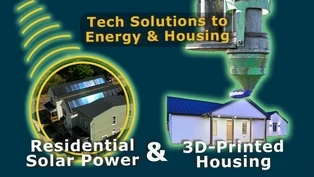
Promo: Tech-Based Energy & Housing Solutions
Video has Closed Captions
Preview: S2 Ep2 | 25s | On the next episode of Brick by Brick, a look at rooftop solar and 3D-printed housing. (25s)
Providing Support for PBS.org
Learn Moreabout PBS online sponsorship
- News and Public Affairs

Top journalists deliver compelling original analysis of the hour's headlines.

- News and Public Affairs

FRONTLINE is investigative journalism that questions, explains and changes our world.












Support for PBS provided by:
Brick by Brick is a local public television program presented by CET