
BROOKLYN NEIGHBORHOOD POLICING ITSELF
Clip: 11/9/2023 | 12m 30sVideo has Closed Captions
BROOKLYN NEIGHBORHOOD POLICING ITSELF “BROWNSVILLE IN VIOLENCE OUT”
Brownsville In Violence Out (BIVO) is an anti-gun violence initiative in which Brownsville residents respond to low level street crimes themselves, rather than the NYPD. Dushoun Almond, leader of BIVO, joins us to discuss the initiative.
Problems playing video? | Closed Captioning Feedback
Problems playing video? | Closed Captioning Feedback
MetroFocus is a local public television program presented by THIRTEEN PBS
BROOKLYN NEIGHBORHOOD POLICING ITSELF
Clip: 11/9/2023 | 12m 30sVideo has Closed Captions
Brownsville In Violence Out (BIVO) is an anti-gun violence initiative in which Brownsville residents respond to low level street crimes themselves, rather than the NYPD. Dushoun Almond, leader of BIVO, joins us to discuss the initiative.
Problems playing video? | Closed Captioning Feedback
How to Watch MetroFocus
MetroFocus is available to stream on pbs.org and the free PBS App, available on iPhone, Apple TV, Android TV, Android smartphones, Amazon Fire TV, Amazon Fire Tablet, Roku, Samsung Smart TV, and Vizio.
Providing Support for PBS.org
Learn Moreabout PBS online sponsorshipRafael: Good evening and welcome to "MetroFocus," I am Rafael Pi Roman.
In Brownsville, considered one of Brooklyn's most dangerous neighborhoods, community members are coming together to try a new approach to public safety.
Brownsville In Violence Out is an anti-gun violence initiative in which Brownsville residents respond to low-level street crimes themselves rather than having the NYPD make arrests.
Joining us with more on what this looks like is anti-violence advocate and the leader of Brownsville In Violence Out Dushoun "Bigga" Almond.
"Bigga," welcome to "MetroFocus ."
Bigga: Thank you for having me.
I appreciate it.
Rafael: Why don't you tell us more about the goal or your mission of your organization beyond what I said in the introduction.
Bigga: Brownsville In Violence Out is an anti-gun violence program and we are aiming toward minimizing and mediating certain situations that the NYPD and certain other organizations might not be able to sit at the table and take part in a peaceful solution that leads to success.
Rafael: Tell us exactly how that works in practice.
For example, how often are you on the streets?
And how do you know when something is going on or there might be trouble brewing in the neighborhood?
How do you get word of it?
Bigga: They call us credible messengers.
We take our credibility and we use it as we have done time and time again in the streets.
Use our trust and loyalty in the community for people knowing we are the real deal.
You can trust us.
We come from this, as well.
As far as the times we come out, it does not even matter.
We are coming anywhere from 8:00 in the morning and leaves at 3:00 at night depending on the event or situation that happens.
We can be out there, coming home from work on Sunday in the morning.
It does not matter.
Rafael: How do you get the call?
Are 911 calls referred to you why the police?
Bigga: The Brownsville safety alliance, the 911 calls are divergent to us.
As far as the work we do in the community outside of that, we always have our own people, participants -- we call them the in-roads.
We say you need to get over here and there might be a brewing situation and you need to mediate is so it will be a peaceful outcome.
Rafael: Does the NYPD, plain-clothes officers always shadowing you or just sometimes?
Bigga: The NYPD does not shadow us at all.
Rafael: I thought the New York Times article made the reference to them being in the background.
Bigga: that is for the BSA.
That is a situation where the NYPD gives us a two-block radius to take care of ourselves and divert the 911 calls to us and we take care of the problem right then and there.
On the spot mediation.
It is happening right then and there.
Rafael: You talked about credibility and how that helps you enormously because people trust you.
What is that credibility look like?
How does one get that credibility?
Bigga: Back in the day when I was growing up, people became credible because they did what they said they were going to do and they stood for certain things that were outside of the normal practice of life.
Yes, we have all done things we are not so happy about.
At the same time, we were always trustworthy.
People trusted us to be exactly who we say we are.
Not just the timing but a standup individual at the same time.
Rafael: "Bigga," tell us about yourself, your transformation, your experience and why did you decide to become involved in this work for your community?
Bigga: First so long, when I was growing up, I was led to believe that everybody wants to be known as a gangsta.
I do not know why it is such a historic thing anymore.
The gangstas from my time took care of their communities and their families and the nature the community was right.
We sit here and say, in these days and times, we look at the youth and a lot of them are saying "I'm a gangsta."
You don't really know what that means.
We realize these young men and women are being taught the wrong way.
It is like the blind leading the blind.
I want to make it to heaven.
I don't know about anybody else.
I want to try to get the chance to right my wrongs.
For my family, grandchildren, children and everyone else's children, I want them to be able to travel peacefully without hearing a gunshot.
I want them to play in any part in the world and not be afraid, do not have the fear of being shot.
Rafael: You are talking about righting the wrongs, but you were on the others of the law for a while.
Bigga: Yes, I was.
Rafael: That turned you around.
Why?
How?
Bigga: Because I realized I was being part of a bigger problem.
I like to say, something that might grandmother, Helen Clark, God bless her soul, your ancestors did not die just for you to die, and I pass that on to the generations now.
Our ancestors did not fight just to sit back and watch us kill each other.
Rafael: That is a good message.
The New York Times article that I referred to, I think it came out in April, told a story about you personally intervening with a man who was going into a bodega with a gun and then he gave you the gun and went home.
It has an interesting twist at the end I want to get to.
What was his intention?
Was he intending to rob the bodega?
Bigga: Displaced honor and displaced manhood.
That was a situation where he saw somebody that he had a problem with.
In all actuality, you did not have a problem with this individual, you were just hungry.
I walked up to him because he knows where I come from and how I carry myself.
I asked him if there was anything I could do for you.
He said I want something to eat.
I got him something to eat, we went across the street, we ate it and he gave me the firearm.
Rafael: The twist of the story is he came back the next day and volunteered.
Bigga: He came back the next day and he broke up a fight with two pizza men at the Domino's down the block.
Rafael: That is a wonderful story and you have an incredible persuasive power, but is this the way you become a volunteer in your organization in Brownsville In Violence Out or is there something the paper left out about training and vetting?
Bigga: There is a lot with this.
We operate under the crisis management system.
There is a training you undertake to be a credible messenger.
Situations like that, that is just a normal thing that is supposed to happen in every community.
Every young man, every young woman has a duty to their community where they stand up, if you see something and you can peacefully negotiate it, do it.
Rafael: Most overwhelmingly, that is the way it goes with you guys from what I read.
You have been very successful at de-escalating all kinds of potential crimes and tough situations, but unfortunately they do not always go smoothly.
In fact, Tyrone Sloan, a member of your organization was shot in the chest after intervening in the situation involving a gun near where he lived.
What was the effect on your organization and fellow volunteers?
Did it change the way you conducted your business?
Has anything like that happened since?
Bigga: No, not with our team.
In the past, even when he came aboard -- I came aboard before him -- I started tapping into therapeutic services.
When you are part of the crisis management system, you have these resources at your disposal and he utilizes them.
After that, he needed more therapy.
A lot of us have been shot.
Me, myself, I have been shot.
Does it play in the back of my head?
Yes.
Is he working through it?
Yes.
He got right back to work.
He is doing all right.
Rafael: What kind of feedback are you getting from the community about the work you guys are doing?
Bigga: Well, it has been good.
There has been a lot of community members wanting to take part in our events.
We operate in one part of Brownsville and now we are moving to another part of Brownsville where the teams get bigger.
The response is good because C AMBA allows us to be ourselves and at the same time work and do what is best for the community.
Rafael: According to the New York Times article, which I quote maybe too often here, not everyone is on board.
There are some residents and storeowners say they prefer uniformed police officers and they feel safer with them.
What do you say to these folks?
Bigga: You know, I am not going to sit here and say -- everybody talks about defunding the police and things of this nature.
This is impossible.
Here at CAMBA, we look at the NYPD as a community partner.
We cannot keep saying these things to shut the police down.
It is unrealistic.
We need them to do their job, too.
We are trying to say we will take care of this part.
We will do this in the community with the people we know, that we are familiar with, and try to mediate certain conflicts that leaves you a better chance to take care of other crimes that are happening out there.
Rafael: We only have about 30 seconds left.
Do you think the model you are using in Brownsville is the model they can be replicated in other communities Bigga:?
Bigga:Definitely.
Without a question.
People have to do their part and not try to shut each other down.
Rafael: Thank you for the work you are doing in Brownsville and joining us today and giving you the latest on it.
Bigga: My pleasure and God bless.
Thank you for having me.
Rafael: Thank you.
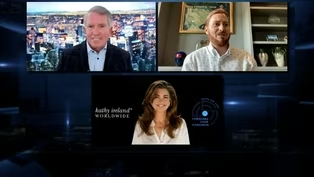
KATHY IRELAND TEAMS UP WITH FORESEEABLE FUTURE FOUNDATION
Video has Closed Captions
Clip: 11/9/2023 | 13m 13s | FASHION MOGUL KATHY IRELAND TEAMS UP WITH FORESEEABLE FUTURE FOUNDATION (13m 13s)
Providing Support for PBS.org
Learn Moreabout PBS online sponsorship
- News and Public Affairs

Top journalists deliver compelling original analysis of the hour's headlines.

- News and Public Affairs

FRONTLINE is investigative journalism that questions, explains and changes our world.












Support for PBS provided by:
MetroFocus is a local public television program presented by THIRTEEN PBS