
Budget Priorities & Redistricting Fight
Season 10 Episode 13 | 24m 44sVideo has Closed Captions
Gov. Cox unveils his proposed budget, plus the fight over Utah's congressional map heats up again.
Gov. Cox unveiled his proposed budget for the next year. Our expert panel examines what this suggests about his policy priorities and how it could influence the Legislature. Plus, the fight over Utah's congressional boundaries is taking another turn. Journalist Brigham Tomco joins State Representatives Ryan Wilcox (R) and Hoang Nguyen (D) on this episode of The Hinckley Report with Jason Perry.
Problems playing video? | Closed Captioning Feedback
Problems playing video? | Closed Captioning Feedback
The Hinckley Report is a local public television program presented by PBS Utah
Funding for The Hinckley Report is made possible in part by Cleone Peterson Eccles Endowment Fund, AARP Utah, and Merit Medical.
Budget Priorities & Redistricting Fight
Season 10 Episode 13 | 24m 44sVideo has Closed Captions
Gov. Cox unveiled his proposed budget for the next year. Our expert panel examines what this suggests about his policy priorities and how it could influence the Legislature. Plus, the fight over Utah's congressional boundaries is taking another turn. Journalist Brigham Tomco joins State Representatives Ryan Wilcox (R) and Hoang Nguyen (D) on this episode of The Hinckley Report with Jason Perry.
Problems playing video? | Closed Captioning Feedback
How to Watch The Hinckley Report
The Hinckley Report is available to stream on pbs.org and the free PBS App, available on iPhone, Apple TV, Android TV, Android smartphones, Amazon Fire TV, Amazon Fire Tablet, Roku, Samsung Smart TV, and Vizio.
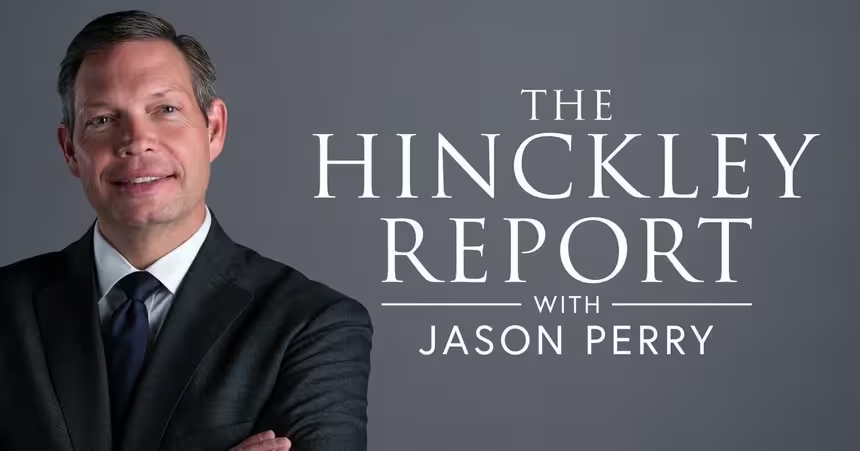
The Hinckley Report
Hosted by Jason Perry, each week’s guests feature Utah’s top journalists, lawmakers and policy experts.Providing Support for PBS.org
Learn Moreabout PBS online sponsorshipJason Perry: On this episode of "The Hinckley Report," new developments in the battle over Utah's congressional lines, Governor Cox unveils his budget priorities for the coming year, and what do Utahns think about major issues ahead of the legislative session?
announcer: Funding for "The Hinckley Report" is made possible in part by the Cleone Peterson Eccles Endowment Fund and by donations to PBS Utah from viewers like you.
Thank you.
♪♪♪ ♪♪♪ Jason Perry: Hello and welcome to "The Hinckley Report."
I'm Jason Perry, Director of the Hinckley Institute of Politics.
Covering the week, we have Representative Hoang Nguyen, a Democrat from Salt Lake City in the Utah House and a member of the PBS Utah advisory board; Brigham Tomco, reporter with the "Deseret News;" and Representative Ryan Wilcox, a Republican from North Ogden in the Utah House.
Thank you so much for being with us.
A lot's happening to set the stage for the legislative session that's going to come on the 20th of January.
And one of those things that happens every year is the governor proposes his budget, but does this by law, has to submit a budget to the legislature.
And every year he sort of sets his priorities based on his budget itself.
And Brigham, I want to talk to you for just a moment because you've done some great reporting already on these numbers.
And the governor started with some great things about Utah; number one economic outlook in the country, number one in innovation, number one in social mobility, a lot of things, but we have a flat budget this year.
Talk about that.
Brigham Tomco: Well, thank you.
So Utah Governor Spencer Cox described this year's budget as a austere budget.
And he said that the primary reason for that is President Donald Trump's Big Beautiful Bill.
And this bill had several tax deduction provisions or extensions that will decrease the amount of income tax that the state of Utah can bring in.
And so this is going to result in about $300 million less than anticipated in terms of revenue for the governor and lawmakers to work with as they plan their budget for next year.
Jason Perry: Representative Wilcox, so it's a $30.7 billion budget.
That's $100 million less than last year.
Talk about, from a lawmaker's perspective, what you do when you get this particular budget, and what this sets in motion for your priorities as a legislature.
Ryan Wilcox: It sounds a little bit like a bait question from a former chief of staff to the governor.
That said, we do look at it.
There's a process that we're constitutionally again required to go through at the very beginning of the session, where we go through our appropriations hearings, hear from every agency.
It does serve as a base point for the agencies, meaning that most of the executive branch agencies are generally only authorized to speak to us about things that are in the governor's budget.
And so that there's that piece to it, but then we also dig in legislatively on to any and every small detail that may or may not be included.
And many changes are made between now and when we actually pass the state budget, so it's a starting point.
It's a good place to start, but we don't see that as the finished product at all.
Jason Perry: Talk about from your side of the aisle how you approach this, too, because you already established some priorities on the Democratic side of the aisle.
Hoang Nguyen: Yeah, we have.
And you know, I think it's a very informed starting point because the staff over at the governor's office, they take quite a bit of time going through and speaking with different departments, state agencies to see where we are.
Where it's a flat budget year, it makes sense to me as a business owner where we are on the economy.
Our revenue's down statewide.
Local taxes, local revenues that has been in the decline for the last couple of years now, and so it makes sense that it's down.
As far as priorities, I do, you know, I know there's some priorities in there that I definitely agree with.
There are priorities, I think affordable housing is something that's a big deal that we need to look at to see where we can boost more housing.
So, I think it's a good start.
Jason Perry: I want to get to a couple of the key pieces that do align with things you've talked about in the legislature, Brigham, that you reported.
I want to start with you, if you'll go into this for a moment, the Homeless Services Campus.
Homelessness is something that the legislature has been working on funding for the past couple of years.
Talk about this amount of money that's going to be put in to it this year, $25 million from the legislature last year towards this issue, $25 million this year on this campus.
Talk about that.
Brigham Tomco: Yeah, so Governor Cox has said that this is his funding priority for fiscal year 2027, which they are going to be appropriating from January to March next year.
And he's pushing for upwards of $50 million to fund the construction of this massive 1,300 beds, 16-acre campus north of the Salt Lake City Airport, and then another $20 million in ongoing funds to help operate this.
And the governor has this ambitious vision for this central transformative campus that would have all of these services and treatment centers in one place with a focus on mandatory treatment, really.
And in some cases, keeping people there involuntarily to clean up the streets with a big focus on public safety, but also a focus on sobriety.
And part of this is an emphasis coming from the federal government under the Trump administration that has overhauled the federal grant process to prioritize projects that emphasize those same priorities that the governor has for homeless services in the state.
Jason Perry: Representative Wilcox, this is a key piece of this proposal, as President Trump has put forward a series of grants and funding opportunities available for states to approach this.
And talk about how this might work together as the state tries to handle this particular issue.
Ryan Wilcox: States respond to incentives just like people do, right?
So I'm not surprised to see this now aligned with priorities from the administration to take advantage of that.
But I don't want to get lost in that.
That's not why we're going through this process.
I spent some time up in Sioux Falls, South Dakota this summer studying with legislators from different parts of the country and, you know, local folks up there who have come up with a really similar model on a much smaller scale that really has worked.
By having a central location where they bring it in, they've been able to partner and reduce duplication of their private, you know, nonprofit partners that provide most of the services to really make a difference in that community, in that state.
So I've seen it work on a county level, on a city level.
Really, how I hope that this works.
And you know, in talking with Tyler Clancy, who's now going, been named as our new homeless services director, I think we have a shot here if we do this right, leveraging, of course, federal resources.
But if we do it right, we can make a huge difference here and see some long-term gains.
Hoang Nguyen: And that's the key there, though: if we do it right.
Let's not overlook the fact that where it's going to be located, on the west side of Salt Lake City.
Jason Perry: Near the airport.
Hoang Nguyen: Near the airport, but still Salt Lake County.
I participated in a two-day meeting with lots of stakeholders to talk about how are we as Salt Lake County and Salt Lake City going to address the fact that it's going to be in Salt Lake City.
And the biggest fear that I've heard from so many leaders in the city and the county is, "Okay, the state says we have to put it here.
We did not have a choice.
We had to put it in Salt Lake City.
Our fear is, is there gonna be ongoing funding to support it, or is it gonna fall on the taxpayers's dollars of the county to keep supporting it?"
Where it's supposed to be a statewide or a state facility, we need to make sure that the funding is gonna go just not the one time with the first few years when this facility is launched, but it's an ongoing funding to make sure that it's not gonna fall on taxpayers.
Brigham Tomco: Well, something the governor has emphasized is that similar projects like this in San Antonio, or Miami-Dade in Florida, or in Reno, Nevada rely primarily on municipal and philanthropic funding, so from these private donors.
And so he's hoping that the city, or not just Salt Lake City, but cities in the area can contribute to this.
But he did say that the state is taking kind of a heavy-handed approach to helping to fund this project because most of the homeless population in the state is in the capital city.
So it does seem like a statewide problem that the state as a whole needs to invest in, not to mention that the Olympics are coming here within the next decade.
Ryan Wilcox: That cuts both ways, right?
We have this conversation.
You know, there were folks that wanted to move the Jazz recently out of Salt Lake City.
Or they didn't want the, you know, the baseball proposal to be here.
It's here because it's our capital city.
And this is where, this--you know, it's where, it's all of our capital, not just the city itself and those that reside here.
And so there's advantages to perhaps putting it somewhere else, but the bottom line is we're all invested in the city.
Jason Perry: Maybe just to that point, we just, if we take advantage of you not just being a legislator, but as a business owner in Salt Lake City, talk about that connection to this particular issue, because I know you personally have weighed in on this issue.
Hoang Nguyen: You know, when we broke up the Rio Grande years ago, and we moved to the resource facilities model, right, one of the resource facility model was the Geraldine King's Resource Center that was right across the street from where my my family businesses are.
And that was a huge impact to the community.
And where we have, we're in hospitality.
We have thousands of people that come to our businesses weekly.
It was a big impact, and so you know, I joined the advisory board there to make sure that there was gonna be to what the state has said when we break up Rio Grande, we're going to invest in this resource model.
You know, we're five, six years into this new model now, this stuff that worked well.
There's things that really did help the population, but there was also a cost to the local stakeholders in it.
So it's going to be really interesting to see when we move it to this new location on the west side.
You know, we had neighbors in the Rose Park area show up in huge numbers to the community meetings to talk about their concerns because it's out in, though it's in Salt Lake City, it's in an area where there's farmland still.
And the neighbors are really concerned about their safety and their quality of life when it's out there.
So we will, it's yet to be seen if the states really will show up in the way that they say they will to keep supporting this facility out there.
Jason Perry: Okay, let's get to another budget priority.
The governor has proposed a significant amount of spending for education.
Brigham, give us this one, $20 million for reading programs in particular.
Brigham Tomco: So this is an emphasis that the Governor and First Lady Abby Cox have had for a long time, but this year they're taking a unique approach that is more policy-focused than budget-focused.
So there will be these $20 million for reading assistance in classrooms, another $60 million for targeted behavioral interventions for those students who are struggling.
But kind of the centerpiece of Governor Cox's, I guess, legislative proposals for next session is a retention policy that would mirror a policy that's been implemented in Mississippi over the last decade that some say have contributed to the Mississippi Miracle, of their reading scores going from 49th in the country to 8th in the country, tied with Utah.
And so what this would do is hold third graders back that don't meet that reading comprehension level before they move on to the fourth grade.
So this is sure to be a controversial part of the next legislative session.
Jason Perry: That part in particular, right?
Hoang Nguyen: Can I point out something with the education funding requests?
It's about $100 million less than it was last year in his request for education.
That's concerning.
That is concerning to me when, you know, I know it's gonna be a tight budget year again, but we have significant challenges in our schools right now, in our public education with reading, with chronic absenteeism.
$100 million less is gonna be a lot less dollars going to things, resources that we really need.
In that budget education budget, too, is the school safety and how much money he wants to put.
Was it $53 million?
Ryan Wilcox: It's $53 million.
Jason Perry: This has been something really close to your work, too.
Do you wanna break that out?
Because that seems to have some great support from both sides of the aisle.
Ryan Wilcox: The state school board here a few months ago asked for $100 million for that part of the budget.
The real costs are quite a bit more than that, right, of what we need to invest in the long term.
But what's beautiful about this is this is the governor coming out early, and this is, again, the advantage to having it in the governor's budget is that it gives permission, so to speak, to those folks looking at that to prioritize it.
$53 million in one-time funding, you know, helps with secure vestibules, helps with identification systems, helps with, you know, camera systems, like the physical hardening one-time fees, the door locks that lock from the inside in an emergency, bleed kits, all that kind of stuff.
What we really need, though, is ongoing, to your point about will the state be there in the long term.
To the extent that that gets earmarked is just a normal part of what we do so that kids aren't worrying about it.
Families aren't worrying about it.
It's just we just do safety, like Toyota with kaizen, right?
Like safety first.
You just start off, and it's part of your process.
We take care of that stuff, so we don't have to do massive one-time investments in the future.
Hoang Nguyen: If I may, Representative Wilcox, you know, I do respect where this bill is going with the intent of this bill with.
It was addressing a, or it hopes to address the most horrific, worst case scenario that can happen in our schools.
Where I do feel like we are overlooking gravely, because you know, I met with leaders at the Salt Lake School District.
And to be compliant with this bill, it's gonna cost $100 million alone for Salt Lake School District to be compliant, to get all the locks, and all the windows, and everything they need, and then to pay for the ongoing security that's needed for it.
What they impressed me was what's missing is the piece that we do not have the training, the programs in this bill to also address the day-to-day issues that they're they're dealing with safety.
From fighting, to bullying, to the conflict between teacher and students, that's a huge missing piece.
And we know that the majority of, statistically, the majority of people who come back and do those shootings at schools, they had a connection to the school because of some kind of negative experience at the schools.
Ryan Wilcox: And that's true for high schools, for secondary schools.
It's not accurate for primary schools, elementary schools.
That gets exactly reversed.
Over 90% of those who target elementary schools are outside actors.
Over 90% of those who target secondary schools are inside actors.
They're already within the school.
And so how you harden, what you do, it's more important to harden an elementary, for example, because of that.
High school, it's more important on the inside.
But you're not wrong on the need for training.
In fact, that's really the largest need long term for the state.
It's not the one-time things.
And frankly, the code stuff will fix that for every school that's built, starting last year for now and forever, because it has to be approved by the state security chief, just like we do with the fire marshal.
So the schools will fix that into their costs long term.
It's the training costs, and the personnel, and the interventions that they need long term.
That's what that, you know, 1% of the WPU, around $50 million would take care of in the long term.
Hoang Nguyen: And are you, I mean, are you concerned that it's gonna take away from instruction, it's gonna take away from the resources that these schools need?
Ryan Wilcox: Yeah, no, not at all, no.
Jason Perry: I want to get to some of these other funding mechanisms because we're going to need this on all of these topics as a discussion about the ongoing funding.
Brigham, what's interesting is this is the first year in four years that we've not seen an income tax reduction proposal on the table.
That has something to do with our economy.
Talk about that, as you've been reporting on these stories.
Brigham Tomco: Sure, so Governor Cox has been proud to tout the cut in income tax that the state has undergone during his first and now going into his second term.
He said that this year he's not proposing one, not likely to support one, and mainly because of this One Big Beautiful Bill Act, removing those $300 million in anticipated revenues, which he said is a tax cut at the federal level that Utahns will experience.
And he has also framed this conversation, saying that if we are going to think about cutting the income tax, which is something that legislative leadership is always pushing for it seems like, we need to have a broader conversation about what we are going to replace that revenue with, whether that's property taxes, sale taxes, because Utahns are going to be impacted or hurt in different ways if we keep on this trajectory.
Jason Perry: Okay, Representative Wilcox, talk about this issue because it comes up a bit in your party.
Ryan Wilcox: Well, the framing, I would probably use different framing.
I don't think it hurts Utahns to keep more money in their pocket, right?
So there's the simple stuff with that.
I know one of the larger frustrations that I've heard from folks is that as they try to get ahead, the combination of inflation, and maybe it's the point where I am in life, so most of my friends are somewhat around my age.
But you know, they say, "I make more now than I've ever made, and I bring home less than I've ever--it goes a lot lower than it ever has gone.
Doesn't stretch like it used to."
And that's just, I think that's just reality with what we've seen across the board.
And so even though they're small amounts, we've reduced taxes every year since I came back to the legislature, since 2021, one form or another.
And I think over time, yeah, that makes a difference for people and hopefully allows them to invest, if we want our small businesses to invest.
Remember the Big Beautiful Bill we've talked about a little bit, and it's going to affect our revenues this time.
But that argument, that play was intentionally so that businesses and families could invest in the long term.
That takes time to play out.
We're what, four months into the Big Beautiful Bill?
And a bunch of it hasn't even gone into effect yet, so we'll see what that looks like.
Jason Perry: Okay, I want to get into some big issues coming this next week.
We think there is likely to be a special session.
Ryan Wilcox: Yeah.
Jason Perry: Yes, we're gonna say yes, that's happening next week?
Hoang Nguyen: Seems like it, yes.
Jason Perry: Highly likely.
Gonna be Tuesday and maybe even in the evening, which will be interesting.
Let's talk about a couple of these issues because at the heart of this special session is the redistricting process here in the state of Utah.
And Representative Wilcox, maybe you could talk about that for just a moment because we understand there may be a couple points on this, one dealing with the filing deadlines for congressional districts.
Ryan Wilcox: Yeah, the filing deadlines are likely to change for congressionals only, meaning that those will take place in March, which is really kind of where all of the filing used to take place, and open up the day after the session ended.
So it's not that big of a diversion from current practice.
Jason Perry: Okay, go ahead.
Hoang Nguyen: It feels more like a stall tactic right now.
I think it's trying to delay when we can actually have our actual voting and things that need to happen for candidates by stalling it out.
I don't think it really serves a purpose to delay it at this point.
So I mean, we'll see what happens in session.
Ryan Wilcox: We're in this timeline, remember, because Judge Gibson delayed for eight months on issuing a ruling.
Every point along the way that the court has set a deadline, they've blown through it.
And then we had, you know, 30 days to call in to session and do these things.
This is definitely not the timeline any of us would have chosen.
If we could have had a timely judgment back earlier in the year, then we wouldn't be having this conversation.
So it's certainly not something we want to do as a caucus, or as a party, or any of that, but this is where we are.
Jason Perry: Go ahead, Brigham.
Brigham Tomco: Yeah, so Speaker Mike Schultz and Senate President Stuart Adams and Governor Cox, they've all said a similar thing to the effect that the timeline that Governor Cox, or sorry, that Judge Gibson's decision has set in place has kind of put them in a tough position, not having enough time to file a full appeal of this ruling that, you know, selected a new congressional map for the state.
And so it seems like the reason behind shifting these candidate deadlines is to provide more time to appeal this decision to the Utah Supreme Court, potentially to the US Supreme Court, and maybe once again switch out the congressional map before the 2026 November midterm elections.
Hoang Nguyen: Look, Prop 4 was the law of the land.
All Prop 4 is doing is asking for fair transparency, a map that is representative of the people.
The judicial court, their job is to uphold our constitution.
That is their number one job.
And it is also to interpret when things, actions are being done that doesn't necessarily follow those guidelines that protects our constitution.
That's all that happened here.
The will of the people was they wanted to have fair and equitable maps.
They wanted communities of interest to be kept together.
They wanted to make sure that it fit different fairness metrics.
The map that was proposed by the independent commission fit those, and it complied with the law of the land.
Timeline, we can argue timeline all we want.
We had map that met the law.
The map, when it was, the Amendment D to repeal it, that's where we got into a stickiness problem, right?
So I still feel strongly that this could have been avoided, the hundreds of, you know, thousands of taxpayer dollars to fight this in court could have been avoided if we just went with the will of the people for fair maps.
Ryan Wilcox: The will of the people is an interesting argument to make here because we're talking about, what, less than 3% difference in that one.
But we're also talking about every other county outside of Salt Lake, Grand.
There are like three, four county summit that are Democratic strongholds.
Everybody else rejected it.
So yeah, my district didn't vote for this, right?
And neither did most of the districts in the legislature.
So when you see legislators pushing back, they're literally representing their own constituents who did not support that by and large.
And to the point of the process, that may have been the intent.
And I'm positive that that's what the signature gatherers were telling people, that this is just, you know, to have fair maps.
What we've ended up with here by Judge Gibson, and this is super important for people to understand, is not only did it not follow the constitutional process, which Article IX exists, so we can't keep pretending like that doesn't exist.
But not only did she not follow that, she didn't follow her own.
Then she allowed a third party plaintiff to draw the map.
The plaintiff is the one that sent it to the lieutenant governor.
It wasn't--didn't go through even normal channels that way.
And there's nothing in the constitution or the law that allows a third party to do such a thing.
Hoang Nguyen: The constitution-- Jason Perry: Quick point on that, okay, go ahead.
Hoang Nguyen: The constitution does also state that the people have the ability to change their government, change their laws.
It's also in there a few, you know, a few sections down in the constitution.
It very, very clearly states that people have the right to change their-- Ryan Wilcox: And in that same Prop 4, again, it requires it to be a recommendation to the legislature.
That's it.
Jason Perry: Okay, we have 30 seconds, Brigham, because this has implications.
However this goes, either side, it's gonna change who runs for this office.
Talk about that really quickly, 30 seconds, because we've got a lot of Democrats running for that potential seat if that's the map we use.
Brigham Tomco: If this map holds, it's going to create a new political world in the beehive state because we're going to have a competitive Democratic primary for national representation of Northern Salt Lake County.
And so we're going to see arguments playing out in the Utah Democratic Party about how they want to represent themselves on the national stage in a way we haven't seen for a long time.
Jason Perry: Okay, this will have to be the last comment.
Thank you so much for breaking this down.
A lot to watch in this next week.
And thank you for watching "The Hinckley Report."
This show is also available as a podcast.
Thank you for being with us.
We'll see you next week.
announcer: Funding for "The Hinckley Report" is made possible in part by the Cleone Peterson Eccles Endowment Fund and by donations to PBS Utah from viewers like you.
Thank you.
♪♪♪ ♪♪♪

- News and Public Affairs

Top journalists deliver compelling original analysis of the hour's headlines.

- News and Public Affairs

FRONTLINE is investigative journalism that questions, explains and changes our world.












Support for PBS provided by:
The Hinckley Report is a local public television program presented by PBS Utah
Funding for The Hinckley Report is made possible in part by Cleone Peterson Eccles Endowment Fund, AARP Utah, and Merit Medical.