
Buffalo Grocery Store Shooting/Rising Cost of Water
Season 50 Episode 21 | 26m 46sVideo has Closed Captions
Buffalo Grocery Store Shooting/Rising Cost of Water | Episode 5021
Another racially- motivated shooting has rocked Black Americans. Host Stephen Henderson talks with the Detroit Branch NAACP about the tragic mass shooting in Buffalo, NY that killed 10 African Americans and injured 3 others. Plus, Stephen looks at the rising cost of water for communities of color with We the People of Detroit Co-founder Cecily McClellan and Wayne State law professor Peter Hammer.
Problems playing video? | Closed Captioning Feedback
Problems playing video? | Closed Captioning Feedback
American Black Journal is a local public television program presented by Detroit PBS
Buffalo Grocery Store Shooting/Rising Cost of Water
Season 50 Episode 21 | 26m 46sVideo has Closed Captions
Another racially- motivated shooting has rocked Black Americans. Host Stephen Henderson talks with the Detroit Branch NAACP about the tragic mass shooting in Buffalo, NY that killed 10 African Americans and injured 3 others. Plus, Stephen looks at the rising cost of water for communities of color with We the People of Detroit Co-founder Cecily McClellan and Wayne State law professor Peter Hammer.
Problems playing video? | Closed Captioning Feedback
How to Watch American Black Journal
American Black Journal is available to stream on pbs.org and the free PBS App, available on iPhone, Apple TV, Android TV, Android smartphones, Amazon Fire TV, Amazon Fire Tablet, Roku, Samsung Smart TV, and Vizio.
Providing Support for PBS.org
Learn Moreabout PBS online sponsorship- Just ahead on "American Black Journal," Detroit NAACP president, Wendell Anthony is here to talk about the mass shootings in Buffalo, New York, where African Americans were targeted yet again by a white supremacist.
Plus we'll look at the cost of clean, safe water in the Great Lakes region.
Stay right there.
"American Black Journal" starts now.
- [Announcer] From Delta Faucets to Behr Paint, Masco Corporation is proud to deliver products that enhance the way consumers all over the world experience and enjoy their living spaces.
Masco, serving Michigan communities since 1929.
Support also provided by the Cynthia & Edsel Ford Fund for Journalism at Detroit Public TV.
- [Announcer] The DTE Foundation proudly supports 50 years of "American Black Journal" in covering African American history, culture, and politics.
The DTE Foundation and "American Black Journal" partners in presenting African American perspectives about our communities and in our world.
- [Announcer] Also brought to you by Nissan Foundation and viewers like you.
Thank you.
(upbeat music) - Welcome to "American Black Journal," I'm Stephen Henderson.
Another racially motivated attack has rocked black America.
An 18 year old white man is under arrest for killing 10 people and wounding three others at a supermarket in a predominantly African American neighborhood in Buffalo, New York.
The accused gunman allegedly wrote a 180 page screed, a white supremacist document espousing the so-called Great Replacement Theory.
Which claims there's an intentional effort to replace white America with people of color through immigration.
I spoke with Detroit NAACP president, Reverend Wendell Anthony, about this latest tragedy.
Reverend Wendell Anthony, we find ourselves again I think trying to decide which emotion is right?
Is it sadness?
Is it anger?
Is it frustration?
This just keeps happening.
And I gotta say, I'm tired of deciding which emotion is the right one.
I want this to change and I guess I just don't know what will make that happen.
- Well, Stephen, always good to be with you.
I mean, you feel like I do.
I think it's a combination of all of the emotions at the same time.
You're angry, you're frustrated, you're disappointed, you're disgusted, you're challenged.
You wanna do something.
You want something to stop.
You want something to start.
And here we are again.
And the tragedy, Steve though, you and I both know this is not the last one.
It's gonna happen again until we recognize that there's not a black problem or a brown problem or a red or a yellow problem, America has a problem and the problem is racism.
It's white supremacy.
It's those who believe that black and brown people have achieved too much and taken things away from them.
The fact that an 18 year old man, white man, drove 200 miles armed, planned and executed 10 black people, wounding others whom he'd never met.
They ain't done nothing to him.
Because he got bored during the pandemic when he home with his mama, something is here.
And the fact that you have politicians, Republicans, and they must own this.
The Republican Party must own this.
Not the Democrats, the Republicans must own it.
Because these are Republican extremists and people who are fighting that, championing the dogma of Kevin McCarthy, Marjorie Taylor Greene.
Of all these individuals, Matt Gaetz, of all these folk who are enabling them.
In fact, I agree with Liz Cheney that the GOP has enabled this mess to occur.
And until they step up and negate and expel these people and say we don't want nothing to do with this and enforces policies and programs that speak to collectivity rather than individuality, we got a problem.
It's interesting, Stephen, I'm sitting between Jeremiah Wright on my right and Barack Obama on my left.
Now, y'all didn't like Jeremiah because you're saying he was too strong.
He told the truth and he was just too hard.
Okay.
You didn't like Barack Obama and he was the president and he tried to bring everybody together.
On the one hand, you didn't like Jeremiah 'cause you said he was too divisive.
On the other hand, you didn't like Obama because he was trying to unify the country.
But what the hell do you want then?
I mean, somewhere, we have got to come together and face our reality.
- Obviously, I agree with what you're saying and this does lie at the feet of white conservatism, white republicanism, whatever you wanna call it.
But I wanna talk about white comfort.
Because that is what, that's just what came to mind for me after this happened over the last week.
It's not the people who are pushing these things who are only responsible.
It's those people who might even be of good faith and not believe in white supremacy, want things to be equal, but whose lives aren't affected by this and who don't come out of their comfort zone to say, we can't have this, we're not doing this.
Some of these folks vote Republican in some of these cases.
Some of these folks live in communities where there aren't African Americans or African Americans are kept out.
And Martin Luther King talked about the danger of the white moderate.
I think that's where our problem, that's where a lot of our problem lies.
- Stephen, you see me nodding at everything you're saying, 'cause you're right on point because I was gonna make that point.
Dr. King said, "Well, we will not remember so much the loud noise and the bad stuff from the bad people of this generation.
But we will remember the silence of the good people of this generation."
I was asked the other day by a reporter, "What are you gonna say to your church?"
Or, "What did you say to your church the Sunday after the shooting?"
Well, I say to my church what I say all the time.
Out of these ashes, we rise.
We have challenges.
That we still must forge ahead.
That we still must love and work and have faith and put work to our faith and to our prayers.
That we live in a society that is still challenged.
But that's not the question, Steve, the question is what do the white pastors, the white preachers, the white leaders.
Where are the white civil rights leaders?
Why do you come to Wendell Anthony and folk like me all the time when Wendell Anthony ain't shooting nobody.
Wendell Anthony ain't got no racism issue to ploy and to dig deep.
I'm not trying to talk about, people are taking over and this Replacement Theory.
Y'all are.
What do you say to your congregation in Grosse Pointe, in Dearborn, in Troy, in Rochester, in Livonia?
What are you saying to them on Sunday mornings?
Where are the big preachers?
Who have all these programs, the evangelicals.
Who believe in the message of God and of Christ, who talks about loving your neighbor as yourself and doing unto others as you would have them do unto you.
What is your message to them?
I don't hear nothing.
And so I agree with you, Stephen and that's why when you're at your job, when you are at your church, when you're at your club, when you're playing bid whist or playing poker or whatever your game is, and you all having these little discussions.
And somebody throws some stuff on the table that you know ain't right, you gotta check it.
And when you have the opportunity to make a difference in terms of diversity in your company, you need to inspire it and create it.
And isn't it something that Mitch McConnell and a delegation of Republicans went to the Ukraine to talk about democracy over there and freedom over there and how we must support this move for democracy over there.
But they won't do a darn thing over here.
They still will not do anything to deal with gun violence, to deal with gun checks, and to deal with not taking your weapons a second amendment.
They always wanna hide behind the second amendment.
That's the biggest lie in town.
Ain't nobody trying to take your guns.
People are trying to get you to be responsible with your guns and you won't do nothing with that.
And all this talk about being pro-life.
No, you're not pro-life, you are pro-birth.
And then when the baby is born, you tell them to go to hell.
You won't do nothing with healthcare.
You won't do nothing with gun violence.
You won't do nothing with education.
You won't do nothing with jobs and high wages and difficult wages.
And yet, you run around there talking about you're pro-life.
You're pro and you're pro death, because you will not engage in making a difference.
So, there's room in this boat for all of us.
W. E. B.
Du Bois said it well years ago when he said the problem of the 20th century is the problem of the color line.
The problem of the 21st century is still the problem of the color line.
And he also said that America will be destroyed because of ignorance.
And unless we destroy ignorance, the United States will be destroyed.
This is ignorance at its highest level.
Nobody trying to replace anybody.
Critical Race Theory does not exist.
We have critical racial issue in America and let's deal with it.
Calling all good white folk, all good black folk, all good brown folk, red folk, yellow folk, whatever kinda folk who you are, we need you and we're calling you.
America needs you, people need you, if we're gonna get out of this mess.
- So, we've only got a couple minutes left.
But I also wanna talk a little about black radicalism and the role that it used to play.
Any role that we need it to play now in moving more people to the idea that they gotta do something about this.
- Well, Stephen, that is true.
But it's not black radicals that are running around here shooting up supermarkets.
- It's true.
- They did not shoot up a Jewish synagogue.
They did not go to Texas and kill folk who are from Mexico and our Latino brothers.
The Anti-Defamation League recently said that of the 450 recent killings, right-wing extremists have done 75% of those, Islamic extremists are responsible for about 20%, and left-wing are responsible for 4%.
- So, but then the question is- (indistinct) So, I'm asking, should we have more black radicalism?
Do we need more black radicalism now to focus people's attention on this problem?
Not violence obviously, but the more radical instinct that says, if we are going to live like this in this country then everybody's gonna live this way.
It's not just going to be us who are under threat, who are victims all the time.
That we're not going to let everybody else exist in peace while we exist in terror.
- Well, Stephen, you're trying to get me in trouble now.
'Cause what the people (indistinct) the revolution, Reverend Anthony is calling for a revolution of behavior.
Reverend Anthony believes just as Christ.
Christ was called a radical.
He was called an extremist.
Dr. King was called an extremist.
He was an extremist for love and equal opportunity and equity.
He was an extremist for bringing people together.
That's the same kind of extremity I'm talking about.
Yet it's hard to tell people to lay down your weapons and to be good citizens, when everybody around you is coming at you.
I remember what Coleman Young said years ago when they were saying, "Well, are you gonna talk about disarming in Detroit?"
He said, "As long as you got all these hostile white suburbs around me, I'm not gonna be talking about disarming anything.
Now, I am not suggesting black people should take up arms.
But I am saying that we cannot be passive in our behaviors, in our policy, in our voting.
We have to be radical in our thinking, radical in our positive and constructive behavior to get up, take ourselves to the poll, to get engaged, and to let people know that hell no, this won't go.
We won't accept this.
- We turn now to the cost of water.
Federal government is sinking billions of dollars into fixing aging water systems while water rates are rising for so many people.
On May 25th, Detroit Public TV is gonna air "Water's True Cost," a show produced by the Great Lakes News Collaborative that examines the factors that impact water affordability.
Here's a preview, followed by my conversation with Cecily McClellan from We The People of Detroit and Wayne State University law professor, Peter Hammer.
- [Narrator] Across the Great Lakes region, water systems are aging.
And that means looming costs to maintain critical infrastructure.
To prevent more water crises and keep our water safe, we'll all need to pay but many households already find water unaffordable.
As the nation embarks on historic infrastructure upgrades, the Great Lakes News Collaborative digs in to uncover water's true cost.
- Miss McClellan, I'm gonna start with you.
It seems like we've been talking forever in Detroit about access to water, the cost of water, and the dangers of not making sure people have clean access to water all the time.
Seems like a really basic concept.
We have not been able to get that right for a really long time.
Talk about where we are and the things that your group still finds itself having to do to make sure that everybody can get access to clean drinking water.
- Well, one thing that's high on our agenda of We The People of Detroit is to work for a water affordability plan.
Detroit has been in the forefront of water affordability probably going back to 2005.
Unfortunately, we've had other cities like Baltimore and Philadelphia that have preceded us in getting a city wide water affordability.
That is what our agenda is.
We did push it and was very much active in Proposal P to have it as a charter amendment, but that is one of the campaigns that we are actively involved in right now.
We have seen just based on Gary Brown's rates indicating that it has been a 437% increase in rates for the residents of the city of Detroit.
That is unsustainable.
Having a high poverty rate, water affordability is a plan that would make sure that our residents have the ability to have clean, safe, and affordable water and would add to our collection roles.
- So, Peter, one of the things that has always puzzled me a bit about the way we deal with water, and I know that you've thought a lot about this as well.
If I don't pay my taxes for instance, I can still take my children to the public school around the corner and enroll them.
And the reason that that's true is because we believe collectively, that there's a right to public education.
And it's not contingent on my ability to pay or yours or anybody else's.
Water seems like it should be in the same category.
Instead, we have it set up as a fee for service.
You pay and you get what you pay for and if you can't pay, you don't have access to it.
Particularly in communities of color like Detroit, this plays out in a way that deprives people of a very basic need.
And so I guess the question is, why don't we believe that this is a collective good, a public good that everybody should have access to, and then we figure out how we pay for it.
- A great question, Stephen.
And I share a lot of your intuitions.
I start with sort of the reality that nobody chooses to live without water.
So people were to frame this in a choice and I think it's part of the sort of false choices and this notion of this hyper focus in American individuals and not context and systems.
And you have this kind of moralizing sense if you don't pay your bills, you're blameworthy.
If you're blameworthy, you can be punished.
And the punishment here is to either take your house or turn the water off.
And then you kind of think about how essential water.
Everybody learns in high school that you can live longer without food than you can without water and that water's essential for life.
And you get the stronger intuition of, in my sense is that the people have a right to be able to have access to water.
Now, there are complicated questions about how one pays for that, but essentially we're saying that Detroit we've been pioneering an income based water affordability plan for decades now.
And the beauty of that, it's just simply a form of price discrimination and every monopoly would wanna price discriminate 'cause you maximize revenues when you do so.
So with a water affordability plan, you actually have the ability to get more revenue and more equity.
And it also creates a community that everybody pays what they can.
And that's sort of very consistent with progressive notions of taxation.
And I think you get a better community ethos.
You're taking care of everybody's needs from the children to the elderly to the medically needy.
And you're providing essential services such as life.
I mean, we wouldn't say that we're not gonna send the police to your house or the fire team to your house.
The same thing we should say we're not gonna send people to your house to turn your water off.
- Yeah.
Cecily, I wanna give you a chance to talk about the last couple of years.
In particular during the pandemic and the work that you and your group have done to try to fill the gaps, which of course got wider during the pandemic and the needs went way up because of the pandemic.
Give us a sense of that threat or the fear of losing access to clean water while you're also trying to battle the spread of a deadly disease.
- Well, prior to the COVID 19 pandemic, the pandemic, Detroit had reach crisis level in terms of shutoffs.
I mean, we probably over the past 10 years have shutoff over 200,000 residents at different points in time.
I mean it was reaching a pandemic in terms of or had reached a pandemic in terms of shutoffs.
So you had households that had been without water for months and even years.
You had persons fearful of reporting that they didn't have water because they had children.
And that could be a liability in terms of being able to sustain maintenance of your children inside of your household from the state.
It was truly unfortunate that it took the pandemic in 2020 before there was a moratorium placed on households.
And that was truly a relief, 'cause prior to that, we were servicing as many residents as we possibly could who did not have water.
We're delivering water to their households and attempting to negotiate and then navigate the water department as well as the various water resources to make sure that the citizens could get access to assistance, which is the only thing Detroit has available right now.
And also that they weren't being treated unfairly by the water department in terms of their policies and in terms of shutoff.
We had a sigh relief just in March of 2020 with the COVID 19.
But right now we have the same fear building because it's a moratorium and it's going to end.
And Gary Brown has his way, it may end even before December of this year.
So we have residents calling now that are concerned who have larger water bills because their income didn't change in many cases.
And therefore now they're concerned in December, they're going to be shut off again.
And so therefore, we need to look at having a water affordability.
So we don't have persons with low income constantly with a fear that they won't have access to life sustaining water.
So, that's where we stand today and we're still monitoring the hotline to ensure that if we can assist you in any way with the water department or with water resources, we do that.
- Well, and the goal of course, is a permanent moratorium.
In other words, that we move away from the idea of shutoffs all together.
- Absolutely.
The goal is to have a water affordability plan.
We found and I happened to manage the water affordability plan or assistance plan for the city of Detroit back in 2007 to 2012.
And what we found is that when people were given an affordable rate based on their income, we had a 85% payment rate.
They paid it.
So you had people returning to the customer roles, paying their bill that once could not afford it.
So they felt useless in trying to pay any part of the bill.
- Peter, I wanna give you a chance also to talk about the fact that this is not just an issue in Detroit.
When we think of the state of Michigan, we think of Flint which faced its own water crisis related to how clean the water was or how dirty it was.
Same thing playing out in Benton Harbor recently.
And again, it's older cities with large populations of people of color that seem to face this issue more than everybody else.
- Yeah.
With the key center we're talking about spatial/structural racism in each of those cities that you identified.
Detroit Flint, you could add Pontiac, Benton Harbor, is an example of spatial/structural racism.
And in each of those areas, you've seen a regional resegregation.
So going over a 50, 70 year period through series of white flights.
We used to have segregated space inside a city like Detroit.
Now the entire city of Detroit serves a segregated space in the entire of a predominantly white region.
And what that has also done is completely reallocated resources.
So this notion of regional equity is something also very important to the key center.
And Detroit used to own the entire Great Lakes Water Authority.
It was only through the bankruptcy, and the bankruptcy and emergency management is this other through line that takes you from Benton Harbor to Flint into Detroit.
And the Flint water crisis is really a result of emergency management and decisions the emergency manager made.
It was the emergency manager that started the mass water shuts in Detroit in 2014.
So there's a lot of commonality and what's underlying that with this regional resegregation is municipal distress, which is structural.
It's not the sort of notion of profligacy and people are not paying their bills.
There are structural matrix of those deficits.
So the entire city, just like the household in Detroit are struggling in ways that the standard answers are not gonna necessarily solve.
So one thing that I would put out there in the public is we should be thinking about renegotiating the Great Lakes Water Authority.
Thinking about a regional equity perspective, a regional water plan, and how we can think about the way that the wealth that the Detroit Water and Sewerage Department created in the suburbs needs to be thought of more equitably in terms of regional revenue sharing, regional reallocation and the water system could actually be one of the instrumentalities that implemented that.
So it's time for new answers, new creative sort of thinking and renegotiating Great Lakes Water Authority is one of those important, big ideas.
- And you can watch "Water's True Cost" on Wednesday, May 25th, 7:30 PM.
That's gonna do it for us this week, thanks for watching.
You can find out more about our guests at americanblackjournal.org, and you can always connect with us on Facebook and on Twitter.
Take care and we'll see you next time.
(upbeat music) - [Announcer] From Delta Faucets to Behr Paint, Masco Corporation is proud to deliver products that enhance the way consumers all over the world experience and enjoy their living spaces.
Masco, serving Michigan communities since 1929.
Support also provided by the Cynthia & Edsel Ford Fund for Journalism at Detroit Public TV.
- [Announcer] The DTE Foundation proudly supports 50 years of "American Black Journal" in covering African American history, culture, and politics.
The DTE Foundation and "American Black Journal" partners in presenting African American perspectives about our communities and in our world.
- [Announcer] Also brought to you by Nissan Foundation and viewers like you.
Thank you.
(upbeat music)
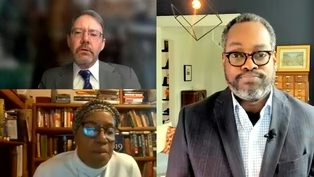
The Rising Cost of Water for Communities of Color
Video has Closed Captions
Clip: S50 Ep21 | 11m 19s | Michigan’s aging infrastructure and the rising cost of water for Detroit residents. (11m 19s)
Providing Support for PBS.org
Learn Moreabout PBS online sponsorship
- News and Public Affairs

Top journalists deliver compelling original analysis of the hour's headlines.

- News and Public Affairs

FRONTLINE is investigative journalism that questions, explains and changes our world.












Support for PBS provided by:
American Black Journal is a local public television program presented by Detroit PBS