Roots, Race & Culture
Buffalo Soldiers
Season 1 Episode 5 | 26m 45sVideo has Closed Captions
Explore the history, contributions, and legacy of Utah’s Buffalo Soldiers.
Long before Bob Marley, Buffalo Soldiers — Black Americans who served on the Western frontier during the Civil War — were changing the face of the American West. We explore the uplifting, courageous, and inspiring story of Utah’s Buffalo Soldiers. Historians Fiona Robinson and Robert Burch shed light on this misunderstood group of men who helped transform the state of Utah into what it is today.
Problems playing video? | Closed Captioning Feedback
Problems playing video? | Closed Captioning Feedback
Roots, Race & Culture is a local public television program presented by PBS Utah
Roots, Race & Culture
Buffalo Soldiers
Season 1 Episode 5 | 26m 45sVideo has Closed Captions
Long before Bob Marley, Buffalo Soldiers — Black Americans who served on the Western frontier during the Civil War — were changing the face of the American West. We explore the uplifting, courageous, and inspiring story of Utah’s Buffalo Soldiers. Historians Fiona Robinson and Robert Burch shed light on this misunderstood group of men who helped transform the state of Utah into what it is today.
Problems playing video? | Closed Captioning Feedback
How to Watch Roots, Race & Culture
Roots, Race & Culture is available to stream on pbs.org and the free PBS App, available on iPhone, Apple TV, Android TV, Android smartphones, Amazon Fire TV, Amazon Fire Tablet, Roku, Samsung Smart TV, and Vizio.
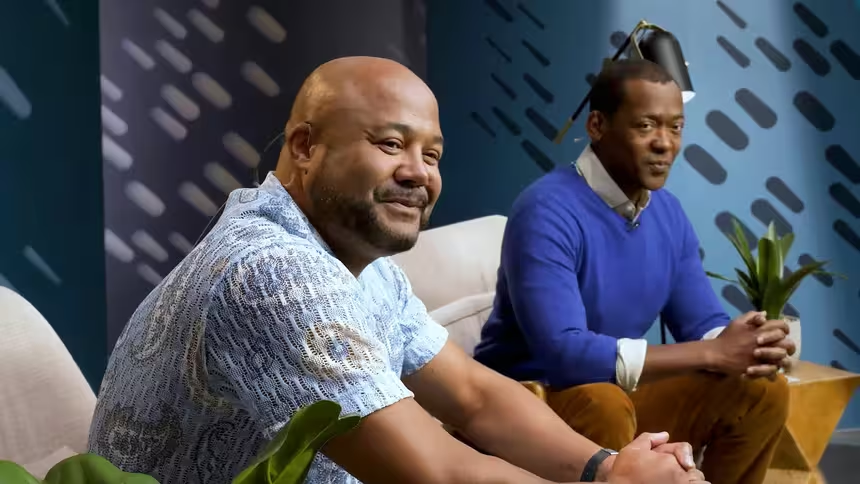
Welcome to Season 7
Bold and honest conversations tackled with humor, insight, and empathy.Providing Support for PBS.org
Learn Moreabout PBS online sponsorship(calm brisk music) - [Narrator] Roots, Race and Culture is made possible in part by the contributions to PBS Utah, from Viewers Like You.
Thank you.
♪ Yeah.
Yeah.
♪ - Welcome everybody to Roots, Race and Culture.
A new show on PBS, Utah, where we bring you into candid conversations about shared cultural experiences.
I'm Lonzo Liggins.
- Hi, I'm Danor Gerald.
Today, we are going to uncover a piece of Utah history that's so famous, people all over the world have been singing a song about it for decades.
And I'll show you.
- Here we go, this should be interesting.
He's about to tear it up.
- All right.
I'm no professional.
Gimme a chance to warm up here.
You guys talk amongst yourselves.
- Let's introduce our guests here.
Let's start with you, Fiona.
- I'm Fiona Robinson-Hill.
I'm a local and I am a researcher historian here.
- Awesome.
Good.
How about you, Robert?
- My name is Robert Burch.
I'm executive director of Sema Hadithi African American heritage and culture foundation.
And we work to tell the story of black folks in Utah.
- Awesome.
Well that sounds good.
Now let's hear the star of the show.
- All right here we go.
(continuous guitar music) - Not bad.
- I'll give it a three.
(all laughing) That's the world famous musician that's sang that song.
- Yes, not me, but Bob Marley.
- I was gonna say you.
- So "Buffalo Soldier," if you don't recognize it, that is a very famous song by Bob Marley, in which he's singing about our subject today, the Buffalo soldiers.
And he's in fact singing, not just about the soldiers in general, but he's actually in that song at one point, singing about Utah's Buffalo soldier.
So, let's jump into this, I can't wait to hear about this history and to share it with our audience.
- Let's hear about some of the historical stuff.
- Yeah.
We've got a photo of them.
So can you tell us who these people are Robert?
- [Robert] Well, those are actually the soldiers that are prepared to go to San Juan Hill and that's in the Spanish America war.
- [Danor] These are with the rough riders, right?
So these are the black soldiers that congress help establish?
What time period was that?
- In 1866, when the soldiers were initially separated from white soldiers in the United States.
And so those are them preparing to go to San Juan and we also have a flag from that battle at San Juan up at Fort Douglas.
- That's right, right around the corner right.
Now Fiona, you've been digging deep into this history here.
- Yes.
- Tell us a little bit more about the soldiers in general.
- So the Buffalo soldiers, they were the all African-American regiment in the United States army, and they came to Utah the first in 1886.
In the Uinta basin, and then they came to Salt Lake City, 10 years later, 1896.
- Okay.
So you've got two different groups here.
You've got those who are at Fort Duchesne, which is from what I understand, a cavalry, the ninth cavalry?
- The ninth Calvary.
And they established Fort Duchesne.
- They established the Fort?
Okay.
- They did, those were their orders to establish the Fort.
And then... - Why way out there in the middle of nowhere?
- They had specific orders to protect the mail route and help oversee native American affairs in that area.
Because they established the fort on the reservation that's out there.
- So why were they protecting the mail route?
What was going on in the mail route?
- Well sometimes bandits would try to steal mail and stuff like that.
- Really?
- Yeah.
- Also, so being a postman back in the day was... (all laughing) It wasn't just driving a little truck and dipping mail.
- Oh no, you had to have a gun.
- So that's what they were there for?
Just to help to protect that route, to make sure that no bandits stole anything and.... - But also when you say to oversee Indian affairs, because at this point in Utah's history, there's a lot of people coming from the east, from Nauvoo, we have a lot of settlers, a lot of them LDS.
And they're mixing with all of these natives who are already here, right?
So why did the U.S. send these soldiers here?
To just keep the peace or what?
- Yeah, to keep the peace.
And they were a federal presence in the area.
So there was not really any law out there.
So to say like Salt Lake City was several, like a two day journey.
And so there was, and then the closest one was Colorado.
So there was no jurisdiction really, Utah wasn't a state.
It was just a territory.
- Wow.
So we're talking the roots of the state here.
There were black soldiers here helping get things under control and settled and keeping the peace?
- Right.
- Can I ask a quick question?
To take it back and keep it really basic?
How did they even get the name Buffalo soldiers?
Where did that come from?
- Right, that's a really good question.
There's a couple of theories floating around, there's the main one that people associate with and it's the physical description of Buffaloes and then associating it with African-Americans being with like the association with Buffaloes and... - And they were known for their fierceness in battle as well by the natives.
And that is something that, that name was given to them by the native Americans.
So here we have a shot of some of the Buffalo soldiers and these aren't necessarily those here in Utah, but you can see them wearing Buffalo hides even.
And from what I understand, these natives gave them that name because they were very fond of the Buffalo.
They reverence that animal and so they gave them that kind of street cred.
(all laughing) Well you can see the soldiers really trying to take advantage of it too.
I mean, I'm gonna be a Buffalo, let me put on a Buffalo skin.
Let me put on a Buffalo hat and you know.
- And they hadn't really even seen a lot of Africans I'm sure at point, the natives here.
- Right, and so it was a very like sacred animal to the native Americans.
And I like to say, they adopted that with honor, that name.
It was a like, "Yeah, I'm gonna call myself a Buffalo soldier."
And it did like when Buffaloes were cornered, they fought with everything they had to the death.
And that's why like during the Indian wars time period, the Buffalo soldiers were out there fighting and that's what they did too during those time periods.
- So just how many soldiers are we talking about here in Utah?
these black cavalry and infantrymen in Salt Lake?
How many are we talking about?
- By 1896, there were over 600 soldiers in Utah.
- That boosted the black population.
- Yeah that changed the demographics dramatically.
Of course they were here with their families and their kids and stuff too, right?
- Yes.
- So that's even, there was even more black people.
- That might be more black folks than there are today.
(all laughing) We might have had a population increase.
- We hot half of them right here.
(all laughing) - At that time period, wasn't that a bizarre thing to have like these 600 black people running around because Utah at that point didn't have a lot of black people running around, right?
I mean, what was a black population prior to that?
Do you know how many black people were there?
- African-Americans had started coming with the regular settlement in 1847.
So at least that I can think of right off the top of my head probably about 20, 30 slaves and the rest of free people, business people, things of that nature.
- This was the majority of black people in Utah were these soldiers basically from the settlers?
- Around that time it probably would've been, and then later with the coming of the railroad, would've have increased that population dramatically.
- People coming to work on the railroad.
- And then, when they did the census, they would've been counted amongst the citizens.
So these were actually like considered citizens of the state And so it wasn't just like, "Oh, they're just visitors.
They're just here for a short time period."
When they did the directories, they were considered citizens.
So it wasn't just, they're just visiting.
They're just here for a short time period.
These are actually citizens of the state of Utah.
- How much did they impact the development of the state?
Were they well known?
I mean what kind of... - The things that the soldiers provided were a lot of infrastructure things from roads, of course like Fiona said, the protection of the mail, and you would think later on with the coming of telegrams and railroads and all of those type of infrastructure type of thing that were needed, not just construction, but protection of what was being constructed.
So they really helped provide some of the basic infrastructure for Uinta basin and other places.
- And is there a lot of this history in the state of Utah?
Where do they talk about this?
You grew up in Utah.
Is this something?
- I grew up in Utah too?
I didn't hear about the Buffalo soldier.
I didn't hear about them all.
The only time I heard about them was through Bob Marley's song, and I would love after you guys talk about this, to hear about some of the lyrics in the song and how they actually relate to what happened in Utah.
- I was never taught it in school.
I never heard about it.
Not until I was an adult and someone pointed out at the Fort Douglas cemetery, that's where the Buffalo soldiers are buried.
- Oh, right around the corner.
There's right here.
- Yeah, right around the corner.
But even here, the Uinta basin, they were part of a lot of the infrastructures, but here in Salt Lake, when the 24th infantry got here, the band was a major part of the social gatherings.
They played baseball, they were part of parades.
- And I really wow.
- Really part of the social gatherings of the city.
- Wow, you know, we actually have a photo of some of these black families at the Fort Douglas cemetery from back in the day.
So take a look here.
You can see that is probably a holiday celebration where they're all there.
It could be a Memorial day or something.
- [Lonzo] Yes probably memorial.
- [Danor] Probably Memorial day.
And so right there around the corner and look at how many families, I mean, it's a very old photograph obviously, and here we are at some sort of a parade and you can see them marching right there.
- [Robert] That's in Salt Lake.
That's old school Salt Lake.
- [Danor] Salt Lake City.
Actually, this is the 4th of July.
You can see in the bottom corner there.
They're celebrating here the 4th of July.
And so I gotta tell you something, I'm a transplant to the state of Utah, here connected in a lot of ways in an ecclesiastical nature.
I had no real connection to Utah growing up, but you don't hear very much.
And I've done a documentary about early black pioneers.
You don't hear much about them.
And there were very few, but to see that many black citizens, walking through the streets, playing their musical instruments, participating, that's a really big deal.
- Yes.
- Well, there's a really a conclave in Central Salt Lake City, near downtown where African-Americans frequent.
And that's a project that we're actually working on to show that.
And that's what was one places that the soldiers spent a lot of time in downtown Salt Lake, along I think that it used to be called Wester street.
I think it's main street now.
- So this is another project that your foundation's working on?
- Yeah.
- Well, talk about your foundation too, because your foundation's called the Sema Hadithi.
What does that mean?
- That means, say the story or tell the story.
We found out a lot of people do their genealogy research, but we have to share that.
And that literally changes the narrative of what the American history, American story is, is when we also share our story.
So it's not about changing the story, it's the chapters that are missing.
And that's what we wanna do in Downtown, Salt Lake and other parts of Utah.
Add those stories to the book.
- I'm hearing all this for the first time growing up here, I've been to Utah for 30 some odd years.
I moved here when I was eight years old, my father was in the military.
And it begs the question, why isn't this stuff told?
Why don't we hear about the Buffalo soldiers in Utah history?
I heard about everything else in Utah history and not it.
- It's not even just Utah, right?
It's kind of a revisionist history in the United States generally speaking.
I mean, there's a ton of people and things that took place that just gets swept under the rug and buried.
- And I'm glad you brought that up because there's this picture of Teddy Roosevelt and he's, I can't remember what the battle is, and it it's the battle of San Juan And that's mentioned in, there's a picture of Teddy Roosevelt.
In that picture, he's at the center of the picture.
Most of those pictures, when they show those pictures, are centered on him, they crop out the black people that are at to the right and to the left of him.
And they just show him and the white soldiers.
- Right, the rough riders.
And the thing about that, those soldiers who fought with him were the 24th infantry who were stationed here, right around the corner from us, like a stones throwaway at Fort Douglas, right?
Fort Douglas.
And so that's the 24th.
- Yes.
- And in the song, this really didn't click for me until just a few days ago, in the song at the very end, he says... - Just the Bob Marley song?
- Yes, In the Bob Marley song, "Buffalo Soldiers," he says, "Trodding through San Juan in the arms of America."
And I used to think, okay, that's the arms of like, but it's not, in the arms with the guns, here they are.
This is a historical painting of the Utah soldiers, the 24th infantry fighting in this war with Teddy Roosevelt.
And they were the first people at the top of the hill.
- Trodding through San Juan in the arms, meaning guns.
- And wearing with the guns of America.
- And that's what I was referencing earlier.
Like literally this song is world famous.
And people are singing about Utah.
And Utah doesn't even teach this fact.
- Right, and again, it's significant that banner that end up being placed at top of that hill.
It's the banner that's still at Fort Douglas now.
You can go over and see that banner now that those African-American soldiers placed there when they took San Juan Hill.
- So when the 24th got to Utah, all the regiments of the 24th were in Utah, were in Salt Lake City.
And they came to Salt Lake and they were called to the battle front in San Juan.
And then they came back to Salt Lake.
So anytime you hear about the 24th in San Juan, it's the ones that were in Salt Lake and they left Salt Lake and then they came back to Salt Lake.
So anytime you hear about the 24th or the Buffalo soldiers, even if it's the ninth Calvary, those are the ones in Duchesne, and they left Duchesne, they left Salt Lake, then they came back.
So it's our Buffalo soldiers that were down there.
- And you can see some artifacts from here because you're working with the museum at Fort Douglas and the curator there.
What's his name?
- Boe.
- Boe.
- Burges.
- Burges that's right.
He's been really helpful in helping you find some of this information.
And they're doing a pretty good job over there of trying to preserve this history.
- Yes, and again it's an organization that we've partnered with because there's so much we want to do on Buffalo soldiers from reproducing their uniforms.
To having enactment of some of their military leaders like Allen Allensworth, who was the chaplain there, he was the black chaplain there at Fort Douglas.
As well as Brigadier Charles Young, he was one of the officers there at Fort Douglas as well.
So we wanna make sure that we work with Fort Douglas to represent those soldiers and get people to understand that the significant black soldiers who came through Utah are one who did outstanding jobs in the United States army and really achieved high rank.
- Well, and I understand you guys are working on a really cool project to help make this happen.
A graphic novel?
- Yeah.
- And this is where your research really is centered on, is finding all the information to fill this novel.
So we have some images from that.
- [Lonzo] That look amazing.
- [Danor] Tell us about this one.
- [Lonzo] And I wanna hear about Fort Damn Shame.
Tell me about Fort Damn shame.
- [Fiona] Fort Damn Shame was a nickname because it was actually a failure the first six months.
So they actually nicknamed it Fort Duchesne was called Fort Damn Shame.
- [Lonzo] Drunk disorderly.
- [Danor] Wow.
Oh, that's the... Wow, so you're telling the story of those soldiers from Fort Duchesne and is the Fort Douglas, the 24th, are they in this novel as well?
- [Fiona] This is the ninth Calvary at Fort Duchesne in the first six months.
- [Robert] And it really talks about, wanna talk about their challenges because it did start off as a failure and because the soldiers decided that they wanted to make this happen, they made sure it happened.
The leadership was not necessarily there for them to be successful.
And so they took it upon themselves to make sure that that Fort became what it was supposed to be.
- Wow, that is phenomenal.
And I really just feel like you being able to put this history into that kind of a format really gives it an opportunity to reach the young audiences.
Who are not gonna necessarily hear this in school.
And so my commendations to you for coming up with this idea.
Where is the novel in terms of publication?
How far are you in the development of the project?
- Oh, we're quite away out.
Fiona is the main writer on it.
And Riley Jensen is the artist that you see here.
- [Danor] Beautiful artwork and great story teller.
- The first time I saw her artwork, I knew that we had to make a commitment to doing this because the work is beautiful, the story is beautiful, we just need to make it come alive.
- That's fantastic.
- These are some great guys that we need to remember.
- I've got a quick question for you.
Do they talk about Buffalo soldiers outside of Utah?
Are there... - Yeah.
- In Texas we talked about them.
- It's really big in Texas, New Mexico, Oklahoma, Kansas, Montana, but for some reason, Utah, it's just not a big deal.
- So we've gotta get Utah up to date?
- Yes.
- Yeah.
- And this is where it starts?
- This is where it starts, by educating people.
And you guys are doing some work in order to get that done.
- Some of the most exceptional military leaders, black majors served here at Fort Douglas.
So we need to make sure that story is told.
- Wow, and I love that we are taking this part of a culture that's really unknown, that's a part of the state history and we're bringing it to light.
Now we also have a really cool place that we discovered where there's some culture, right here in Utah, that you would not expect to be here and it has to do with food.
And so let's go ahead and check this out.
It's an authentic family owned and operated Jamaican restaurant.
And it is right up there, at parleys canyon.
So take a look at this.
- [Narrator] Ski country.
- Meke Dayz, owner, chef, Jamaican born, way of New York city and now living in Parksville, Utah.
Jamaican personality we are very assertive.
Say what we wanna say.
Same thing for us being a New Yorker.
I just kind of had to tone down my aggression a little bit.
I got closer to God in many ways here, because this place is beautiful.
I believe I've been here 15 years.
My mom, I believe 17 or maybe 18 years.
We all do everything.
My mom is the main chef.
I'm a chef as well.
So as my sister, my dad helps with keeping us together organized and he keeps the place looking fresh all the time.
- It's a joy, you know.
It's good to know that you are doing something for yourself as a family too, because it's very hard but I love my family and we get along very well.
That's why this work, you know?
- We wanted people to step into Jamaica.
- I'm sure there's something that means something in every spot in this restaurant.
- Yeah, like this is our grandmother's.
This is how her windows looked in her home.
We wanted to bring her to life in here as well.
So this is hers too, even though she's not with us anymore.
- I mean being professional in the kitchen has been in your family for generations.
- Yeah, anything we touch is gold.
- [Danor] How did you guys become so good at this?
And end up in Utah and all that?
- So my great grandmother, her name is Florence.
She was a chef for two Asian families in Jamaica, their personal chef for years.
She walked 11 miles to and from work.
And she would come home every day and cook dinner for her 11 grandchildren and my mom was one of them.
So my mom was just always so inspired by her grandma.
She was an amazing chef.
Like anything, she touched, turned to gold.
And obviously my mom got the same blessing.
She passed on to us.
So we were like, "Okay, we're gonna open the restaurant here."
- Years ago, I came into this kitchen which used to be a juice bar.
And I said to the lady, "Can I see the back of your kitchen?"
And she showed me the back of the kitchen and I said, "Perfect, this would be the perfect place for the restaurant."
And then two or three years ago, she closed the business and I came in and pursue it.
And I'm like, "Yeah, it was the perfect place for us."
- So you are drinking a homemade ginger beer made from fresh, arm-grated ginger, a little lemon and brown sugar.
This is a beef patty, which Jamaica's very well known for.
It's a pastry crust again.
So it took me four years to work on this because of the altitude.
So this is really all homemade and... - So this is are your specialties?
- Yeah, this is my recipe.
- Oh my goodness.
- It took me forever.
- Wow.
That is the real deal.
Where do all these spices come from?
All the influence there?
It's such a small island.
You would be surprised to have so many different.
- I agree.
So Jamaica, the Taino Indians are the ones that live on the island and then the Spaniards came in, and then from the Spaniards came, they brought over Africans and then the Asians too migrated to Jamaica.
So all those Indian spices, Asian spices, Spanish spices, African, that's all a part of Jamaican culture.
Basically four different cultures wrapped up in one in Jamaica.
- So I'm tasting the world here.
- You are.
- Man, I wish I was eating that right now.
- Yeah, that tell you that beef patty, that food was 11 outta 10. it was off the charts.
Yeah.
You gotta go and check that place out.
- It's great family.
- Yeah.
Good family.
But I love that cultural influence right here in the state.
Now can you give us some more information about Sema Hadithi, where we can find some more of these projects?
because there's much more to talk about here than we have time for.
- Oh yeah.
We have a great team of researchers about 40 in total that are working on the history of black people in Utah.
But if you go to SemaHadithi.org, you can go on and just make sure you sign up to go into the museum, sign up for our newsletter.
And you'll get a lot of information of all of the projects that we got coming soon.
We're gonna be working on an equal justice initiative project, a mural for Richmond park, a lot of different projects coming up here in this June that you would see us working on.
As well as Buffalo soldiers of course.
- That's great.
That's great.
- That's awesome.
And you know, and speaking of another resource for black people in Utah, the Utah black chamber of commerce has just come out with a book and it is "Stories From a Thriving Community" from black people in the past and the present and how they've helped to build this community.
And of course we'll have that information on our website for those of you that wanna check that out.
- Well, I just wanna say thank you guys for sharing this information, for bringing this to life for Utah, for the students, for the audience, for the people.
I'm so happy that we were able to bring this story to people and share their history.
I'm sure these people are happy that their story is being told.
- And I hope there's more stuff we can put up with it, and we're gonna talk about this some more.
We want you guys to stick around and we can go into a little bit more detail about the history of this and really dig deeper into what it is that they brought to the state.
And what it is that we can do to help make their stories last longer and make their stories become a permanent part of Utah's history.
Because I'd love for my kids' kids to learn about this in school.
- Definitely.
- Right.
So thank you guys for your time.
- Thank you.
- All right.
Perfect.
- All right.
So join us next week.
As we discuss a new topic that affects your life every day, no matter how light or dark your skin is, in fact, it impacts you because of how light or dark you are.
Next time on Roots, Race and Culture.
Bye for now.
Take care y'all.
- [Narrator] Roots, Race and Culture, is made possible in part by the contribution to PBS, Utah, from Viewers Like You.
Thank you.
(steady upbeat music)
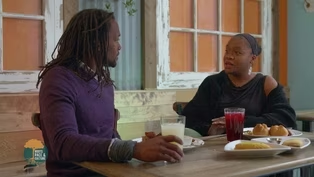
Video has Closed Captions
Clip: S1 Ep5 | 4m 1s | Good food isn't the only thing being served up at this authentic Jamaican restaurant. (4m 1s)
Buffalo Soldiers | This Thursday!
Preview: S1 Ep5 | 30s | We'll discuss one of Utah's most influential — and unknown — groups, the Buffalo Soldiers. (30s)
Extended Interview - Buffalo Soldiers
Video has Closed Captions
Clip: S1 Ep5 | 13m 32s | Learn why some early Utah settlers didn't want the Buffalo Soldiers to leave. (13m 32s)
Providing Support for PBS.org
Learn Moreabout PBS online sponsorship













Support for PBS provided by:
Roots, Race & Culture is a local public television program presented by PBS Utah