
Building Michigan's Future Workforce, Trumpeter Kris Johnson
Season 6 Episode 24 | 26m 46sVideo has Closed Captions
Building Michigan's future of work and Detroit jazz trumpeter, composer Kris Johnson
This week, One Detroit calls back conversations from our latest Future of Work Town Hall to learn how the state's workforce and economy need to change to stay competitive. Plus, Grammy-nominated jazz trumpeter and composer Kris Johnson joins WRCJ's Cecelia Sharpe to talk about his role directing the Detroit Symphony Orchestra's Paradise Jazz Series Big Band debut performance.
Problems playing video? | Closed Captioning Feedback
Problems playing video? | Closed Captioning Feedback
One Detroit is a local public television program presented by Detroit PBS
Building Michigan's Future Workforce, Trumpeter Kris Johnson
Season 6 Episode 24 | 26m 46sVideo has Closed Captions
This week, One Detroit calls back conversations from our latest Future of Work Town Hall to learn how the state's workforce and economy need to change to stay competitive. Plus, Grammy-nominated jazz trumpeter and composer Kris Johnson joins WRCJ's Cecelia Sharpe to talk about his role directing the Detroit Symphony Orchestra's Paradise Jazz Series Big Band debut performance.
Problems playing video? | Closed Captioning Feedback
How to Watch One Detroit
One Detroit is available to stream on pbs.org and the free PBS App, available on iPhone, Apple TV, Android TV, Android smartphones, Amazon Fire TV, Amazon Fire Tablet, Roku, Samsung Smart TV, and Vizio.
Providing Support for PBS.org
Learn Moreabout PBS online sponsorship- [Will] Just ahead on One Detroit, we'll take an in-depth look at the future of Michigan's workforce.
Our panel of expert guests, provide insight into where the state stands now, where it's heading, and what it will need to stay competitive for years to come.
Plus, Grammy nominated trumpeter and composer, Kris Johnson, sits down with WRCJ host, Cecilia Sharp, to talk about the debut of the Paradise Jazz Series Big Band at orchestra hall.
It's all coming up next on One Detroit.
- [Female Narrator] From Delta faucets to bear paint, Masco Corporation is proud to deliver products that enhance the way consumers all over the world experience and enjoy their living spaces.
Masco, serving Michigan communities since 1929.
- [Male Narrator] Support for this program is provided by, the Cynthia & Edsel Ford Fund for Journalism at Detroit public TV, The Kresge Foundation.
- [Female Narrator] The DTE foundation is a proud sponsor of Detroit Public TV, among the state's largest foundations, committed to Michigan focused giving.
We support organization that are doing exceptional work in our state.
Visit DTEFoundation.com to learn more.
- [Male Narrator] Nissan Foundation and viewers like you.
- We're starting off this week's One Detroit with an important conversation about Michigan's workforce, workplace, and the work itself, with our new future of work initiative.
Where does Michigan stand in efforts to build a strong workforce that will keep the state competitive for years to come.
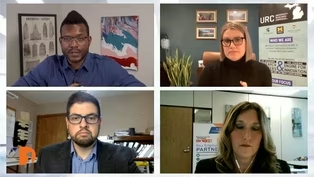
Chad Livengood, senior editor at Crain's Detroit Business, joined me for the first of our monthly town halls on the future of work.
The discussion covered wages, attracting and retaining talent, and meeting the needs of employers.
Here's a portion of that conversation with guest panels, Britany Affolter-Caine, from the university research corridor, and Jennifer Llewellyn, from Oakland County Michigan Works.
(bright upbeat music) According to Forbes who ranks Michigan 40 based on when they look at the GDP of the state for 10 years, five years, quarter of a quarter, like I said, they have us coming in at 40.
The US News has us 22nd in business environment, 41st in employment and 25th in growth.
CNBC has us 11th, and my favorite is Thrillist, which has us at Number 1, but that may not be the most accurate depiction of the state.
So, my first question to you is, does this matter?
Do rankings really play that big of a role in how our states' perceived, and might that affect our business competitiveness?
- Particularly when you're a policy maker, you wanna look at these data and you wanna be able to benchmark Michigan versus other states.
Right now, there is, at least in my mind, sort of an obsession with some of the Southern states that are seemingly on the rise.
Particularly when it comes to the automotive industry, just think about back in last fall, when Ford motor company announced they're gonna invest $11 billion in four different plants in Kentucky and Tennessee.
That got a lot of policy makers out of their seats because here's a hometown automaker building a new electric vehicle assembly plant near Memphis with a battery plant, and then more battery plants around south of Lewisville, Kentucky, in order to spur the next generation of automotive innovation with EVs.
People wanna look at some of the stats related to those states to see, what is Tennessee doing that we're not doing.
A common thing people talk about is, well they have a lower income tax, or Florida doesn't have an income tax.
Everyone always wants to gauge against that.
I think you have to kind of go back and look at educational attainment, and focus less on what is the tax policy, and get a little more focused on, where do Michigan workers stand as far as being prepared in the workplace to compete with other workers in other states and other countries.
- Before we get into talking about developing talent and what we could be, what was the last time where Michigan was in a really good position, where we were leading the country, if we were leading the country, when it comes to our business competitive, to our wages, to the places that people were able to live, and enjoy, and raise their families.
- Yeah.
I mean, on business competitive, all the different scales, we are vastly better than we were, to say the least.
A big part of that is tax policy, think back to 2011, when then Republican governor Rick Snyder and the Republican legislature got rid of what is now called the Michigan business tax.
It went to a simplified 6% corporate income tax, and it was a $1.8 billion a year tax cut for businesses.
They've made major reforms for property taxes for businesses.
There has been a immense number of policies that have boosted the standing the business climate for Michigan, which some of those rankings said we're 22nd, we were 42nd 10 years ago.
I mean, we were in the bottom 10 then for sure, but this educational attainment is really starting to creep up on us.
And some of our panels we'll get into that today because we are just a lagging region and our major city, Metro Detroit, the metropolitan area, it's just lagging other comparable metropolitan areas.
When you co compare us against Atlanta, Minneapolis, Cleveland, we just have fewer adults with bachelor's degrees, and that is spelling trouble long term for both the diversification of our economy and also maintaining that automotive industry.
- Jennifer, we can start with you, what to you makes this time right now so urgent for us to get these kinds of things right?
- Anytime we come out of an economic disruption, it's a great opportunity for individuals to reassess businesses, to reassess government, education, to reassess what are the opportunities.
And when you look at the electrification of vehicles, when you look at industry 4.0, you look at the transformation that the healthcare industry has endured over the last few years, there's a real, a appetite right now for individuals to pursue new opportunities, to pursue post-secondary education.
The governor's 60 by 30 goal, to have 60% of Michigan residents with the industry recognize degree or credential, really set the bar high.
In Oakland county, County Executive Dave quilter, set the Oakland 80 goal.
An ambitious goal to have 80% of Oakland county residents with that certificate or degree, and programs like Michigan Reconnect that are offering free community college tuition to any Michigan resident 25 or older.
As difficult as COVID was and the pandemic was, and as much of a disrupt option is that caused the workforce and particularly challenges for our businesses, this is a really exciting time looking forward, at least from a workforce development perspective.
- As we're thinking about that, I guess the biggest question is, how do we create the talent that we will need, that will drop business here?
- It's really important universities prepare students for work, for being employed anywhere in the world.
We do, however, we're good stewards, we live here, Michigan is our home, and so we wanna make sure we are building really important relationships and pipelines to employers here in the state.
And all three of my Institute are engaged, and then I know universities across the state are, public and private.
I think it's also important that we extend the conversation beyond just the recent college graduate, to think about all of the alumni and the continuum of the career, and what would attract them home.
A few jobs ago, I was a talent director for Ann Arbor spark, and I can't tell you how often I got requests from folks who were looking to come home after having been in California, or Texas, or Boston, or wherever, because this is a good place to raise their family.
And so, we gotta think about the entire continuum.
- What does it look like if we do this successfully?
If we in invest in the right things, if we help educate our future employees, what does that look like?
- We have two, I would say clear cut examples, maybe even three.
One is rocket mortgage, Quicken loans.
They were a growing, but still small.
4,000, 5,000 employee mortgage company out in the office parks of Livonia, when Dan Gilbert, moved the company downtown around 2010.
And, now there's like somewhere in the neighborhood of 17,000 employees in downtown Detroit.
That's largely result of its growth, and also Dan buying up like every vacant office building along Woodward avenue that he could get his hands on, but that brought reinvigoration to down the downtown core, and it brought more people.
I mean the company never releases data, but I've run into so many countless Quicken employees over the years, who moved here from, they went to UCLA, they got it recruited.
They started at Quicken in an office in Phoenix, and they got transferred to Detroit.
I mean, that's one example.
They're a competitor in the wholesale market, up the road in Pontiac United wholesale mortgage, they also have had similar success in having a job set requires a certain type of skillset and attracting people to the state.
- Yeah.
That's a tough question.
And the truth is they probably won't see it for a while.
It will have a lag time for that.
One of the questions you had asked us earlier was, what are some of the roadblocks or barriers to future progress?
One of the things I'm gonna shine a light on that I think is really a good thing, this past year we had incredible bipartisan support to pass in record time, an incentives package to attract key projects to the state.
We can do it.
We know we can, that's proof of concept.
We probably need to then take that next step and start to play the long game.
We're not particularly good at that in Michigan, life sciences corridor and so on, there's some examples we can point to, but we could be good at it.
It's just going to require that not everyone's going to feel the benefits equally at the same time, but we have to make every effort to ensure wherever we're making these investments and planning for the future, that everyone will eventually benefit, and that we recognize that we're all in this together.
We're not Southeast Michigan, we're not west Michigan, we're not the UPA, we're Michigan.
- Finally, Jennifer, your thoughts on how Michiganders might feel the correct path being taken, again, at a time where it seems like we are so close to seizing certain opportunities that we may not get again.
- Yeah.
I think it ultimately comes down to three basic things.
I make it sound basic, it's obviously much more complex than that.
But it comes down to good jobs with competitive wages, it comes down to investing in people, whether that's the supports that they need, and building strong communities.
And if we can leverage these opportunities to accomplish those three things, good jobs with wages, investing in people and building communities, the rest will fall into place.
So I know I'm oversimplifying a lot, not just a bit, to Brittany's point, we come up with each new change in administration, we have new programs, and new focus, and new investment, and then we change the legislature and then it happens in DC as well, and we've not developed a long term sustainable strategy around how the state intends to invest in workforce development, economic development, longer term.
Our missions here in Oakland is, really making sure that people know that the workforce system is here, it's accessible, it's easy to use.
You can call, you can email, you can reach out to a career advisor at any point because people do need to see the benefit.
It's what's in it for me.
How will this change my circumstances?
How will this change my family?
How will this change my future?
And we all have a responsibility to do that.
- Can you still make it to the middle class, if you're working in a service industry?
Is that possible?
- If you get into an electrician journeyman track, you can make a pretty good living.
There's just a problem with this notion that don't go to college, we need more people to go become plumbers.
We only need so many plumbers.
I mean, there is a maximum plumbers at some point in the economy, but right now, like we cannot get enough people to write software code in this state right now.
One key stat we haven't talked about, in Southeast Michigan, there are 800 thousand living breathinging adults between ages of 20 and 60 right now who have gone to college and not finished.
These are the folks who have the potential to get retrained to learn a new skill, even in their 40s or even in their early 50s, because we know people are are working longer, as a society we haven't saved, and several generations have not saved as their parents did, so they're gonna be working almost till 70 if not longer.
And so there is a trajectory here where there's of opening and growth for people to get retrained even an elder age, and learn a new skill and adapt to a changing economy.
Because otherwise you are pretty much kind of restrained to working in the service sector.
And yes, the service sector has definitely grown tremendously, but that's also why we have so many families, majority of families in the state, who live below this, what's known as ALICE state.
They simply, they are employed, they're working every day, but they just don't make enough, and make ends meet to support a family and such.
And so they're living on the edge paycheck to paycheck.
- Brittany, we'll leave it to you.
Your last thoughts.
- I wanna leave on a positive.
I mean, it's always good to know what you're up against, but we are the envy in many ways.
We have these amazing institutions.
My three universities, the universities across this state, very diverse landscape of higher ed, and we've got really strong government in the county level and the state level entities like Michigan Works, that can help us.
These are assets if we try to build them from scratch would probably not be very successful.
They're here and we can leverage them.
And we are a creative group of people here in the state, and so we need to come together and play the long game.
- [Will] Some of the biggest names in jazz are making an appearance at this year's Detroit symphony orchestra paradise jazz series.
Among the performers, is Grammy nominated trumpeter and composer, Kris Johnson.
He's directing the debut performance of the Paradise Jazz Series Big Band, on April 30th at orchestra hall.
The ensemble features top Detroit musicians and special guests from around the country.
WRCJ host, Cecilia Sharp, sat down with Johnson, to talk about the concert and Detroit's rich jazz community.
- You've been across the world, around the world, performing, composing, arranging, teaching, and you're back here in Detroit.
Coming up on April 30th, you will be leading, let me get this right, the Paradise Jazz Series Big Band, with special guests, Kurt Elling and Terence Blanchard, and this is all under your direction.
Talk about that upcoming concert.
- I have always had a dream of leading my own big band.
For as long as I can remember, wanting to arrange for big band, wanting to be a part of something larger than life.
I remember when I joined the Basie Orchestra, I was so excited to be in that section, so excited to be a part of that group.
But then I immediately was like, okay, I wanna write for this group, that was the next ambition.
Like, great, it's great on playing trump, but I wanna write for this group, so I started submitting arrangements.
So it's always been, I'd say, playing and writing have always had this dance with me and always been essential to who I am.
And this opportunity came up, and honestly, like, it's almost like why hasn't this existed sooner.
To be able to have a group of young professionals from Detroit, that are really representing the jazz paradise jazz series at Detroit.
And so we're really honored to do that.
I'm so honored that I was selected to be the musical director for this, and we're gonna have a absolutely fantastic performance.
Terrance Blanchard has long been my musical idol, Just, I look up to him so much.
I've been a huge fan for as long as I can remember, and honestly has really influenced my career in many ways, especially his work in film, his combination of being a band leader and being a ranger, being a composer, so I have that opportunity to share the stage with him.
And of course the great Kurt Elling, who's gonna be singing with us and all of the wonderful musician that I've played with for years in different capacities to come together into this big band is going to be absolutely dynamite experience.
So definitely don't wanna miss that one.
- Let's back things up.
How did you get started in music?
- I come from a musical family.
My dad was actually a bass player, my uncle a keyboardist, and music was always around me.
Like most of us in the African American community, especially in Detroit, grew up in church, just hearing music, being exposed to it, but I honestly was a bit of a late bloomer when it came to actually latching onto performing music.
I took piano lessons like everybody else, kind of tried to sing in the choir, that type of stuff, but it wasn't until my freshman year of high school that I started getting serious about music.
And it was actually a mutual friend of ours and my mentor, Damien Crutcher, who really was the first person to see something in me and really believe in me and kind of instill that like, you can do this attitude.
He actually used to call me professor Johnson.
I'm talking about from like freshman and sophomore year on, it was always professor Johnson to this day.
He kind of just saw that, he has this gift to see things in people.
And honestly, through just working together with him, and starting to participate in youth ensembles through Detroit symphony orchestra, Michigan state university, University of Michigan, lyric chamber ensemble, you name it, really just the programs that were available in the Michigan area, really just like shaped me as a musician.
And then went on to Michigan state university and the rest is history.
- Can you talk specifically about the impact of Detroit's rich jazz community, impacting you as a musician and preparing you for your career?
- Absolutely.
To be honest with you, I didn't realize how lucky we were.
I mean, I was so excited to be around the music, but I didn't really feel to realize what the history of Detroit was until I started having more experiences outside of Michigan.
I remember my freshman year of high school, I started getting to jazz, my brother actually took me to the Detroit jazz festival, which as you know, is the largest free jazz festival in the world.
He took me there.
I was convinced that I didn't like jazz.
The only type of jazz that I had heard was smooth jazz and I worked at the family nursing home.
And I had this association with smooth jazz and like, the smell of bleach from being a Janitor there.
So to me, I don't know, like I was really into RnB and hiphop, I started to get into classical music, I thought I didn't like jazz.
My brother was like, come on, you gotta come to the jazz festival.
Took me there, and my mind was blown.
I remember seeing someone on stage improvising on trumpet, and I was like that's what I want, that's freedom, that's everything, that's expressiveness, that's exact I'm looking for.
And I remember I made a distinct decision at that point, that that was what I was gonna pursue.
- You were recently appointed as director of Michigan state university's Community Music School-Detroit.
What is your vision for CMS-D under your leadership?
- What's beautiful about this program is, if you look at Community Music School-Detroit, actually in east Lansing, they started a community music school in east Lansing, and it really served as an outreach program as well as a way to connect the community to what Michigan State University was offering through the college of music.
And really it's an extension of the work that's being done there.
And for me, as I walked into this position just a few short months ago, I was really just blown away by the connection that the school has already to the community, to the wonderful instructors that we have down there teaching our students, and also noticing that we are already providing lifelong education to the city of Detroit.
So we have early childhood music, there's music therapy, there's sequential instruction for grade school students.
We also have adult ensembles, adult lessons, so many different things with music technology and production literacy.
It's really amazing.
And so for me, I feel like my role, is to one, of course, help us to be as effective as possible in making sure that we're reaching as many students as possible and doing so in a great way.
But also two, to take the opportunity, to make sure that everyone is aware of the resources that we have and to help remove any barriers that anyone might have in order to be able to study music.
So our goal is, we could have grandchild, mother, and grandmother, all studying at the same institution and to be able to come in and get the resources they need.
To me, it's a natural continuation of the work that I've been doing for my whole career, and that's really just to be able to share the joy of music in a deep and insightful way.
And I'm really proud of my team, I'm really proud of the work that we're doing in the community.
- Kris, with everything that you are doing, you maintain such a humble confidence.
You're confident about what you know, yet still open to learning and growing.
How do you maintain that balance?
- In terms of the humility, it's, I know so many great people, let alone great musicians.
There's no way that I can get a big head about it.
I'm just surround constantly by musicians who are better than me, I'm surrounded by people who are just fantastic, that I look up to and aspire to learn from, so there's really no room for that.
And some of the most talented people that I know, some of the most dynamic people that I know, are also some of the most giving, caring, and humble people, and I really aspire to honor that legacy.
And that's something that's just really important to me.
Confidence has been a work in progress.
What I've noticed is, in the times where I haven't felt confident, in the times where I was unsure of my ability, or possibly even suffering from imposter syndrome and worrying about whether or not I was worthy to be in a position, I noticed that I had the opportunity to thrive, I noticed that the resources were there to be able to help me along my journey, that I noticed that I always showed up and did the work.
So even if I'm not confident in my ability to complete a task right away, I'm very confident in my ability to adapt, and to learn, and to grow, and do what I need to do to live up to that.
So I think confidence is all so about work ethic, and confidence is also about being able to go after what it is that you know is right and what is meant for you.
- [Will] That will do it for this week's one Detroit.
Thanks for watching.
Make sure to come back for one Detroit arts and culture on Mondays at 7:30 PM.
Head to the One Detroit website for all the stories we're working on.
Follow us on social media and sign up for our weekly newsletter.
- [Female Narrator] From Delta faucets to bear paint, Masco Corporation is proud to deliver products that enhance the way consumers all over the world, experience and enjoy their living space.
Masco, serving Michigan communities since 1929.
- [Male Narrator] Support for this program is provided by, the Cynthia & Edsel Ford Fund for Journalism and Detroit Public TV, The Kresge Foundation.
- [Female Narrator] The DTE Foundation is a proud sponsor of Detroit Public TV among the states largest foundations committed to Michigan focused giving.
We support organizations that are doing exceptional work in our state.
Visit DTEFoundation.com to learn more.
- [Male Narrator] Nissan Foundation and viewers like you.
Building Michigan's Future Workforce: Where to Go From Here?
Video has Closed Captions
Clip: S6 Ep24 | 15m 22s | What does Michigan need to stay competitive in the future of work? (15m 22s)

Kris Johnson Directs DSO’s Paradise Jazz Series Big Band
Video has Closed Captions
Clip: S6 Ep24 | 8m 27s | Detroit jazz trumpeter, composer Kris Johnson directs DSO's Paradise Jazz Series Big Band (8m 27s)
Providing Support for PBS.org
Learn Moreabout PBS online sponsorship
- News and Public Affairs

Top journalists deliver compelling original analysis of the hour's headlines.

- News and Public Affairs

FRONTLINE is investigative journalism that questions, explains and changes our world.












Support for PBS provided by:
One Detroit is a local public television program presented by Detroit PBS