Hello, Mr. Chuck!
Building
Season 2 Episode 11 | 27mVideo has Closed Captions
Mr. Chuck teaches kids about structures are built.
Mr. Chuck teaches kids about structures are built.
Problems playing video? | Closed Captioning Feedback
Problems playing video? | Closed Captioning Feedback
Hello, Mr. Chuck! is a local public television program presented by WKNO
Support for WKNO programming is made possible by viewers like you. Thank you!
Hello, Mr. Chuck!
Building
Season 2 Episode 11 | 27mVideo has Closed Captions
Mr. Chuck teaches kids about structures are built.
Problems playing video? | Closed Captioning Feedback
How to Watch Hello, Mr. Chuck!
Hello, Mr. Chuck! is available to stream on pbs.org and the free PBS App, available on iPhone, Apple TV, Android TV, Android smartphones, Amazon Fire TV, Amazon Fire Tablet, Roku, Samsung Smart TV, and Vizio.
Providing Support for PBS.org
Learn Moreabout PBS online sponsorship[doorbell ringing] (children) ♪Hello!
Hello!♪ ♪Won't you be my friend?♪ ♪Hello!
Hello!♪ ♪Let's say it again.♪ ♪Hello!
Hello!♪ ♪Won't you be my friend?♪ ♪Hello!
Hello!♪ ♪Now you are my friend.♪ ♪♪♪ ♪H-E-L-L-O♪ ♪That's a word we all should know.♪ ♪H-E-L-L-O♪ ♪You can say it.♪ ♪Just say hello.♪ ♪♪♪ Hey!
There's Mr. Chuck!
Well, hello, friend!
Hello, Mr. Chuck!
Hello, friends!
I'm glad you could drop by today.
Have you ever been to the zoo and seen the prairie dogs?
They don't build a house.
They live underground in tunnels th at they dig for themselves.
Other animals though are builders.
Birds for example.
They build nests.
Look at this one.
See how the sticks twigs and grass are woven together to make a nest?
The amazing thing to me is that it stays together.
You know birds must be awfully good builders, but you know not all birds build the same kind of nests.
People are builders too.
We choose many different kinds of materials and many different sizes and styles of houses.
The outside of my house is made of wood.
What is your house made of?
Brick, wood, stone?
Well, you know, although we may say we live in a house made of wood or brick our houses are really made up of many different things.
At the bottom of each house is a foundation.
Sometimes it's a solid concrete slab.
Sometimes it's brick or concrete bl ocks with space underneath.
Then there's a frame.
Usually it's built out of wood.
If you look at just the frame you might get an idea of what a house is really going to look like.
The frame of the house is kind of like your skeleton.
It gives the house its shape.
Lots of things go into a house.
Glass, wood, concrete, metal, and many other things.
All of these materials are put together and when they're put together they make a house.
♪♪♪ Oh!
Have you ever had fun stacking things up and knocking them over?
Try this some time.
Recycle some paper cups out of the trash and stack them up.
Then knock them over.
Like this.
You know this would be a lot more fun with some music.
♪♪♪ Hey!
I've got an idea.
I'm going to stack the cups while the music is playing then when the music stops I'll knock them over.
Yes.
♪♪♪ One more time.
♪♪♪ This is fun.
I tell you I think I like to do this a lot.
What else do you have around the house that you could build with?
I'll bet you can think of lots of things to stack and knock over.
(male #1) Pretty good.
How about like this?
Alright.
You don't have to have blocks at ho me.
You can stack other things like pl astic cups.
They can stack like this... or they can fit together like this - one inside the next.
How many can you stack this way?
You could stack cat food cans, too.
They have a different shape than bl ocks or cups but they fit together really well.
You could make a colorful tower.
How about that?
And what about plastic bowls and co ntainers.
They're light and colorful and they come in different shapes and sizes.
Take a look at this.
What fun!
Would you like to see it again a little slower?
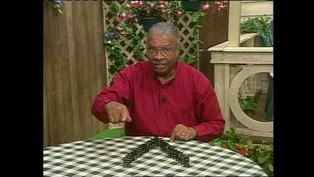
Oh dominoes can be fun to play with.
You know you don't exactly stack them.
You resOally line them up... and then tip the first one over.
And all of the other dominos fall over one at a time.
Let's try it.
I'm going to line some up here.
There's one, two, three, four, five, six.
Is that enough?
Maybe two more.
Seven, eight.
The trick is to get them spaced close enough that they knock each other down.
But not too close.
Let's try it.
Once you've got the hang of it you can make patterns like this.
♪♪♪ Whoops.
That can happen you know.
♪♪♪ Take a look.
I'm going to knock down both rows with this one domino.
[drum roll] [applause] Oh that is fun.
Why don't you try it sometime?
♪♪♪ Have you ever seen the Eiffel Tower?
I have.
Me, too.
But my family hasn't climbed one before.
I have.
♪♪♪ Eiffel Tower.
♪♪♪ [crashes] ♪♪♪ [crashes] ♪♪♪ [crashes] [laughing] I know a place where you can learn more about bird nests, skeletons, dinosaurs, and lots more.
Know where?
The Pink Palace Museum.
Oh you want to go?
Come on.
Today boys and girls we're going to visit the Pink Palace Museum.
You know the Pink Palace is a great place to go if you want answers to questions like how did people live a long time ago?
How do we know what dinosaurs look like?
Or who was W.C.
Handy?
Inside this museum are answers to many of your questions and maybe the answers to some question you haven't even thought of yet.
So come on let's go inside.
We'll start with a little natural history.
What's natural history you ask?
Well natural history is a way of learning about animals, plants, even rocks in a way that many people can understand and enjoy.
But let's back up a minute.
You might want to know what a museum is.
A museum is a collection of things.
The way these things are shown to us is called an exhibit.
Some exhibits show how people lived a long time ago and some exhibits show us what scientists believe the earth was like before there were any people.
There are many different kinds of museums.
Some museums have exhibits of art.
Others, like the zoo, help us to le arn about living things.
The Pink Palace has exhibits that help us see what our area, the mid-south, was like many years ago.
It also has exhibits that help us learn about nature which brings us back to natural history.
Come on.
Let me show you what I mean.
Bones.
Everybody's got them.
But what are they for?
A bone by itself is just a bone, but when you put lots of bones together you get a skeleton.
The bones of your skeleton help yo u stand upright.
Without your bones you couldn't wa lk or pick up things or bend your elbow to scratch your nose.
Your skeleton also helps protect th e things that are inside you like your heart, your stomach, and your brain.
Lots of things have skeletons.
This is a monkey skeleton.
This skeleton belongs to a lizard.
Has your mom every told you to watch out for bones when you're eating fish?
Birds have bones that are very, ve ry light.
What would happen if a bird's bones were too heavy?
Do you think it could fly if its bo nes were too heavy?
Make no bones about it, if you want to learn about bones this is the place to come.
Let's go see what else we can find.
Do you like birds?
You can learn more about them right here.
Did you know there are over 8,000 different kinds of birds in the world?
Do you know why birds sing?
Do you know why different birds bu ild different kinds of nests?
You can learn the answers to these questions and lots more right here.
Oh don't be afraid.
It's not a real dinosaur.
It's an exhibit that gives you an idea of what dinosaurs looked and sounded like.
You know when you come to the museum you want to prepare to spend quite a bit of time.
It's a big place with lots of things to see and do and when you see an exhibit that you want to find out more about get your mom and dad to read the information card for you.
You'll find out lots more about th ings you're interested in.
Hey, come on.
I think there are more dinosaurs around here somewhere.
Come on.
This is a mastodon.
This huge animal roamed the earth over ten thousand years ago.
Can you think of an animal you've seen that looks like this?
How about an elephant?
Mastodons don't roam the earth any more and haven't for over 10,000 years so how do we know what mastodons look like?
Now we're back to bones again.
And of course by putting bones together we get an idea of what a mastodon looks like or any animal for that matter.
Where do bones come from?
They are thousands of years old, so how do people find them?
Well they look for them.
Exhibits like this one give you an idea of how these bones looked when they were found.
This is a real photograph of the pl ace where these bones were found and this exhibit is sort of a close-up look at what this area was like when th ey found the bones.
Another way we know what animals looked like thousands of years ago is this.
It's a fossil.
Fossils are impressions left by an imals and even plants that got trapped inside rock many, many years ago.
If you look carefully when you're collecting rocks you might find a rock with a fossil in it.
But you can find out much more about that when you visit the museum.
Now let's go find out what else we can see.
This is the Clyde Park Circus.
It has that name because a man named Clyde Park made it.
That's right.
Someone made this by hand.
You know it's a model of the circus and as you can see there are thousands of pieces.
Each one was carved and painted by Mr. Park and it moves.
Let's watch.
♪♪♪ I'm sure you have lots of questions about things we've seen today and probably about many of the things we didn't see.
Remember there's an answer to almost every question.
The trick is to find the answer, so if you don't know, ask.
[jungle noises] (male #2) It's time for... (Mr. Chuck) To day boys and girls we're going to talk about polar bears.
You know polar bears live near the Arctic Circle.
Let me show you on the globe here.
This is Memphis, and way up here is the Arctic Circle and that's where polar bears come from.
It's always very cold up there, to o.
That's why polar bears have thick fur.
They even have fur on the bottom of their feet.
This fur helps keep their feet warm and also helps them walk on the ice without slipping.
A polar bear's fur is white with a hint of yellow.
The white color of the polar bear's fur helps it blend in with the snow and ice.
♪♪♪ In the wild polar bears have to hu nt for their food.
They're very good hunters.
They eat fish, seals, and walruses.
Polar bears are the best swimmers of all bears.
Although polar bears may look like a larger version of a cuddly stuffed animal, they're not.
All bears can be dangerous.
They get angry very quickly.
That's why there's a deep ditch se parating you from the bears.
You can learn more about polar bears and many other kinds of bears right here at the zoo.
♪♪♪ Every home should have a planned escape route for how to get out of their home in case there's a fire in the home.
Once your smoke detector goes off you only have about two minutes to exit your home, and you need to have at least two ways out.
If you can't go out the door you need to be able to go out the window.
Sometimes we are hampered by security bars or maybe upstairs.
If you're upstairs get what we call collapsible ladders at any hardware store and you can climb down.
If I had the security bars I would have them half of the window so I could get out the top half.
Also make sure that you have a meeting place out front because you parents once you get there and do not see your child you're going to think they're still in the house.
If you do you're going to go back in.
If you go back in there something bad is going to happen to you so have a meeting place like a neighbor's yard, utility pole or the mail box and make sure you practice and if you do these little tips you will be safe.
Well moms, dads, and friends of all ages, that's all we have time for today.
Thanks for dropping by.
We've had fun building and stacking.
And you know I had a great time at the museum.
Did you?
I hope so.
We'll have lots more fun next time.
Until then play safe.
So long.
♪♪♪
Video has Closed Captions
Clip: S2 Ep11 | 2m 49s | Mr. Chuck teaches how fun it can be to play with dominoes. (2m 49s)
Providing Support for PBS.org
Learn Moreabout PBS online sponsorship














Support for PBS provided by:
Hello, Mr. Chuck! is a local public television program presented by WKNO
Support for WKNO programming is made possible by viewers like you. Thank you!