
BurlyCares supporting senior performing legends
Clip: Season 6 Episode 12 | 19m 46sVideo has Closed Captions
The BurlyCares team explains the special help offered to senior performers.
The BurlyCares team explains the special help offered to senior performers, and the “legends” describe the impact it has on them.
Problems playing video? | Closed Captioning Feedback
Problems playing video? | Closed Captioning Feedback
Nevada Week is a local public television program presented by Vegas PBS
BurlyCares supporting senior performing legends
Clip: Season 6 Episode 12 | 19m 46sVideo has Closed Captions
The BurlyCares team explains the special help offered to senior performers, and the “legends” describe the impact it has on them.
Problems playing video? | Closed Captioning Feedback
How to Watch Nevada Week
Nevada Week is available to stream on pbs.org and the free PBS App, available on iPhone, Apple TV, Android TV, Android smartphones, Amazon Fire TV, Amazon Fire Tablet, Roku, Samsung Smart TV, and Vizio.
Providing Support for PBS.org
Learn Moreabout PBS online sponsorship-Among the many entertainers who call Las Vegas home is a senior population facing significant struggles often due to the unique natures of their careers.
Here to explain and share what's being done about it are Georgette Dante, a variety show performance artist; Fielding West, a comedy magician; Lovey Goldmine, a burlesque performer; Stephanie Castellone, a contortionist and CEO of the nonprofit BurlyCares; and Annette Houlihan, a burlesque performer and BurlyCares end-of-life doula in Las Vegas.
Thank you all for joining us.
And for those of you who perform for us, thank you.
We're going be showing clips of it during this discussion.
I want to start with you, Georgette.
-Can I do one trick?
I couldn't perform before because I got a broken hip.
-Okay, yes.
You want to show a trick.
I'm going to start with you.
-Okay, here we go.
And go up the sleeve.
So you go up the sleeve.
You ready?
There it goes.
-Where did it go?
-Up her sleeve.
[laughter] -Can you keep a secret?
-I sure can.
-So can I.
-Wonderful.
[clapping] -Georgette, as I understand it, you come from a circus family, started performing at three years old and went on to wrestle alligators?
-Yeah.
-What else?
-I was once buried underground in a van for a week with 102 rattlesnakes to promote boxing and wrestling.
I also trained boxers, and I trained wrestling, at one time.
-How do snakes in a van promote boxing?
-Well, because it's exciting.
It's more exciting than boxing or wrestling.
[laughter] -Some boxers might take issue with that.
-And we had a lot of marijuana.
They were happy.
I was happy.
They didn't know why, but I was happy, they were happy.
-Who had marijuana?
-I had 102 rattlesnakes.
-The snakes had marijuana?
-I kept blowing.
I kept them happy.
I was there for a week.
Trust me.
(Lovey Goldmine) What did they pay you, Georgette?
-Hey, well, that's-- -I'm interested in that.
-Sixteen, seventeen years old when I did this.
-Wow!
Okay.
So you moved to Las Vegas in the '90s.
You'd been performing-- -No.
Here 2010.
-2010.
-I travel 80 to 100,000 miles a year.
I was born and bring me by the circus.
-Okay.
So you moved to Las Vegas in 2010.
You're 75 years old.
You told me that it wasn't too long ago that you ended up homeless.
But tell me-- -No education.
In the circus and the carnivals and the bands and the boxing and wrestling, no education.
One day, two days a week.
Performing since age three as a pretend midget.
I went to school two days in my life.
We know how to handle your money because you don't pay taxes, because clubs back in my days were owned by the gangsters.
And they didn't pay taxes.
You didn't pay taxes.
So when I come to Vegas 2010, I was doing belly dancing, face painting, magic, you know, a variety of different shows.
I was working constantly, and then the virus hit.
And then I went to my friend's house, Eddie.
He has nothing but homeless people around him.
But my van is fixed up really nice.
It's insulation, Bob Hope, Buddy Hackett, Chubby Checker, Fats Domino, all these famous movie stars on the wall in the van.
-Because you've worked with them?
-Yeah, I worked with them.
-Living in the van four and a half months, but when money is short... then Stephanie-- -That's where Stephanie comes in.
You founded this nonprofit to help people like Georgette.
What was it that happened that made you say this is really needed here in Las Vegas?
(Stephanie Castellone) During the pandemic it became very obvious that there was a high need for our population of people, our performers, our legends that we call them, were in great need.
Many of them were isolated, afraid to come out of their house.
But in particular, there was one woman who, unfortunately, was diagnosed with end stage cancer right at the advent of the pandemic.
I had known her for many years and had taken care of her on and off while I was working full time as a nurse.
So I had a relationship with this woman.
And as she was passing-- -And she was a burlesque performer?
-She was a very well-known burlesque persona, had a one-woman show in Miami for over 13 years.
-Wow!
-She was phenomenal.
And I just happen-- my specialty in nursing happens to be hospice.
And so I was able to help-- -Well, stop right there.
-Yeah.
-So contortionist, CEO of BurlyCares, but you're also a registered nurse?
-Yeah.
-What a unique combination-- -Yeah.
- --to come together, and then you start this nonprofit as a result?
-Yeah.
Very serendipitous.
And at first it was overwhelming because, oh, gosh, how am I going to do this?
And so it was daunting at first, but the woman that really wanted me to do it was the woman I was helping pass during the pandemic.
And she was so sweet.
She was like, Okay, let's see how we can do it.
Take it in stages.
You don't need to do everything.
Because she knew my personality, that I'm just gonna do it.
But no, Take in stages.
Do it how you see fit.
You're running it.
You're running the show, so you do as you see fit.
And she's like-- -Why did she tell you it was important to do it?
-She knew all of her friends that she had worked with for many years and formulated very close friendships with we're aging.
And she told me as she was passing, Watch, we're all going to start going because it's just time, you know.
And so it's life.
It's part of life.
And I agreed with her.
I said, of course, you know, none of us are here forever.
So she was correct.
Within the next two years, we lost another five, which is a lot for us as a community.
-Annette, I keep seeing you nodding your head.
(Annette Houlihan) Yes.
-What are you agreeing with her about?
-Well, the need for the care that BurlyCares provides for a population that's, you know, performers, gig workers, and things like that.
And a lot of people, you know, weren't the best with their money and/or were the result of shyster managers and things like that.
So a lot of people-- and a lot of people didn't have children or didn't have spouses or partners, and when someone is ill, usually that role of caregiver falls to children or spouses.
-Why aren't performers having children?
-I'd love to answer that.
-Yeah.
Well, you have.
It's a rarity.
-In the world of burlesque and showgirls and show people, many are afraid that if they have children, it's going to affect their body and they're not going to be able to continue to perform.
So I think we're right down the middle, 50/50 of people that I know.
The ones who had children, and I'm one of them, we have a community to rely upon.
We have our family to rely upon.
But for women or, you know, people that decided not to have children, they're very isolated.
And again, when you look at kind of the quality of what we did-- you know, we're performers.
Oh, here's a great gig.
They're gonna pay you under the table.
But we weren't really schooled as far as being able to take care of ourselves later in life.
And it's a young person's kind of profession.
And even though some of us still perform here and there, it's really a young person's profession.
So as you age out, and especially if you don't have children, what is there for you to do?
And education, back when we started performing, a lot of us, I had children, I had to.
I mean, I had to-- well, if it wasn't for my bad taste in men, I think I would have gone to Broadway.
Anyway, so um-- -But earlier you told me had you not found the right daddy-- -Oh, yeah, because I have a real good daddy.
I have a real good daddy.
[laughter] -He's kind of a burlesque historian.
He knew me when I was good looking.
You know what I mean?
So he's a great man.
-I'm gonna cut you off there because I want to show some of your performance from earlier.
Ladies and gentlemen, this is Burlesque Hall of Famer Lovey Goldmine.
[chiming sounds] ♪ If they could see me now ♪ ♪ that little gang of mine ♪ ♪ I'm eatin' fancy chow ♪ ♪ and drinking fancy wine ♪ ♪ I'd like those stumblebums to ♪ ♪ see for a fact the ♪ ♪ kind of top-drawer ♪ ♪ first-rate chums ♪ ♪ I attract ♪ ♪ All I can say is wow ♪ ♪ We look at where I am ♪ ♪ Tonight I landed, pow, ♪ ♪ right in a pot of jam ♪ ♪ What a sight ♪ ♪ oh, holy cow ♪ ♪ They'd never believe it ♪ ♪ if my friends ♪ ♪ could see me now.
♪♪ [applause] -That was awesome.
Thank you so much for that.
And we have Fielding coming up as well.
Fielding, will you tell me how BurlyCares helped you.
(Fielding West) Oh, they're still helping me.
I had a knee replacement in June of last year and went to therapy.
And my-- they only let you go to therapy, physical therapy for so long.
Then they throw you out, and start charging you to go.
Ms. Stephanie says, No, I'm gonna get you somebody that's going to come to your house three days a week and work on your knee with you.
So I've got somebody that comes over.
And the coincidence about this, the young lady that comes over was my assistant in Downtown Las Vegas at the Lady Luck hotel for two years-- -Wow.
- --when I had my own show there.
-Wow.
-So that's Joanne.
And Joanne still comes to my house every-- three days a week, Mondays, Wednesdays, and Fridays.
And what's happened, my cats love her so much.
[laughter] -Now they're-- -I'm going to cut you off, Fielding, because we're getting down a unique alley there.
-No, no.
She takes care of the cats.
What I'm saying is she's such a good friend and a great therapist, which makes it a lot easier to do.
-You wouldn't have been able to afford this care?
You didn't have the insurance?
-I have, I have some new insurances now, but not at the level that I needed the care and the therapy.
-So we talked about education or lack of education.
We talked a little bit about finances.
But being paid under the table, that means you're not paying into social security, right?
-That's what happens.
I started performing in nightclubs when I was 12 years old as burlesque because my mother.
I'm sixth generation of show people.
And the club owners didn't pay taxes.
You didn't.
One day-- well, the circus was one day, two days.
The nightclubs, one week or two weeks.
And they didn't pay it, and my lack of education, I didn't know how to pay taxes.
It's besides the point.
I hardly get anything for social security.
So again, Stephanie again, same old thing.
-What kind of social security payments are you finding that these legends are getting?
-It ranges quite a bit.
Some of our legends are lucky in that they were-- they served in the service, so they get a stipend from the VA.
But by and large, I see quite a range.
I've seen as low as 600 a month, which doesn't really-- definitely doesn't pay rent anywhere.
And we've got some that get, you know, that have been good with their money or have paid in each year and knew the tax system and get, you know, a little over two grand, you know.
So it ranges.
But most of all of our clients are very much on a fixed income.
-So you're helping with basic life necessities, medical supplies, medical care, but there's another aspect to your service.
And that is where you come in again.
Better known to burlesque fans as Blanche DeBris.
Can you first-- [cheers and applause] -Can I get a little taste of Blanche DeBris?
-Oh, you know, Blanche likes to end every show with, Be kind to one another, remember to hold hands, and shine.
So that's a little bit of Blanche's, you know, the fairy godmother of burlesque.
-Yes, she is.
-Well, and you are applying that into this other line of work that you are doing, which is as an end-of-life doula.
What is an end-of-life doula?
-First of all, it's kind of a new designation or description for the role.
I mean, it's-- doulas, end-of-life doulas, death doulas have been-- that role has been performed by humans for millennia, right?
And so it's only very, really very recently that it's been sort of like pinned down.
And an end-of-life doula is a nonmedical person who works with the person who is, who is dying, and a lot of times also their loved ones, their families, biological and logical families.
In order to alleviate fear and anxiety over the death and dying process, to provide information, advocacy, fill in the gaps that hospice care and palliative care might leave.
Not because their their care isn't good, but because the amount of time required to spend with someone is immense.
And hospice care workers, they are so busy and doing such wonderful things that they don't have the time to spend with the person who is dying.
And a lot of times a dying person and the people around them won't be informed, because the biggest fear of anyone, like universally, is death, right?
So no one talks about it or wants to think about it.
So when it's happening, no one-- everyone feels lost, and they're not sure what to do or what's going to happen.
One thing a doula can come in and do is to provide information and education for the person and the family of what to expect to start conversations that are difficult.
-Now, in these cases, are their family members often present, or-- -I'd say, like Lovey mentioned, probably about half.
50% of the time, yes; and 50% of the time, no.
We are the family.
We are it.
-That's something that makes this population unique.
-Very unique, yes.
-Stephanie, I want to stop right now, and let's watch some of your performance from earlier.
Ladies and gentlemen, Stephanie Castellone, also known as Miz Charlamay.
♪♪♪ [cheers and applause] -Wowee!
-It hurts to watch.
[laughter] -It hurts me when I don't do it.
-It brings up a good point about the physicality of this career and that it's not sustainable later in life, right?
-It is, but you definitely have to listen to your body and know when to, what I call "retire tricks."
-Same thing in magic.
I'm not jumping up and down on boxes or going through trapdoors.
That ship sailed and hit an iceberg.
-Same thing in burlesque.
-Same deal.
-It is.
-Now, how much of that is why you're working a second job, because you're working a second job as well?
-Well, I've got two things I do.
I teach speech for young performers, what I call a class called Stagecraft 101.
It's to teach how to enter and exit the stage and what to do and what not to do, proper speech patterns.
And I teach timing, which is something that no one has ever thought of doing.
I played drums for years and put myself through college playing drums.
And I said, you know what?
If you can teach timing to a comic or to a magician-- well, actually, the point is, if you can teach music, you can teach timing.
That's the whole-- so I do that.
I still travel with the Lance Burton & Friends show.
I'm still on the road doing at least three shows in large theaters per month.
I'm leaving in five days to go to Colorado and then to Santa Fe, New Mexico.
-And he's 80 years old.
-Almost.
How old are you, Fielding?
-I'll be 74.
-Don't push it.
[laughter] -I know.
-You've opened for Liza Minnelli, The Temptations, Earth, Wind & Fire.
Let's take a look at some of your performance from earlier.
Ladies and gentleman, Fielding West.
-Okay.
I know that you enjoy magic, because you told me so.
I want to show you something.
I like to do this nice and close so everybody gets a chance to see what it looks like.
You know the expression, Give me five?
Give me five.
Whoa!
You've done that before.
Do that one more time right there.
One more time.
Oh, that's a good one right there.
Let's see what we got here.
-Whew!
-That's my buddy Bob the Bird.
What do you think?
-Hello, Bob.
-Isn't that a neat trick?
-Yeah, I'll say.
-For starters.
Hold your hand out.
Watch this.
-Hello sweetheart.
-Say hi to Bob.
Let me see.
That's what I like.
You sit.
You sit right there.
That's a good boy.
Hey, hey.
-Oh, boy!
-I said "sit."
[laughter] -Well, thank you.
[applause] -[unintelligible] -And I'll tell Bob the Bird that.
-Yeah, poor Bob the Bird.
I thought-- I thought maybe we were going to have to have an end-of-life doula service for Bob.
-We haven't done animals yet.
-On film.
-I want to ask about that.
Why did you choose to include that service, Stephanie?
-The death doula service?
Because it was integral in the beginning in the formation of BurlyCares with the woman that I helped pass.
It was very much part of, and it's also my specialty, right?
So that's really where I feel comfortable.
That's where I'm most proficient.
That's where I can do the most teaching and the most, you know, comprehensive help, I feel like.
20-plus years in hospice, I think, is enough to like know what to do when someone's getting ready to pass.
-And BurlyCares is offering-- it's starting in the fall-- -Yes.
-I'm going to jump in-- doula, a death doula training and certification, which is-- I'm going to be first signed up in the class because I'm very early on in my experiences.
So Stephanie-- -And what have your experiences been like?
-Well, looking back, I realize it started with taking care of my own mother many years ago when I was quite young.
And I realize now, when Stephanie told me when I was helping, I thought I was just, you know, helping my friends.
And Stephanie was like, Oh, no, no.
You have a gift.
And coming from her, who I know has the gift and does have the passion and the calling.
Because a lot of people talk about end-of-life care as a calling and a passion.
-Yes.
-For her to say, like, You've got it.
And me go like, I don't know if I want it, but okay.
And then of course the more I, you know, but the more I learned and the more that I experienced the beautiful-- how death can be a beautiful human experience, not a medical one.
We want to, we want to bring death back to the experience that is the spiritual and a human and a compassionate and a beautiful passing.
-Thank you so much for your time.
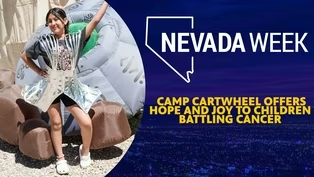
Camp Cartwheel offers hope & joy to children battling cancer
Video has Closed Captions
Clip: S6 Ep12 | 5m 10s | A look at the work Nevada Childhood Cancer Foundation (5m 10s)
Providing Support for PBS.org
Learn Moreabout PBS online sponsorship
- News and Public Affairs

Top journalists deliver compelling original analysis of the hour's headlines.

- News and Public Affairs

FRONTLINE is investigative journalism that questions, explains and changes our world.












Support for PBS provided by:
Nevada Week is a local public television program presented by Vegas PBS