
Business Innovation in the State Capital; Tom Szaky
7/9/2022 | 26m 47sVideo has Closed Captions
Business Innovation in the State Capital; Tom Szaky
Steve Adubato is joined by a panel of business innovators to discuss social entrepreneurship. Panelists include: Eleanor Kubacki, Co-Founder & CEO, EFK Group Elijah Dixon, Social Entrepreneur Geoffrey M. Goll, President, Princeton Hydro. Steve Adubato sits down with Tom Szacky, CEO, TerraCycle, to talk about his breakthrough technology in creating reusable products from waste.
Problems playing video? | Closed Captioning Feedback
Problems playing video? | Closed Captioning Feedback
Think Tank with Steve Adubato is a local public television program presented by NJ PBS
Business Innovation in the State Capital; Tom Szaky
7/9/2022 | 26m 47sVideo has Closed Captions
Steve Adubato is joined by a panel of business innovators to discuss social entrepreneurship. Panelists include: Eleanor Kubacki, Co-Founder & CEO, EFK Group Elijah Dixon, Social Entrepreneur Geoffrey M. Goll, President, Princeton Hydro. Steve Adubato sits down with Tom Szacky, CEO, TerraCycle, to talk about his breakthrough technology in creating reusable products from waste.
Problems playing video? | Closed Captioning Feedback
How to Watch Think Tank with Steve Adubato
Think Tank with Steve Adubato is available to stream on pbs.org and the free PBS App, available on iPhone, Apple TV, Android TV, Android smartphones, Amazon Fire TV, Amazon Fire Tablet, Roku, Samsung Smart TV, and Vizio.
Providing Support for PBS.org
Learn Moreabout PBS online sponsorship- [Narrator] Funding for this edition of Think Tank with Steve Adubato has been provided by NJM Insurance Group.
Serving New Jersey'’s drivers, homeowners and business owners for more than 100 years.
Veolia, resourcing the world.
The Port Authority of New York and New Jersey.
Moving the region through air, land, rail, and sea.
The New Jersey Economic Development Authority.
Choose New Jersey.
TD Bank.
Kean University.
Where Cougars climb higher.
Hackensack Meridian Health.
Keep getting better.
And by Delta Dental of New Jersey.
Everyone deserves a healthy smile.
Promotional support provided by The New Jersey Business & Industry Association.
And by ROI-NJ.
Informing and connecting businesses in New Jersey.
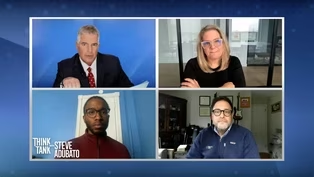
[MOTIVATIONAL MUSIC] - Hi, this is Steve Adubato and for the next, I dunno, 15 minutes or so we're gonna be talking about innovation, innovation, business innovation, and the state capital of New Jersey.
Are you saying, "Okay, what's the state capital?"
It is Trenton, New Jersey.
You know, that sign over the bridge, "Trenton Makes The World Takes."
Got a great panel who knows all about Trenton and business innovation.
We got Eleanor Kubacki, co-founder and CEO of the EFK Group which is a women owned advertising agency.
I know it's more than that, Eleanor, but can we get away with that description?
- Absolutely.
Yes.
- Thank you.
And we have Elijah Dixon, social entrepreneur, in what area, Elijah?
- Trenton, New Jersey.
- No, I know geographically but an entrepreneur in all kinds of things or what?
- Primarily in the arts.
- Geoffrey Goll is President of Princeton Hydro, which is an environmentally conscious organization focused on water projects.
Is that right, Geoffrey?
- Yeah, we're a water resources and geotechnical engineering and consulting firm.
- Great, and Geoffrey wants everyone to know that guitar behind him, he plays it, but he is not a professional.
- That's correct.
- Eleanor, let's start with this.
So, business innovation in Trenton, take it from the jargon of business innovation in Trenton to what does it actually mean?
- Well, I think you have to be innovative to dedicate yourself to an inner city that is struggling.
I think that is the baseline, and from there that innovation just grows because you realize that you have to fight every day to bring new ideas, technology to the marketplace.
So when you come into Trenton and it really, for me, I've been there for 25 years, my entire company's lifespan and it really charges me up to work harder, do better.
And as you can tell, all the guests on the panel, we all have socially responsible conscientious companies, and I think that really says something to the mindset that you have to create.
And, you know, there is a new economy and there's gonna be a new normal and people like us are ready for that because we have to be ready for adjustments and changes so we're used to that in Trenton.
- Well said.
Let me ask you this Geoffrey, the term business incubator is thrown around a lot as well.
You notice there's a lot of phrases here.
We'll talk about the HUB, if you will.
The HUBZone is something called the HUBZone in Trenton put a business incubators in Trenton, talk about that Geoffrey.
- Well, I mean, it's really a great place to, you know, start up a business.
The city is definitely supportive and encouraging.
They provide incentives such as financial and for businesses that really want to get new and hit the ground running.
I mean, we've been in business for over 24 years but we felt we wanted to be re-energized by moving to Trenton to have that incubator sort of atmosphere.
And it really is a supportive group in the area and provides for that innovation, especially for example, we're in the Roebling, you know, John A. Roebling and Son's building and you also want to be in an area that's very inspiring as well.
- Hold on, excuse me, just for a second.
Go back, 'cause we're gonna show some of the pictures of Roebling.
For people who don't know why the name Roebling matters so much, not just in Trenton but in this country, in the world, the Roebling building produced what?
And why was that so important?
- Well, Johnny Roebling and his son actually built the Brooklyn Bridge back in the 1800's.
Since then, in the late 1800's and early 1900's, they were the producer for most of the cabling in their wire works in Trenton for bridges all over the country, the Golden Gate Bridge, the George Washington Bridge, the Verrazzano-Narrows Bridge, any iconic bridge that's a suspension bridge in the United States came out of Trenton.
- Yeah.
It's a big deal.
And that's where you're located, right?
- That is correct.
We're in the Carpentry Shop.
- Got it.
Elijah, lemme ask you, you grew up in Trenton?
- Yes I did.
- You did.
And our producers describe you as a social entrepreneur.
Define that for us.
- Sure, so as opposed to your typical entrepreneur who prioritizes profit over everything, I'm heavily focused on improving the social environment of my community and ensuring that the jobs are created whether it's construction jobs, actual retail/service oriented positions are all primarily sourced to the best of my ability from within the community.
That way we are working to catalyze growth and long term economic mobility for our community here.
- Elijah, I wanna follow up with you.
Give us one concrete, powerful example particularly in the arts, which is what you care deeply about as it relates to being a social entrepreneur, one concrete example, please.
- In my area that I'm operating in which is the Hanover Academy of Redevelopment area or the Creek Canal Coastal district, depending on on who you're asking, it's still located within the downtown area, and the arts have been a strong catalyst for growth.
Before there were market rate loss.
Before there was the ongoing and future development of the downtown area from the state offices to other private redevelopment projects that are taking place.
The artists were a strong catalyst to bring people in from the neighboring suburbs here into the city.
However, there was not a, at the time, a willingness to really pay the artists for their work.
There was not a hub for the artist to congregate, to be able to work at a below market rate, or even at times just bartering space for services.
And so The Orchard House, which I founded back in 2015 when he served as that as that hub for the artist here in addition to other projects that are located and were located within the East Hander Street Corridor.
- It's so interesting.
You know, Eleanor, Elijah mentioned the hub, he's talking about one hub, but what is a "hub zone" and is that an official name of a government program?
Is it some sort of slang in Trenton?
What is it, a hub zone in Trenton?
- Yeah, so one of the greatest benefits an emerging company can get from going to a city like Trenton is there is a national program and it is by the SBA, which is a Small Business Association.
And what that is, is an organization that works to grow small, especially minority, women-owned, veteran-owned, so on and so forth, organization.
- One second, is that Small Business Association or Administration?
- Administration.
SB.
- I, yeah, I just wanna make clear that's a federal agency.
Go ahead on, I'm sorry.
- Yeah, so four years ago, I said, "I want federal accounts.
"I wanna be able to grow my business."
I went directly to their website.
I signed up and within two years of getting my certifications, I doubled my company.
Now I wouldn't have had, yep, I know after 25 years, if I only would've known (Steve laughing) but the reason is is that they nurture you.
They tell you how to win these national accounts.
What's so great about national accounts for emerging companies is on average, they're five years in term.
So you get larger contracts for larger periods of time, and all of a sudden, we, the smaller companies, get to compete with the big guys and so much so is that there's another program where we got to become partners with the biggest ad agency in the world called Ogilvy, which a lot of people know and they became our mentor, our official mentor and we won CDC work together, we won the National Science Foundation.
We're now working with the Navy.
So it's unbelievable the opportunities that are out there for small and emerging businesses.
- You know, it's so interesting to listen to, to see three entrepreneurs that are engaged in Trenton doing important things, but the expression in a city like Trenton has been used several times in this discussion.
And I'm curious about this.
Jeffrey, when people say, "A city like Trenton," I happen to be born and raised in Newark, New Jersey, and when people say a city like Newark, I think I know it pretty well but I'm not gonna assume people know, Trenton is not like every other city, but it has certain urban challenges, issues, opportunities, problems, et cetera.
How would you describe "A city like Trenton," Jeffrey?
- Well, as you, it was the center of the American Revolution.
It was the, you know, the famous battle of Trenton.
Washington Crossing is right up the road from us.
- Right across the Delaware.
- Yeah, right up the road and across the Delaware there.
And it was also, it's a transportation hub.
The Northeast Corridor Line goes right through this center of Trenton.
Our office is only a few blocks from there.
There's a light rail line so there's lots of commuting opportunities but there's also a vibrant business community and local community in the area with a variety of different foods, Italian and Spanish, Portuguese.
I mean, there's all kinds of cultures within the city itself that makes it very attractive.
And it does have its own challenges like any other urban center but it's definitely a place where you feel that the weight of history and the friendly local community.
- And, you know, it's so interesting, Elijah, again, you know, a city like Trenton better than most, being born and raised there.
But again, growing up in Newark, one of the things about Newark is it has a huge corporate community and a lot of corporations that are there that are multinational corporations, Trenton is different in that way.
And some of the corporations, and again having corporate support is huge and folks at NJM, New Jersey Manufacturers, they are the ones who talk to us about this but at the same time, there are other corporations as well, care, deeply about Trenton.
So my question to you, Elijah, is how important is "corporate support, philanthropic, and otherwise investment" et cetera, et cetera, in "a city like Trenton."
Elijah.
- Generally speaking, corporate support in the form of jobs being located here, or corporate support in the form of them paying property taxes here, or corporate support, you know, just like all of the above whether it's in investments or otherwise, it's important but I'm not gonna say that it is critical because Trenton has been void of those corporate, of those corporations for, I would say decades, you know, since, you know since it's de-industrialization.
And so what I believe is going to turn the city around and actually is turning the city around now is small businesses, you know, such as the one that are ran by the individuals on this segment here, you know, individuals who are, you know putting their money where their mouth is, setting up shop, setting up business, hiring individuals, and then we're creating an environment in which others, whether it's corporate entities or other small businesses from the region are looking to now relocate here and take advantage of our, as Geoffrey has said, us being a transportation hub and innovation hub.
Yeah.
- And also, I mentioned the state capital at the beginning of this program, it is the capital of the state of New Jersey.
It is where state government operates out of.
To be clear the state legislature, the governor, et cetera, et cetera.
That's where the capital is.
But also I'm curious about this.
Eleanor, how much is there a push for more and more people not just to be involved in business innovation in Trenton, but to live, to work, live, pay taxes, be a part of the community of Trenton.
That matters, doesn't it?
- Yeah, it absolutely matters.
And I agree with Elijah that we can't wait for corporations.
We've been waiting for corporations to come in and quote/unquote, "save the day" and they have not come.
Now, it really is about getting all of us together, organized, and moving forward.
We have an excellent mayor.
It's the first time since I've been in the city that we have a mayor that reacts and is there, and to help us.
- Your mayor is Reed Gusciora.
- Correct.
He is absolutely wonderful.
That's a huge win for us, and I look forward to us just capitalizing on all the assets that we have, but I agree, we can't wait anymore.
We just gotta move forward.
And the truth of it is at the end of the day, yes, there is a social responsible aspect of being in Trenton.
But let me tell you this, is that I owe Trenton a huge debt, a huge debt to help, you know me become a very successful woman business owner, so it can be a two way street.
- So you owe Trenton?
- Yeah, absolutely.
- Geoffrey, you feel the same way?
- So far.
They've had our backs through COVID, through, I mean, originally we were looking at the space, we were thinking of backing out because of COVID and who knows what the office atmosphere was gonna be like but the city and the mayor really came through for us and helped us navigate, for example, economic development loans to move in, our landlord was extremely helpful in terms of providing us with incentives on leasing and the business community was extremely welcoming.
And, and you talk about how, you know in the local community, we really feel there's an untapped resource within the city.
One of the incentives for us is to try to hire more locally and have people and basically uplift the community at the same time we're uplifting ourselves as a business.
- Finally, Elijah, are you bullish, positive about the future of the city?
- I am, and that's only because I'm on the ground interacting with the various players here and I know what's coming down the pipeline.
I know who's doing what, and I must say that I am very optimistic, looking forward to the future here.
- This has been a very interesting panel, talking about business innovation in the state capital which is Trenton, New Jersey.
Eleanor, I wanna thank you.
And Elijah and Geoffrey, we appreciate it.
That expression and real quick, can I, I'm running outta time, but Trenton Makes The World Takes, Eleanor, still real, correct?
- Absolutely.
I believe in it and I'm here to stay and there's a lot of us on the ground.
So yes.
- Thank you to all of you and we wish everyone in the city of Trenton all the best because it is our state capital and too many people don't know about the city and why it matters so much.
Thank you to all of you.
- Thank you.
- Thank you.
- You got it, stay with us, we'll be right back.
To watch more Think Tank with Steve Adubato, find us online and follow us on social media.
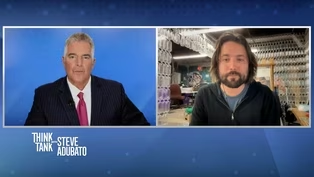
- Talk about innovation we are honored to be joined by Tom Szaky, who is Founder and CEO of an organization called TerraCycle.
Is that right TerraCycle Tom?
- You got it, absolutely thanks for having me.
- It's great having you.
Based where?
- In Trenton, New Jersey.
- That's right.
We're talking about Trenton.
We're talking about innovation, business innovation.
Tell everyone what TerraCycle is.
- So TerraCycle is a global waste management company.
While we are headquartered in Trenton, we operate nationally in 21 countries around the world.
And the stuff we do is recycle things, no one else recycles, from cigarette butts to dirty diapers, help companies make their products from waste, and even have launched the world's largest reuse platform.
So your favorite products in fully reusable package.
- So hold on one second.
There's municipal recycling and then there are companies like yours.
What's the difference?
- Well, so in municipal recycling what you are recycling, is what the garbage company that's contracted can make money at.
So an aluminum can, right?
The aluminum is valuable enough to incentivize someone to collect it, and process it and then make money whatever they can sell.
But 80% of goods, you can't recycle locally.
That's everything from a pen you may be writing with or to a toothbrush, to a coffee capsule and TerraCycle focuses only on recycling the things that you can't municipally recycle, by getting a stakeholder who may be interested in it to fund the cost of collecting and processing it.
- How did you get into this?
Because my understanding is, our producer Abi told me that you told her you were at Princeton University.
We just actually share the Dean of the graduate school at Princeton we're taping most of the day today, and I'm thinking, so Tom is at Princeton, he leaves Princeton and does this, how does that happen?
- It's exactly right.
I left in the middle of my second year because I got really fascinated first by the concept of purposeful business.
Viewing profit more as an indicator of health and then using business as a tool for good and I fell in love with the topic of waste because garbage is filled with all this phenomenal anomalies.
- Back up Tom - Yeah.
- You fell in love with the topic of waste?
- That's right.
- Could you explain that love affair?
- Yeah garbage is a topic, to me is like eternally fascinating because it is filled with all these anomalies.
So I'll give you a couple of examples, right?
- Please.
- We live in a materialistic world, our status in some part in maybe in no small part is linked to the stuff we own, but isn't it interesting that the garbage industry will legally own everything you possess with no exception.
One day all your possessions, will be legal property of a garbage company, and that's really odd, and 99% of what you buy becomes property of a garbage company within the year of purchase.
- How do you recycle dirty diapers?
- So the most important part... - Scarlyn and our cameraman just laugh at that.
Scarlyn it's a legitimate question.
- It is.
- Seriously How do you do that?
And when, explain it?
- We do it today in Japan, France and Holland.
So it's live in multiple countries and so the first and most important thing is the business model, right?
- Collecting diapers and processing them is much more expensive than the results are worth.
So it's finding a stakeholder in this example, Pampers who is excited and willing to fund that solution and then we set up methods of how do we collect it, we gotta make sure it's done safely, do it in ways that consumers will deposit diapers and so on so we create smart bins, that smell control, deploy them in front of retailers, and then we come up with unique technology to be able to turn those diapers into sellable outputs, like plastics and cellulostic material and so on.
And honestly each waste stream has a journey like that.
- Why Trenton, New Jersey?
You could be a lot of different places, why Trenton?
- Certainly so.
I mean to be very honest, when I first left Princeton, I needed to find a facility and Trenton was the closest place that had affordable real estate.
That's the honest story but since being here for 20 years I have really fallen in love with this town in that it is the best location in the Northeast, right between Manhattan and Philadelphia.
We have what, 600 team members and many of them live in those cities, and commute here.
And also the city, both the state and the city government leaders are here to help us.
They're coming through our office all the time helping and thinking through, how this company can succeed.
So we are... And it's purposeful to be here.
It benefits the city much more than if we located in Brooklyn or San Francisco or some where else that, already has a lot of exciting companies in it.
- How many people do you employ?
- 600.
- Six?
(Steve exhales) Wow!
in and of itself, the idea, the reality of we employ at any one time eight to 10 full time people on a bunch of freelancers who are just incredibly talented and make they things happen.
I can't imagine what it must feel like to employ 600 people and know that you are helping them live their lives, their quality of life, food shelter and I'm not saying...
Sounded like you're some sort of benefactor if you will, but that's gotta be rewarding 'cause they're working hard for, but you're employing 600 people.
- Yeah.
- And contributing to the tax base of Trenton, please Tom.
- No, you're absolutely right.
I say it's a privilege to be able to have that opportunity.
And it's just such a thrill that we're able to turn purposeful business into something that, employs all these people but also a quarter billion people engage with our programs every day.
Just folks out there collecting and recycling all over the world.
- Wait a minute, a quarter billion?
'Cause I also know you have a global footprints.
Explain that to us.
- Yeah so we operate today in 21 countries, in Thailand is a nonprofit, the TerraCycle foundation but everywhere else is a mission driven for profit.
So from Canada to Japan, all headquartered out of here in Trenton and today about 250 million people a year also a day interact with TerraCycle programs that could be walking into a Walmart and recycling your car seat.
It could be going into the world's largest, sorry Japan's largest retailer and recycling your cosmetics, and in that process, we don't only collect and recycle millions of pounds of hard to recycle waste but we also raise capital for charity.
So we've donated about 50 million dollars to organizations for helping to collect and recycle this waste, and so this is what we're all about is how do you use the context of for profit capitalism, which is an incredibly powerful tool.
I'd say the most powerful tool in the world today.
Probably more powerful than war and politics than anything but to do it where we reframe profit as an indicator of health, I mean we profitable and so on but more as a health indicator than as a reason of being and then the reason of being can become environmental and social improvement.
- Let me ask you something.
We have a sister program called Lessons and Leadership that I do with my colleague Mary Gamba, and we're always interviewing leaders, and trying to understand how they think and what they've learned as leaders, and et cetera, et cetera.
But I'm fascinated by leadership on some level.
So I wanna ask you this, what is, in building TerraCycle over 20 years and being in Trenton and employing 600 plus people et cetera what's the most significant leadership lesson you've learned over the years?
- That's a good question.
What first comes to mind is how to embrace failure not to seek it right.
We don't wanna seek it, we don't wanna be, we wanna be conservative and avoid risk.
But if you're gonna innovate and grow and push the envelope you certainly will fail.
And what I think is so important, the way we approach it I'm not saying it's the right answer, but it's been a huge unlocking method.
For instance, anytime there is an issue, a failure of some kind big or small, the first thing we ask is, what are we gonna learn a about this?
Because then the investment in that failure is like tuition.
I mean we go to school, spend a lot of money to learn, produce nothing, but a lot of education.
- Yeah.
- And failure... - Few seconds left Tom.
I'm sorry for interrupting.
'Cause I'm fascinated what you're saying but we don't have the innovation to continue give me a few more seconds on this go.
- Yeah, no absolutely.
I think if you embrace failure as education the organization will be incredibly strong for it.
People will take risks, they'll try new things.
They'll push the envelope and if we fail then we learn something, and if we don't fail we succeed, there in other ways there's no negative if you do it right.
If you criticize failure and fear it, then people will never want to to innovate and you'll get stuck where you are.
- You're listening to a very strong, innovative leader.
Tom Szaky who's Founder and CEO of TerraCycle.
Hey Tom thank you so much for joining us we appreciate it.
- It's my pleasure, thank you.
- Best to you and your team.
I'm Steve Adubato and that's Tom Szaky.
We'll see you next time.
- [Narrator] Think Tank with Steve Adubato has been a production of the Caucus Educational Corporation.
Funding has been provided by NJM Insurance Group.
Veolia.
The Port Authority of New York and New Jersey.
The New Jersey Economic Development Authority.
Choose New Jersey.
TD Bank.
Kean University.
Hackensack Meridian Health.
And by Delta Dental of New Jersey.
Promotional support provided by The New Jersey Business & Industry Association.
And by ROI-NJ.
(Music playing) NJM Insurance Company has been serving New Jersey policy holders for more than 100 years.
But just who are NJM'’s policy holders?
They'’re the men and women who teach our children.
The public sector employees who maintain our infrastructure.
The workers who craft our manufactured goods.
And New Jersey'’s next generation of leaders.
The people who make our state a great place to call home.
NJM, we'’ve got New Jersey covered.
Business Innovation in the State Capital
Video has Closed Captions
Clip: 7/9/2022 | 16m 40s | Business Innovation in the State Capital (16m 40s)
How New Technology Could Change the Recycling Industry
Video has Closed Captions
Clip: 7/9/2022 | 9m 48s | How New Technology Could Change the Recycling Industry (9m 48s)
Providing Support for PBS.org
Learn Moreabout PBS online sponsorship
- News and Public Affairs

Top journalists deliver compelling original analysis of the hour's headlines.

- News and Public Affairs

FRONTLINE is investigative journalism that questions, explains and changes our world.












Support for PBS provided by:
Think Tank with Steve Adubato is a local public television program presented by NJ PBS