
Can Term Limits Be Fixed?/Belle Isle Spring Cleanup
Season 4 Episode 32 | 26m 46sVideo has Closed Captions
Can Term Limits Be Fixed?/Belle Isle Spring Cleanup | Episode 432
It’s been almost three decades since Michigan voters approved term limits for our state legislators. Our One Detroit contributors discuss the downsides of term limits. It’s estimated that 53 million Americans are providing care for a loved one. If you are a caregiver, you know that it can be a rewarding, but difficult responsibility. Episode 432
Problems playing video? | Closed Captioning Feedback
Problems playing video? | Closed Captioning Feedback
One Detroit is a local public television program presented by Detroit PBS
Can Term Limits Be Fixed?/Belle Isle Spring Cleanup
Season 4 Episode 32 | 26m 46sVideo has Closed Captions
It’s been almost three decades since Michigan voters approved term limits for our state legislators. Our One Detroit contributors discuss the downsides of term limits. It’s estimated that 53 million Americans are providing care for a loved one. If you are a caregiver, you know that it can be a rewarding, but difficult responsibility. Episode 432
Problems playing video? | Closed Captioning Feedback
How to Watch One Detroit
One Detroit is available to stream on pbs.org and the free PBS App, available on iPhone, Apple TV, Android TV, Android smartphones, Amazon Fire TV, Amazon Fire Tablet, Roku, Samsung Smart TV, and Vizio.
Providing Support for PBS.org
Learn Moreabout PBS online sponsorship- Hi, I'm Christy McDonald and here's what's ahead this week on One Detroit.
A closer look at the effects of Michigan's term limits, which are the strictest in the country.
Stephen Henderson and Nolan Finley weigh in on how to change them.
Plus when caregivers need care themselves, connecting with the growing need for respite care.
And it's Earth Day, how about helping out with the cleanup on Belle Isle?
It's all I had this week on One Detroit.
- [Reporter] From Delta faucets to Behr paint, Masco Corporation is proud to deliver products that enhance the way consumers all over the world experience and enjoy their living spaces.
Masco, serving Michigan communities since 1929.
- [Reporter] Support for this program provided by the Cynthia and Edsel Ford Fund For Journalism at Detroit Public TV, the Kresge Foundation, Community Foundation for Southeast Michigan.
- [Reporter] The DTE foundation is a proud sponsor of Detroit Public TV among the state's largest foundations committed to Michigan focused giving.
We support organizations that are doing exceptional work in our state.
Visit DTEFoundation.com to learn more.
- [Reporter] Business Leaders For Michigan dedicated to making Michigan a top 10 state for jobs, personal income, and a healthy economy.
Also brought to you by and viewers like you.
(bright upbeat music) - Hi there and welcome to One Detroit, I'm Christy McDonald.
Thanks so much for joining me this week.
We have a lot coming up for you, including a closer look at term limits in Michigan, and a new idea being floated around Lansing as a solution.
One Detroit Senior Producer, Bill Kubota has a closer look at the effects of Michigan's term limits, which are the strictest in the nation.
And then One Detroit contributors, Nolan Finley from the Detroit News and Stephen Henderson from American Black Journal debate the idea and give us a little context on how term limits affect our legislature's ability to get things done today.
Also ahead on the show relief for the millions of caregivers across the state.
It's a report for the New York and Michigan Solutions Journalism Collaborative.
And then cleaning up Belle Isle for Earth Day.
It's all ahead.
We're starting with term limits in Michigan that have been in effect since 1998.
And while there have been critics on both sides about how well term limits have worked there's a new proposal for term limited lawmakers to be on the ballot as write in candidates.
One Detroit's Bill Kubota has more.
- [Reporter] Troy, Michigan just before the first shutdown last year public interest group voters, not politicians talking election reform, term limits in particular.
- But of all of these States that have done it, Michigan has by far the most restrictive term limits.
- [Reporter] Michigan like 14 other states limits how long legislators can hold office.
- You know, I think it's very clear that it was a failed experiment.
- [Reporter] Nearly three decades ago, Patrick Anderson helped lead the fight for term limits statewide.
- Take me back to 1992, what was going on back then?
- In 1992, Michigan citizens were upset with the out of control government, just like they are now.
- To where were you guys on term limits at that time?
How did you feel about it?
- Bob, remember the whole mail scandal with John Dingell and Barbara-Rose Collins.
He was a whole mail scandal.
- Yeah, the banking scandal.
- [Reporter] Washington, the House Banking and post office scandals Congress people co-opting taxpayer money spring talk of term limits.
Though many tried it wouldn't apply to Congress, term limits were slapped on state legislatures instead.
- I was all in favor of having term limits for state legislators because I didn't think we'd ever beat Dominic, Jacobetti.
(laughing) I thought he'd be around forever as the appropriations King in the state House of Representatives.
- [Reporter] Dominic Jacobetti had held his seats since 1955, 37 years by then an upper peninsula Democrat, imagine that.
- Jacobetti ruled the roost when he wants something done to get a hold of Jacobetti.
- [Reporter] Term limits didn't officially start till 1998.
House members held to three, two year terms Senator serving only two, four years stints a total of 14 years.
- What term limits really does, is break up the power from just a few people and puts it in the hands of more people.
And that's what we want with our government.
You don't want government where the power is concentrated in the hands of a few people because it's easier to be abused.
- [Reporter] So nearly a quarter century later, where are we now?
- Upon reflection, I felt that much like Ed three, two year terms in the state House of Representatives in particular was much too short.
- Term limits didn't necessarily solve the problems they were intended to.
And they created a new problem because the legislators who had less experience were less likely to be responsive to their voters, and they were less likely to have the kind of experience that would allow them to stand up to governors and lobbies.
- [Reporter] A study by Wayne State University researchers made the case that lobbyists had gained more influence because of term limits, others beg to differ.
State rep. Steve Johnson is from West Michigan.
- No, I was elected back in 2016, reforming our no-fault system was such a huge issue to people that I talked to when I was knocking doors in my campaign.
But we had a lot of people that were new and they were saying, well, I don't really care what the interest groups in Lansing say, I don't care if this hasn't been done in the past.
I think we can do it now.
And that's what term limits allows is allows those fresh ideas that haven't been pushed down by the interest groups but instead they're really fighting for their community.
- And it is so.
- [Reporter] Auto insurance reform signed by the governor in 2019.
- Some of the premiere pieces that I worked on was all the legislation for autonomous vehicles.
- [Reporter] Former State Senator Mike Kowall, wanted to help local companies lead the way in self-driving cars.
He got it done in 2016 but he thinks that term limits forcing out legislators had become well problematic.
- This is not simple stuff.
I mean, how do term limits affect that kind of legislation do you think?
- Well, you know, probably somebody coming in right off you know, from the general public coming in, wouldn't even know to begin to work on that unless they were nurtured by another legislator or had an intimate working knowledge of, you know, engineering and that sort of thing.
And we don't have a lot of engineers coming into the legislature.
- [Reporter] Steve Bieda was first elected in 2002 - I had about 50, over 50 public acts in my career.
One of the bigger ones was dealing with compensation for people who are wrongfully convicted.
- Bieda worked that bill six years in the house six more in the Senate, turnover meant educating more new faces each election cycle.
- The fact that it took as long as it did you know, it was like 12 year endeavor.
I don't think that would have taken as long if it wasn't for term limits hampering it.
- If you were to change them, would you get rid of them?
Would you extend them?
What's your position on that?
- I think at this point in time, I would extend them three or four terms in the Senate and then an equal amount in the House.
And then I would alternate them so that we wouldn't be losing everybody all at one time because there's a tremendous brain drain that goes on.
- How hard would it be to change the term limits that we have now?
- It would require a constitutional amendment to change the term limits that we have now.
So that would mean a ballot initiative.
- [Reporter] A ballot initiative, daunting and expensive.
Now Sarpolus, the Democrat and Labrant, a Republican are pushing an idea.
- This year I began in doing some work in Rochester Hills and one thing I was looking at the way they run their government.
- [Reporter] There are term limits in Rochester Hills too.
- But the quirk and city charter fact is that after the two terms, if you want to run for a third term you're gonna have to basically win by a write in ballot.
- [Reporter] Rochester Hills mayor Bryan Barnett is in his fourth term because residents keep writing him in.
- And the campaign was really about, it's very important not why you should vote for me, but how you should vote for me.
- So we thought we'd make a quick video to show you just how simple it is.
- 99.5% of people had never written anyone in, in a ballot before.
So it was a massive education campaign.
And that election in 2015, I took I think 54% of the vote not being on the ballot.
- [Reporter] Sarpolus and Labrant would like to get the legislature to take something like this to Michigan voters this fall.
- There's a lot of people that feel that the term limits have kind of inhibited better government.
- But you know what?
I think the people that think term limits inhibited better government should go forward and make that argument like we did in 1992.
- Patrick Anderson has been a real critic of attempts to overturn term limits.
But when he heard about our particular proposal, he didn't dismiss it out of hand.
He thought it was kind of an interesting concept.
- When I heard Ed Sarpolus and Bob Labrant two were getting together, right?
They are two of the most experienced, knowledgeable, political people that I know.
I'll probably talk to them about it because those are two interesting guys and I'd like to hear what they have to say.
- Well, what about just altering what we have?
Make them a little bit longer.
- The camel wants to get his nose under the tent so they didn't get all the way in.
The same people who are always talking about just changing them a little bit, they want to change them a lot.
- I think in the end of the day you come in, and you serve your community, you do your job and you go back home.
- I would get this all the time though.
When I was term limited out, it was people like, well, we're really sorry to see you go, you've done a great job.
You've been super good part of the community.
But at the same time, they would say we really like term limits.
It's almost like, well, we'd like it for the other guy, or we like it for the people we don't know.
But for the people we know, we don't really like it.
So maybe the right idea would be a good idea.
(soft music) - Steve, I think everyone agrees now that term limits, at least in their current form aren't working.
That they're doing more harm than good to governance in Michigan but nobody seems to know how to undo this thing we did.
What are your thoughts on what it's gonna take to get out from under this, the effects of this law?
- You know, term limits, when you poll about them or ask the public about them, they still have a fairly significant amount of support and they are tied right now I think to the general lack of faith in political leaders.
That, you know, we've had such a long run of political narrative that says, you know, everybody who gets elected is out for themselves.
Everybody who gets elected is potentially corrupt.
None of them know what they're doing.
People buy into that narrative.
And so it becomes difficult to convince them that that they shouldn't be limited in the amount of time that they're around.
This is a public problem at this point, as you point out, I think everybody who is part of government or covered government, or has to deal with government has seen how badly it's failed, but the public still thinks this is the right way to run things.
- The irony there is it's hurting the people of Michigan the people who thought well, we'll get rid of these career politicians.
Instead, we've got a whole lot of Pogo sticking politicians always looking to their next job.
You've got people entering leadership positions after one term, two term in the legislature, they really don't know how the institution works, the limits of their own power.
They don't fully understand constitutional governing.
So you've got really, basically amateur out up there.
And it puts the institution makes the institution a lot more powerful than the people's representatives.
And I don't think we're gonna get rid of term limits.
I think we can modify them but I've always advocated for giving voters something else making them feel like another hammer.
And I thought I've always felt the best way to do that was part-time legislature.
- Well, I mean part-time legislator is maybe its own bag of tricks.
I mean, I've lived in two States that had part-time legislatures, Kentucky and Maryland.
Both I think do the best they can under those circumstances.
But they have a lot of problems that are related to part-time legislators that I don't know that are improvements.
You do have to attack this notion that people have about the people who represent them.
And you have to make changes to bring those representatives closer to those people.
We've already taken I think a little bit of a step in that direction with with taking redistricting away from elected leaders and putting it in the hands of citizens.
I also think, you know, reforming campaign finance at least making it more transparent if nothing else is another way to get people to think more highly of the people who represent.
And you and I know most of these people who hold elected office there are nowhere near as bad as the public thinks they are.
- No.
- They are hobbled by some of this stuff but they're not bad people.
- They're not bad people, but they could be a lot better with a little experiencing.
What we're doing denying them here is experiencing.
I think that the book is gonna be out on redistricting until we see what happens.
You got 39 States operate with a part-time legislature.
I don't think if you go to Michigan voters and just say hey, term limits don't work, we want to lengthen them.
They should be lengthened to at least 12 years for both the House and the Senate.
I just don't think they're going the people will buy it unless you make them feel like they've got something else to hold over these folks.
And 39 States operate with a part-time legislature.
I don't see any reason why Michigan can't.
- Part-time legislations would solve some of our problems, but again, it's sort of nibbling around the edges, I think, instead of dealing with this core problem, which is that people feel disconnected from the people who represent them.
They think that they're not there for them.
They don't think that there's an actual relationship between the people who were there and good governing, [Indistinct] - Because they come and go so quick, you go, you don't get to know folks.
And, you know, I haven't seen any recent polling on this.
I assume, you know, the folks who might put the money behind a ballot drive just don't believe they can be successful at it.
But this is perhaps one of the worst things we've ever done to ourselves.
- Turning now to caregiving and the increased need for help across our state.
It's estimated that 53 million Americans are providing care for a loved one.
If you are a caregiver, you know, it can be rewarding but a very difficult responsibility.
Plus, many caregivers are not taking the time to care for themselves.
That's because some don't know where to turn for help or perhaps they feel they can't afford in home or outside respite services.
Well, tonight in a report for the New York and Michigan Solutions Journalism Collaborative, and in partnership with Urban Aging News, One Detroit's Will Glover takes us to an adult day program in Detroit that is addressing this major issue and providing some relief for stressed caregivers (uprising music) - Hey, good girl.
- [Reporter] Here at the Hannan Center in Detroit a program called DayBreak offers older adults with dementia a chance to socialize and take part in activities that stimulate their minds.
For family caregivers, DayBreak provides a much needed short-term break to focus on their own needs and obligations - Respite care for the caregiver, as well as the person who's living with dementia is just absolutely vital.
One of the reasons why it's so vital is that often the person who is taking care or supporting that other person are oftentimes sicker than the person that they're trying to help, or they're neglecting their own health in the process, just because they're not able to do all the other things that they do.
That's kind of why we call it DayBreak.
I've been a caregiver for about 12 years.
I took care of my father where he went to a nursing home and then I started taking care of my grandmother, and then she went to a nursing home.
Now I'm taking care of my mom and I've been taking care of her for about five years, just after my father, and my grandmother passed.
So it's been a journey.
It can be kinda rough.
It really can.
I'm not gonna sit up here and sugar coat it.
It has its ups and downs, you know, but at the end of the day, I'm glad that I, you know, I can do it - [Reporter] A survey conducted by AARP, and the National Alliance for Caregivers shows only about 14% of family caregivers are using respite services.
Although 38% believe it would help relieve stress.
So why aren't more caregivers taking time off?
Cost and transportation are two major factors.
- Transportation's a huge issue for the families that we're targeting.
Some of them use Metro lift, others have their care partners that drive them there.
But when we first did our research in the program that was one of the key things that we found was that people did not always have a way to sort of get to the place or to that day program.
One of the good things about adult day programs it's an affordable alternative to say, placing someone in a nursing home or an assisted living facility.
And we try to keep our costs really low.
We have some awesome partners.
We have the city of Detroit that's provided funding for the adult day program along with Detroit Area Agency on Aging.
So that helps defray a lot of the costs.
So it can range from $5 an hour up to $8 an hour.
(applause) - All right, good job.
- DayBreak offers several different types of activities during the day for our older adults.
We have a a Tai-Chi instructor that comes in once a week.
We also offer exercise program where we have an exercise fitness person comes in twice a week.
I have an art therapist that comes in once a week as well.
We are looking at different options for musical people to come in.
We have several people that are really gifted in music and they come in and play the piano.
We had a participant to play the piano for us as well.
- As a caregiver, it helps me because they do things with my mom that I don't do.
Like, you know, we do walking and she does like work around the house.
But as far as the speech and game playing and stuff like that, I don't do that at home.
She wants someone else to talk to besides me.
She get tired hearing my voice, you know, and then she's in her own communities when she's there, you know, they get each other, you know.
I can't fully understand what she is going through but other people that's, you know, that has dementia fully understand each other.
And that is, you know, that's a blessing right there.
And also it gives me a chance to get a little breather.
- When people come to the adult day program they don't have to come for a full day.
They can come for, you know, four hours or they may come two, three times a week.
We try to be very flexible.
And I think that's one of the things people ought to look at when they are looking for an adult day program is sort of what are the hours?
How flexible they are?
What does it look like in terms of late pickup or late drop off?
Looking at the cleanliness of the facility, you know, the experience of the staff.
There's all these things that as you're trying to find this place for your loved one, you want them cared for in a certain way.
- [Reporter] The DayBreak program had only been open for about six weeks when the COVID-19 pandemic shut down the in-person activities, early last year.
- When the pandemic hit, one of the things that we were able to do was to immediately start sort of what we call this sort of telephone reassurance.
We began calling our caregivers, our care partners, and to the extent that we're able to talk with the participants as well.
That's what we did.
- During the course of the past year, I'm in contact with my caregivers weekly.
I speak to each and every one of them.
So my calls can last from three minutes to an hour and 10 minutes.
It doesn't matter.
I'm there for the caregivers.
We talk about any resources they may need.
I do whatever I can for them.
- [Reporter] Adult day services have resumed at the Hannan Center with the COVID safety protocols in place such as deep cleaning, limited capacity, and vaccinated staff members.
The mission remains the same to preserve the quality of life for participants and provide peace of mind for caregivers.
- I love the DayBreak program.
It really helps it, you know, stimulates my mom's mind, it keeps her busy.
And overall I will recommend that people will put their loved ones into a day program or adult program.
It's just a good program all the way around.
- We've placed some information about respite care and resources in Michigan on our website just head to OneDetroitpbs.org.
And finally, April 22nd is Earth Day.
It's a worldwide celebration to remind everyone to care for our environment.
Well, here at Detroit Public Television our Great Lakes Now Bureau teamed up with PBS Education and the Belle Isle Conservancy to offer an internship to a high school student to help plan the Belle Isle spring clean up this weekend.
And as part of her work, Brionne Davis had to make a video to help raise awareness, check it out.
- My name is Brionne Davis.
I am a senior at Detroit School of Arts and I'm an intern for Great Lakes Now, and Belle Isle Conservancy.
I don't remember my first time coming to Belle Isle but I do remember coming with my mom and dad and we would play around with the kite or just go to the playground.
- Hi, Amy, how are you doing today?
- Hi Brionne, it's nice to finally meet you.
I'm doing great.
Welcome.
- I'm producing a video that will be documenting my internship on Belle Isle and it will be available on PBS Learning Media.
I hope that it will inspire others to make a change within their community.
I'm so excited.
Let's go.
One of the things I've done in my internship is work with Miss Amy.
We explored the Vernal pools.
I see a lot of mud and leaves, but with Miss Amy I was able to see some insects.
I didn't even know that there were salamander eggs.
- Look, Oh, look, wonderful.
See these little jelly things?
- Or just salamanders in the Vernal pools.
And so I'm really excited to find more.
I would definitely love to find some snails.
When I come to Belle Isle and I see litter, it makes me very upset because Belle Isle is one of the many treasures within our city.
And to see people taking advantage of it by having huge parties and then leaving their trash is very disappointing.
- I saw that you picked up a can, do you see a lot of litter in here?
- Yes, unfortunately so, especially after a windy day or a day where a lot of people have been picnicking.
Could you tell me about the history of Belle isle?
When I talked to the park manager, I learned about his position here on Belle Isle and also about what he does to stop the litter and what they're actively doing.
- Our janitorial staff will go through during the day and they will pass out trash bags to just about all of our customers.
- Seeing all the trash and litter on the Island, is that frustrating?
- It is, that's why we're into our litter campaign for 2021.
- The important thing that I learned was the law that they have, where they're actually gonna find people, if they do leave trash.
- The program is basically the same at the other state parks.
They have staff that are on litter daily because it's just something that, that you just have to do - On April 24th is the Earth Day event, that was gonna be hosted by Belle Isle Conservancy.
And we're going to be having a big spring cleanup.
And I'm excited about that because hopefully, my peers and those that I know, and just those that are Detroiters or outside of the city will come to clean up Belle Isle because we have a lot of pollution and it definitely needs to change - For more information on the Belle Isle clean up, just head to greatlakesnow.org and that is gonna do it for One Detroit.
Thanks so much for joining me.
For all the stories we're working on, head to onedetroitpbs.org and find us on social media at One Detroit.
I'll see you next time.
Take care and be well.
You can find more at onedetroitpbs.org or subscribe to our social media channels and sign up for our One Detroit newsletter.
From Delta faucets to Behr paint Masco Corporation is proud to deliver products that enhance the way consumers all over the world experience and enjoy their living spaces.
Masco, serving Michigan communities since 1929.
- [Reporter] Support for this program provided by the Cynthia and Edsel Ford Fund For Journalism at Detroit Public TV, the Kresge Foundation, Community Foundation for Southeast Michigan.
- [Reporter] The DTE foundation is a proud sponsor of Detroit Public TV, among the state's largest foundations, committed to Michigan focused giving.
We support organizations that are doing exceptional work in our state.
Visit DTE foundation.com to learn more - [Reporter] Business Leaders for Michigan, dedicated to making Michigan a top 10 state for jobs, personal income, and a healthy economy.
Also brought to you by... and viewers like you.
(upbeat music)

Video has Closed Captions
Clip: S4 Ep32 | 2m 30s | Brionne Davis is working with the Belle Isle Conservancy on their Spring Cleanup efforts. (2m 30s)

Can Term Limits Be Fixed? There’s a New Idea Underfoot
Video has Closed Captions
Clip: S4 Ep32 | 7m 39s | Michigan's term limits: Keep them? Change them? Now, there's a new idea underfoot. (7m 39s)
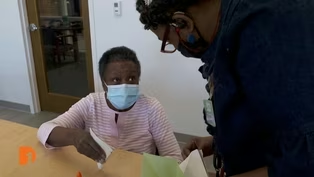
Respite Care: Giving Stressed Caregivers Relief
Video has Closed Captions
Clip: S4 Ep32 | 6m 27s | Caregiving isn't an easy job. Here's more on a Detroit program that provides some relief. (6m 27s)
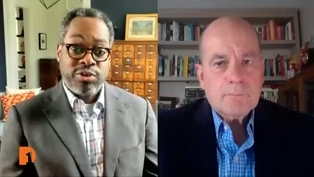
Stephen and Nolan Take on Term Limits
Video has Closed Captions
Clip: S4 Ep32 | 5m 1s | Stephen & Nolan talk the downsides of term limits and another way to fix them. (5m 1s)
Providing Support for PBS.org
Learn Moreabout PBS online sponsorship
- News and Public Affairs

Top journalists deliver compelling original analysis of the hour's headlines.

- News and Public Affairs

FRONTLINE is investigative journalism that questions, explains and changes our world.












Support for PBS provided by:
One Detroit is a local public television program presented by Detroit PBS