One-on-One
Candi Carter; Elizabeth Schedl; Pamela Monaco, PhD
Season 2025 Episode 2833 | 27mVideo has Closed Captions
Candi Carter; Elizabeth Schedl; Pamela Monaco, PhD
Candi Carter, Founder of We’ve Got Friends, discusses how her non-profit provides inclusive spaces for teens and young adults with disabilities. Elizabeth Schedl, Executive Director of Hudson Pride Center, talks about the variety of ways their non-profit advocates for the LGBTQ+ community. Pamela Monaco, PhD, President of Ocean County College, discusses the stigma around community college.
Problems playing video? | Closed Captioning Feedback
Problems playing video? | Closed Captioning Feedback
One-on-One is a local public television program presented by NJ PBS
One-on-One
Candi Carter; Elizabeth Schedl; Pamela Monaco, PhD
Season 2025 Episode 2833 | 27mVideo has Closed Captions
Candi Carter, Founder of We’ve Got Friends, discusses how her non-profit provides inclusive spaces for teens and young adults with disabilities. Elizabeth Schedl, Executive Director of Hudson Pride Center, talks about the variety of ways their non-profit advocates for the LGBTQ+ community. Pamela Monaco, PhD, President of Ocean County College, discusses the stigma around community college.
Problems playing video? | Closed Captioning Feedback
How to Watch One-on-One
One-on-One is available to stream on pbs.org and the free PBS App, available on iPhone, Apple TV, Android TV, Android smartphones, Amazon Fire TV, Amazon Fire Tablet, Roku, Samsung Smart TV, and Vizio.
Providing Support for PBS.org
Learn Moreabout PBS online sponsorship- [Narrator] Funding for this edition of One-On-One with Steve Adubato has been provided by Bergen New Bridge Medical Center.
Citizens Philanthropic Foundation.
Delta Dental of New Jersey.
We love to see smiles.
New Jersey Sharing Network.
Robert Wood Johnson Foundation.
Working for a more a healthier, more equitable New Jersey.
United Airlines.
The Turrell Fund, a foundation serving children.
Congress Hall.
A Cape Resorts property.
And by Community FoodBank of New Jersey.
Promotional support provided by NJ.Com.
Keeping communities informed and connected.
And by BestofNJ.com.
All New Jersey in one place.
- This is One-On-One.
- I'm an equal American just like you are.
- The way we change Presidents in this country is by voting.
- A quartet is already a jawn, it’s just The New Jawn.
- January 6th was not some sort of violent, crazy outlier.
- I don't care how good you are or how good you think you are, there is always something to learn.
- I mean what other country sends comedians over to embedded military to make them feel better.
- People call me 'cause they feel nobody's paying attention.
_ It’s not all about memorizing and getting information, it’s what you do with that information.
- (slowly) Start talking right now.
- That's a good question, high five.
(upbeat music) (light uplifting music) - [Videographer] Okay Gabriel, what do you like the most about We've Got Friends?
- I like to chat, and talk, making arts and crafts.
I like, I like to dance.
And we also like to have pizza too.
- As soon as they get here and they see their friends that they recognize, they do the We've Got Friends handshake, they're high fiving and giving each other hugs.
They converse with each other.
They're so comfortable.
And that's the whole idea of this is for them to have lifelong friendships.
- [Woman In Background] Wooo!
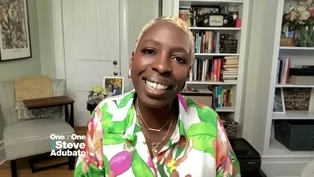
- You just watched some video from We've Got Friends, a great organization and the founder of that organization is with us right now, Candi Carter, founder of We've Got Friends and an Emmy award-winning broadcast executive, lemme, lemme be more specific, former executive producer of The View.
Hey Candi, how you doing?
- I'm doing well.
How are you?
- I'm great.
And just watching that video reinforces how terrific this organization is.
The website is up for We've Got Friends.
First of all, tell us about your son, Emerson, and how Emerson's experience growing up... triggered this initiative, which is helping so many young people, please.
- You know, when you're a parent and you have a child with special needs, they literally do not have friends.
I think when they're very young, when they're toddlers, it's all, you know, everybody's together because the parents are always there.
But the minute the kids hit middle school and they can walk around town by themselves or they can be dropped off at a movie, our kids are at home.
And I realized this and I just wanted to find a way for him to have friends.
So I went to his school and said, look, I'm gonna go to my church.
I have the rectory, which looks like a house.
I'll be there every single week and handed out flyers.
And one parent showed up with a kid, another parent showed up with a kid.
Literally after five months, I had 30 kids.
I had 30 parents.
And it just kind of became a thing, you know, as moms we kind of make it happen.
- Yeah, moms do make it happen.
I have to ask you, tell us more about Emerson.
What's he like?
- So, yeah, he's, he is amazing.
I always say I have Forrest Gump at 22.
So when you see Emerson, he looks like a fairly typical child, but he was born with a rare chromosome abnormality that caused brain damage, other issues.
He was in the hospital for a year basically in and out, open heart surgery as a 10 month old, but developmentally delayed.
So he's 22, but like a five-year-old.
So we still do a lot to help him with his day-to-day care, bathing, brushing his teeth, those types of things.
But he walks and talks and moves around and he loves to be in the space.
I always say kids with special needs know how to socialize, but it doesn't look like how we socialize.
You know, he wants to be next to the kids, he's not necessarily talking but really happy to be there, right.
And that just shows you all of the levels of kids who have disabilities.
- I don't know if you have to be a parent to appreciate this, maybe, maybe not.
How much we obsess over our kids being as healthy as possible, but then being as happy as possible.
They go hand in hand.
- They do.
- That being said, what's it like for you Candi, to see your son, to see your son with these other young people together, just being together?
- It's so funny.
Well, first of all, let me just give you this analogy.
Think back to the pandemic.
Think about when everybody was isolated in their homes, people were literally suicidal, upset, depressed, couldn't take the fact that they couldn't have human contact with friends, family.
I mean, it was really, really a horrible thing.
But the world felt it.
That's what our kids feel like.
They don't have that feeling and touch of friendship and just comradery with other people.
They're typically very isolated.
And so when the kids come together, it's like a cartoon.
They don't have a filter.
So their eyes are big as saucers.
Like they can't believe their luck that they're all together and having a great time.
And so I literally just got an email from a member at my church and she wrote me an email yesterday and she said, "Candi, I was working at Tony's kitchen, I was in the church and I-" - Great organization here in town, a great, Tony's kitchen around the corner from where I am, but go I'm sorry.
- Yeah, no, they serve millions of meals or hundreds of thousands of meals every year.
- They sure do.
- But, so she said, I was at Tony's kitchen, I heard noise.
And she goes, I went in and I looked in there and I saw, We've Got Friends.
She goes, I had heard about it but I'd never actually seen it.
And she said there was so much joy emanating from the room, even though the kids were different levels and it didn't necessarily look, you know, like you would think it would look, they were having a blast.
They were loving each other.
And she said there was so much joy in the room.
And that's what it is.
It's just, it's a very simple idea that has a massive impact on the child and the entire family, quite frankly.
- Candi, let me ask you this.
Obviously it's a not-for-profit organization.
You know, we're a not-for-profit production operation.
I spend way more than half my time raising money to keep the lights on - That's right.
and keep it going.
What about you?
- Yeah, we're constantly raising money.
And I will tell you, I do not like to get political at all, but I got an email two weeks ago that said the funding has been cut from AmeriCorps.
And we had a young college- - Hold on, federal, sorry for interrupting, federal funding for AmeriCorps, - for AmeriCorps go ahead.
- Cut, gone.
They lost their funding and literally they said, your worker's done tomorrow.
And she was supposed to go all the way through I think the end of the summer.
And this is a college student who took off a year and wanted to do something meaningful and working with We've Got Friends, getting to know the young people has changed her life.
She's like, all of the kids are like my best friends.
- Hold on one second Candi, I'm sorry.
So the people understand what AmeriCorps is.
- Yeah.
- AmeriCorps is an organization that takes college students who want to make a difference in a community - Yeah.
- For those who need help and pay them to do that.
Go ahead, pick up your point, Candi.
- Yes, and also just people in the community who wanna help.
- That's right.
- And so, where I am a small organization and I can't afford to have a full salaried person to go to every single group and make sure my parents are taken care of and make sure there's consistency and make sure we have the games that we need.
I was able to do that through AmeriCorps, right?
Because it was subsidized by the government, gone.
Now I had one AmeriCorps worker who did an enormous amount of work for my small organization.
Imagine the organizations in the US who had 30 AmeriCorps workers.
The company that we were working with, the church, had multiple AmeriCorps workers who helped them with their food kitchen and all kinds of things, gone.
And so we are American foundations helping Americans and now we've lost that.
And so that makes our fundraising this year more critical than ever.
It's really a scary time for nonprofits.
We are worried.
We have a golf outing coming up on July 14th.
That's our major fundraiser.
- Put up the website right now.
If people wanna make a difference and support We've Got Friends.
And I'm sorry Candi for interrupting, go ahead.
- Yeah, I mean, look, I always say like the average person has six friends.
If you committed $6 a month to We've Got Friends, like you do that in a day at Starbucks, right?
But that's an easy way to give month over month and help support an opportunity to give kids with special needs socialization.
My son is not going to college, right?
He literally is like a toddler.
But We've Got Friends is his education, his ability to be social, to be appropriate, to walk in a room, to know how to greet people, to say good morning, give mommy a hug.
Mommy says, "Emerson, I love you."
For him to say "I love you" back, that's how our kids can move through the world in a way that will help them, you know, in life.
And so that's really what We've Got Friends is.
It's the socialization piece that's so important and it's important to us.
Like I said, think about the pandemic, how you felt when you couldn't make those connections.
When my kids walk in a room and they see each other, the joy that you felt the first time you could hug your friend or your family member after the pandemic is how these kids feel every week.
- Lemme just say this to you, to Emerson, your son, to all the young people at We've Got Friends and those who are part of your organization.
We wish you nothing but good things and success in these challenging times.
I say it all the time about our series, Making a Difference.
You are making a huge difference.
You don't need me to tell you that.
And let this not be the last time you join us to update us on what We've Got Friends is doing and consider us one of the friends in your broader community.
Thank you, Candi.
Wish you all the best.
- Thank you so much.
I really appreciate it.
- You got it, stay with us.
We'll be right back.
- [Narrator] To watch more One on One with Steve Adubato find us online and follow us on Social media.
- Hi, I'm Jacqui Tricarico, Senior Correspondent for "One-on-One."
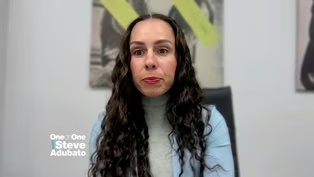
And joining us now is Elizabeth Schedl, who is the Executive Director of Hudson Pride Center, serving the LGBTQ+ community in Hudson County, New Jersey.
Elizabeth, so great to have you with us.
- Thank you so much.
I'm excited to be here.
- Well, first, can you describe for us what the Hudson Pride Center is?
- Yeah, so Hudson Pride is the largest LGBTQ+ community center for the state of New Jersey.
We have two locations, one in Jersey City and one in Union City.
And we offer social services, referrals for medical and primary care services, housing, food support, mental health services, you name it, we pretty much offer it for our community.
We're open five days a week.
We serve as a drop-in center, so anyone can kind of stop by, check out our services, kind of even just grab some food, hang out, maybe work on homework or look for a job.
We're always here for the community.
- So many programs that you offer.
Something that I feel like is always on parents' mind, I'm a parent, I know you're a parent as well, is our children's mental health.
And I know that's especially important for the LGBTQ+ youth within our community.
So tell me a little bit about this YouthConnect Program and what you all are doing there.
- Yeah, absolutely.
And I will say now, more than ever, really mental health services and programs for our youth and young adults is extremely important, so we're very proud of the services we provide for our youth and in that capacity as well.
YouthConnect has been around for over 15 years.
We offer services for LGBTQ+ youth and young adults living in Hudson County.
If somebody doesn't live in Hudson County, we still offer the services.
We can do it virtual, or if they are able to get to us in person, then we'd offer those same services.
Every Friday night we have a free workshop for our youth and young adults.
It starts at 6:00 PM and it goes till 8:00 PM.
During that workshop, we offer free dinner.
Some of those workshops really differ, right?
So like one week you might be doing an artistic paint night, or another week you might be crafting, another time you might be talking about your coming-out stories, it really ranges.
And we definitely wanna provide a sense of support and community where other LGBTQ+ youth can find friends and community and in a safe space.
On top of that, if you enroll into our youth program, outside of that, you could get a number of different services, one of which is free mental health services by affirming and safe mental health providers, which is extremely important.
And we try to take away the barriers such as finding that provider if you don't have insurance, or don't wanna go through your parents' insurance, or if you don't have the money to cover co-payments.
So we offer it completely free for our youth and young adults.
- That's incredible, 'cause we know how hard it is.
Even with so much talk in the press and everywhere that we hear about the struggles of youth mental health, the services are still really tricky to find, so it's so important.
How have you seen that program- Give us an example of how you've really seen that program directly impact some of the young people you see come through your doors.
- Yeah, definitely, I think a lot of the youth, about 35% to 40% of all the clients we serve identify as youth or young adults.
A lot of them are dealing with issues with family or friends' acceptance, lack of awareness and support by the people in their surrounding communities of their identity or their sexuality.
So really when they come to us, they're looking for that type of connection.
And a lot of them might be struggling with substance abuse, suicidal ideations, low self-esteem, different things that youth in general might be going through, but also can be exasperated when you don't have family support or you have a government that is very anti-LGBTQ or anti-the-gender-diverse community.
So what we often do is pair them with a provider that they would prefer to work with that specializes in something they might be going through, and then they really are able to work through those issues and kind of find that guidance that they're looking for to move through those things that are happening.
And what we really see is youth feeling happier, more engaged, and want to experience life in a different way.
- You touched on this a little bit, but community involvement is so crucial to helping us with our nonprofits, with our organizations, and moving things forward.
Talk about how you're working with the community, especially with hospitals and schools, to continue the work that you're doing.
- Yeah, so with the schools, it's really exciting for us.
We have a partnership with Partners in Prevention under the NJ4S state grant.
And what that allows us to do is to go into schools throughout Hudson County with our education specialists and kind of do workshops for not only the youth, but also the staff.
So really helping to provide a special level of education to staff so they can better support the youth that are in their classrooms.
And then, also to the youth, helping them, you know, with conversations around sexuality, gender identity, and also just having a safe and affirming space.
A lot of our youth come into our YouthConnect Program through those workshops that we're doing in schools throughout the county.
So that's a really, really great program that we have.
The second piece is the hospitals, and clinics, and other medical primary care private providers.
So we do a lot of work throughout Hudson County and beyond with those medical practices, because there's a really important level of education or training that we want them to have when they're seeing clients that identify as part of our community, right?
You wanna make sure that their intakes help identify the gender-diverse community, right?
So like that's the first thing you see when you go into a doctor's office is this form you have to fill out.
If you aren't properly able to identify yourself on there, you may feel like, "This isn't the place for me, I'm not gonna feel comfortable disclosing or talking about a lot of different things."
So that is a really important factor for us.
The other piece to that, when working with these hospitals and medical providers, is making sure we have a really good connection with their team.
When my staff call one of them up and say, "Hey, I have a referral for you, I have a client that needs X, Y, or Z services," we wanna make that really easy, and so we can help facilitate establishing the appointment, making sure everything runs smoothly.
Because a lot of times just even getting that appointment and the lag time and, you know, all of us, right, going to the doctor, it might be a month out, that lag time is a barrier in itself.
So we try to eliminate all of that as much as we can.
- We're taping this in May, it's gonna air in June, which is Pride Month, which is so important, it brings attention to so many issues that you're raising.
But, lastly, why do we need to make sure just outside of June, too, and all the other months in the year, that we're making sure to support our neighbors that are part of the LGBTQ+ community?
- Yeah, I appreciate that question.
I think Pride Month is so important, right?
It's not just celebration, but it's an awareness, it's a protest.
It's all of the things that we continue to do to fight for our community, and our rights, and our lives, right?
Especially when so much of it is on the line with a stroke of a pen at this point.
And so I think, for me, what I would like to say is that, you know, please don't just show up and become an ally or support us during this one month.
We live every single day and all the months throughout the year.
And we've right now, above any other time, we really need your help, and your support, and kind of the acknowledgement of our existence, and our rights.
- Well, it's so important, and we'll continue to air this even after June.
(chuckles) So thank you so much, Elizabeth, for joining us.
We really appreciate it.
- Yeah, and thank you for the time.
Anytime that we can talk about LGBTQ+ rights, issues, and Hudson Pride Center, I would be happy to come on.
So thank you so much for having me.
- Thank you, we'll definitely have you back.
Stay with us, we'll be right back after this.
- [Narrator] To watch more One on One with Steve Adubato find us online and follow us on Social media.
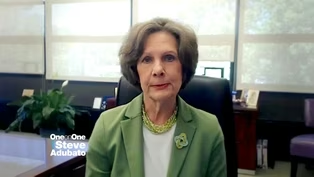
- We're now joined by Dr. Pamela Monaco, President of Ocean County College.
Dr. Monaco, great to have you with us.
- Thank you for the invitation.
- You got it.
We'll put up the website of the college.
Tell us a little bit about the institution and the students you serve.
- We are the oldest community college in the state of New Jersey.
We were founded 61 years ago.
We serve a variety of students.
You know, we're an open access institution, so we provide opportunity for people right outta high school.
We work with our Vo Tech, we have early college students, and we have working adults and seniors, all of whom are looking for a different life.
- Dr. Monaco, let me ask you this, the perception of some about community county colleges, very often they don't understand who you are, what you do, who you serve, and why you're so important.
Where do you think that perception on the part of some comes from?
- Oh, honestly, I think that it really is a reflection on people valuing four-year degrees, universities, and they don't understand community college is the only American higher education entity that was founded in the United States.
It was the whole principle started from the University of Chicago, which believed that there needed to be local colleges that could educate the people right there and not have them have to give up their homes, move away and so forth.
And what we do is we provide the first two years for those who want to transfer.
It's the same quality as you would get at Rutgers or any of the others.
- That's right.
- Much more affordable price.
And you get more personal attention, because we do not have large classes, we have small classes.
And for the students who are trying to figure out who they are, where they want to go, it gives them an affordable way to experiment, discover themselves, and be able to transfer with no problems at all.
- Dr. Monaco, talk about preparing your students for careers.
We happen to be aware of the initiative you have.
I think it's called the Dental Assistance Program.
- Yes.
- I mean, becoming a dental assistant, that's just one area.
Talk about that program and also the larger initiative to help young people be prepared to enter the workforce trained and ready to go.
- Well, traditionally, Ocean County College has focused on being a transfer institution, but we are very responsive to the needs of our residents in the county.
And these days, particularly young people, they want to get a degree that will them into a career, and dental assisting is just one of the examples.
Part of the appeal is that you know where you're going to go, you're going to get a good income, and it's also quick.
That's another feature I would say of the younger people these days is the idea of two years or four years seems like a very long time.
And the dental assisting, they get to work in, you know, with a dental chair, with people, they're going to be equipped and they can go right into a career.
We are also developing a dental hygiene program, a radiography program.
We have a very well respected nursing program with some of the highest pass rates for this standardized test in the state.
- And also, I know that the dental programming is done in cooperation with Delta Dental, one of our longtime partners.
And they've talked about, they told us about that initiative.
Is that a fair assessment?
- Oh, yes.
I mean, they work hand in glove with us, maybe chisel and tooth with us, and have been wonderful supporters in terms of helping us with funding.
These are very expensive programs.
And then also providing us with the context to really develop good advisory boards.
- There's also another reason I mention this, because the role of foundations and corporations and support of higher education, support of what we do as well, is so important.
Particularly at a time when government funding of higher education is let's just say precarious at best.
What's it like to be a college president in 2025, particularly as it relates to the economics of running the institution?
- I'd say one has to have a skin, a rhino hide, and an intestinal fortitude.
You know, it's a tough time.
When I went into higher education decades ago, you know, there were lots of jobs, there was lot of support there.
Nobody questioned higher education or very few did.
Today, what keeps me going, and I think all of my fellow presidents, is that students still need us.
And we just have to pivot and figure out where our allies are.
And as you said, we are very fortunate with having a very good foundation and still many corporations and other entities who need our graduates and who are willing to invest.
- That's right.
Before I let you go, the future of Ocean County College and the community slash county college universe moving forward, what do you see?
- Well, we are very fortunate here in that we are well supported by our commissioners, and it is the county that puts forth a great deal of our funding.
- So you get county funding from Ocean County as well?
- Oh, yes.
It's our number one funding source actually.
I think that we are going to continue to be regarded as sort of the underdog in the higher education universe, but, you know, underdogs have grit and stamina and we know how to run the race and we're not going anywhere.
People need us, you know, technology changes.
We are the entity that not only prepares people for the workforce, but we also are able to provide the incumbent workers with the new training, the new technology, the new skills that they need.
So, we're here for the long run.
- Dr. Pamela Monaco, President of Ocean County College.
We'll be having other college presidents from the community slash county college universe, because they are doing important work now more than ever.
Doctor, thank you so much for joining us.
We appreciate it.
- Thank you.
- You got it.
I'm Steve Adubato, thank you so much for watching.
We'll see you next time.
- [Narrator] One-On-One with Steve Adubato is a production of the Caucus Educational Corporation.
Funding has been provided by Bergen New Bridge Medical Center.
Citizens Philanthropic Foundation.
Delta Dental of New Jersey.
New Jersey Sharing Network.
Robert Wood Johnson Foundation.
United Airlines.
The Turrell Fund, a foundation serving children.
Congress Hall.
A Cape Resorts property.
And by Community FoodBank of New Jersey.
Promotional support provided by NJ.Com.
And by BestofNJ.com.
- How long you been waiting?
- About a half hour.
- Brutal.
This keeps up, I'm gonna miss my pickleball game.
- I've been waiting eight years for a kidney.
What can you do?
(gentle music) - [Narrator] Over 100,000 people in the US are waiting for a life-saving transplant.
But you can do your part in an instant.
Register as an organ donor today at NJSN.org.
Combatting the stigma around community college
Video has Closed Captions
Clip: S2025 Ep2833 | 7m 56s | Combatting the stigma around community college (7m 56s)
How this non-profit is supporting the LGBTQ+ community
Video has Closed Captions
Clip: S2025 Ep2833 | 9m 23s | How this non-profit is supporting the LGBTQ+ community (9m 23s)
Providing inclusive spaces young adults with disabilities
Video has Closed Captions
Clip: S2025 Ep2833 | 10m 14s | Providing inclusive spaces young adults with disabilities (10m 14s)
Providing Support for PBS.org
Learn Moreabout PBS online sponsorship
- News and Public Affairs

Top journalists deliver compelling original analysis of the hour's headlines.

- News and Public Affairs

FRONTLINE is investigative journalism that questions, explains and changes our world.












Support for PBS provided by:
One-on-One is a local public television program presented by NJ PBS