
Candidate Messaging Throughout the State
8/26/2022 | 26m 46sVideo has Closed Captions
Messaging strategies for candidates throughout the State.
A look at how messaging changes as candidates travel the state stumping for votes. Plus, how can voters sift through the rhetoric and choose a candidate that best suits their ideals? When it’s all about the money, what happens to the message?
Problems playing video? | Closed Captioning Feedback
Problems playing video? | Closed Captioning Feedback
CapitolView is a local public television program presented by WSIU
CapitolView is a production of WSIU Public Broadcasting.
Candidate Messaging Throughout the State
8/26/2022 | 26m 46sVideo has Closed Captions
A look at how messaging changes as candidates travel the state stumping for votes. Plus, how can voters sift through the rhetoric and choose a candidate that best suits their ideals? When it’s all about the money, what happens to the message?
Problems playing video? | Closed Captioning Feedback
How to Watch CapitolView
CapitolView is available to stream on pbs.org and the free PBS App, available on iPhone, Apple TV, Android TV, Android smartphones, Amazon Fire TV, Amazon Fire Tablet, Roku, Samsung Smart TV, and Vizio.
CapitolView
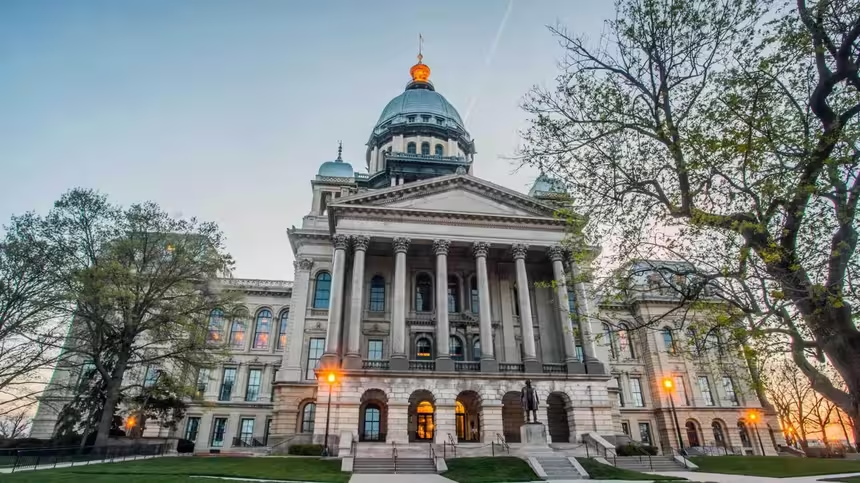
CapitolView is a weekly discussion of politics and government inside the Capitol, and around the state, with the Statehouse press corps. CapitolView is a production of WSIU Public Broadcasting.Providing Support for PBS.org
Learn Moreabout PBS online sponsorship(bright upbeat music) (uplifting gentle music) - Welcome to Capitol View, our weekly look at the happenings inside and outside the Illinois State Capitol, I'm Jennifer Fuller.
Our guests this week are Kent Redfield, the Emeritus Political Science Professor at the University of Illinois, Springfield and Alex Degman, statehouse reporter for Illinois public radio and WBEZ in Chicago.
Gentlemen, thanks for joining us.
- Hey, thanks a lot.
- Good to be here.
- We talked a lot last week about the Illinois State Fair in Springfield, which has now wrapped up and campaigns are turning their eyes to far Southern Illinois.
The Du Quoin State Fair opens this weekend and runs through labor day.
Alex, I wanted to get started with you.
I know you spent a lot of time out at the fair in Springfield, listening to the messages of the candidates and campaigns.
Now they've turned their eyes to Du Quoin, much further south in the state.
How do you think messaging and how the candidates respond to things will change?
- Well, when you're looking at the Springfield State Fairs and the Du Quoin State Fairs, they're both really agriculture based and they're both there to put forth the idea that Illinois is an agriculture state.
Agriculture is the backbone of this state.
And that was made very clear by both candidates at the Springfield State Fair.
And I imagine that kind of thing is going to continue, but there is a little bit of difference because, as we were talking about a little bit earlier, in Illinois, politicians have to change their messages, whether they're, and they don't have to, but typically they do when they're speaking in Chicago, versus when they're speaking in Springfield, versus when they're speaking down in Carbondale, Marion, Du Quoin.
I don't think that the main message that they're trying to get across, that we support agriculture and we're going to do what is best for the backbone of the state, I don't think that's going to change that much, but there may be a little work that they have to do to, I guess, tune their message to their specific audience.
- Ken, how important is it to make sure that the message is tailored to the audience you're speaking to?
- Well, you obviously are playing to local media that is attuned to, you know, southern Illinois, central Illinois, the suburbs, Chicago.
And so depending on your campaign, you know, you wanna make that message resonate, show that you are, you know, if you're not one of them, you understand them in terms of wherever you're speaking, you also want it to play into your narrative.
And so, you know, Pritzker is deep, you know, this week, deep down state.
And so he wants to talk about down state, but he also wants to say, you know, hey, I'm down here in Southern Illinois.
That's not a hell hole.
And I wanna represent the whole state.
And he wants that to contrast that with, you know, Bailey who is, you know, on his home turf and can talk agriculture, but you know, Bailey doesn't need to solidify his down state base.
He needs to expand his elector in the suburbs.
And if, including suburban Cook, and then if possible in Chicago.
So you know where they're, where they're trying to solidify and where they're trying to expand is different for each candidate.
- We'll get to the comment that you alluded to in just a little bit, but Alex, you mentioned that both fairs are about the state's focus on agriculture and its need for agriculture when it comes to the Illinois economy.
This week, we saw J.B. Pritzker and Darren Bailey face off in a forum hosted by the Illinois Farm Bureau.
And they talked a lot about their agriculture policies, but it was a very different conversation.
We see the difference between what J.B. Pritzker sees as the next step for agriculture and energy, in many cases.
And what Darren Bailey says is what farmers need from the state legislature.
Does that message need to be solidified?
Or do you think that they've got the backing that they need there?
- Well, as Kent mentioned, just a moment ago, Darren Bailey, when he does forums like this with the Illinois Farm Bureau, he is on his home turf.
And you could see that during the forum, when he seemed to be very in his elements, he seemed to be talking directly to people about things that they're actually going through right now.
Whereas governor Pritzker, he seemed to know what he was talking about, but it was also very political speechy, if that makes sense.
It seemed like a lot of his press conferences in the past when he's trying to appeal to organizations and appeal to the people who he's talking to.
And that was no different yesterday.
But at the same time, when you ask if people have made up their minds necessarily, I think a lot of people have, but at the same time, J.B. Pritzker is the governor and he's the governor of an agricultural state.
So it's his job to go in front of these folks and tell them that he understands, that he at least is capable of handling what they need.
And, both he and Darren Bailey did show that yesterday, I think.
- Kent, when the two of them, as Alex said, are making very different pitches in areas that they are going to and visiting, and particularly, in front of different affinity organizations, how much does J.B. Pritzker need to play to downstate Illinois, to rural Illinois, to agricultural Illinois, if most of the votes that he will get are going to come from the city of Chicago and the suburbs?
- Well, I, you know, he needs a certain amount of, you know, there is part of the democratic vote does reside in downstate.
Most of it is in the urban areas of downstate, Rockford, Quad cities, Peoria, Bloomington, Normal, Springfield, Champagne, Urbana, Danville, the metro east.
I mean, you know, the all, there's an awful lot of rural territory that is gonna be very strongly Republican, but by showing, you know, attention to downstate and having an inclusive message, you know, that helps him in terms of his overall narrative that, you know, I'm the one, you know, we're the ones with the big tent and, and thus we're mainstream, you know, we're not extreme.
And so, you know, he does need, you know, he can't abandon down state, but he does, he wants to craft his message in a way that resonates with that larger theme about, and he takes advantage obviously of the incumbency.
He gets to take the picture by the butter cow, he and his wife get to battle over who buys the champion steer.
And that's all great publicity that doesn't, you know, you don't have to pay for it and it's a good story.
And it makes for great pictures, you know, in local and statewide media.
- One of the things you alluded to earlier is some messaging, some comments from state senator, Darren Bailey in his campaign, talking about the problems involving crime in the city of Chicago.
And he has gone so far as to call Chicago a hell hole.
And then he walked those comments back and then he came back and said, yes, you know, there are these problems and it is in fact, a hell hole.
Alex, what are those comments doing in terms of garnering any sort of support from voters?
- Well, as it relates to supporters, you might imagine that a lot of Darren Bailey supporters who are particularly focused on crime in Chicago and across the state, they agree that Chicago is a hell hole, or at least has hell hole qualities.
But the problem is, he is not generating much support in Chicago with those comments.
Now you'll hear Darren Bailey and Stephanie Trussell saying that when they walk in the Bud Billiken Parade and when they walk the streets of Chicago, when they talk to people, that they agree with him, that it's scary, and there are things that need to change.
And I think he's really leaning into that.
He's really leaning into the fact that, yeah, I know what I'm saying, but I'm going, and this is what people are actually telling me.
But on the other hand, you have a contingent of people who do not think that Chicago is a hell hole.
And in fact there was a recent, I think it was either, it was within the last week or so, that there was a pretty big push on social media to show pictures of Chicago in this great light and be like, oh gosh, what a hellhole.
And you know, so there there's been a bit of backlash and I don't think he's doing himself any favors by continuing to go down this road, even though he, even though he believes that this is the thing to do, but what he needs to remember is that there are people in the suburbs that also like Chicago.
And the thing about Chicagoans is that if you tell them that Chicago is a bad place, even if they believe it, they don't want somebody else telling them that.
So he's, and this kind of extends to suburbanites too, because people from the suburbs are from Chicago.
They have a really, they have a really strong connection to the city and they just don't like it when somebody who they perceive as an outsider tells them that they're, that where they live is not good.
- The underlying message that he appears to be getting at here is that Chicago's mayor and governor J.B. Pritzker have failed when it comes to combating crime in the city of Chicago and across the state.
Kent, is that message getting through or are people fixated on that one comment?
- Well, it is, you know, there is, you know, obviously violent crime at any level is a problem.
And, people realize that we have to do better in terms of dealing with violent crime, particularly in, in certain areas of Chicago and other urban areas.
But where Pritzker probably has the advantage when we're have dueling campaigns is, you know, when you talk to Bailey, what's your solution, you know, one of his response is, well, we have to get people to obey the law better.
And ultimately you're going to see from the Pritzker campaign, you know, commercials that remind people that Bailey was one of the key supporters of a movement to essentially kick Chicago or Cook County out of the state of Illinois.
You know, so what's your solution, you know, to abandon Chicago, you know?
Or, and that's, you know, that's not going to play well, that will, you know, you come up against people's regional pride and their identity with their, you know, where they live.
So you have to get, you know, more specific.
And when we get into things like cashless mail that are, is going to take effect, you know, next year, people's eyes generally glaze over, and it just reinforces whatever narrative that they came into the discussion with rather than, you know, getting to a discussion about, you know, what actually should we be doing?
And what can the governor do when the city of, you know, he doesn't run the Chicago police department?
Obviously the mayor does.
And, you know, the governor can't un-elect the mayor of Chicago.
So, you know, it's a hard argument to make when you get down to what are the, what specifically can you do?
And so you retreat back to the rhetoric and the stereotypes, and that's probably not, you know, all you're doing is reinforcing where voters already are.
- There have famously been conflicts between heads of the state and heads of the city of Chicago, between the governor and the mayor of Chicago for decades, if not generations.
Alex, what do you think that whoever wins the governor's race is going to have to do to try and bring Chicago and down state back together?
You have to govern the entire state.
You can't just govern part of it.
- Well, I think it's going to be an interesting thing to try to do, because as you mentioned, it's been going on for decades.
We've been trying to figure that out for a long time.
And I think the key thing to do is just to, and I, I hate to go back to this, but the thing that you could do right now is tone down the incendiary rhetoric that is pushed specifically toward one region of the state.
If we're going to work together as a state, because it, even though agriculture, I mentioned this before, agriculture is the backbone of the state, but the Chicago metropolitan area with its 9 million plus residents is the economic engine of the state, and the two need to work together.
And if you're going to have politicians from one side of the state just completely lambasting, and I don't know if that's the right word to use, but just completely excoriating them over everything, and vice versa, you have people from Chicago who shout down state, like you don't understand what we need and things like that.
It's just, it's not going to get better.
So I don't know if that's something that the governor can do.
The governor can certainly set the tone, but it's gonna be up to certainly everybody.
- There was something that, that came out this week from Chicago's mayor, Lori Lightfoot, and it's not an attack on a specific person so much as a campaign or even a political action committee.
The mayor is accusing Dan Proft's People Who Play by the Rules PAC of changing some video in a campaign ad, actually darkening the video to make her look darker.
And she used it in saying that it's playing into racist stereotypes.
Proft denies those claims, but Kent, how much is this going to play with an accusation of a truly racist campaign ad or no, it's not, you're taking this out of context.
Is this going to hold any water?
- It hurts Bailey, even though it's not his ad.
And it helps both Pritzker and actually the mayor, because it makes her look more sympathetic.
And she obviously has lots of problems.
I mean, if you just visually compare the picture that came from her appearance in front of the Chicago Citizens Club, I'm not sure that's the right title, and then what's in the ad, it is noticeably darker and the shading is bad.
And, you know, either, you know, that was in, in the bad old days, that happened all the time.
You know, if you had a minority candidate, you did everything possible to make, if you were running against that candidate to emphasize the racial stereotype.
You know, this could have been bad editing, you know, rather than being intentional, but, you know, just you hand those two pictures to the man or the woman in the street, they're gonna draw a conclusion that, you know, somebody's, you know, somebody's manipulated the video.
And so, you know, the people that made the ad, the people that reviewed the ad, you know, all of the people within Proft's organization and indirectly Richard Yuelin, who is funding that operation, you know, they bare responsibility for, you know, I mean, they're either trying to manipulate people with racial stereotypes, or they're incompetent.
I mean, you know, that's a lose-lose situation in terms of trying to explain your way out of that.
And so you have to say, well, you know, who are you gonna believe?
You know, me or your lying eyes?
That's never really a good defense.
- Alex, this is yet another example of a week where we're talking about things that are in campaign ads, or things that people have said along the campaign trail.
And there are a lot of voters standing up saying, you're not talking about the issues that are important to me.
You're not talking about inflation.
You're not talking about the economy.
You're not talking about unemployment.
Do you think that the candidates in the next two plus months are going to get to those issues in any real way?
Or are they going to stick with what's been working so far?
- That is a really good question.
I think, at least I hope what will happen is they will get into those meat and potato, bread and butter issues like you talked about as they continue with their campaign, with what they, with whatever they think is working.
More often, and this actually isn't that new of a phenomena, more often than not in campaigns, no matter what they're for, you see a lot of rhetoric as opposed to a lot of substance, because people are prone to react to rhetoric more so than they're gonna react to, well, this is what I'm going to do as governor, I'm going to fix the roads, I'm going to improve schools, I'm going to do this.
No, what they respond to is a creative way to message that, but also attacking your opponent.
So it's, politics is a very, very interesting game.
I would say, and I would really hope that, like I said, I would hope that all of these issues come to the fore, but in terms of whether that's going to be helpful to the campaign, I don't know if that's a good strategy.
- In the areas where, say, governor Pritzker needs to pick up some votes downstate in very rural areas, you still see him going out, as you see incumbents do, saying, well, here's a check for this.
Here's some money for infrastructure, for a new school, for things like that.
Does that move the needle anymore?
- It does move the needle in that you've got something concrete, literally and figuratively, that we're doing for downstate.
And so you have an ad with a downstate citizen talking about, this is what we've done for the airport.
This is what we've done for the roads.
You know, the governor, you know, cares.
And when you're an incumbent and you've got a record, which Pritzker has, you know, we're in better fiscal shape, we can argue about whether, you know, how great it actually is, but it's certainly better than where it was.
We're doing things.
And so you're gonna see Pritzker running that.
Here's what I've done, we're going to do more, but there's also gonna be that backdrop of Republicans, Bailey's extreme, Devore, the candidate for attorney general, is extreme.
All Republicans are extreme, you know, and so whatever the problems are, you know, you can't trust these people who are unqualified to, you know, for public office to solve your problems.
And so, you know, that's gonna be that underlying narrative about, and so you don't have to explain how you're gonna fix things if the other person is not qualified to hold office.
And so again, this is campaign 101, you're talking about, here's the great and wonderful things I've done.
And, you know, whatever the problems are, my opponent can't help you because they don't have any answers, they don't have any programs, they're too extreme.
And, you know, Bailey has a much more difficult task running against an incumbent with a record when Republicans are in the minority in the state.
And right now, you know, not only does he have a significant financial disadvantage compared to the governor's war chest, but people the main spending is anti-Pritzker coming from, you know, people who play by the rules, the independent expenditure committee that never mention Bailey's name, it's all an attack on Pritzker.
You don't come away, you know, I wanna vote against Pritzker, but, you know, they don't tell you who to vote for.
And so it's not, you know, it's not ideal in terms of, you know, if right now the money's not being spent effectively to, you know, to build Bailey as a candidate.
- Kent, I wanna stay with you on that campaign finance conversation.
When you talk about, you know, a million dollars here, a million dollars there, and, you know, suddenly we're talking about real money as that cliche goes, but we've seen governor Pritzker put a lot of money into his own campaign and a lot of money into campaigns for Democrats, both here in Illinois and across the country.
Senator Bailey has been, as you said, the beneficiary of Dan Proft and Richard Yueline, and, you know, a lot of other Republican donors, but at the end of the day, how is a voter supposed to get past what they're seeing and hearing in those campaign ads and get to what these candidates are actually about and what they'll be able to do if elected?
- Well, you know, it is hard if you don't see them in depth in person, you know, either personally or through debates, through interviews, you know, if all you are getting is the message run by modern political campaigns, it's very hard for the voters because you know, the people that do this for a living understand that, and it's certainly been shown, it's much easier to drive up your opponents and negatives than to increase your positives and so these are, you know, there's a lot of messaging out there about how terrible the other person is.
And it's very difficult in a 30 second ad, in the 60 second ad, TV or radio, to get any kind of substance, you're dealing in very broad, very broad narratives.
And some of it's fine.
I mean, you know, are you better off than you were four years ago?
That's a legitimate question than voters can get around.
And you know, is this person empathetic?
Does he, you know, if he isn't one of us, does he understand us?
Those are reasonable things for voters to take into account.
It's very hard to get the whole of what's involved with running the state of Illinois, but you tend to all of the way, all of this money, the way it's spent tends to drive out the substance.
And it makes it very hard for voters To get to, you know, what are the important things to me and, you know, and which of these people are really gonna make a difference for me my family, my region, my state?
It's hard.
- Alex, that job tends to fall to people like you and to people like me, those journalists who are tasked with finding the truth and reporting the truth.
Do you find it more difficult today than maybe five or 10 years ago?
- Well, I find it more difficult today, if for no other reason, other than there are some political candidates who are taking this strategy of running their campaign entirely through ads, and they're not talking to reporters at all, they're not doing debates at all.
So initially when I'm first pondering this question, I thought to myself, well, let's go back to what we all learned in middle and high school about how to research things like using primary sources and who is this person, what are their credentials?
And like, looking into that.
And I would say, let's do that.
But then I realized, well, that's kind of not the strategy anymore.
As Kent said, the people who are running these campaigns, they're good at it.
They're very good at this and that's why they do it.
And that's why you're seeing a lot more candidates just not talking to us anymore and not doing the public forums and public debates and getting in front of voters, because there there's a chance that they're gonna have to go off message and they don't want that.
- And Kent, as we wrap things up with just about a minute or so remaining, voters have a lot of times talked about voter fatigue.
Now we have this other layer of accusations of voter fraud, false allegations that the 2020 election was stolen, for example, with Illinois system, with the State Board of Elections and county clerks running those elections, are there allegations that need to be addressed, or should voter confidence be high here?
- We have good, we have a very good election process.
It's well run, well organized.
The State Board of Elections does a great job.
The individual county clerks do a great job.
And so there have not been a lot of allegations of massive fraud or, you know, that, you know, and certainly nothing like we had historically.
There's really two ways to look at it.
We've got a professional board running this in terms that is a bipartisan board.
It's not an elected statewide official, like it is in much other states with very good laws, there's a lot of security built into this.
Now, I mean, you can say one of the reasons we have such a good system is it was built on a bipartisan basis by two political parties that don't trust each other.
And so the way to make sure that your opponent doesn't cheat is to design a system where it's hard for anybody to cheat.
And so that's kind of a lefthanded way of saying, you know, we have a pretty good system that gets, when we make changes, they're vetted, you know, to make sure that we don't have any loopholes.
So I think you can have confidence in what we're doing in Illinois.
- We'll continue to look into this issue and others here on Capital View.
Alex Degman, Kent Redfield.
Thanks so much for joining us.
(upbeat music)

- News and Public Affairs

Top journalists deliver compelling original analysis of the hour's headlines.

- News and Public Affairs

FRONTLINE is investigative journalism that questions, explains and changes our world.












Support for PBS provided by:
CapitolView is a local public television program presented by WSIU
CapitolView is a production of WSIU Public Broadcasting.