
Capitol Riots/#Cut50
Season 49 Episode 3 | 26m 46sVideo has Closed Captions
Capitol Riots/#Cut50 | Episode 4903
Congresswoman Brenda Lawrence is here to talk about the attack on the US Capitol that left her fearing for her life. A talk with her about where the nation goes from here. Plus, Dream Corps, the nonprofit founded by CNN contributor Van Jones, weighs in on what needs to happen in the first 100 days of the Biden administration. Episode 4903
Problems playing video? | Closed Captioning Feedback
Problems playing video? | Closed Captioning Feedback
American Black Journal is a local public television program presented by Detroit PBS
Capitol Riots/#Cut50
Season 49 Episode 3 | 26m 46sVideo has Closed Captions
Congresswoman Brenda Lawrence is here to talk about the attack on the US Capitol that left her fearing for her life. A talk with her about where the nation goes from here. Plus, Dream Corps, the nonprofit founded by CNN contributor Van Jones, weighs in on what needs to happen in the first 100 days of the Biden administration. Episode 4903
Problems playing video? | Closed Captioning Feedback
How to Watch American Black Journal
American Black Journal is available to stream on pbs.org and the free PBS App, available on iPhone, Apple TV, Android TV, Android smartphones, Amazon Fire TV, Amazon Fire Tablet, Roku, Samsung Smart TV, and Vizio.
Providing Support for PBS.org
Learn Moreabout PBS online sponsorshipJust ahead on "American Black Journal"?
We've got a great show for you this week.
Congresswoman Brenda Lawrence is gonna join to talk about the attack on our nation's capital and how it left her fearing for her life.
We'll talk about where America goes from here.
Plus Dream Corps, the nonprofit founded by CNN contributor Van Jones weighs in on what needs to happen in the first 100 days of the Biden Administration.
Stay right there "American Black Journal" starts now.
Announcer 1: From Delta Faucets to Behr Paint, Masco Corporation is proud to deliver products that enhance the way consumers all over the world experience and enjoy their living spaces.
Masco, serving Michigan communities since 1929.
Announcer 2: Support also provided by the Cynthia & Edsel Ford Fund for Journalism at Detroit Public TV.
Announcer 1: The DTE Foundation proudly supports 50 years of "American Black Journal" in covering African-American history, culture, and politics.
The DTE Foundation and "American Black Journal" partners in presenting African American perspectives about our communities and in our world.
Announcer 2: Also brought to you by Nissan Foundation, Ally, UAW, solidarity forever, Impact at Home, and viewers like you.
Thank you.
♪♪ Welcome to "American Black Journal".
I'm Stephen Henderson.
We're gonna spend today talking about the fury and the fallout from the insurrectionist mob that attacked the U.S. Capitol.
That mob left members of Congress vulnerable to violence and to the coronavirus, and the U.S. House has now moved to impeach Donald Trump for a second time, now for inciting this insurrectionist violence.
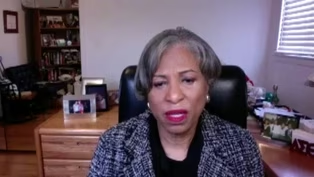
Orlando Bailey of BridgeDetroit talks with Congresswoman Brenda Lawrence about the attack and what it means for our nation's future.
Congresswoman, I wanna start with the impeachment.
You joined in with 232 other legislators in voting for impeachment.
We know that this is a historic vote.
Tell us why and what was going through your head when you were hearing arguments from the other side not to impeach President Donald Trump.
My statement was we can get back to unity and to moving forward until we have justice, and we have accountability.
It's just amazing to me.
The reference to Black Lives Matter was often brought up, the protests and the rioting.
There were some people who were in Washington, and we must acknowledge this, who are peacefully protesting, which is their right.
You may not like an issue that a person has.
But in America, we have the right to assemble and to peacefully protest.
But what we saw in the Capitol was not a protest.
It was a riot, and it was not peaceful.
It was violent, and it was an insurgents because their number one goal was to stop the government from performing its constitutional duty.
And at that day, it was to certify the electoral college vote.
And so, there is no comparison between a protest for civil rights to that riot that we saw.
And then you heard people say, "Why didn't you say something when there was riots as a result of the peaceful protests for Black Lives Matter?"
Did you not hear me?
Did you not see me on the record saying that this has nothing to do with our issues, and that writing and tearing a property does nothing to advance the issue of people hearing us, changing laws and policies?
And someone said, "People are sick and tired of the Democrats contesting."
Well, my goodness, it's been four years of listening to a president's divisive comments.
I am not a Democrat.
I am the radical left.
I am the socialist.
I am the enemy just because I'm a Democrat.
And I can tell you that we as a country must recognize what happened was a deadly... People died.
It was a deadly Riot on our Capitol, and we must address it.
Yeah.
Some people have asked what the goal of the impeachment is, citing the fact that Donald Trump would be out of office as early as next week.
The Senate won't have time to take up the issue.
So from your vantage point, what is the strategy here for this impeachment?
Accountability.
I mean the fact that the president did it 12 days before he was gonna leave office does not negate that what he did sitting in the seat of the President of the United States was wrong, illegal, deadly, and there has to be accountability.
What are we supposed to do?
You know what, I was getting ready to divorce my wife, and it's only 13 days from now, so I shot her.
So what's the big deal?
You're not gonna be together, just let it go.
No.
The crime happened.
He led that.
He said go to the Capitol.
He directed them.
They had on everything Trump.
They said, "Hang Pence."
They beat people.
They destroyed it.
They were looking for members of Congress.
I was on the floor, listening to this mob outside the doors of the floors of Congress being told about gas mask, like to hide and protect myself.
I'm sorry to interrupt, but I really wanna get your first hand account around the... What exactly was happening inside the Capitol, and what were you doing?
And what was really going through your mind as this violent insurrection was happening?
I didn't have the advantage of watching TV.
I didn't know what was happening because I was on the floor, and there's no TVs on the floor.
And so I'm sitting there, and all of a sudden they take Nancy out, and they're locking the doors, and they're telling... Then the police comes in and said, and this is something I'll never forget, he said, "They're headed our way."
They we're headed our way, what does that mean?
He said they're in Sanctuary Hall, which is the divider between the House and the Senate.
And so they said, "You need to take cover.
You need to get behind the seats in the House."
And someone later told me that the seats are designed to be bulletproof.
But I'm saying I was right by the door, and I said, "Okay, I gotta move because if they break in the door, I'm first line of fire."
Then they said, "Reach under the seats and get a gas mask.
We've been using tear gas.
Put on your gas mask."
All this time you know they're yelling, because it's... And so I've never had a gas mask in a box.
I couldn't figure out how to open it.
I'm screaming out, "How do you open this?"
And then I'm trying to kneel down, finding the best place to hide.
Other members are crying, and screaming, and praying, and we're trying to figure.
Then we start hearing me banging at the door, and you can tell it's multiple people's loud voices, and they're trying to get into the gallery where we were on the floor.
And I'm sitting there going like, "Am I gonna die today?
I mean is this really getting ready to happen?"
And I'm watching my colleagues fall apart here.
And I said, "Oh my god."
And then the police came in from the opposite side where we could hear the mob, and said "Everybody out, everybody out.
Come this way, come this way."
And so we're running down back stairways and hallways to be taken to a room that was secure.
When we get to that place where we were safe and the police was surrounding us, I was so angry.
I was so angry, because you know what, the Republican members were running with us.
This was not about Democrats and Republicans.
This was about a siege on the Capitol, and that's why sitting there yesterday in this debate, they were running for their safety, just like we were.
It was an attack on all of us.
I was so angry, and they we're so angry.
Both sides to this issue.
You we're together.
And to hear you say that you were wondering in your mind if you're going to die, or legislators and even media to both cite this issue, it has to be infuriating.
I wanna move us a little forward and talk about really this not weird, but this dichotomy, and the evidence of double standards and how the handling of the insurrection by law enforcement was handled versus how law enforcement handled the Black Lives Matter protests that happened last summer.
Could we have seen the Black Lives Matter protesters storm the Capitol and come out alive or not have seen the amount of force that these insurrectionists did not see?
We know for a fact, and there is all kind of levels of investigation.
Had this been a publicly known rally of Black Lives Matter, with the leader, and in the case of what happened on Wednesday, January 6, it was the president of the United States directing them to go to the Capitol it was all over social media, the president publicly announced that, we would've had National Guard, police, and whatever we needed there.
We saw it happen repeatedly.
When he wanted to walk across the street and hold a Bible upside down in front of the church, the National Guard was called in to protect him.
And he sent these insurgents to get Pence.
I mean how ironic is this?
Pence became the enemy because he did not agree with Donald Trump, and all of his followers, these rioters, agree Pence now has to go, and whatever that meant to them.
And they were shouting, "Hang Pence."
But when we know a black man can run down the street and be shot and killed, a black man without a weapon can, in public display, be choked to death.
A black man can have a sandwich in their hand or a black woman could be asleep in her bed and murdered.
And here you have these people, open carry, destroying property, in a riot mode, being insurgents, you know it's happening, and the police were instructed to stand down.
You saw how passive they were.
And then we're investigating.
Police officers have been removed from duty.
We're looking at outside members who encouraged and directed this mob.
So, it's so many levels of accountability here, and we're not gonna sit back.
The Black Caucus had a national town hall yesterday to address the fact that we know that the disparity and treatment was just on public display, and that we are not going to sit back and be silent on this.
So, the president elect is to be inaugurated next week.
Tell us what you're seeing happen in Washington around security threat, and even at the Capitol.
I'm hearing lawmakers having to go through metal detectors to get to the floor.
Do you have security concerns about the inauguration?
And do you feel safe at the Capitol?
I had to go back two days ago to Washington.
I had so much anxiety.
We had federal marshals now that meet us in airports and fly on the planes, because the intense aggression that members of Congress are being subjected to.
And the amount of National Guard is unbelievable.
The gates are up, but I couldn't go five feet without running into two, three, four National Guards.
You've seen photos of them.
They're not taking this lightly.
The crowd size will be minimum.
Someone just asked me, "Then why don't you just do it in private?"
This is a narrative that we're fighting, that Joe Biden is not a legitimate legal president.
And if we don't go through a public display of the legal transfer of power that validates that Biden is now the president of the United States, that narrative will grow, and just like they said, Obama was not an American citizen.
But we must, we must.
Just like Nancy Pelosi, after I went through all that trauma, was in a safe room and sitting there for hours.
She walked in and said, "We must go back to the Capitol."
And I'm sitting there going like, "Oh my god.
I'm trying to pull it together here."
She said, "We have been attacked.
They want to stop us.
They can't win.
We are elected by the people.
We have taken an oath to protect the Constitution.
We will go back and do our job."
And she was right.
We could not allow, and we're walking past tear gas cans, broken glass, doors being dishinged, and all of the wounds of war, and we're walking past all that to go to the floor to vote.
We must have an inauguration that shows America that democracy wins.
The people voted, the votes have been counted, and we will have a new president.
I'm excited about Biden coming to the table.
He is committed to working for everyone, whether you voted for him or not, for all of America.
And we in Congress are gonna have to work closer together as well.
January 20 is the day that Joe Biden will be sworn in as the 46th President of the United States.
The theme for the inauguration is America United.
Bringing people together is also the mission of the nonprofit organization Dream Corps, which was founded by social entrepreneur and CNN political contributor Van Jones.
The group has some recommendations on what communities of color need during that critical first 100 days of the administration.
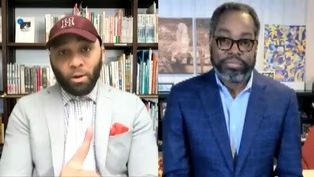
I talked with Louis Reed, a director in Dream Corps' Criminal Justice Reform program, known as Cut50.
Let's start with this #cut50.
What is that, and what are you trying to tell President Elect Biden?
Yeah.
So Cut50 is a bipartisan criminal justice initiative of the Dream Corps, and we are co-founded by CNN political commentator and now Reform Alliance CEO Van Jones, as well as Jessica Jackson who is the legal mentor to Kim Kardashian.
And essentially we have a very robust agenda to reduce the national prison population.
We wanna be able to close prisons, and we wanna be able to open doors of opportunities for people who have been disenfranchised and impacted by our criminal legal system.
That is a huge issue all over the country.
Talk about the opportunity now that we have a different person who's going to be in the White House to handle it differently than we have the last four years.
Well, one of the things I do wanna say is that as someone who has served nearly 14 years in federal prison, I can attest that people should not be, people's freedom should not be contingent as to who is in the White House.
People who are in a prison house don't care who's in the White House, so long as they can get back home to their momma's house.
And so during the last four years, approximately two years ago, we had the benefit of working with this current administration, the outgoing administration, on a bipartisan piece of legislation called the First Step Act.
That one bill, in and of itself, has released more than 15,000 people from federal custody in a little bit more than two years.
And when you quantify those numbers, essentially what that means is that we have more than 500,000 years of human freedom restored back into our communities.
Now that is just a tip of the iceberg of what we can do on a bipartisan basis and what we should be doing with this incoming administration.
We can no longer be passive.
We can no longer play politics.
We can no longer kick the can down the road, so to speak, as it relates to people's freedom.
And in my mind, there's nothing more urgency, especially with the state of our union right now.
There's nothing more urgent than health and freedom.
And when you think about the people who have been impacted by COVID, seven out of the 10 hotspots in the United States of America are either in prisons and/or jails.
This incoming administration, I think that they are in prime position to give people a springboard to success, rather than in perpetuating a trap door to failure.
You mentioned it briefly just now, but you spent a significant amount of time behind bars.
Talk to our viewers about that experience and what it taught you.
Yeah, so one of the things that I often tell people when they hear about the work that I've been doing as it relates to advocacy, doing national organizing, leading advocacy on historic bills, such as the First Step Act, et cetera, people have a tendency to exceptionalize me.
But my counter to that is that if given the opportunity, there are more than 2 million people in the United States of America who are currently incarcerated.
There are more than 70 million people in our communities with criminal convictions.
There are another subset of approximately six to 7 million people who are on some form of supervision.
If given the opportunity, if we created a space for these individuals to be able to have that springboard to success, rather than the trapdoors, the failures that they have been navigating through life.
They would rise to the occasion.
And so, when I was incarcerated, there was a transformation that I have.
First and foremost, unapologetically, I am a Christian.
I'm a person of faith, and I believe that it was my faith that kept me going through that incarceration experience.
The second thing is that an education, a passport opened up in my mind where I was able to matriculate through university and earn my education while I was incarcerated.
I.e.
the argument and the persuasion to bring back Pell Grants for people who are incarcerated, especially those individuals on the federal level.
And the third thing, I realized that those closest to the problem are also closest to the solution, but often furthest from resources and power.
That was a notion that I developed from a mentor Glenn E. Martin, and I wanted to be able to individually stand in that gap and try to bridge that disconnect as much as I could.
And so, the work that we're doing here at Cut50 has allowed me to expand my network through the Empathy Network.
And the Empathy Network is the nation's largest bipartisan coalition of impacted organizers and advocates, literally people who are on the ground, who have their hands in the dirt within their community and their fingers on the pulse of what is happening within their community regarding criminal justice reform.
So, through the Empathy Network, we have been able to bridge that chasm, bridge that chasm between those individuals who know about the solutions and the people who are empowered, but may be disconnected from the issues.
We have been able to bridge that chasm, and all of that came as a result of a transformation that I had when I was incarcerated, and also I should say facilitated by the leadership of Van Jones and his vision for the Empathy Network as well.
So let's talk about this first hundred days of the Biden Administration and what your group sees as the opportunity to act swiftly, to start doing things differently.
Yeah, well, first and foremost, obviously, the priority for this administration is gonna be on COVID, which we have no compunction about.
But what we are going to be challenging this administration is not to forget the so-called least of these among us, those individuals who are still incarcerated.
Again, seven out of the 10 hotspots in the United States of America are in jails and prisons.
And so, we want to make sure that the people who are incarcerated don't inadvertently be sentenced to death as a result of, by virtue of their incarceration.
And so, we have been working with the Reform Alliance on what we call the Safer Plan.
The Safer Plan is a five-point recommendation that we have been submitting to governors since last year, two administration since last year.
And very briefly I'll talk about what that five-points Safer Plan means.
Number one, we need to make sure that every institution in every correctional facility on all four points of our country have PPEs.
That means staff and so-called inmates as well.
Number two, we need to suspend copays for people who are currently incarcerated.
There's no reason why if an individual is exhibiting signs of COVID-19 that that person should have to pay for a medical copay as a result of maybe inadvertent infection.
Number three, we need to make sure that people who are within six to 14 months of release, that they go.
There's no reason why we should be keeping those individuals incarcerated and in custody when they will inevitably be released.
And another thing, we need to make sure that people who are in that vulnerable population, 65 and older, that there are special parole considerations for those individuals, and let's get those people out of custody.
♪♪ That's gonna do it for us this week.
Thanks for joining.
As always, you can find more information about our guests at americanblackjournal.org.
You can connect with us on Facebook and on Twitter.
We'll see you next time.
♪♪ Announcer 1: From Delta Faucets to Behr Paint, Masco Corporation is proud to deliver products that enhance the way consumers all over the world experience and enjoy their living spaces.
Masco, serving Michigan communities since 1929.
Announcer 2: Support also provided by the Cynthia & Edsel Ford Fund for Journalism at Detroit Public TV.
Announcer 1: The DTE Foundation proudly supports 50 years of "American Black Journal" in covering African-American history, culture, and politics.
The DTE Foundation and "American Black Journal" partners in presenting African American perspectives about our communities and in our world.
Announcer 2: Also brought to you by Nissan Foundation, Ally, UAW, solidarity forever, Impact at Home, and viewers like you.
Thank you.
♪♪
Video has Closed Captions
Clip: S49 Ep3 | 14m 21s | Capitol Riots | Episode 4903/Segment 1 (14m 21s)
Providing Support for PBS.org
Learn Moreabout PBS online sponsorship
- News and Public Affairs

Top journalists deliver compelling original analysis of the hour's headlines.

- News and Public Affairs

FRONTLINE is investigative journalism that questions, explains and changes our world.












Support for PBS provided by:
American Black Journal is a local public television program presented by Detroit PBS