
Capitol View - April 11, 2024
4/11/2024 | 26m 46sVideo has Closed Captions
Capitol View - April 11, 2024
This week: we'll have the latest on the immigration crisis in Chicago, where some 10,000 immigrants are being housed in shelters.
Problems playing video? | Closed Captioning Feedback
Problems playing video? | Closed Captioning Feedback
CapitolView is a local public television program presented by WSIU
CapitolView is a production of WSIU Public Broadcasting.
Capitol View - April 11, 2024
4/11/2024 | 26m 46sVideo has Closed Captions
This week: we'll have the latest on the immigration crisis in Chicago, where some 10,000 immigrants are being housed in shelters.
Problems playing video? | Closed Captioning Feedback
How to Watch CapitolView
CapitolView is available to stream on pbs.org and the free PBS App, available on iPhone, Apple TV, Android TV, Android smartphones, Amazon Fire TV, Amazon Fire Tablet, Roku, Samsung Smart TV, and Vizio.
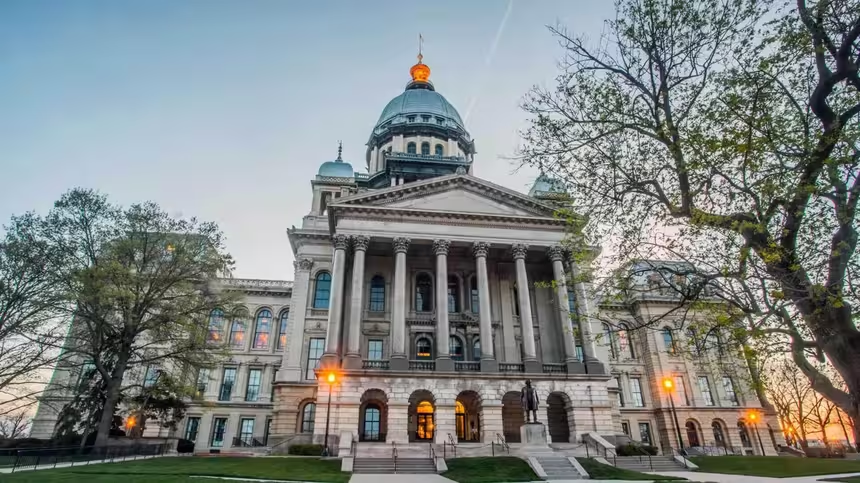
CapitolView
CapitolView is a weekly discussion of politics and government inside the Capitol, and around the state, with the Statehouse press corps. CapitolView is a production of WSIU Public Broadcasting.Providing Support for PBS.org
Learn Moreabout PBS online sponsorship(upbeat music) (intense music) - Thanks for joining us on "Capitol View".
I'm Fred Martino.
It's an extremely busy week in Illinois, and we have two of the best to bring us the news and analysis on the top stories facing state legislators.
I am very pleased to welcome Andrew Adams of Capitol News Illinois and John Jackson from the Paul Simon Public Policy Institute at Southern Illinois University Carbondale.
Gentlemen, thanks for being with us.
- Thanks for having us.
- Amen, thanks.
- Andrew, I wanna start with you.
Lots of new developments in the Chicago area immigration crisis.
We are taping this on Wednesday, so updates are possible.
A recent report indicates Chicago Mayor Brandon Johnson may ask the Chicago City Council to spend another $70 million on the crisis.
Chicago closed two shelters on Sunday, but there are still about 10,000 immigrants in 21 shelters in the city.
"The Chicago Tribune" reports hundreds have been arriving in the Chicago suburbs.
And we are now seeing small numbers of cases of tuberculosis in addition to measles.
There is a lot to unpack there, Andrew.
- Yes, absolutely.
There is, as always, a lot of news about how the city is handling this situation.
So, you know, let's start with the money of it all.
Because I think that has the most implications for our state lawmakers, who are expected to provide more funding to the city and to other cities for this situation.
The news you mentioned is that it's being reported that Mayor Brandon Johnson of Chicago is going to ask the Chicago City Council for $70 million to help fund this effort.
Now that money would be expected to go to things like maintaining the shelter system, providing services and that kind of support for these recent arrivals.
This comes just two months, I believe, after Mayor Johnson noticeably did not say he would provide $70 million as part of a deal that was allegedly reached between the mayor, the Cook County government, and the state.
Now, Cook County did put in $70 million towards that effort and the state put in twice that.
And while Mayor Johnson denies agreeing to any deal, others that were familiar with that meeting said that his team and that he had agreed to this a while ago before backing out of it publicly.
- Okay, very interesting.
And certainly as you point out, something that is likely to see more discussion in the general assembly.
Because yes, this latest news is Chicago asking for possibly additional money from the city council, city dollars.
But as you pointed out, the state has spent a lot of money to try to help Chicago and help other locations.
And then the context of it all, this is also a crisis in New York City, in Denver, in other cities where if you look at New York state, the state and the city, it's now the discussion, not billions, but getting above trillion.
We're talking about lots and lots of money over time to be spent on this issue.
And the question comes up politically, how can you manage that?
Which, in one of the stories this week an analyst said this is a federal issue, essentially, and that cities are not used to handling situations like this.
- Exactly.
And you know, Mayor Brandon Johnson has faced a lot of criticism over how he has handled this situation, as to how he has responded to criticism about the situation.
And part of that is that city governments, simply, are being put under a lot of strain.
You know, Chicago has had to provide services, they've had to provide food, shelter, counseling, healthcare, to 30-some-thousand people over the past year or two that they didn't expect to.
And that's a significant cost for people who really do need help and support in order to go about their lives, start being full members of society.
Now I'll also add that, with regards to kind of the state implications, the state is providing funding not only to the city but to other cities, to other villages around the state, even as far south as Urbana the last time I checked on the grant program for non-Chicago cities, a grant program that is expected to receive more funding when state lawmakers approve budgets.
And it has received bumps in funding throughout the past year or so.
And that's interesting because we're at a bit of an inflection point with regards to where migrants are arriving.
I think as you mentioned earlier, "The Chicago Tribune" has been reporting that more buses are arriving in suburbs than there have been, and certainly the city is receiving fewer buses.
And this just goes to a lack of coordination between Texas and Governor Greg Abbott down there and these other cities, these other states, including Illinois, that are receiving these buses.
- Okay.
And as we wrap up, I should say I misspoke when I said about New York, that like Chicago and the state of Illinois, spending hundreds of millions.
In New York, it's now getting to, they're talking billions.
And I believe I said trillion.
Billion was what I meant to say as we look at it.
But really the major point is it is a lot of money, not just in Illinois, but in other states and cities around the country, and something that we're gonna be hearing about for a long, long time.
Well Andrew, thank you for that information.
John, I wanna move on to something else now that does definitely involve money as well.
There has been one real bright spot in Illinois with the addition of some factory jobs, particularly electric vehicles.
So a growth industry in the future.
But there also is some sobering news as well.
A new report shows about 1,000 workers are losing their jobs as four Illinois factories announced closures this year.
And listen to this, here is the long-term context in that Newsweek report.
They say that the St. Louis Federal Bank says that the number of people employed in manufacturing jobs in Illinois has almost been cut in half since the 1990s.
In February, 1990, nearly one million people were employed in manufacturing roles, when data collection by the US Bureau of Labor Statistics began.
In February, 2024, that number stood at just over half a million.
Tell us more about this, John, and its continuing political implications.
- Well Fred, this is a reflection of the new economy that we're in.
And what role will Illinois play and what role will the Midwest play?
The statistics you just cited about Illinois cited in that article are really a reflection of the national statistics.
The old economy came out of the industrial revolution.
It was based on making things, manufacturing jobs.
The new economy which came online in the last decade, two decades ago, sometimes called the service economy, is more about thinking up new things to make and designing them and writing the computer codes necessary.
Probably the epitome of this has been Apple, which led the way.
They think up and design the computer code for the new things that we can't live without, iPhones and iWatches.
And that is what the new economy's all about.
Financial services, computers, communications and all of that.
And Apple, while they have all of that high-end employment in Silicon Valley, most of the things that are made are made in China and southeast Asia.
So the Biden administration has been trying to bring some of that back home with the American Rescue Plan and the Computer CHIPS Act, both of which provide federal subsidy for bringing some of those jobs back.
One of those areas is green energy, and solar for example.
The other really high profile one is electric vehicles, and that's where Rivlin comes in.
Governor Pritzker has been trying his best to make sure Illinois has a role with that.
And Rivlin, of course, makes electric vehicles.
I think they were at 100 layoffs there.
The factories at Rivlin didn't actually close.
I think the other three did because they were in old manufacturing positions and they didn't wanna invest the money.
But Rivlin will be here and electric vehicles will be here even though they haven't sold as rapidly as they thought they would.
And that's the reason for the cutback.
I thought the Newsweek article was really half the story, though.
It's about the gross, that is, the 1,000 jobs that the headline talked about, mass layoffs.
What they didn't consider is there is always growth in jobs being expansion jobs here in Illinois from our own companies, and being new jobs brought in.
And the governor's been trying to ensure that we have a role in that.
All of this will be the context of the next election.
What is the best plan for dealing with the new economy?
And Trump has his position, which is mostly to raise tariffs on things coming in.
Biden's been trying to get ready for computer chips and solar energy and that sort of thing.
And that's what the governor's trying to do.
- Okay, well, a very interesting analysis there.
And it kind of brings us, John, to our next story.
Andrew, speaking of jobs, of course, fewer folks working in manufacturing as I mentioned in that Newsweek story.
When you look back to 1990, about a million, and now a little over half a million.
So where do they go?
They go to service jobs.
And that brings us to our next story.
There is an effort to get rid of the lower Illinois minimum wage for workers who receive tips.
A bill has advanced but it looks to be in danger.
Tell us about that.
- So to step back a little and just make sure that everyone remembers how the tipped wage works here in Illinois, currently the Illinois minimum wage is $14 unless you make tips.
So unless you work at a restaurant, for example, and customers can add 20% or whatever they choose to the bill.
Then your minimum wage is $8.40 with the caveat that your employer has to make up the difference.
Now that's the current state of affairs.
Several advocacy groups are attempting to end that practice so that tipped workers would simply make $14 or whatever the then current minimum wage is, just like everyone else.
And still receive tips.
But as you said, despite it going through a House committee, this has been a controversial proposal.
Now it's been controversial for a number of reasons.
There's disagreements about what current research says about this.
There's disagreements about what would help and hurt workers.
One of the major arguments for this is kind of on its face, it's a system that lends itself to bad actors not necessarily making up the difference between that $8.40 and the actual minimum wage.
It opens the door for those kind of harms to workers.
But the opponents of this proposal, people who like the system as it is, which include perhaps unsurprisingly retail merchants and purveyors of food, people who currently employ tipped workers, they say that that's actually overblown, and that kind of abuse is not necessary to the system.
In fact, they will add on, and some tipped workers will add on that by allowing these kinds of tips, restaurants and the like can offer services and food at lower menu prices, therefore encouraging people to come to the restaurant and encouraging those people to tip because they like the service and they like the price.
So by raising the minimum wage, you might actually be hurting workers, or at least that's how the argument goes.
Now there's disagreement even within the usually agreeable Democratic party.
Oftentimes the majority party in Springfield agrees on major issues.
But there is significant disagreement here with even Democrats not being unified on this.
And when Democrats are not unified on a subject, it takes its time to move through the legislative process as they put together enough of a majority to pass it.
- All right.
Well, we will be watching, very interesting story.
And again like so many of these, a national issue as well.
There have been a lot of coverage recently about in California, some fast food restaurants now required to pay a minimum wage of $20 an hour.
And some restaurants are questioning the sustainability of that plan, and we will have to wait and see.
It is so fascinating to look at this issue.
John, we have another pocketbook issue now.
You and I watched the State of the State Address together, and we recorded analysis for our online "Capitol View" special.
One thing that we talked about was the governor's spirited presentation about his ideas for healthcare reform.
One idea being floated is a prescription drug affordability board.
A recent column in "The Chicago Sun Times" raised concerns about this.
Tell us more.
- Well, this is a perennial fight in this country, and the conflict goes back decades on how to make drugs affordable and what's a fair gain for the drug companies.
Probably the most recent prominent example nationally is that President Biden finally got the authority to let Medicare put a cap on insulin at $35 a month for those who need insulin, because that had become a terrible fight for those trying to pay the bill on insulin.
And one thing that's been advanced nationally, in fact, 10 states have already done these boards that we talked about earlier, and they're supposed to study this and put some controls on and so forth.
That is now subject to all new policies, the debate over intended versus unintended consequences.
The intended might be to control the price of drugs, but the unintended might be, the critics say will be, the taking of some drugs off the market by the manufacturers, not being available in Illinois and thus having to be mailed in.
Or the question of paying with cash.
Poor people often pay in cash, and the critics are saying it's going to do more harm than good.
10 states, as I mentioned, have done this.
Some of the critics are saying, why don't we wait and watch and see what happens?
Justice Brandeis has this famous quote which says, "The states are the laboratories of democracy."
Well, this is a possible laboratory of democracy kind of experiment.
And we may do this and see how it works in Illinois, or the critics would hope that we don't do this and let the other 10 states lead the way.
So we'll see.
But it's going to be a fight, and always is nationally and in Illinois.
- Absolutely.
Well Andrew, speaking of money issues, sorry, we got a lot of money issues this week, but it is going to be a while before we know what happens, but we could be paying more for utilities in the state.
You reported on this last month for Capitol News Illinois.
- Yes, the Illinois Commerce Commission, which oversees utilities, so think Commonwealth Edison or Ameren, is currently reviewing plans from those two electric utilities on what they're spending and what their rates are going to be like for the next three years.
These plans, though they are four year plans, are taking a while to go through the approval process.
The process was supposed to have finished in December, but we are now looking at year two of review after the ICC and its five member board rejected the utilities' initial plans, even after those plans had been edited, revised, and reviewed by advocates and ICC staff and the attorney general for compliance and effectiveness.
This is part of a much broader shift at the ICC, which has been taking more aggressive stances against utilities and keeping those utility rates lower than they otherwise might, and imposing stricter guidelines on environmental impact and climate impact in the wake of the state's 2021 Climate and Equitable Jobs Act, which truly reformed almost every aspect of the utility and energy industry, changing a lot of the backend that a consumer might not think about.
But that really shook up the way that these utilities deliver electricity and gas to our homes.
- Okay.
And yeah, we'll be watching.
Could be maybe the end of the year, is that right?
- Yes.
So we will find out what the plan for electric rates will be sometime around the end of the year.
- All right, thank you Andrew.
We have about four minutes left, John, for one final story.
The headline for Rich Miller's column in "The Chicago Sun Times" says it all.
The new director of the Illinois Department of Children and Family Services has her work cut out for her.
Tell us about the major challenges.
- Well, this is one of the most difficult jobs in state government.
And it's also been conflict-ridden with the last director and the one before that.
It's always been a problem.
And it's because the question is, what are the rights of children, particularly those who might be abused in homes?
And what is the state role in that?
And then pitting that against the parental rights, and when do you take a child away from a dangerous situation in a home?
And we've had a lot of sad experience with that, and kids that were badly mistreated in their homes and taken by the state, or in other cases should have been taken before they got injured or even killed.
So you've got the pitting of those two very valid interests.
What kind of alternatives can the state provide?
And the new director, Heidi Mueller, talks about this.
And says she describes DCFS as, quote, "Providing a safety net for our state's most vulnerable residents, and the tragedy that results when there are holes in the safety net."
And I think that summarizes it admirably.
- Yeah, very difficult job, and something that we'll be watching as well.
We have about two minutes, Andrew, so I think we can briefly talk about this last story here, the Illinois Supreme Court upholding a law limiting where sex offenders can live.
Tell us about the law and the case that went before the court.
- Yes, so as people might be aware, if someone is convicted of certain crimes like child sexual abuse, they are restricted from living near places where children congregate, like schools or daycare centers.
Now, a man moved to a new home.
This man was a registered sex offender for a crime he had committed in the early 2000s.
And he checked with his realtor, he checked with the local police, he checked with the state police.
They all said, this home is fine.
You're not near any places that would preclude you from living there.
Turns out everyone was mistaken.
He was actually relatively close to a daycare center and was being told he had to leave.
Now, the state Supreme Court said, while that is unfortunate and there is room for this to be appealed at a lower court, for this specific case, the general law that says that sex offenders can't live near certain places is valid, it is constitutional.
Which was at question.
Basically questioning whether, well, where you choose to live is a fundamental right or not.
- Very interesting.
And certainly raises this question when you look at this, the oversight as well in terms of notification to people who are purchasing homes.
So it's a very interesting issue.
Andrew and John, thank you so much for being with us this week.
- Good to be here.
- Thank you for having us.
- Thank you for joining us as well and for supporting public media.
For everyone at WSIU, I'm Fred Martino.
Have a good week.
(energetic music) (music continues) (music continues)

- News and Public Affairs

Top journalists deliver compelling original analysis of the hour's headlines.

- News and Public Affairs

FRONTLINE is investigative journalism that questions, explains and changes our world.












Support for PBS provided by:
CapitolView is a local public television program presented by WSIU
CapitolView is a production of WSIU Public Broadcasting.