
Capitol View | April 23, 2026
4/27/2026 | 26m 46sVideo has Closed Captions
Jeff Williams host this week’s top stories with analysis from Jeremy Garner of the Chicago Tribune.
Jeff Williams host this week’s top stories with analysis from Jeremy Garner of the Chicago Tribune.
Problems playing video? | Closed Captioning Feedback
Problems playing video? | Closed Captioning Feedback
CapitolView is a local public television program presented by WSIU
CapitolView is a production of WSIU Public Broadcasting.
Capitol View | April 23, 2026
4/27/2026 | 26m 46sVideo has Closed Captions
Jeff Williams host this week’s top stories with analysis from Jeremy Garner of the Chicago Tribune.
Problems playing video? | Closed Captioning Feedback
Where to Watch CapitolView
CapitolView is available to stream on pbs.org and the PBS app.
CapitolView
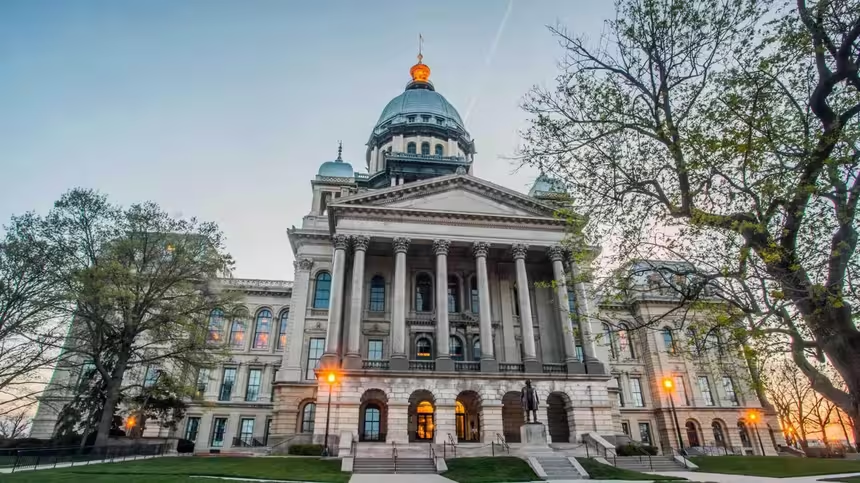
CapitolView is a weekly discussion of politics and government inside the Capitol, and around the state, with the Statehouse press corps. CapitolView is a production of WSIU Public Broadcasting.Providing Support for PBS.org
Learn Moreabout PBS online sponsorship[MUSIC] >> Welcome to capital view on WSIU.
I'm Jeff Williams sitting in this week as we take a look at what's making news around the state in Illinois politics.
At the top of the news this week, we pause to remember a trailblazer in state politics, a longtime state representative and House majority leader who passed away late last week.
Barbara Flynn Currie also, the legislative session continues to chug, along with lots of bills flying around under the Capitol dome.
We'll take a closer look at some of those and likely more this week on Capitol View.
To help lead the discussion is Jeremy Gorner.
State government and politics reporter for the Chicago Tribune.
Jeremy, welcome back to the program.
>> Glad to be here.
>> I know it is a busy time, but before we before we jump into the fray of the of the legislative session.
I wanted to pause just a moment to honor and remember a person who was very much part of that legislative process in Illinois for some 40 years, and that's former House Majority leader and longtime state Representative Barbara Flynn Currie from Chicago.
She died last Thursday at the age of 85.
Jeremy, I know you did a retrospective of piece on on Leader Currie.
Um, how will she be remembered?
>> So, um, I mean, Barbara Flynn Currie was, um, she was in the state legislature for 40 years.
She was the first female House majority leader.
She was a long time.
Um, she was the long time top lieutenant to longtime House speaker, former longtime House Speaker Michael Madigan.
And, um, she was really she was known, you know, as a champion for progressive causes.
I mean, she pushed for the legalization of same sex marriage.
She focused on, um, just myriad issues affecting low income people.
The earned income tax credit, for instance, she was, um, she was instrumental in, in um helping abolish the death penalty in Illinois.
I mean, there's just so many things over her 40 year career that she was, um, that she had a hand in.
Um, and for much of that time as a leader in, um, you know, in the Democratic caucus, which, as you know, has long held, um, for the most part a supermajority over the last 30, 40 years.
And especially in the time, not actually, they haven't had a supermajority for 34 years, but like, like in recent years, they've had a supermajority, but they've had the majority in the legislature.
And she's been really a face of that, um, for the Democratic side.
Um, and I know that you and I were talking before that, Jeff, I mean, she was often wouldn't be surprised if she was labeled the smartest person in the room.
Um, but she kind of.
But she was also known for that kind of quiet leadership.
I mean, she was known as just a great debater on the House floor on a number of issues.
Um, and, you know, one, one former colleague of hers said that she could be a little intimidating because she was so brilliant.
Um, but at the same time, she would also go out of her way to mentor young lawmakers, especially women.
I mean, you know, when she started out in the legislature, I believe it was only 13 women, um, you know, either in the house or in the, um, in the legislature as a whole.
Um, that's grown to, um, you know, you know, to the present day as being very diverse, you know, many women in leadership, um, you know, in the, in the general, you know, in the General Assembly and, and in state government.
>> Yeah.
As a newly, as a newly minted, uh, reporter 35 plus years ago.
You're right.
That was the one piece of advice that a senior state House reporter gave me when I went into a committee hearing, and she was chairing it, and she said, the only thing you need to remember is that she's the smartest person in the room.
And you'll be you'll be fine.
So yes, she definitely, definitely will be missed.
Well, according to the according to the calendar, there's a what?
A little over a month left or so in the spring legislative session.
Six weeks or so, a number of bills floating around that are still not quite as.
As they say, one of those is the governor's major projects.
Bill slash.
What?
Chicago Bears Stadium bill.
That has a lot of implications, many of them beyond just the the keeping the bears in Chicago.
Um, bring us up to speed.
I think there was a deal.
And then the House did some changes that the Senate may or may not like.
Um, what's the status on this thing?
>> So basically there was an amendment that was passed to a bill that was passed in February, and it's all centered around um what's called um, payment in lieu of taxes.
Jeff.
You know, or the pilot program basically, um, what this would do is that if the bears ultimately decide to move to Arlington Heights, which would be the site of, um, which they have their eyes on the site of the former Arlington International Racecourse, which is, you know, the bears own that property now.
Um, instead of paying property, like the regular property tax rate, they would get to negotiate, um a set, um, a special payment with the local taxing bodies.
You know, you're talking the school, the school boards, the parks, whatever taxing bodies, um, that play a role in taxing the public, you name it.
Um, and this special payment would basically, um, be made instead of paying the regular property taxes.
And this is supposed to give them this special rate as an incentive for them to build a multi-billion dollar billion stadium.
Um, you know, on the site of Arlington Heights.
Now, at the same time, you know, the, the, the Indiana legislature passed legislation that would create a finance authority to, um, build a new stadium for the Bears in Hammond, Indiana, if the bears wish.
And the bears are still evaluating that option.
But in this case, um, you know, there's, you know, there's some fine tuning to the pilot bill that's focused, you know, for the bears, um, for the bears and other, um, big corporations who want to take advantage of these mega projects.
There's been some changes, um, to the bill, um, since February when it passed and the bill actually, uh, you know, was filed overnight.
Um, but, um, you know, you know, but, you know, there's still, there's still could be concerns from the governor's office and from the, the Senate going forward.
I mean, you know, the bears are off or the House is off next week.
Um, the bears, um, you know, are on this week and they want this new bill to go through committee and then maybe go through the full House for a vote this week, because the clock is ticking.
The bears said that they're going to make a decision at some point soon.
Um, but, you know, it might have a ways to go.
The Senate may not agree with some of these changes.
Um, I guess like, you know, one of the things, I guess as far as some of these changes go, this latest mega project project bill would, um, make data centers ineligible for such incentives.
Data centers are responsible for residents skyrocketing electric bills, for example.
There would also be local review boards that would not only approve mega projects but also participate in negotiations.
This was something that State Representative Kam Buckner, who is leading negotiations in the House on stadium projects.
He said he discussed this with the Illinois Federation of Teachers, which was concerned about how a major a mega projects bill like this could raise taxes for, um, you know, residents in the general area and so on and so forth.
Um, and then, you know, so there's tax certainty and they also want to create a pot of property tax relief for residents in those areas, um, as well as putting money into a statewide property tax relief fund.
But you know, we're going to, but, but those numbers are still being worked out and that could be a point of contention.
Um, um, you know, going forward, possibly with the Senate.
Um, so those are just like some of the changes that we've seen with this new bill that, um, you know, the House is really trying to push this week, but again, it remains to be seen what happens in the Senate and really how much on board the bears and the governor's office to, um, you know, Governor Pritzker is ultimately going to be tasked with signing this bill if it goes if it gets to him, we'll see what they say.
>> Yeah.
This thing sounds like it has just about as many moving parts as the public transportation bill did.
And we all know what happened with with that thing.
Is it is there enough pressure to get this thing finished by the end of the session?
Or.
Or could it potentially spill over into a veto session or even a special session over the summer?
>> Well, I mean, so so bears CEO Kevin Warren, I believe him and or other members of the bears management team have said that they're going to make an announcement and to spring early summer, I believe, um, as to whether you know, what their next plans are, are they going to move to Hammond or are they going to move to Arlington Heights?
And with adjournment here in the legislature coming up on May 31st, you figure, you know, the House and Senate need to work something out, um, before that.
So yeah, but but but the, the reason that the House is so adamant about trying to push something through its chamber this week is because of the way the schedule is, has been drawn up and the General Assembly, um, the house is off next week and then the only the Senate is in and we've seen there's been a lot of weeks, um, not to get too granular, Jeff, but you've probably heard it too.
There have been several weeks this session where only the Senate's in or only the House is in.
And, um, yeah, that's so we'll just have to see what happens there.
>> Yeah.
You know, making the sausage is a messy process.
But still the process is important.
And it sure seems like they've had a really, uh, unique calendar for, for, for this session.
Uh, one of the other, one of the other bills, I think that passed in the Senate and is now in the House, I believe something also that you have, I think you may have done a story on it last week, the e-bike E-scooter Safety bill.
You can't walk down the street in Carbondale.
I'm sure it's every other city in the state without seeing an e-bike or an e-scooter.
And I've seen them weave in and out of of traffic, and some of them are going 35 plus miles an hour down a street with 20 mile an hour speed speed limit sign.
What will this what will this bill do?
And, um, where do you think it is in terms of how successful it might be in actually getting, through the General Assembly this session.
>> Yeah.
So I mean, this bill passed 54 to nothing last week through the Illinois Senate.
And basically what it does is that, um, it would establish a regulatory framework for these electric bicycles, these electric motorcycles, e-scooters, you name it.
And, um, these are devices that are growing in popularity, but there's been a number of safety concerns.
Um, and, uh, you know, I guess from, you know, the Secretary of State's office, the Illinois Secretary of State's office, which is really pushing for this bill.
Um, they say that from 2019 to 2022, um, these they're called micromobility devices, uh, these electronic transportation vehicles, um, they, these e-bikes and e-scooters and whatnot.
They, um, they've cut injuries with these vehicles and fatalities have jumped 300% across the US, including in Illinois for over that three year period, 2019 to 2022.
So, I mean, Alexi Giannoulias, the Secretary of State, has said that while these devices are convenient and affordable and environmentally friendly, I mean, the technology is evolving faster than, um, Illinois law.
So, um, so, so, so basically, I mean, you know, not to get too much in the nitty gritty, but under the legislation, riders of like e-bikes and e motos, for example, um, that are capable of traveling more than 28 miles an hour, um, those drivers or riders would be, have to get a driver's license, registration insurance, a title.
Um, they gotta be at least 16 in most cases to operate these vehicles.
Um, though you could, you could be 15 if you're, if these are lower speed e-bikes, but um, but yeah, generally, but, but riders of like these e-bikes and e motos along with e scooters, um, electric skateboards, electric unicycles, they're prohibited under this bill from exceeding 28 miles an hour on roads, bike paths and sidewalks.
Um, to your concern about sidewalks, I mean, that was the chief concern I got from readers when this was posted was what about sidewalks?
Um, so basically what the legislation would do, this is only just part of the legislation because I know we have I could talk about this legislation all day, but basically it would create uniform safety standards and statewide standards and safety standards.
Um, and it would replace the current patchwork of local ordinances that have had to address this budding technology, you know, on their own, you know, the local towns and municipalities.
So, um, so that's where the state is swooping in to have uniformity, um, surrounding regulation of, um, these bikes and e-scooters and whatnot.
>> I would assume that also puts in some uniformity in terms of, in enforcement and the burden of enforcement on, on state and, and local and county law enforcement agencies, then to enforce whatever this would safety bill would would implement.
>> Yes.
Yeah.
And that was one of the things too, is that, um, you know, I know one proponent of this bill.
Um, I mean, there aren't really very many opponents that I saw said that this would make law enforcement, you know, it's, it's designed to make law enforcement's life lives a lot easier, you know, in trying to enforce safety regulations just on the street, basically.
>> Yeah, yeah.
A couple other things that I wanted to touch upon.
And I know these are all kind of moving targets.
There are at least a couple of, of constitutional amendments that have been been batted around this session.
One is the so-called millionaire's tax that would impose a 3% tax on income over $1 million.
I think it it's in the House, but it kind of depends on the day whether or not it's got support or doesn't support, or even if it would make it make it through the Senate.
This is not a not necessarily a new idea.
Um, any insights onto what may be moving or not?
Not moving with that, that particular initiative?
>> Yeah.
So basically the, um, the millionaire's tax amendment passed through the Revenue and Finance Committee yesterday.
So, um, in theory it could be called on the House floor this week, but um, you know, we'll see what kind of support it has.
I mean, even among, even among Democrats, you still might see some Democrats who are very pro-business and, you know, they don't and don't want to discourage, um, um, you know, people who have, you know, the wealthy in this state from leaving the state or their businesses, um, their corporations leaving the state.
I mean, that's, that's, you know, one thing that, um, is a concern among, you know, some, you know, obviously that's a big concern for Republicans, but even some Democrats, but then you have progressive Democrats who really have been pushing for this idea of progressive revenue.
Um, just bringing in more revenue to the state of Illinois as a way of creating a more fair and equitable tax system so that, um, you know, the wealthy pay their fair share and that low income people aren't, um, further, um, further exacerbated by the tax burden in Illinois.
And so this seems to be a never ending battle we hear about in Springfield.
And certainly every year in Springfield, we hear about it, but it's really heating up this year.
Um, especially because especially out of concern, um, with the federal government.
Um, the Trump administration, um, you know, their threat and even in some cases their actions already of taking away federal funds from blue states like Illinois, um, you know, leaving the states, you know, creating more of a burden of, for state governments to kind of fend for themselves.
And that could, you know, you know, very possibly, result in, um, more taxes.
And, you know, people who are, you know, less wealthy, you know, poorer people, you know, being impacted.
So that's a concern among progressive Democrats.
Um, and why they would love to see an amendment like this.
I know House Speaker Chris Welch has been a proponent of millionaire's tax amendment.
Um, and the idea, so basically this would have to this vote if it passes, if it passes the House and Senate, um, before May 3rd, because it would go on the November ballot ballot.
Yeah.
To see if, um, uh, you know, see if voters approve of something like this.
And, um, in the past, this question has been posed to voters and voters seem to in Illinois seem to be in favor of it.
Um, but it's just, it just hasn't generated enough support, um, in the General Assembly for it to pass historically, I believe it's because if it's going to be a constitutional amendment, there's a higher threshold for voting.
I believe it's 3/5, if I'm not mistaken.
For something like this to pass.
So I mean, either way, you know, you're seeing a you could be seeing a division among Democrats on something like this, Democrats who control the legislature.
So we'll see what happens.
Like I said, it passed committee yesterday.
It could go through the House, the full House this week.
Um, again, the House is off next week.
Well, it's it's got to pass through the house this week if it's going to get on the November ballot because um it's got to be, it's got to pass six months before the November election.
So that deadline is May 3rd.
And um, with the house off next week, um, they gotta pass it this week and leave it for the Senate next week so that they can decide whether they want to pass it another one.
>> And this one I think was introduced by Speaker Welch himself.
That would be a proposed amendment that would rewrite part of the state's constitution on legislative Redistricting that would add a couple of new new provisions, I think.
Similarly, I think focused to some extent on providing equal opportunity and participation.
To be honest, I haven't read a whole lot about this.
I think is this one relatively new in terms of being before the General Assembly?
>> Yeah.
I mean, so basically what this amendment would do is it would ensure, um, no citizen is denied an equal opportunity to participate in the political process.
Um, and the language says and to elect representatives of his or her choice on account of race.
Um, this is, this could be looked at as, um, the, you know, the state of Illinois stepping in to impose a state protection on redistricting in Illinois, um, just in case the federal government steps in and, um, you know, overturns possibly the, um, the VRA, the Voter Rights Amendment, the Voters Rights Amendment.
Um, and, uh, you know, so that could, you know, that's really, um, that's really kind of a way for the state, um, to, um, or the voter, the Voter Rights act.
I'm sorry.
Um, and, um, that's basically something that, or the Voting Rights Act, that's basically something that, um, you know, the federal government has, you know, you know, that state governments, especially in, in blue states, are fearful that the federal government might do.
So this is really kind of a state response to that.
But at the same time, you have Republicans in Illinois who look at this as a form of super gerrymandering.
I mean, Republicans have long complained that, you know, the way that the legislative districts are drawn, um, in Illinois and the congressional maps as well, congressional maps.
>> Especially.
>> You.
Yeah, you have, um, you know, you know, in the Illinois House, there's 78 Democrats to 40 Republicans in the Senate.
it.
It's 40 to 19 Democrats to Republicans.
You have Republicans who feel like if the maps were drawn more fair, um, uh, then, you know, in the house, they could probably then the Republicans should be entitled to maybe, you know, as many as eight more seats.
I've heard I've heard them argue.
Well, they feel like a an amendment like this could further exacerbate, you know, the unfairness that they feel, um, Democrats are imposing on, you know, these legislative maps.
So, so we'll see what happens with that to again, that went through the, I believe that went through the executive committee yesterday.
And, um, that's also being considered this week.
Um, on the House floor.
>> Yeah, we got about 4.5 minutes or so left.
Something I wanted to touch on.
I saw that, uh, I believe you had written something about it, maybe maybe last, um, last week and that is on Illinois's credit card swipe fee ban that I think is actually set to go into effect in July.
But now it seems there's a federal agency, maybe part of the US Treasury, that intends or has indicated that it may try to put a put a stop to this to the States ban, which correct me if I'm wrong, but I think is this are we like the first state to try and to do this in the country as well?
>> Yeah.
So passed in 2024, basically this, um, this law, it's called the Illinois Interchange Fee Prohibition Act.
Um, it would, it's set to take effect in July.
The law would basically ban these so-called swipe fees or also known as interchange interchange fees, um, on, on tax and the tip portions of customers bills.
Um, and the goal here is to lower the amount of credit that credit.
The goal here is to lower the amount of money that credit card companies, Jeff can, um, can charge retailers, you know, credit card companies and financial institutions, banks, you know, currently charge retailers a fee when, when consumers use cards, you know, based on total transaction, including for goods, you know, including goods, taxes and tips and.
This law bans fees on the tax or tip portion of the customer's bills.
Now, these financial institutions have argued that the implementation of this would be burdensome, costly.
It's just very complex.
And it would affect not only their industries, but it could also hurt small businesses and consumers.
So what we saw earlier this month, um, um, you know, I believe this was last week, the office of the Comptroller of the currency, which is, um, part of the federal government.
Um, it's an independent bureau of the US Treasury Department.
They're planning to put out an order.
Um, it's, it's to call it an order preempting the Illinois Interchange Fee Prohibition Act.
Um, you know, so, so they're basically singling out this Illinois law as a way of saying, hey, you know, we're trying to preempt Illinois from putting this into effect.
And, um, and at the same time, you know, you, you have this a federal judge in February ruled that key provisions of this law, um, you know, you know, could go into effect.
And it's a decision that banks and credit unions have appealed.
Um, but retails, but that retailers supported the legislation.
Um, but that retail, you know, it's basically a decision that banks and credit unions have quickly appealed.
But um, there's also been bills out there that could potentially, um, there have also been bills out there that could potentially in Illinois that could repeal this law.
Um, and, you know, you have I talked to a couple of those sponsors who said basically they echoed the concerns of the financial institutions.
They said that implementing this would be, um, too complex.
Let's maybe, you know, delay the implementation for a year.
One of the lawmakers told me.
But also in light of this notice from the federal government wanting to preempt this so that the law doesn't go into effect.
Um, you know, these these lawmakers in Illinois still, you know, who are in favor of repealing the law, they still want to review what the federal government wants to do, especially since these lawmakers are Democrats and they're a little wary of the Trump administration.
Um, you know, with really just anything.
I mean, you know, Democrats are distrustful of whatever the Trump administration wants to do.
But at the same time, you know, they have a common they have a common sentiment here that they both have problems with this Illinois law that's in effect.
>> Yeah.
Well, Jeremy, we are once again out of time for this edition of Capitol View.
I know it is a busy time for the state Capitol.
I appreciate you taking time to enlighten us on what's been what's been happening under the under the Capitol dome.
>> Thank you.
>> Jeremy Garner, Chicago Tribune, I'm Jeff Williams, thank you for joining us for this edition of Capitol View.
Have a great week.
[MUSIC] [MUSIC] [MUSIC]
 New Episode
- News and Public Affairs

Top journalists deliver compelling original analysis of the hour's headlines.

- News and Public Affairs

FRONTLINE is investigative journalism that questions, explains and changes our world.

 New Episode
 New Episode
 New Episode
 New Episode
 New Episode
 New Episode
 New Episode
 New Episode
Support for PBS provided by:
CapitolView is a local public television program presented by WSIU
CapitolView is a production of WSIU Public Broadcasting.