
Capitol View - April 25, 2024
4/25/2024 | 26m 46sVideo has Closed Captions
Capitol View - April 25, 2024
Analysis of the week’s top stories Kent Redfield, emeritus political science professor at the University of Illinois Springfield and Mawa Iqbal of WBEZ.
Problems playing video? | Closed Captioning Feedback
Problems playing video? | Closed Captioning Feedback
CapitolView is a local public television program presented by WSIU
CapitolView is a production of WSIU Public Broadcasting.
Capitol View - April 25, 2024
4/25/2024 | 26m 46sVideo has Closed Captions
Analysis of the week’s top stories Kent Redfield, emeritus political science professor at the University of Illinois Springfield and Mawa Iqbal of WBEZ.
Problems playing video? | Closed Captioning Feedback
How to Watch CapitolView
CapitolView is available to stream on pbs.org and the free PBS App, available on iPhone, Apple TV, Android TV, Android smartphones, Amazon Fire TV, Amazon Fire Tablet, Roku, Samsung Smart TV, and Vizio.
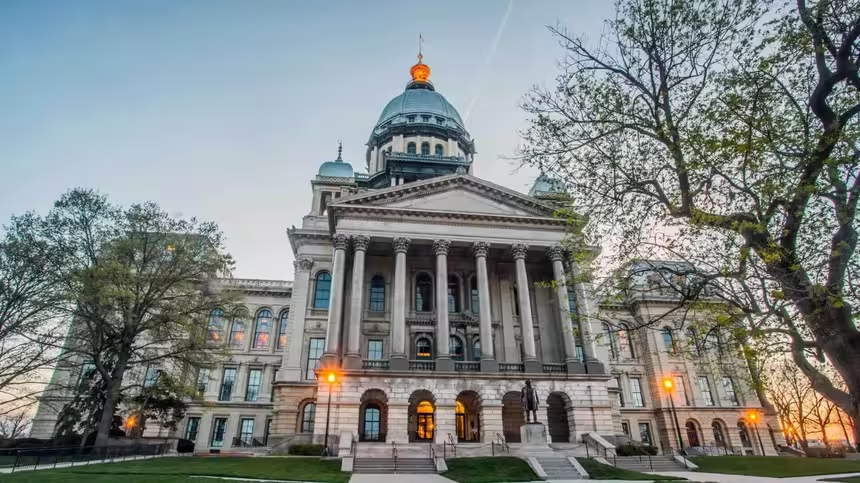
CapitolView
CapitolView is a weekly discussion of politics and government inside the Capitol, and around the state, with the Statehouse press corps. CapitolView is a production of WSIU Public Broadcasting.Providing Support for PBS.org
Learn Moreabout PBS online sponsorship(upbeat music) (upbeat music) - Thanks for joining us on "Capitol View."
I'm Fred Martino.
It's a busy time in Springfield, with the Illinois General Assembly meeting to discuss the budget and a variety of important issues in the state.
We have two of the best to help us make sense of it all, Mawa Iqbal of WBEZ in Chicago, and Kent Redfield, Emeritus Political Science Professor at the University of Illinois, Springfield.
Mawa and Kent, thank you both for being here today.
- Good to be here.
- Yeah, thanks for having us.
- Well, it is great to have both of you here.
Mawa, we're beginning with a number of stories about the immigration crisis continuing.
In the Chicago area, there are concerns about getting work permits for immigrants.
One of your colleagues reported on this for WBEZ.
- Yeah, so it's, of course, as you've mentioned, definitely an influx of people, new arrivals coming into the city.
As of this morning on the city's dashboard they have on their website, there are just under 40,000 people who have arrived in Chicago since August of 2022 and about 8,600 of them are in shelters.
And so getting work permits, getting jobs, getting any source of income is vital to a lot of these people to make sure that they have access to stable housing and can kind of get out of the situations that they might be in with, you know, food insecurity, housing insecurity, that sort of thing.
And so right now what's going on is, you know, the federal government, a lot of advocates are saying the federal government has to step in and change the way that they allow people to get work permits.
They're saying that right now it's really difficult for a lot of these migrants coming in to get work permits, that it takes a really long time.
And so they suggested that Illinois could actually follow what some other states have been doing and do like a statewide path to getting work permits.
So in Utah, they passed a law that is currently stalled, but it would have allowed unauthorized immigrant workers to apply for a two-year work permit after paying a fine and passing a criminal background check.
And so there's a lawmaker state representative, Elizabeth Hernandez from Cicero.
She's also planning on introducing a joint resolution, which would basically kinda ask Biden to use authority to grant work permits to all immigrants.
So it's one of those where advocates are saying, you know, like these resolutions, they're powerful and they send a message, but they're not necessarily binding.
And so action is gonna have to come either from the federal government to just change the federal system, the way they've been doing it since 1986, or from the state to do their own thing, which can be pretty difficult, but not impossible given what advocates are saying are some examples of other states doing things like that, so.
- Important context and really great reporting.
I'm looking forward to seeing more from both WBEZ and your partner, the Chicago Sun Times, because this issue will continue to be a very, very big challenge for the entire state.
A lot of money being spent by the state and of course the city of Chicago.
And as you point out, Mawa, this is really a federal issue and one that is getting a lot of attention at the federal level.
And Kent, work permits are not the only federal backlog.
Republicans in Congress blocked a bipartisan immigration bill that would've provided additional funding to tackle additional delays, like evaluating asylum claims.
The Center for Migration Studies says there were about 2.8 million pending immigration cases at the end of the first quarter of fiscal year 2024.
- Yeah, it is.
You know, that's the latest chapter in a long history of failure to update and rationalize the immigration system and we're talking about the majority of the people that we're focusing on in terms of coming into Chicago are people who are applied for asylum.
They have been given court hearing dates.
That's part of that horrendous backlog that's there.
And then, so they have a legal status, which is separate from undocumented aliens who are in the country.
And some of them have been here for a very long time.
And you know, you can just, this has got a lot of facets to it, then the politics essentially, you know, we killed a bill, a modest bill, but it was a bipartisan bill, came out of the Senate, got killed in the House.
You know, people are betting, at least on the Republican side, if former President Trump is reelected, then they'll be able to, you know, and they have control of both houses of Congress, then they'll be able to put something out there that's much more dramatic in terms of change.
And so we're not even really doing legal immigration in terms of that part of the system.
And so whereas Chicago took in 1.3 million immigrants between 1990 and 1910, primarily Hispanic and Asian, which really changed and revitalized a lot of the south suburbs, you know, that part of the system is not working.
So we are catching the brunt of this because of the politics of and the governor from Texas trying to raise the visibility of the issue.
But it's been a massive failure at the federal level with both parties really unsuccessful to either force something through on their own or reach a compromise.
- And it's important to talk about because of course, over the next six months, we will be hearing a lot about it in campaign ads and context is crucial.
As you point out, this was a bipartisan agreement that was stopped by Republicans and the advocates for the legislation said that it included some of the toughest new measures to deal with this, as well as providing money to begin to deal with this enormous backlog of immigration cases.
And the border patrol representation, the union for border patrol officers supported this legislation as well.
- Yeah, and we should quickly note that, you know, this is part of a migrant crisis that is worldwide that we have displaced populations throughout South America, throughout the Middle East.
And so this is one part of not only a federal failure, but a huge issue internationally.
- Absolutely.
Mawa, this continues to grow for the entire state of Illinois.
We have reported extensively on the hundreds of millions of dollars spent by the state on immigrant shelters and food assistance.
And now there are proposals before the General Assembly to provide education funding for immigrant children as well.
Tell us more about that.
- Yeah, so it kind of started back in October when the Illinois State Board of Education was coming up with their proposed FY 2025, so the next fiscal year's budget.
It's an $11 billion budget.
There's a lot of stuff in there, but what's been a pretty kind of heated topic of debate, especially in the State House recently between Democrats and Republicans, is the funding for new arrivals.
And so when they first proposed, when they were first making the budget, they earmarked $35 million for this new arrival grant program.
Basically, public schools can apply for these grants through the state to basically help with new arrivals.
So like the money could go towards hiring more bilingual staff.
It can go towards getting more materials in the students' native languages.
But I was at this committee hearing a couple weeks ago, it was this house committee hearing, where is ISBE, so the Illinois State Board of Education, came in and they're like, okay, we know we said $35 million for this program.
We're upping that now to $188 million.
That is our updated ask as of now, just because just the sheer influx of students that have come into Chicago public schools and the suburbs is really high.
A lot of the educators who work in these Chicago and Chicago area schools have said that this increase, they've seen as like unprecedented.
And so they really, really, really need support to meet these students' needs who are often coming in not only with language issues, so like language barriers, needing help with English tutorials, but also a lot of trauma, right?
A lot of these educators talked about how these students, particularly students who are coming from Central and Southern America, are facing a lot of like trauma and facing a lot of emotional hardship just with the way that they have come here and also their housing situation, like we talked about earlier, might be a bit precarious.
So they need a lot of support.
And so the State Board of Education is asking for this big chunk of change.
Of course, a lot of Republican lawmakers are staunchly opposed.
They kind of go back to what they've usually been saying, which is like, you know, Illinois has basically made itself to be a welfare for immigrants, a welfare state for immigrants, and we need to stop letting people in 'cause it's stressing out our taxpayers by asking for more funding to meet the growing influx of migrants.
But of course, as we talked about before we started recording, we do have a Democratic super majority.
And so I do feel like that funding, even if it's not at the $188 million ask, I do see some bit of funding going towards addressing the migrant increase in the school districts.
- Yeah.
Important information.
Thank you for bringing us up to date on that, Mawa.
Kent, we are taping this on Wednesday, so there may be updates on this next story, but if you can tell us what you know about Governor J.B. Pritzker's health insurance proposals, where they stand right now in the General Assembly.
- Okay, so this is a general, this gets talked about in terms of utilization management in terms of healthcare.
And so we have a lot of intermediate actors depending on what particular health plan you're in, what system you're in.
And there is huge cross-pressure.
The medical costs have been skyrocketing.
We're looking at increased costs that people are trying to budget for.
And so these are attempts to make the utilization, probably the best way to say is to mitigate some of the impact of the cost containment mechanisms that have been adopted by large insurers in terms of trying to limit access.
So we have things like step utilization is a phrase where they talk about, you know, your doctor wants you to do X, but the insurance company would like a couple of other things, you know, other medications before you go on to the more expensive medication.
You have authorization issues in terms of being able to get from your primary into a specialist in terms of treatment.
And you know, as this is something that as far as what the state can do, we can deal with big kind of full health insurance plans.
We can also, this is an issue that affects retirees, state employees.
It doesn't affect self-funders, self-insurers.
So there isn't kind of, this is everybody's in the same boat sort of thing.
But-- - There are some rays of hope, though, in terms of the assembly looking at this legislation and giving, yeah.
- Absolutely.
So, you know, we are going to get a variety of things that are in this bill, trying to make it, put the doc, the primary physician more in control, trying to make it run more smoothly and more predictably from the patient's standpoint.
- Yeah.
So these things, you think it's gonna eventually pass.
- Yeah.
- Is that what I'm hearing?
Okay.
- But it comes with a cost.
And we're starting to butt up against our budget issues and so-- - Yeah.
Oh, yeah.
- That's really the issue is we got a lot more good things that we want to do than we've got money for.
- I understand.
- And this is one more of them.
- The Freedom Caucus, comprised of a number of Republicans in Illinois, put out a press release and criticized healthcare legislation.
So it will also be a political issue as well, as all issues are.
Mawa, I want to move on to you now, and we are taping this on Wednesday, so there may be updates.
Capitol News Illinois reported that proposals on the Illinois pension system, speaking of big costs, tell us more about what we are expected to see as far as proposals with pension.
- Yeah, I think it's no secret that the pension system in Illinois has been underfunded for a really, really long time.
And so what's happening now is there are proposals to the Tier 2 pension system, which covers public school teachers, state workers, public university employees.
And so the Tier 2 pension system was created during Governor Pat Quinn, Democratic Governor Pat Quinn's administration in 2010 during the Great Recession as sort of like a very modest, kind of like a not as well-funded system.
And so what's happening now is lawmakers and the governor are calling for changes to make sure that the funding for this tier, which is pretty low, doesn't drop below the safe harbor laws.
These are laws that basically say that for any retirement plans that replace social security, they cannot offer benefits that don't at least match social security benefits.
So this is something that Pritzker had laid out in his budget address back in February is this proposal that basically, you know, that this law that was passed in 1995 and signed by then Republican Governor Jim Edgar, it put the state on this 50-year ramp to get the Illinois pension systems to a 90% funded level by 2045.
So Pritzker basically in his proposal is calling for an extension of that deadline to 2048, so giving us three more years, but then to up that funding goal to 100 percent.
So we'll see what comes of that proposal.
There have definitely been people from Pritzker's office coming into the General Assembly to kind of pitch this idea, pitch this proposal to the lawmakers.
But yeah, like you said, it's a very, you know, kind of chronically, it's a chronic issue that definitely comes up a lot.
- And some might argue there's not enough reporting on this issue because this really could be a problem because when you're looking at increasing the benefits of this Tier 2 plan, there are of course two main ways that that might be done.
The state provides more money or employees are asked to provide more money, and it is very difficult to ask employees to provide more money when they may not be getting cost of living adjustments that match inflation, so they're already in the hole and then possibly being asked to provide more money.
Very, very difficult math.
- Yes, definitely.
- Yeah.
And a lot of states dealing with this that still have pension systems.
Of course, there are states that have gotten rid of pension systems and gone to a defined contribution plan like a 401k, the 403b, like that in the for-profit world, the 401k, or they have some other ways to deal with this.
But very difficult problem with defined benefit plans.
They are expensive.
Kent, the Cook County Sheriff is talking about another piece of legislation we want to get to.
This is something we've also talked about on this program before that moves us to law enforcement and it's called Karina's Law.
Tell us about Karina and the legislation.
- Yeah, this involves domestic violence situations where the partner, almost inevitably the woman in the relationship, gets an order of protection against their partner.
Could be a spouse, girlfriend, boyfriend, you know, those kind of situations.
That then triggers a revocation of a FOID card.
If the person that the order of protection that it's being applied to has a FOID card, then their card is revoked and they should not have, be possessing guns.
The problem becomes in the enforcement because there's no automatic under the law that the surrendering of the weapon should take place.
The state police are probably the lead group with this, but you get, you know, agency, but you get local law enforcement involved.
And so we had a situation where, you know, an order of protection was entered into, and then the person was still living in the home, still had their weapons, and tragically, the mother and the daughter, Karina, and were killed.
A son was also wounded.
And what this law is going to do is say within 24 hours, the weapon should be seized and taken.
- Yes.
As you know, Kent, there was hope that this could have been passed in the veto session and it was not.
Do you think it will pass this time in the general?
- Again, I think they're going to get it, but this is a law, you know, anytime you're dealing with Second Amendment issues, then there are all those questions about, you know, having a judge take away someone's guns, even-- - Right.
- In the face of the evidence that's there for the order of protection.
Plus these are very dangerous situations, you know, potentially, so if you're sending out a local sheriff in a rural county by themselves to try and seize weapons in that kind of situation, that could be extremely dangerous depending on the circumstances.
And so it's a heart-wrenching thing.
There's tremendous need to do this.
But, you know, getting the inter-agency cooperation, dealing with the public safety and then dealing with the issue of exactly where do you draw the line-- - Right.
- In limiting Second Amendment rights.
- We will continue to follow it.
So important.
Such an important story and important issue.
Mawa, I only have about three minutes left.
Across the country, Republicans have used union endorsements of Democrats and Democratic proposals as a campaign weapon.
The contention of political ads often talks about unions as having control over Democrats, but a recent column by Rich Miller about the Chicago Teachers Union tells a different story.
In that case, you can read it in the Chicago Sun Times and other publications.
Tell us more.
- Yeah, so what's basically at the center of all this is this bill that would pretty much place a moratorium on Chicago Public Schools from doing anything with the school or the district selective enrollment schools.
So basically saying that CPS can't shut these schools down, they can't make changes to their budget, they can't make any alterations to how they admit students.
And this was something that was really like CTU, the Chicago Teachers Union came really hard against this and lawmakers have said that, you know, they've gotten calls, sometimes even threatening calls from CTU to not vote for this bill, to basically like have it, let it die on the floor or in committee or whatever.
But last week they passed it.
They all passed this bill and the vote was really interesting.
It was... Let me see if I have it here.
The vote was 92 to 8 was the final roll call.
So it was a little lopsided, but it basically kind of shows that, you know, that the CTU, sometimes their lobbying doesn't really work.
And I think that that's really evident in this situation.
- Yeah.
So it really goes against that story of unions always getting what they want, in this case with this particular piece of legislation, despite activity, as you point out, that the idea moved forward.
- And it's also, you know, the mayor, Brandon Johnson, and the Chicago Public School Board have come out in support of diverting resources from selective enrollment schools to more neighborhood schools to kind of encourage students to go to their local schools versus trying to get into these, you know, or at least putting more investment to these like highly competitive, very selective CPS schools.
But basically, yeah, that this bill would put a moratorium on doing anything to these schools until 2027, when the Chicago Public Schools elected their first elected school board.
Huge change coming.
- Very interesting.
Very interesting.
So delayed and gives folks a chance to evaluate this and think about it.
So very great reporting, and Mawa and Kent, we're about out of time.
Fascinating issues we've been talking about this week.
Thank you for helping us make sense of it all.
- Good to be here.
Thank you.
- Thank you for being with us at home too.
For everyone at WSIU, I'm Fred Martino.
Have a great week.
(upbeat music) (upbeat music continues) (upbeat music continues) (upbeat music continues)

- News and Public Affairs

Top journalists deliver compelling original analysis of the hour's headlines.

- News and Public Affairs

FRONTLINE is investigative journalism that questions, explains and changes our world.












Support for PBS provided by:
CapitolView is a local public television program presented by WSIU
CapitolView is a production of WSIU Public Broadcasting.