
Capitol View - August 1, 2024
8/1/2024 | 26m 46sVideo has Closed Captions
Capitol View - August 1, 2024
Fred Martino talks with Rep. Patrick Windhorst, Republican Floor Leader and Representative for Illinois House District 117. They discuss the recent legislative session and future priorities.
Problems playing video? | Closed Captioning Feedback
Problems playing video? | Closed Captioning Feedback
CapitolView is a local public television program presented by WSIU
CapitolView is a production of WSIU Public Broadcasting.
Capitol View - August 1, 2024
8/1/2024 | 26m 46sVideo has Closed Captions
Fred Martino talks with Rep. Patrick Windhorst, Republican Floor Leader and Representative for Illinois House District 117. They discuss the recent legislative session and future priorities.
Problems playing video? | Closed Captioning Feedback
How to Watch CapitolView
CapitolView is available to stream on pbs.org and the free PBS App, available on iPhone, Apple TV, Android TV, Android smartphones, Amazon Fire TV, Amazon Fire Tablet, Roku, Samsung Smart TV, and Vizio.
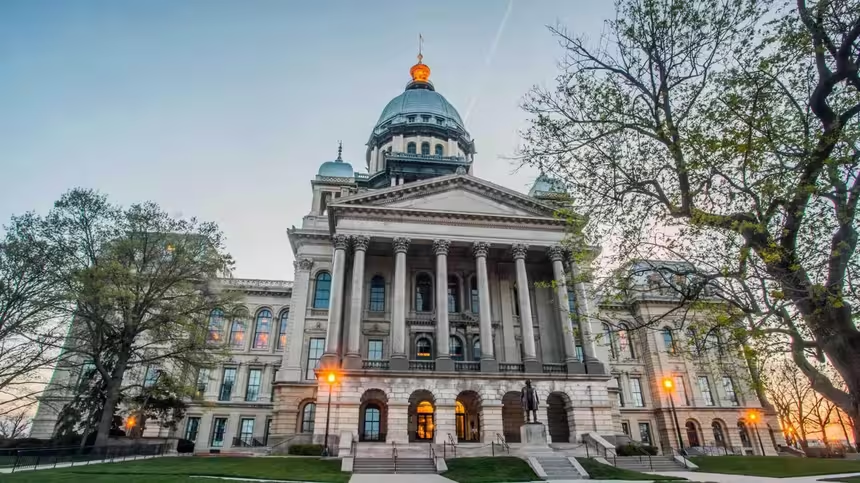
CapitolView
CapitolView is a weekly discussion of politics and government inside the Capitol, and around the state, with the Statehouse press corps. CapitolView is a production of WSIU Public Broadcasting.Providing Support for PBS.org
Learn Moreabout PBS online sponsorship(cheerful music) (compelling music) - Thanks for joining us on this special edition of "Capitol View."
I'm Fred Martino.
Recently on the final episode of "Illinois Lawmakers," we featured Democratic governor J.B. Pritzker.
Tonight, another look back at the recently completed legislative session and a look ahead to future priorities.
I am very pleased to welcome the Republican Floor Leader, 117th District's State Representative, Patrick Windhorst of Metropolis.
Representative, thank you so much for being with us.
- Well, thank you for having me on.
Appreciate the opportunity.
- Good to have you here.
I wanna start with what you see as the top accomplishments of the recent session.
- Well, every legislative session, the biggest item that we take up is typically the budget.
And I think that was especially true this year.
We have seen some budget years in the recent past that showed growing revenues that led us to believe that there would continue, potentially, to be that going forward.
This year we saw a tighter budget year.
In fact, there was a revenue increase, a tax increase that was included as part of the package that received some vigorous debate and discussion.
And I, you know, talking to my colleagues on the other side of the aisle led to some of the issues behind the scenes in getting that final budget deal completed.
So I think when you talk about a $53.1 billion budget, the largest in state history, that is going to be a large part of the discussion for that legislative session.
- Yes, absolutely.
There was a lot of debate over the tax increases that occurred.
Also, one tax cut that some Republicans did support, which I believe doesn't take effect until 2026, which is the 1% tax on groceries.
Some controversy over that, though, because of the loss of revenue to municipalities that don't choose to have a local tax.
What did you make of all of that and the decision to put forth that proposal by the governor?
- Well, it ends up being a complicated issue because, as you've outlined, this is a tax that's collected by the state, but the revenue benefits local governments only.
The state does not see a benefit to its revenue to its budget.
So when that tax is cut or eliminated, it is our cities and counties that are the ones that are experiencing that loss in revenue.
I supported the bill eliminating the tax.
I've long advocated for the elimination of the grocery tax.
It is a 1% tax, of course, on groceries, that tends to cause that price of groceries to increase, of course, by that percentage, but also has an impact on lower-income families especially, that tax.
So I supported eliminating the tax.
Now, the difficulty had been what to do with the local governments and their loss of revenue.
For some local communities, it's going to be a significant loss of revenue that they count on to meet their budgets each year for public safety and roads and other programming that they have.
So we on the Republican side had advocated that the state should match that difference, as we've done previously with the grocery tax and when it was taken off.
What ended up occurring with this bill was that we are allowing the local governments to put on their own tax if they want.
So I supported the bill because, for two reasons.
One, I've long advocated for eliminating the state-mandated grocery tax.
I think that is important to eliminate, basically, again, it's a state mandate.
But the second piece is it allows for local control.
So if a local community says, "We don't want the tax anymore, we didn't need it, it's not necessary for our revenues," that tax in that community goes away.
If the community does need it, then our local elected officials, those city council members and mayors, will make that decision.
And again, as voters, we have the biggest impact on our local elections.
So that'll give us a greater say in what our local communities do.
You know, it would be nice to eliminate the tax in its entirety and make the local governments whole in a different way.
But this was the option that was presented to us and the one we had to vote on, and I supported it.
- Okay, and of course, that's often the case.
You have compromise, and you have to simply decide based on what is before you.
So we've talked about some of the accomplishments in the session largely related to the budget and revenue.
Now I wanna get to the flip side.
Tell me about your biggest disappointments during this session, things that you thought were important that weren't addressed during the session.
- Well, there are some items that we've been highlighting over the last several years, and at least one of them, in fact, a couple of them have bipartisan support.
It's just getting either the right vehicle to the floor to vote on or getting leadership to, in the House on the Democratic side, to allow a bill to be called for a vote.
The state is crying out for property tax reform.
From the southern part of the state where I represent, up to northern Illinois, it's pretty well universal that the voters want property tax reform.
There have been commissions that have been formed over the years, task forces to look at the issue.
Different proposals have been put forward.
You know, it's a complicated issue similar to the grocery tax in that property taxes are, well, they're not collected by the state, they're collected locally, but they benefit local governments, our schools primarily, but also cities, counties, other local taxing districts.
But the state, through legislation, has a large say in how those taxes are collected and allocated and what those rates may be or what caps may exist.
One proposal that's been put forward that I think is worthy of further debate and discussion is looking at our state's budget when what we're seeing is on our pension payments that those are staying about the same, but they're becoming a smaller percentage of the state's budget.
So looking at a gap in the percentage of the state's budget that exists for our pension payment and using some of that money to send to the local governments that would be required as a mandated property tax relief.
So go to school districts, they would be required, if they accepted that money, to lower their property taxes by an equal amount.
I view it as a creative idea to bring down property taxes.
There are other ideas, but we need to move forward on that issue.
Another is ethics reform.
We talk about that a lot, especially when there's a high-profile arrest or trial or conviction.
But there are some things that we've not done as a state we should.
We should eliminate the ability of legislators to be lobbyists to local governments.
There are some loopholes there that are pretty significant that we need to eliminate.
Another is we should eliminate the revolving door from a legislator leaving the general assembly and becoming a lobbyist almost immediately.
We put in a six-month period a couple years ago, but there is, again, a large loophole that allows for someone to resign a day before the general assembly ends and not have to wait that six-month period.
Those are two items that I think are large that we should be tackling and talking about, particularly given the reputation of the state for high property taxes and poor ethics.
- Yeah, and probably because of the nature of those two items, that they would be big changes depending on the way the legislation was proposed, it may be a while before those happen, a full session at the most optimistic possibility.
But I do wanna look ahead to November.
After the election, the annual veto session takes place.
It is very short, just a handful of days during two weeks.
So probably those proposals would not be taken up during something like a veto session.
What should be, though, the urgent top priorities that you think should be on the table during this upcoming November session?
- Well, there was one item that was put forward that we actually expected a vote on at the end of the legislative session in May.
And that deals with reforms to the prisoner review board.
There have been some high-profile cases regarding what we call the PRB, where individuals have been released that there have been disagreement about whether they should have been released, but also whether there was appropriate notification given to victims who need to be notified that a former assailant is being released from custody, and also whether the PRB is fully informed about the existence of orders of protection.
There were some high-profile cases that occurred regarding that.
Representative Kelly Cassidy from the Chicago area had put forward legislation that was moving, moved quickly and moved in the Senate, moved out of our committee, the Criminal Justice, Judiciary Criminal Committee, rather, on a unanimous vote.
We expected it to be called.
It's a bill I think we should see called, that we're in that short timeframe, as you mentioned.
Some of the larger items, again, as you suggested, I don't know that we will see.
What we expect, though, is the veto session, while brief, we won't see any large pieces of legislation, but we have already been told that the lame duck session, which will be after January 1st, but before the new general assembly is sworn in, to expect us to have some activity during those days, during those couple weeks before we're sworn in.
So for your viewers who may not be aware, when we have the veto session in the fall, there's a higher vote threshold for legislation to be effective immediately.
It's 71 votes in the House of the 118.
Once we get past January 1st, even though it's still the same general assembly and before the new one's sworn in, that vote threshold drops to 60.
So that's where you see more controversial legislation being brought in.
You know, the Safety Act, which has received a lot of discussion over the last several years, that was passed during the lame duck session in 2021.
You know, I personally think those lame duck sessions should only be left for emergencies, that it is a true emergency where there's something that needs to be done, let's do it, potentially take it up during that lame duck session.
But for legislation that receive a full vetting for over the session, that needs to be done after the new general assembly is sworn in to reflect the will of the people in the election.
- The "Chicago Tribune" recently featured an editorial noting that Illinois was performing poorly on many economic measures.
You have mentioned one thing that a lot of people talk about, property tax reform.
What are some of the other ways, top ways that you think could be advanced to improve economic measures in the state of Illinois?
- Well, we have a reputation for being a high tax state.
Depending on the measure, we're number one, sometimes number two, but definitely in the discussion of one of the top states as far as our overall tax burden.
When you take in our income tax, sales tax, property taxes, all the various taxes, those on businesses as well, we're in the conversation for being the highest tax state.
That has an impact when we attempt to attract businesses to our state.
It has an impact when we attempt to attract people to our state, which where I live in rural southern Illinois, is a large issue.
We are losing population.
People are picking up and moving, you know, just across river to Paducah, Kentucky, Cape Girardeau, Missouri, and Indiana or Tennessee, not far geographically, but a lot of it has to do with the taxing climate, the business climate, and just the overall perceived economy.
So looking at the tax structure, particularly property tax is important.
But we also have to look at the business regulations.
It's common for us, just looking back at this past spring, you know, to pass legislation that imposes regulations on business, on economic activity, but also gives rulemaking authority to our executive branch to potentially increase those regulations, which can be discouraging.
One item that is getting agreement, I believe, across party lines is our IDFPR, the Department of Financial and Professional Regulation, which licenses our professionals in the state, most of our professionals in the state.
That has been backlogged.
It's been difficult to get those license processed, which if someone's looking to move to a state and they get licensed in another state first, they're more likely to move to that state than Illinois.
So that affects us in attracting professionals to our state and particularly in an area like southern, rural southern Illinois, where we're needing those professionals.
Anytime we're putting up obstacles, that makes it more difficult for us to have those people move here, to compete with neighboring states, and has an overall drag on the economy of our state and our region.
- In addition to tax policy and some of the business regulations that you're addressing there, I wanna talk about economic development.
The state of Illinois does have a lot of targeted programs for economic development.
There has been, as you know, though, some criticism in terms of the balance in the amount of money spent to boost certain industries, certain areas of the state.
Give us your thoughts on what you'd like to see the state do for your district, as well as the entire state, in using the tools that are available, even with the current tax policy, to attract businesses to the state and residents to the state and keep the people who are already here.
- Well, you're right, it is a balance, and with like a lot of things in life, when things get out of balance, then there are problems.
When you're talking about an economy, we'll use that as our discussion point here, obviously.
So I'm one who believes that we have to be very careful as a government, whether it's national government, state government, local government, about picking winners and losers.
And that is when you set up a tax structure that is burdensome, but then in order to attract a business, you give them a break or a benefit that's not available generally, that is problematic and can be dangerous.
My preference is to make sure we're dealing with an equal playing field where everyone has the same opportunity to succeed, and then we will see more growth that way rather than, again, the government deciding who wins or loses.
But as your question kind of alluded to, we're dealing with the current situation of our state.
So I've just outlined what my preference would be is to improve the overall tax structure, the overall regulatory structure, so that way the state is not picking those winners and losers.
It's just an attractive state for business and people.
- Do you sense, Representative Windhorst, that using the philosophy that you've just described there, some would argue that, you know, we don't have to drive very far to see that philosophy in action.
For instance, I recently drove down for a visit to Tennessee, and there's no income tax, in many areas, fairly low property taxes, some of the lowest in the country, so benefits, essentially, as you're describing that don't pick winners and losers.
They're available to anyone there.
And economic activity there is stunning.
I mean, there are people moving there every day.
There's construction all over the state of Tennessee.
There are new jobs being created.
Do you think there's a real understanding of just how stark the differences are when you're comparing certain state economies in this way?
- I don't wanna speak for my fellow representatives.
I would just say that we, in southern Illinois, see it more starkly just because it's so much closer for us and we are more likely to travel to Nashville or, just use that Nashville as an example, and to see the growth that's occurred in the metropolitan area around Nashville.
And then anecdotally to say, you know, I know a lot of young people under the age of 30 from southernmost Illinois, that that's where they've ended up after college is in the Nashville area.
And it's, I don't know what the percentage is, but it's a significant percentage of our young people have ended up in that area primarily because of the economic growth.
That's where the jobs are, and that's what's booming.
So I, you know, the contrary to that, and what, you know, if you spoke with somebody on the other side is they would say well, are they offering all of the same services our government offers?
So then we talk about the balance and the trade-off that we have to look at when it comes to funding our government and offering things with our government because if we do reduce taxes, which I advocate for, and reduce property taxes, there are things that the government does that it will no longer be doing because it can't afford to do it.
So that is the balance and the trade-off we have to make.
I think ultimately we will be better off if we bring down taxes and reduce those regulations because things will grow, businesses will come to the state, businesses will grow and thrive in the state, people will come, and that spiraling up effect of economic activity will allow for not only more government revenue, but more money in people's pockets that they will spend here in Illinois.
And that spiraling up effect will be for the benefit of everyone in the state.
- We only have about five minutes left, and I do wanna get to some other issues.
You deal a lot with public safety in your job.
I know a bill that you supported was signed into law.
It includes sheriffs on local 911 boards.
I want to give you a chance to talk about that, why it's important to you, what it means.
- Yes, so there is some lack of clarity prior to this bill being signed into law as to whether a sheriff could serve on a 911 board.
There is a rule of law in Illinois dealing with incompatible offices, meaning a individual can't sit on two boards or have two offices that are not compatible.
And there was an attorney general's opinion that said well, being a sheriff and on a 911 board is not compatible.
So this legislation clarifies that the law says it is compatible, and that sheriff can serve on a 911 board.
So in those counties where they already were, it eliminates that problem.
In those counties where they weren't, they will now be able to.
Sheriffs are, in a lot of our counties, are the primary official dealing with public safety and dealing with the dispatching of emergency services.
So having them on the 911 boards, it's important for those to operate as they should.
- Okay, very important to talk about and again, another accomplishment.
Final thing that I think we'll have time for, we've got about four minutes left, but this is a big issue, and it does relate to public safety.
What steps, if any, do you think the state should take to improve mental health services and support for those who are struggling with addiction?
- This is one of the most important issues we face in the state, particularly in rural areas.
My common lament in Springfield is that services that are available in the larger areas of the state are just not available in southern Illinois.
And we have to go out of state to receive the services that we need.
You know, I was formerly a prosecutor, dealt a lot with drug addiction in that capacity, but whether it was committing property crimes, violent crimes, or even people arrested on drug offenses.
So the state needs to take a large look at what is available throughout the state as far as treatment is concerned, and whether it's expanding inpatient treatment options, expanding outpatient treatment options.
Those are both very important.
What we need to make sure we're doing is that we are empowering those people that are in our social services and our criminal justice system to be able to meet this need.
So one concern, and this deals beyond the availability of resources, it deals with individuals who are involved in criminal activity who are addicted.
We have reformed our system with the Safety Act in such a way that those people are, before, they would be potentially held prior to trial and then go into treatment, where they would receive that treatment before their case was adjudicated.
And they would receive favorable treatment in that adjudication because of that treatment.
Now we're pushing the treatment to the end of the case, which means they're going a longer period of time.
Most criminal cases take six months to a year to adjudicate.
So we're going a longer period of time before that person is potentially getting the help they need or may feel a consequence for not.
So there are a couple things, one is the availability of resources.
The other thing is making sure that everyone in the system is working together and the system is providing the tools for those, I'm sorry, the state is providing the tools for those in the system to be able to help those individuals.
Sometimes it does involve the criminal justice system.
And then we need to make sure we look at ways where family members of those who are addicted can get help for them.
There are some states that are looking at involuntary commitment models, which we don't have legislation like that in Illinois, but it's worth exploring if that is a possibility that would work.
But it is the issue that is one of the most primary ones we're facing in rural Illinois, and we have to get a handle on it.
- Yeah, it's very important and a good place for us to wrap up our discussion today because it's one issue that is often overlooked, and it also connects to one that you mentioned earlier in our discussion, which is that licensing reform to also have the availability of healthcare workers.
A lot of people do not realize that Illinois is one of the only states where if someone moves here who has a nursing license and they're an RN, they cannot simply get an Illinois license.
Illinois is not part of that compact that most other states participate in, so very challenging for the availability of some healthcare workers.
Representative, it's always great to talk with you.
Thank you for being here today.
- Great talking with you.
Appreciate the opportunity, Thank you.
- Thanks.
My guest was Republican Floor Leader, 117th District State Representative Patrick Windhorst of Metropolis.
Thank you for joining us on this special edition of "Capitol View."
For everyone at WSIU, I'm Fred Martino.
Have a great week.
(compelling music) (compelling music continuing) (compelling music continuing)

- News and Public Affairs

Top journalists deliver compelling original analysis of the hour's headlines.

- News and Public Affairs

FRONTLINE is investigative journalism that questions, explains and changes our world.












Support for PBS provided by:
CapitolView is a local public television program presented by WSIU
CapitolView is a production of WSIU Public Broadcasting.