
Capitol View - August 10, 2023
8/10/2023 | 26m 46sVideo has Closed Captions
Capitol View - August 10, 2023
Fred Martino interviews Janet Mathis of Elevate Illinois. Then he talks with John Jackson (PSPPI) and Peter Hancock (Capitol News Illlinois) about current events facing Illinoinians.
Problems playing video? | Closed Captioning Feedback
Problems playing video? | Closed Captioning Feedback
CapitolView is a local public television program presented by WSIU
CapitolView is a production of WSIU Public Broadcasting.
Capitol View - August 10, 2023
8/10/2023 | 26m 46sVideo has Closed Captions
Fred Martino interviews Janet Mathis of Elevate Illinois. Then he talks with John Jackson (PSPPI) and Peter Hancock (Capitol News Illlinois) about current events facing Illinoinians.
Problems playing video? | Closed Captioning Feedback
How to Watch CapitolView
CapitolView is available to stream on pbs.org and the free PBS App, available on iPhone, Apple TV, Android TV, Android smartphones, Amazon Fire TV, Amazon Fire Tablet, Roku, Samsung Smart TV, and Vizio.
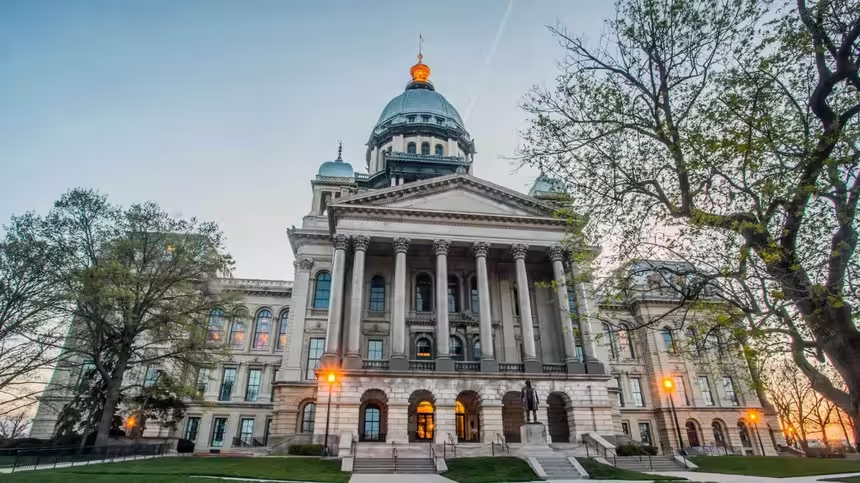
CapitolView
CapitolView is a weekly discussion of politics and government inside the Capitol, and around the state, with the Statehouse press corps. CapitolView is a production of WSIU Public Broadcasting.Providing Support for PBS.org
Learn Moreabout PBS online sponsorship(bright music) (lively music) - Thanks for joining us on "Capitol View."
I'm Fred Martino.
Upfront this week, a critical issue for the state's elected leaders and really everyone who lives here.
Boosting Illinois's image; it's something my guest has been working on for a long time.
We welcome the president and CEO of Elevate Illinois, Janet Mathis.
Janet, thank you so much for being here with us.
- Thanks for having me today, Fred.
- Good to have you here.
You were one of the founding members of Elevate Illinois which came together in late 2018.
Give us a sense of why the group formed.
- So it actually had its roots spread back in the early 2000s, 2008 with a group of economic developers from across the state of Illinois who had gotten together just as a collective and said, "Listen, we're tired of the negative rhetoric "going on about the state.
It's a great place to be."
Unfortunately, it was at a time when we had a governor that was being tried for some things and there was some other negative connotations going on.
And so we decided to do something about it with a group called Grow Illinois at the time.
We didn't have a lot of traction 'cause we were all doing this on a volunteer basis.
We did do some speaking engagements from across the state and got a little bit going, but kind of put it on hold until, like you said, 2018.
And my economic development consulting business partner, Craig Coyle, and I, who had both worked for the state of Illinois in a variety of capacities including the Economic Development Agency, decided "You know what?
"It's time to really go after this "and talk about what's good here in this state because we know this is a great state to be in."
And so we did listening sessions with groups ranging from tourism to regional planning entities to companies to individuals to not-for-profits and others to say, "Does this resonate with you?"
And they said, "Yes."
So we decided to go forward.
We started a board of directors, started the nonprofit, got our 501c3 status for Elevate Illinois.
Got a group of people together to be on the board of directors from across the state and they range from people that are involved in economic development like we are to people that work for higher education, small business, large business.
We have an elected official.
We have somebody that works on municipal staff.
And really just to bring people together to start talking about this, and not just talking about it, but do something about showing people what's good about the state.
I mean, look, I'm a fifth generation Illinoisan.
We have farmland in Livingston County and actually Williamson and we're gonna be here for a long time and I want my son and his children and others to wanna be in this state to realize why it's such a great place to be, not just to live, but to work here, to visit here, to play here, to come here to learn, and hopefully when people come to our institutes of higher education that they stay here and wanna be part of the state's success going forward.
- Okay, and I should say a point of disclosure, you mentioned higher education folks on your board.
That does include a member from Southern Illinois University Carbondale which is WSIU's licensee.
Well, economic development professionals, as you said, formed the group.
Tell us about the areas that you promote when you're bringing business to the state or keeping it here.
- Yeah, you know, Fred, it's numerous and I think people forget this and so we start to enumerate it, but Illinois is literally in the center of everything.
I know there's a tourism campaign with that now, but it resonates because we're the center of the US.
We have unique access to not only this country but across the world with our infrastructure system.
So we've got robust transportation system.
We're the only state that's got all of the Class 7 railroads, which is a big deal.
They all intersect here in Chicago.
Five international airports plus many regional airports as well.
We're literally four hours from anywhere by air in the United States, well, continental United States, disclosure, can't get to Hawaii or Alaska.
Unsurpassed water access, you know, got more than 80,000 million miles of rivers in this state including the Ohio and the Mississippi which are large transportation networks.
We have the Great Lakes accessible through Lake Michigan which gets us to the Atlantic.
Thousands of miles of highways and interstates, including I-80 which is the East West Transcontinental Freeway; so it's the major driver going across east to west in the entire United States.
We've got reliable cheap electric at this point in time, and a lot of states would kill for that and their citizens.
We have water, two major aquifers are here, so abundant water supply, even though we're in a drought situation unfortunately this year.
Again, I'm a farm kid at heart so that always concerns me.
But we do have a lot of water underground in this state that others don't have.
- And not like the drought in the Southwest.
You know, I came here about a year and a half ago from the Southwest.
And so it's amazing where I live in Southern Illinois, all of the water, all of the lakes, and this is a huge economic driver not only for business, but also for tourism which is growing in Illinois, which is so important.
- Absolutely, and tourism is a major economic driver in this state.
We talked about universities, higher education; we've got almost 250 post-secondary institutions in this state, a robust community college network.
Actually, the first junior college in the US was here in Illinois: Joliet Junior College formed in 1901.
They not only get prep people with certificates and a two-year degree, but also work with businesses on worker training within their own businesses that's very specific to them.
Innovation and entrepreneurship is huge here, seven federal labs.
We've got a lot of money coming in from angel investors and venture capitalists.
And I can't forget there's 37 Fortune 500 companies in this state, and I could list 'em all, but I'm not going to.
It's places like Caterpillar and State Farm and Boots, Walgreens, and others that have found this the right place to be, and so they see something here that obviously makes it important to be in the state of Illinois.
- You've talked about a lot of the incredible positives and a really diverse mix of those.
Give us a sense of the biggest challenges, areas where you need more help from the state to elevate Illinois.
- We talked about broadband, so I'll touch on that just for a second.
We do have a disparity across the state in various places of access to technology, communications, fiber, and other backbones to the broadband system.
I know the state is working on that, federal government is working on that, but that is something that's gonna continue to evolve over time; and, of course, the more people that are on, the more broadband we need and access to that capability especially in this remote work atmosphere.
But I will say workforce is and will continue to be the number one concern of all employers.
There just aren't enough workers in the pipeline and we've got increased jobs.
The monthly jobs report doesn't tell the tale.
It only tells the people that aren't actively working anymore.
So numbers are low, but it's not necessarily completely the whole story.
There's a lot of factors that play with this workforce problem: exodus of baby boomers as employees, decreasing graduation rates across the state of Illinois.
It's not just here, it's across the country, so this is not unique to us.
- Yeah, it's a national problem, and I want to touch on some other things.
Believe it or not, we only have five minutes or so left, so I want to get to some other things.
Speaking of numbers, one area where we have seen some success is getting the US Census Bureau to revise its numbers showing a population increase rather than a decrease in this state.
More to be done on that for sure and getting the word out about that, but give us a sense of why this is so important.
- So there's two big reasons.
The first is it negates the commentary that's out there that says everyone's leaving Illinois in droves.
We're actually growing.
So that's important.
The second which is really important is there's a lot of federal programs that are based on population from numbers from the census, so actually $500 billion annually in about 130 programs.
A couple specific to economic development include money being brought into build and repair roads and bridges and then also infrastructure related to water and sewer and municipally owned electric facilities.
There's a lot more too that we could talk about, but those are really important to have.
- A lot of important things.
And you know this as working in economic development, those individual census numbers for various metro areas and cities are important too because some businesses make a decision on whether to locate or stay in a place based on those numbers.
Well, one of the longstanding issues has been getting attention for areas outside of the Chicago region.
Tell me about progress in that regard and your report card, if you will.
- Yeah, so we're making incremental progress.
It was important to us that we recognize there's a symbiotic relationship with the rest of the state and the northwestern corner of the state, the Chicago metropolitan area.
They've done a better job because they're more condensed of working together on sharing their positive news.
So our focus, although we don't ignore Chicago in that area, we do focus on the rest of the state and I think we're doing a good job.
We've shared stories about people, places, businesses, events, and opportunities anywhere from Rockford to Cairo and from Quincy over to Danville and we'll continue to do so.
We're driven by trying to find those pockets out there and they're everywhere.
- Yeah.
And the exciting thing that people will find when they go to your website is that they can help in this effort, so tell us about that.
What can people do watching this interview right now, what can they do to help Elevate Illinois?
- So there's a couple things real quickly.
They can like, follow us on our social media which is on Facebook and LinkedIn currently, but we'll be expanding.
They can listen to our podcasts.
They can share those with others and ask them to like and follow us and comment and make commentary.
They can share stories with us through our website, elevateillinois.org, which we can go ahead and use to reach out to other places.
We can't be everywhere at once, so it's helpful to know from other people what the positive stories are out there.
And then they can also help with financing those efforts and join places like the city of Galvan and Bloomington-Normal Economic Development Council, and Tammy and Rodney Shilling to do that.
So there's multiple avenues and we welcome everyone's participation.
This is grassroots.
- I saw on the website that folks can upload videos to talk about what they see as a way to elevate Illinois, a story to share.
They can also just share a story in written form, correct?
- Absolutely, and photos too.
- And photos too, of course.
We love photos, especially in television.
Such a delight to have you here today.
Janet Mathis is the president and CEO of Elevate Illinois.
Janet, thank you so much for being with us today.
- Thanks, Fred.
I appreciate your time.
- We'd like to hear your thoughts.
Send your letters to "Capitol View."
The email address is contact@wsiu.org.
Analysis now, and we are so pleased to have with us John Jackson from the Paul Simon Public Policy Institute at Southern Illinois University Carbondale and Peter Hancock with Capitol News Illinois.
Peter, I wanna start with you this week.
Capitol News Illinois reports that Governor J.
B. Pritzker has signed a package of bills extending cultural protections to Native Americans while also requiring instruction of Native American history in public schools.
Tell us about this.
- Well, there were three bills.
One requires school districts to allow students to wear items of cultural or ethnic significance in their graduation ceremonies.
And that came out of an incident last year when a student at Evanston Township High School had a feather and some other Native American regalia and was told that he would not be allowed to walk across the stage to get his diploma if he wore those things.
Another one, which is even more interesting authorizes the Department of Natural Resources to work with native tribes that have historic ties to Illinois as well as the Illinois State Museum to establish a cemetery to repatriate the remains of Native Americans.
Illinois is holding onto like thousands and thousands of skeletal remains, and despite the fact that a federal law was passed in 1990 to return them or find some other respectful way of bearing them in the ground.
So this is supposed to speed up that process.
And then, I think there was one other bill that... - Education in schools, right?
I mean, that was an interesting and very important thing to have that requirement for Native American history in public schools.
- Yeah, and another interesting aspect of this is Illinois does not have any federally recognized tribal lands in it currently.
There was a tribe, the Prairie Band Potawatomi, that used to have a reservation here back in the 1840s.
That chief went on vacation to visit some family in Northeast Kansas where another branch of the tribe is located.
And while he was away, the state and the federal government swooped in, confiscated the land and sold it at public auction.
They've had a long standing claim against the federal government over that.
And so there's federal legislation pending that would give back some of that land and give them resources to purchase additional land.
Might be noted that the Prairie Band Potawatomi located just outside of my former hometown, Topeka, Kansas is the site of a pretty significant and successful casino and hotel operation.
So it might be interesting to see whether or not the Potawatomi might try to get an Indian casino in suburban Chicago.
- All right, very interesting stuff.
Great context there.
Thank you for that, Peter.
John, the Associated Press reports that Illinois will soon outlaw advertising for some firearms.
The law will target weapons that officials consider a public safety threat or appeal to children, militants, or others who might later use those weapons illegally.
Thoughts on this?
- Fred, this is just one skirmish in what has become a long and conflict ridden process which pits gun owners and their rights under the Second Amendment against the rights of the communities and of the states to try to protect the public safety in an era of increasing gun violence and increasing numbers of mass shootings.
Obviously, those are huge problems for the community side of the equation.
The whole fight was really started by the US Supreme Court.
In 2008, they ruled in the Heller, H-E-L-L-E-R, Decision and they took a very expansive view of Second Amendment rights, protecting the rights of individuals to own and carry arms.
This ruling effectively overturned what had been good law since 1939 in the Miller case.
The Miller case said in that instance the state could require registration of sawed-off shotguns.
They said the issue of an individual sawed-off shotgun had nothing to do with a well-regulated militia which is taken care of by law enforcement and the National Guard.
Now, we're trying to determine where those boundaries might be between individual versus community rights.
Last year, there was an important decision, the Bruen Decision, and it said that individuals could own and carry guns and they took a very expansive view.
But note, even in that decision, Scalia said that there could be some regulation of guns.
He didn't totally close the door.
So where will those boundaries be?
The NRA and a number of states say there should be no boundaries, and we're getting all kinds of state laws allowing concealed carry, open carry, nobody ever have to take a test and so forth is going on out there.
- Yeah, it's gonna be interesting to see.
And of course, as you know, another one that will continue to go through the courts is Illinois having a law to ban assault weapons.
So other states involved in this as well.
So something we'll be watching very carefully.
John, you also were looking at another controversial issue this week.
Rich Miller wrote about this.
He talked in his column about an Illinois bill to allow non-citizens to work in law enforcement.
This passed unanimously in the house but not in the Senate.
Lots of controversy there.
It won support by various groups including the Chicago Fraternal Order of Police.
But the column notes the bill was the target of an Illinois critic in addition to some in the Senate, a Congresswoman Mary Miller.
Lots to talk about with this one as well.
- It appeared initially to be a relatively tame and certainly not radical substantive way to deal with a real problem law enforcement people are having and that is recruiting enough people at the state and local level.
It looked like it also had great bipartisan possibilities.
As you pointed out, the first vote was unanimous.
The second vote in the house was 100 for and 7 against.
And it seemed to be on its way.
But congresswoman stepped in and issued an incendiary press release, and my terminology would be she decided it should be a part of the culture wars.
It instantly became a part of the culture wars.
At that point, the Senate had at least some Republicans in the Senate had sober second thoughts.
They started talking very ominously about letting illegals arrest law abiding American citizens and all kinds of things like that which Fox News picked up.
So it got to be very controversial.
Nevertheless, it has passed, it will become law, and it has divided the Republican party.
For example, the house leader came down here to talk to what is our most listened to talk radio program and she defended what the Republican house had done, the Republicans in the house.
But the fight goes on and it's all about the fight.
- Very interesting and, of course, misinformation that goes out that this was not any non-citizen, that this bill only applied to those authorized to work and authorized to own a gun who could apply for law enforcement positions.
So that always gets to the heart of a lot of these things that there's a lot of misinformation that's spread out there as well.
We have time I think, Peter, for one more story here.
Capitol News Illinois reports that lots of people are asking state regulators to reject price increases for utilities.
What did you find on this?
- There are a couple of proposed rate increases pending before the Illinois Commerce Commission.
One of the interesting parts of this is that for a long time under a bill that former house speaker Mike Madigan shepherded through utilities could raise rates almost automatically to pay for infrastructure improvements.
That is no longer the case, and that was one of the bills that got Madigan and Commonwealth Edison into some trouble.
And so now they have returned the authority to review rate hikes to the Illinois Commerce Commission.
And these will be the first cases before the newly empowered ICC.
I think they come from Ameren Electric and Ameren Gas which serve primarily downstate Illinois.
There are some significant rate hikes, and so we'll see how the ICC uses this new authority that they've been given.
- Yeah, and on a previous program, we pointed out and showed on screen an email alert that was sent out by AARP to its members to let them know about this and to encourage their members to go speak out to this group to let folks know how these proposed rate increases would affect them.
I guess, Peter, with the inflation that we've seen across the board, we're gonna probably see more contentious discussions of issues like this, I would assume.
What do you think?
- Oh, I think there's no doubt about that.
And also as the climate changes, people's utility bills are going to increase both in the winter and in the summer as our summers are getting increasingly hot and winters are getting increasingly very, very cold.
Yeah, you're likely to see a lot of pushback on this.
And it's not just residential customers.
I think commercial and industrial customers are also very concerned about it.
- Well, and of course, that's another issue.
I'm glad you brought that up because typically this has been something that, including in this show today our interview at the top from Elevate Illinois, a way that the state has been promoted historically is having low electric rates to try to attract companies to come here, and now inflation is hitting all of the country.
Very, very interesting stuff today.
Peter Hancock with Capitol News Illinois, John Jackson from the Paul Simon Public Policy Institute at Southern Illinois University Carbondale, thank you both for being with us.
- Thanks for having us.
- Thank you.
- For all of us at WSIU, I'm Fred Martino.
Thank you for being here and have a great week.
(lively music)

- News and Public Affairs

Top journalists deliver compelling original analysis of the hour's headlines.

- News and Public Affairs

FRONTLINE is investigative journalism that questions, explains and changes our world.












Support for PBS provided by:
CapitolView is a local public television program presented by WSIU
CapitolView is a production of WSIU Public Broadcasting.