
Capitol View - August 15, 2024
8/15/2024 | 26m 46sVideo has Closed Captions
Capitol View - August 15, 2024
Analysis of the week’s top stories with Amanda Vinicky at WTTW and Andrew Adams from Capitol News Illinois.
Problems playing video? | Closed Captioning Feedback
Problems playing video? | Closed Captioning Feedback
CapitolView is a local public television program presented by WSIU
CapitolView is a production of WSIU Public Broadcasting.
Capitol View - August 15, 2024
8/15/2024 | 26m 46sVideo has Closed Captions
Analysis of the week’s top stories with Amanda Vinicky at WTTW and Andrew Adams from Capitol News Illinois.
Problems playing video? | Closed Captioning Feedback
How to Watch CapitolView
CapitolView is available to stream on pbs.org and the free PBS App, available on iPhone, Apple TV, Android TV, Android smartphones, Amazon Fire TV, Amazon Fire Tablet, Roku, Samsung Smart TV, and Vizio.
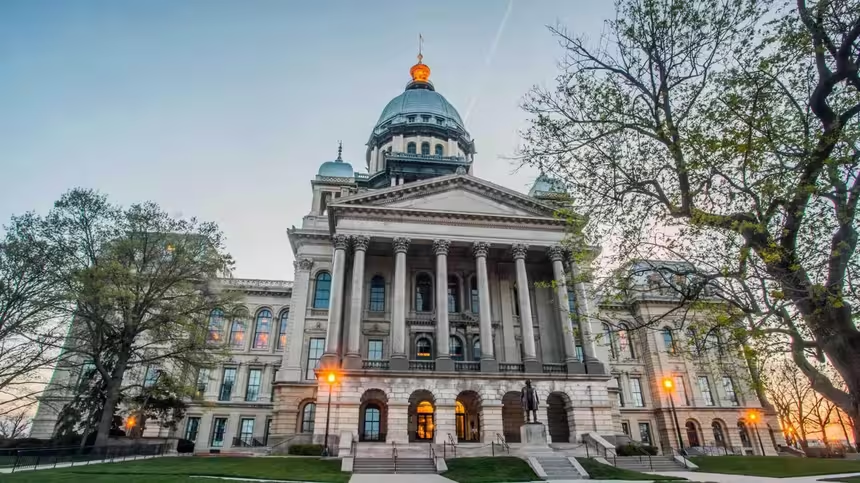
CapitolView
CapitolView is a weekly discussion of politics and government inside the Capitol, and around the state, with the Statehouse press corps. CapitolView is a production of WSIU Public Broadcasting.Providing Support for PBS.org
Learn Moreabout PBS online sponsorship(pleasant music) (camera beeping) (pleasant music) (stirring music) - Thanks for joining us on Capitol View, I'm Fred Martino.
A new Illinois law is designed to help people get identification after they serve their time.
And an investigation finds subsidies alone often fail to help keep grocery stores open in food deserts.
We'll have those stories and much more this week, with Amanda Vinicky of WTTW, and Andrew Adams from Capitol News Illinois.
Amanda, we are gonna begin with another story.
It's an update from last week, after Governor J.B. Pritzker called for Sangamon County Sheriff Jack Campbell to resign.
Campbell announced that he is retiring this month.
Now this, of course, will not stop the questions about the hiring of the sheriff's deputy charged in the death of Sonya Massey.
We are taping this on Wednesday and on Tuesday night, there was a county meeting with residents demanding change.
You have been covering the controversy over this for some time for WTTW, tell us more.
- So, yes, you had the announcement from the sheriff that he's going to retire.
To me, that's basically a resignation, just by another word, really giving into calls from the governor on down for him to leave.
His resignation/retirement letter was both apologetic, but also I think somewhat contrite, really saying that, indicating that he believes this is a political pressure.
That he didn't do anything wrong.
In fact, he had said that he followed state guidelines in the hiring of Sheriff's Deputy Grayson, the one who has been charged with the murder of Sonya Massey.
I think that there are questions on all levels.
Right now, they're really directed at Sheriff Campbell and practices at Sangamon County in terms of, how could a sheriff's deputy, how could any sort of applicant be hired if they had held five previous positions in just a couple of years time?
Frankly, did that raise any eyebrows when somebody is essentially forced out?
What did you know?
If there's somebody who was dismissed from the military for having a DUI, is that the sort of person you want on the force?
I mean, I think there are a lot of sort of compelling forces at this point, because you have the sheriff, again, indicating that he followed state procedures.
Illinois has measures that are supposed to help to protect against this sort of thing with de-certifying of police, but we haven't seen that per reporting put to use at all as of spring.
So despite all that happened after the murder of George Floyd, it appears as if some of the state laws that were meant to be put in place to protect, frankly the public, but also law enforcement from bad apples such as this aren't in place.
Pritzker had said, in calling for Campbell's resignation, that it was because we didn't get answers from the sheriff's office in terms of what procedures they really used, what he knew, and when.
And instead, a lot of that has come out through intrepid journalism rather than information that was publicly put forth by the Sangamon County Sheriff's Office.
And so, as you noted, I think there are both a lot of questions and also a lot of pressure.
We didn't see massive, you know, protests and upheaval, as was the case after the murder of, for example, George Floyd.
And that's because I think you did see this, charges were very quickly brought and the video made public in terms of what happened in this incident.
Nonetheless, of course, there are frustrations.
As well, there should be.
And so as I noted right now, they're directed at the sheriff's office, and that's where you see calls locally in Springfield and at the county board for something to be done in terms of more mental health responses.
So that something like Sonya Massey, where we have on record a call from her mother, indicating that there might have been one of those issues, that you're not necessarily going to get officers of the law, or at least solo, without people who are trained in mental health response.
That costs money, and there is also not a ton of people that do that work that are available to hire.
So there are so many, again, I will use the term, competing forces at work here right now.
That's the local question, I don't think, however, calls for state action are going to go away either.
And frankly, you heard from some of the civil rights activists and Black rights activists that have been very active in this space for quite some time, saying that this is also something that should be brought up at the federal level.
That the presidential candidates need to respond to, and come up with platforms with.
And that this is something that, as the Democratic National Convention comes to Chicago next week, that they expect the DNC to contemplate.
- Yes, I mean advocates for the safety of the public in terms of how encounters with law enforcement go, not only calling for a look at hiring practices, but also continual oversight of how officers respond when they are called to help.
And to try to prevent situations like this.
Thank you for your reporting on this, and certainly we'll continue to follow this as it develops.
I wanna move now to our next story and the economy.
And Andrew, you covered a very interesting story for Capital News Illinois.
It's a study from the Illinois Economic Policy Institute, which we should say is a think tank with ties to organized labor.
But this think tank says that building a cargo focused airport near Chicago would create a lot of jobs, around 6,300 jobs.
Tell us more about this.
- Yeah, this is a fascinating project.
And it's fascinating for a couple of reasons.
So the first one is this recent report, and economists over at this think tank looked at the numbers, they crunched the data.
And they say that the project would bring in more than a billion dollars of economic activity.
So that's construction jobs, that's buying materials, that's supporting the local economy where this would be located in Will County, in Chicago's south suburbs.
It's also interesting because the project has had a very long history and, until recently, was going to be a passenger airport.
You know, calls for an airport in this area between Peotone and Beecher, they've been around since the late 1960s.
And the state has gotten involved and has been studying the issue for more than 30 years.
They've been buying land for more than 20 years, but only in the past really one or two has the state shifted focus to be a cargo airport, as opposed to a passenger airport.
And that's for a couple reasons, part of it is logistical of, there was not a lot of interest as you might be able to guess from that really long development timeline for a passenger airport.
But Will County is an absolute hub for logistic centers, warehouses, freight lines.
It's a really big part of the economy there.
So adding air to that equation, you know, these economists say, would do a lot to support that burgeoning industry.
- Yeah, and certainly a lot of competition for this.
When I saw this story, the first thing I thought of was the drives I take on a highway past Indianapolis.
And a very large operation with cargo planes everywhere.
And certainly with online shopping and a lot more things being delivered to homes all across the country, you can imagine the need for more and more business in terms of cargo and air flight.
So we'll be watching this one as well.
Amanda, we've been doing a lot of reporting as well on new laws in Illinois, and you covered a story about a law that will make it easier for people to get an ID when they are released from incarceration.
An often overlooked, but extremely important issue to support folks after they've served their time.
- Yeah, first of all, a quick note on new laws, there are so many of them.
This is really, tis the season for their, not necessarily being enacted.
Some of these will take effect immediately, others don't take effect until January or so.
But really all of the work that the general assembly did, leading up to their spring adjournment for the session, the governor is running out of time to act on those measures.
So that's why you're seeing, I believe on Friday, well over 200 bills were signed into law.
So let's get to this one, as you noted, there has been a lot of effort and work put into sort of reforming Illinois' criminal justice system, be it with rebuilding prisons.
We now have a court order that says that you've gotta get those who are incarcerated out of Stateville, in Will County as well, by the end of the month.
And the governor's administration has plans to totally rebuild that.
Be it lowering the prison population in the first place, and then the criminal justice efforts that we hinted on, in talking about what happened with the killing of Sonya Massey, in terms of reform on the police end.
But this is another one where you're trying to ensure that once individuals have served their time, that they don't cycle back into that system, that they have the supports that keep the recidivism rate down.
And, of course, key to that is some pretty basic stuff, like having a job, housing, being able to get an appointment with a doctor.
All of these things are difficult to do if you don't have a form of identification.
And that's difficult to do.
If you're stuck in prison, you don't have your paperwork.
You don't know where your social security card is, your birth certificate information, maybe that got left behind 20 years ago before you were put behind bars.
And so, this is taking out some of that, I hesitate to call it red tape, but sort of some of those bureaucratic holdups.
Because the thinking is, if you are in prison, you've served your time, the government knows who you are.
You don't necessarily need a birth certificate to go and prove it.
So there are checks built within the law, but this really removes it.
And you have the Secretary of State's office saying that they're going to proactively educate those, as they are just about to be leaving their time served, about the ability to go ahead, process their paperwork, get that application, so that hopefully you can have either a license or a state ID before you leave.
And again, it will make all of those next steps, like renting an apartment, having a health check, and applying for jobs a whole lot easier.
- Very important to talk about.
We talk a lot about challenges, problems on this program.
It's good to also address, excuse me, address possible solutions.
Andrew, we also though need to look, as you know, when solutions do take effect.
And that brings us to our next story.
A number of times on this program, we have talked about money provided by Illinois to help open grocery stores in areas known as food deserts.
This has also been done elsewhere.
And your colleague, Molly Parker, wrote a story that was published this week about these programs.
It's getting play around the country because it's in conjunction with ProPublica.
And her reporting found some real problems sustaining these businesses.
The one time shot of money isn't enough often to keep these grocery stores open, tell us more.
- Yeah, and this story is a bit of a tough read at times.
So I wanna start out by saying, what are we talking about when we say a food desert?
What kinds of places are these?
There's actually a formal definition the state and federal government use.
And in cities, it's any area that is longer than a mile from a, you know, a full grocery store, somewhere with fresh produce and fresh meat, refrigerators.
And out in the country, in rural areas, it's longer than about 10 miles.
But that's really the bottom of what is considered a food desert.
There are places in this state that are 30 minute drives one way, 45 minute drives one way just to get, you know, fresh meat for, you know, your home.
And over the years, the state has done several different things, tried several different programs to support new grocery stores in these areas.
And often, they come in the form of startup grants.
So that's money to an entrepreneur or a chain to open up a new location that serves or that sells, you know, fresh food to the community in an area that is underserved.
But as an example, in 2018, the state gave six grants, about 13 and a half million dollars, to open up new grocery stores in food deserts.
As of today, four of those grocery stores had closed, which leaves these communities in a lurch.
As another example, you know, there was a lot of talk about this this year, and that was because the governor and several people in the general assembly have been advocating for a grocery initiative to try and address this problem.
They put $50 million towards it for grants and technical assistance and, you know, mentorship for some of the newer entrepreneurs working on opening up grocery stores.
And consistently, you know, the people advocating for this would point to a success story.
Great Scott Community Market in Winchester.
They would point to this grocery store and say, "Look at this, a co-op opened up in place of an IGA that had closed."
It's making relationships with the community, it's building supply lines with local farmers, and it's meeting a need.
We should encourage places like this.
Great Scott at the end of last year also closed, five years after it opened.
And that does not spell hope for these kinds of programs.
Now, there is some work being done to fix this, to address this there.
You know, like I said, we're doing another round of offering startup grants this year.
There was more money added for specifically farmers who wanted to open a grocery store, maybe shortening that supply line between where the food is produced and where it's sold.
Because really the issue is prices.
How does a tiny grocery store with one location and one owner, general manager who has to do it all, make ends meet?
How do they keep prices competitive when that might be great for the people in a small town where it's located, because now they can find food in their community?
But some people will probably still make that 30 minute drive to the Walmart two towns over for whatever reason they choose, and- - Yeah and, of course, the problem is not everyone has the access to transportation to do that.
That's one of the problems.
So the story was very comprehensive and it's very difficult, of course, to cover in a program where we're just giving the summary.
But the bottom line is that this is not a quick fix, right?
- Yeah, absolutely and, you know, there's work being done at the federal level.
Maybe antitrust action against the big chains, but that's contentious.
- Yeah.
- It's a long-term problem, and it's gonna require a long-term solution.
- Absolutely.
We've get a couple more stories hopefully to get to in our next eight minutes.
Amanda, another program will be available in Illinois to help low income individuals.
With a new federal waiver, Illinois is expanding Medicaid to non-medical services.
This is really interesting.
I'm guessing many people watching this will be the first time they've even heard of this idea.
Peter Hancock of Capital News Illinois reported on this, tell us about it.
- So Medicaid is the government program that helps those who are low income and classically, of course, used for medical services.
As you noted, this is trying to take a bit of an innovative take.
Illinois received approval, when you talk about a waiver, really it's sign off from the federal government because federal money is used, to use the money, not just for paying, say, doctor's bills.
But also, when eligibility requirements are met, it could help to cover rent, it could help to cover other sort of appointments such as, you know, behavioral health.
It could help, we were talking previously about efforts to keep those who were incarcerated from going back into the criminal justice system.
There would be support mechanisms for that.
It could be transportation support.
So really, depending on what sort of individual you are, and your circumstances, there aren't blanket ways to say what services are going to be covered.
And it is also going to take some time for Illinois to ramp this up, about a year or so.
But you're going to see basically an opportunity for a program to take a more holistic approach to health.
Recognizing that it's not just going to the doctor and, you know, having your heartbeat and your blood pressure taken.
It's more than that, you need a stable place to live.
You need a place and means to get to buy your food or to get to the grocery store.
To get to the grocery store, get to your doctor's appointments, those sort of things.
- Yeah, social determinants of health, very crucial information.
And with the federal waiver, again, could affect other states as well.
Andrew, a Cook County official says there should be a program to help people with property taxes based on income.
This was the first time that I heard about this particular idea, where you're connecting that relief to income.
He wrote about this in a column published by the "Chicago Sun Times," tell us about it.
- Yeah, so this is another fascinating proposal.
And the idea here, the pitch is that, you know, the government collecting property taxes ought to make sure that people who maybe struggle to pay don't get overloaded with these taxes.
And so, we should institute a circuit breaker.
And these circuit breaker programs are pretty popular, about 30 states have them.
And, you know, the idea is that once your property taxes pass a certain threshold of your income, you get a credit for a portion of that to make it easier to pay.
You know, a lot of these programs focus on seniors.
The idea is that, you know, folks on fixed income might struggle to pay for the property taxes that keep going up.
But other models exist, Illinois used to have a program like this.
And then 12, 13 years ago ran out of money and was never funded.
So it's interesting to see what kinds of ways this might come up.
But I will say that this proposal, which is floating around the Cook County's Assessor's Office and the Cook County Board of Review is still very, very early.
You know, there's no formal language, whether it be a state program or a county program.
And there are lots of groups who would be very interested in having a say into how the details are shaken out.
So we're very early, but it is an interesting idea for how to help people afford their property taxes.
- And with some of the highest property taxes in the country, certainly an idea that folks will be looking at among others in Illinois.
Just three minutes left here, Amanda, and as we reported last week, Illinois Governor J.B. Pritzker was vetted for vice president by the Harris campaign.
Of course, the job went to Minnesota Governor, Tim Walz.
Tell us what you learned when you reported about this, and your thoughts about Governor Pritzker's involvement in the process.
- I mean, the governor didn't make it to the final, final stage, but he made it pretty close.
And he said, as you would expect, that it was an honor to be considered.
That if you got to that point, you had to be an individual that the Harris campaign believed that, if necessary, could step into the job of serving as president of the United States.
The governor had been particularly cagey about it, until after he was not considered.
I presume that that is in part at the request of the Harris campaign, that this is just sort of how it's done.
You don't wanna let something slip that would ruin your chances.
We don't know why she chose to go with Walz over specifically other, some of the other candidates, or why Pritzker didn't make it to that final stage rather.
But we do know that he said it was a, quote, "Long and grueling process, albeit a quite abbreviated one" due, of course, to just the very unique nature of Harris's rise to becoming the Democrat's nominee for president after President Joe Biden stepped out.
And we don't know really what is in the future for Governor Pritzker.
He had said that he has not yet considered whether he might run for a third term, something that he could do, there's no such thing as term limits.
Or whether he would take a position in a Harris cabinet if she got to know him through this process and decided- - Yes.
- That was something if she were to win.
So we- - I was wondering your thoughts about that because that often happens.
Of course, we see that very often when there is a transition.
And the first person I think of is the Commerce Secretary, the former governor of Rhode Island, Gina Raimondo, who has now a national presence as a result of that job working for the Biden administration.
- Yeah, you have perhaps a national profile, but also you're no longer the one in charge.
You're not the chief executive as you are when you're serving as governor.
So I did speak with some people who'd served in cabinet level positions and have no inner knowledge of what Governor Pritzker is going to do, and even what options may or may not be available to him.
Nonetheless, those are elements to consider, as he does seem to have his eye still on some sort of national presence in the future.
But a lot of this is luck, a lot of it is timing, and talent.
- Yes.
It will be interesting, and it'll be so interesting to see both of you at the Democratic National Convention next week.
I can't wait to see your reporting at Capitol News Illinois, Andrew, and at WTTW, Amanda.
You always do great work, and it'll be fabulous to see your coverage and your colleagues' coverage of the DNC.
So thank you and be safe, I look forward to seeing you.
- Thank you.
- Thanks.
- Thank you both.
We will be off next week because we will have live coverage of the DNC, but we'll be back the week after that for a full wrap up of all of the activities in Chicago, as the world will be focused on Chicago for the Democratic National Convention.
For all of us at WSIU, I'm Fred Martino, have a great week.
(stirring music) (stirring music continues)

- News and Public Affairs

Top journalists deliver compelling original analysis of the hour's headlines.

- News and Public Affairs

FRONTLINE is investigative journalism that questions, explains and changes our world.












Support for PBS provided by:
CapitolView is a local public television program presented by WSIU
CapitolView is a production of WSIU Public Broadcasting.