
Capitol View | August 6, 2026
8/6/2026 | 26m 46sVideo has Closed Captions
Brian Sapp talks Illinois politics with Charlie Wheeler and Jason Piscia
Brian Sapp talks Illinois politics and current events with Charlie Wheeler and Jason Piscia
Problems playing video? | Closed Captioning Feedback
Problems playing video? | Closed Captioning Feedback
CapitolView is a local public television program presented by WSIU
CapitolView is a production of WSIU Public Broadcasting.
Capitol View | August 6, 2026
8/6/2026 | 26m 46sVideo has Closed Captions
Brian Sapp talks Illinois politics and current events with Charlie Wheeler and Jason Piscia
Problems playing video? | Closed Captioning Feedback
Where to Watch CapitolView
CapitolView is available to stream on pbs.org and the PBS app.
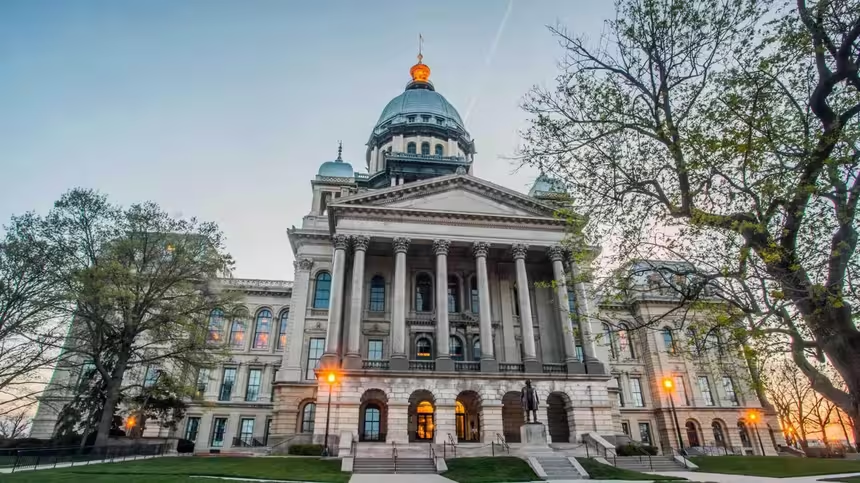
CapitolView
CapitolView is a weekly discussion of politics and government inside the Capitol, and around the state, with the Statehouse press corps. CapitolView is a production of WSIU Public Broadcasting.Providing Support for PBS.org
Learn Moreabout PBS online sponsorship[MUSIC] >> Welcome to the capital of U on WSIU.
I'm Brian Sapp.
Last Friday, the Illinois Legislative Inspector General released his report into the accusations of sexual harassment against Ex-state representative, Harry Benton.
The report says Benton violated state law by engaging in sexual harassment.
Since then, questions have surrounded House Speaker Chris Welch and his staff and how they handled the allegations.
Going back to some of them going back to 2023.
We'll talk about this report and the fallout surrounding it.
And as we head into August, students are returning to school just in time to help with that back to school shopping.
Illinoisans will get a slight tax break with a sales tax holiday on school supplies starting this week.
We'll discuss these stories and more on today's episode of Capitol View.
Joining us for today's episode is Charlie Wheeler.
He's the emeritus director of the public Affairs Reporting Program at the University of Illinois, Springfield.
And Jason Pecha, who's the current director of that program, is also joining us.
Charlie and Jason, it's good to see you.
Thanks for joining us.
>> Good to be here.
>> Let's start.
We're going to start with the Harry Benton story that's been leading a lot of the political and state statehouse news.
And so early this spring, there was Speaker Welch removed Benton from the caucus and from his committees.
And as the season or the session went on, there were questions surrounding this move.
And finally, in July, Mr.
Benton did resign his seat as some word trickled out from this report.
Jason, can you tell us what this report shows and kind of we'll take it from there?
>> Yeah.
Ever since Benton was removed from those committees.
And then last month, as you mentioned, he stepped down from his House seat.
There's been questions about why.
And, uh, we learned that there was this legislative inspector general report that detailed some allegations of a sexual harassment nature.
Um, there was some outcry for that report to be released.
Some lawmakers finally did vote to release that report.
And that report came out late last week, as you mentioned.
Um, and it did, it provided some, you know, halfway salacious details about some of the things he said and did involving staffers in his office and others in the, uh, in his realm of, of, uh, allegations of inappropriate, uh, words spoken and making people, you know, female staffers in his office feel uncomfortable with, with him around.
Um, so, uh, we know that, but it's been interesting over the last few days since this report comes out, a lot of the, the focus has shifted to the House Speaker, Chris Welch, about his handling of these allegations when he first found out about them, as you mentioned, you know, back three summers ago, and that he may have slow walked these these allegations, sort of addressing them, uh, sort of, uh, you know, a, uh, addressing them and, uh, um, making sure that, that they were properly investigated.
Um, so, you know, he's been dealing with some fallout from that calls to resign from members of his own party and definitely members of the Republican Party.
Um, it sort of reminds us how, you know, the beginning of the end for former House speaker Mike Madigan was when he he dealt with a lot of these allegations of of his people in his version of the Illinois House that were accused of, of sexual harassment and his office not doing enough to, to put a stop to it or to investigate it.
Uh, again, that was sort of the beginning of the end of his term, although the stuff that, uh, he's ultimately in prison for now, uh, ended up being the actual downfall for him.
But, um, yeah, it's we'll see where this goes in terms of whether, uh, Welch can survive this storm.
>> Charlie.
As, as we look at this and with your time around the state House, where does this, I guess, would this rank on scandals as you see it?
>> Well, I think there was a serious from my judgment, there was a serious lapse of of judgment in Welch's part by not acting more quickly.
These allegations first surfaced, as Jason said several years ago, and he kind of slow walked the whole thing.
And as, uh, this is going to be a quote from State Representative Kelly Cassidy, who's an outspoken advocate for women and she's a Chicago Democrat.
And she sits on the Legislative Ethics Commission.
And she told the Tribune had the speaker intervened meaningfully in 2023, he may have been able to prevent the victimization of the other two women who were harassed in May 25th and January 26th.
Instead, she said, $1.4 million was spent to re-elect Benton to his seat in 2024.
And so the scandal, if you will, the scandalous behavior in the culture in the legislature towards women, particularly women staffers, apparently is continuing just as bad as it was back in my day.
They did some outrageous things.
But this was, Lord, this was 50 years ago.
And and people sort of, oh, that's the way it goes, you know, but it, it really is something that needs to be cleaned up.
And the One of the people who helped unseat Madigan was a staffer named Lena Hampton.
And she had a an interesting op ed.
And in the again in the Tribune.
Mhm.
And.
And here's here's like her closing paragraph.
Eight years ago, Illinois legislators told survivors that if they came forward, things would be different.
Many did so at tremendous personal and professional sacrifice because they believed the system could change.
Instead, lawmakers put a band aid on a pervasive problem for optics rather than addressing the problem at its core.
One thing is clear if accountability applies only to those without power, then nothing has changed.
Welsh should resign as speaker of the Illinois House.
If he doesn't, the House Democratic caucus should vote to remove him.
And so this is pretty strong.
And as you noted, one Democrat member has already suggested that that wealth should be if he doesn't resign, House Democrats should kick him out as speaker.
That was Fred Crespo, who's from the northwest suburbs.
>> Yeah.
And he he was removed when he he and Welch last last session last year had some disagreements, misunderstandings, I think, and and trying to work out some of the budget last year.
Jason, I just wanted to wrap up.
So we have this report now.
Is there anything next or is it really just kind of having to see how Welch responds to this?
And then also, is there any moves that we've seen of, you know, changing the way investigations are done or anything like that, that that's coming up?
>> Yeah.
Speaker Welch, you know, reportedly has been meeting with, you know, various subgroups of the Democratic Caucus of Democrats around the state to assure them that everything is under control and to try to get them back on his side, to have him avoid having to, to resign.
Uh, so I think, you know, the next step there's, you know, Governor Pritzker this week was talking about how, uh, you know, perhaps it's time to, to look at, you know, shoring up the laws and shoring up the regulations as it pertains to reporting and investigating these sorts of things.
He also mentioned it's up to the House to, to get that in place to get some rules and regulations and maybe laws in place.
Uh, no word yet from the House speaker or the House, as far as we can tell, on whether they're going to move forward with that.
You know, a couple options there.
If they really want to jump on top of it, they could kind of pull together a special session, uh, to maybe ease some minds and show that they're doing something, although, you know, maybe a risky thing or maybe a beneficial thing to do right before an election or there is the regularly scheduled veto session, which is scheduled for after the November election, where they could try to ram something through to, to try to, to, to shore up these laws.
So again, no indication on what they could do.
Um, you know, I think a lot of it comes down to just, you know, if you are a lawmaker, uh, you know, maybe be careful with how you handle your staffers and how you interact with your staffers.
It's a, it's a work environment.
Let's treat it that way.
Um, and again, I'm not sure how many laws can, can prevent those lapses in judgment.
>> Exactly.
And I think just wrapping up there, one of the things I read was, uh, the inspector general was one of the ones that actually gave the training on sexual harassment.
And he voiced incredulous incredulity after having just presented this to Benton not a few weeks later.
Benton was after these.
So I think, yeah, we'll have to just those are there in place to protect our people.
Um, I want to switch topics.
The.
I think there's a thread here, but we'll see.
Last week, the Chicago Public School passed a $10 billion budget.
They are facing a $700 million shortfall.
And one of the ways they are trying to bridge that gap is $150 million that they are expecting from the state.
That's not been appropriated.
But Speaker Welch told the union that he was going to work on it and make it a priority for this fall legislature or the fall veto session.
Charlie, can you kind of give us some background and how is this going to work out?
Do you think?
>> Oh, you're asking me?
>> Yeah.
Sorry, Charlie.
>> Okay.
Well, if I can give an analogy, I would say the odds of the legislature coming up with a chunk of money in a veto session just to hand to Stacey Gaetz and and the Chicago Teachers union.
Those odds are slimmer than the odds that I might be the next quarterback for the Chicago Bears.
I don't see it happening.
And no way.
I mean.
And the the teachers union is in.
Mayor Johnson are trying to lay it on.
Well, it's the governor's fault.
He's got to do something.
And we have this, uh, this law that requires school districts to be funded at 90% of their needs.
I think the next fiscal year or the year after that, and we're not getting there.
And so they're trying to blame the governor and the legislature.
And the fact of the matter is, for starters, where are you going to get this extra money?
That's the big question.
You guys will remember that the legislature had to scrimp and save, and they had to tell a lot of people, no, we can't fund your programs just because the money was so tight.
And they wound up putting through a lot of business type taxes to try and sustain the the programs that we have in place now.
And of course, the, the teacher's union really hasn't suggested, well, here's what we can find the money.
And it would require a massive tax increase.
And I might add that Chicago's number that they say they're owed by the state is large.
But in terms of the other school districts, I went to the state Board of Education.
They have a website with a lot of this data on it.
And you can look they've got a graphic.
Now, this state is for the current or the last fiscal year.
And part of it is because for the coming school year, they don't have the data correlated yet, because one of the factors is enrollment.
Obviously, we don't know what enrollment is going to be until school starts.
But anyway, Chicago is funded at 73% of its needs, and there are.
Oh, along with Chicago, there were like 40 other states or school districts that are at 40 that are at 73%.
>> Mhm.
>> However, there are.
A large number, roughly 160 or so, that are less than Chicago, including some in southern Illinois.
Mhm.
One of the lowest ones is Carbondale High School District is funded at 61% of its needs.
Carterville, Chester, Salem, Fairfield.
They're all at 71% of their needs.
And so you're if you're talking about doing it for Chicago.
Uh, Chicago's number is larger, but their need is not greater than a whole bunch of other schools.
And as a matter of fact, this the state board has calculated that it would require something like, let me pull out their chart here.
This is a fancy chart they had.
Yeah.
It required 3 billion additional dollars to move all organizational units to 90% of adequacy.
Mhm.
And you're not going to find that money.
I mean, the as I say, the legislature had to work very hard to scrape together a budget in the first place and to think that you're going to get this and then the veto session.
Uh, another point to make is for something to become effective immediately.
If it's passed in the veto session, it needs extraordinary majorities.
71 in the House, 36 in the Senate.
Now, you could maybe, maybe wait until after the first of the year when it's back to simple majorities.
But the Chicago school board is saying, oh, no, we can't wait.
So I don't know where this is going to go, but it's you know, if you look at it, it's yeah, it would be nice if we had the money and if there was a willingness to tax ourselves to provide this money for the schools.
Uh, and it, you could say it's, it's the morally right thing to do.
It's the proper thing to do, uh, in policy terms, but in actual political terms, it is not going to happen.
>> Yeah, I think yeah, I think that's it.
And it's just interesting the timing.
Um, I want to switch topics and keep on moving.
We've got about a little over ten minutes left.
Um, Jason, the governor last week signed a bunch of bills and one of those was the Social Media Safety Act.
This was trying to kind of guide, I guess, how social media companies interact with children and protect them from algorithms and, uh, trying to protect them from what they believe are the ills of social media.
Can you tell us a little bit about the bill and what it what protections it might provide?
>> Yeah.
This bill affects people who are under 18 minors and how they use social media.
Any of us who use social media already know that the social media companies pay attention to what we click on and what videos we may linger on a little bit longer than others.
And through that information, they create this algorithm that that gives us more of what we want.
So if you're scrolling through your Facebook feed today, uh, you probably are seeing posts from a lot of people that you don't follow or you haven't actively clicked the follow button on.
But because they create content that relates to stuff that you already watch on a regular basis, uh, they think you want to watch it.
And this is what creates an addictive nature to social media, which is really what is concerned parents and lawmakers.
And part of the reason why this law needed to exist.
So what the law does is, uh, you know, increases some privacy protections, but also gets into addressing this highly addictive nature of social media in that, uh, social media companies would not be allowed to deliver content to minors unless, you know, they, uh, you know, actually actively search for it or actively follow the person.
Uh, they can't get these random people that are related to things that they like.
Uh, this is an interesting change in how, uh, government deals with social media.
Uh, in the past, social media companies have largely been immune from, uh, being held liable for anything, uh, especially for, you know, stupid things that their users will post online.
Uh, there's, I teach a media law class.
We talk a lot about section 230 of the Communications Decency act that that prevents, uh, social media companies being held liable for things.
But the tide is changing slightly.
There's been some court cases in other states to where they're dealing less with the content and more with how these apps are designed and how they addict children and addict people and bring them in and keep them scrolling forever to where, uh, you know, their eyes are falling out of their head and they're not paying attention to the lives around them.
Um, so even though there's been some criticism from social media companies about how a law like this might violate their First Amendment right to, you know, deliver information to people.
Um, you know, again, there's been some court cases that, uh, have been in the favor of laws like this.
Uh, we'll have to see if this one gets challenged, but it's a start and we'll see where it goes.
>> And as you said that the First Amendment, they argue those protections.
But as we look, the tide seems to be changing just in mental health in general, that mental health is very akin to physical health, and these addictions are very real.
I mean, I think we can all stop and think about a moment where we're like, oh, I'm just going to look at something really quick and it's 15, 20 minutes later and you're still doomscrolling.
So yeah, I think it's.
>> 15 or 20 minutes is a low estimate, especially with my kids.
>> So I. Yeah.
Me too.
It's I totally understand I have to make that concerted effort.
Um, Charlie, we got just a couple more topics I wanted to cover.
Um, one is a sales tax holiday here in the state.
Um, it's starting today when this airs for a week and a half.
Can you tell us a little bit about what parents as they're going out back to school shopping, might will be able to look forward to on their, uh, when they're paying for their child's supplies.
>> Yeah.
And on Friday, it goes into effect.
It will be from Friday, August 7th through basically August 16th.
And the states sales tax on school supplies will be reduced from 6.25% to one and a quarter.
Now, the one and a quarter is actually money the state collects on behalf of local governments.
So the state isn't going to get any money.
It's going to lose.
The estimate was something like $10 million by doing this.
But basically what it says is if if you buy books or notebooks or paper or pencils, pens, whatever, uh, you won't have to pay that sales tax.
Now, some things are excluded and it includes clothes too, including shoes.
Anything costing less than $125 will be exempted.
Uh, some of the things that are excluded.
And again, I'm reading what it says.
Yeah, makeup, hair accessories, purses, cleats.
Many types of art supplies aren't included.
Neither are laptops or cell phones or cameras, which would be one of the bigger expenses that a parent would have for their kids.
But like just the other day, I told my daughter that if you and my granddaughter need school supplies before she goes back out to Oregon State.
Well, let's do it next week where we can get them for for reduced price.
So and there were some critics who argued, well, this really isn't that much, and it's not that big a deal.
But on the other hand, I would say that if you're a parent struggling with all these other expenses, being able to save, uh, what would it be?
Well, I don't know how much that usually would spend on this, but they will save a few bucks.
Uh, you're welcome.
That.
>> Yeah, I think you're right.
There's been lots of talk about affordability and prices.
Even even when prices are down, we all love to to save.
Save a few bucks.
Um, I think my kids are grown and out now, so I don't have to do this, but I do know that this would have been welcome as when I was a parent.
Um, I wanted to finish up with one last topic coming to you, Jason.
Um, last week, the Illinois Prisoner Review Board voted to deny a request by, um, former sheriff's Deputy Grayson in the shooting death of Sonya Massey.
Can you kind of tell us what he was asking for and what their about their decision?
>> Yeah.
And just a quick reminder on the timeline.
It was two summers ago when, uh, Sangamon County Sheriff's deputy Sean Grayson, uh, had an encounter with Sonya Massey at her home.
Um, and it ended with him fatally shooting her and killing her.
And, um, you know, that that set off, uh, a whole long conversation about police brutality and how police, uh, should conduct themselves.
And there were questions about his Sean Grayson's, his background as a police officer, if he had some conduct related issues and past police jobs that, uh, and that led to a state law that was passed that helped, uh, will require police officers or police departments to, uh, to do more investigation into that.
Uh, but he was sentenced to 20 years in prison, uh, at the beginning of this year.
Uh, he's been in jail.
In custody since the shooting two summers ago.
Uh, but he suffers from advanced cancer, and he had cancer at the time of the shooting.
And at the time he was sentenced as well.
But it's gotten to advanced stages to where, uh, we're about to where we can call it terminal.
And there is a law on the books, uh, that Joe Cole, the Joe Coleman Act, uh, that allows prisoners to apply to be released from prison as sort of an act of compassion if they're in their final days or months or weeks of life because they have a terminal condition.
Um, so Sean Grayson applied under that law to be released from prison.
Uh, a lot of outcry here in the Springfield community and around the state about whether, uh, you know, that's valid.
And the prisoner review board met, as you mentioned, last week and voted against releasing him, uh, the state's attorney here, you know, strongly worded statement about how, you know, justice hasn't been served yet.
And, uh, so some relief on the side of the Sonia Massie family members on, on how he will Sean Grayson will remain in prison for the time being.
He is free to, uh, apply for this law.
Again, I'm I'm guessing it it may happen again as as if his medical condition worsens.
Um, and, you know, there's other avenues as well that he could apply for, uh, pardons and things, but we'll see where it goes.
But for now, that sort of puts maybe an end to this chapter of the story.
And, uh, we'll see where it goes from here.
>> Yeah.
One of the things I found interesting was he really quick.
>> We got about 45 seconds, but go ahead.
>> Okay.
I was going to say, uh, the state's attorney noted when he opposed Grayson's release, he argued Grayson had cancer when he shot Massey, and the judge knew it when he sentenced Massey.
So it's not that.
Oh, we didn't know about it.
This poor guy.
Uh, and it I thought it was really a long shot.
And it was amazing that the prisoner review board only met for like, I don't know, it was 10 or 12 minutes and it was unanimous vote and no one was there to argue on his behalf.
And so I think it was the right decision.
>> And it's truly a tragic event.
And I think it's, you know, in the community, it's going to be feeling it for a long time.
Gentlemen, thank you for joining us.
It was good talking with you today.
That's it for this week's edition of capital.
>> For having us.
>> Yeah.
Great.
That's it for this week's edition of Capital View.
On behalf of Jason and Charlie Wheeler, I'm Brian Sapp.
Have a great week.
[MUSIC] [MUSIC]
 New Episode
- News and Public Affairs

Top journalists deliver compelling original analysis of the hour's headlines.

- News and Public Affairs

FRONTLINE is investigative journalism that questions, explains and changes our world.

 New Episode
 New Episode
 New Episode
 New Episode
 New Episode
 New Episode


 New Episode
Support for PBS provided by:
CapitolView is a local public television program presented by WSIU
CapitolView is a production of WSIU Public Broadcasting.