
Capitol View - December 12, 2024
12/12/2024 | 26m 46sVideo has Closed Captions
Capitol View - December 12, 2024
Analysis of the week’s top stories with Jason Piscia, Director of the Public Affairs Reporting Program at the University of Illinois Springfield and Kent Redfield, emeritus political science professor, also from the University of Illinois Springfield.
Problems playing video? | Closed Captioning Feedback
Problems playing video? | Closed Captioning Feedback
CapitolView is a local public television program presented by WSIU
CapitolView is a production of WSIU Public Broadcasting.
Capitol View - December 12, 2024
12/12/2024 | 26m 46sVideo has Closed Captions
Analysis of the week’s top stories with Jason Piscia, Director of the Public Affairs Reporting Program at the University of Illinois Springfield and Kent Redfield, emeritus political science professor, also from the University of Illinois Springfield.
Problems playing video? | Closed Captioning Feedback
How to Watch CapitolView
CapitolView is available to stream on pbs.org and the free PBS App, available on iPhone, Apple TV, Android TV, Android smartphones, Amazon Fire TV, Amazon Fire Tablet, Roku, Samsung Smart TV, and Vizio.
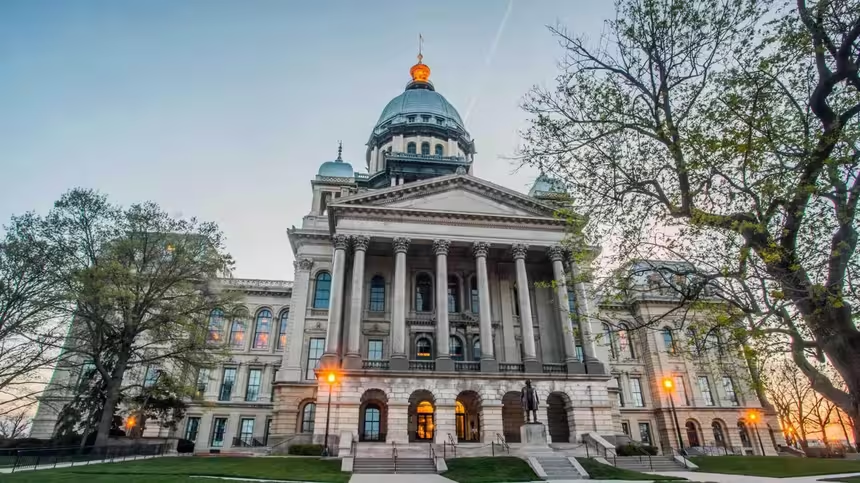
CapitolView
CapitolView is a weekly discussion of politics and government inside the Capitol, and around the state, with the Statehouse press corps. CapitolView is a production of WSIU Public Broadcasting.Providing Support for PBS.org
Learn Moreabout PBS online sponsorship(lively music) (dramatic music) - Thanks for joining us on "CapitolView."
I'm Fred Martino.
This week, a warning that Chicago could be a major focus of president-elect Trump's deportation plans.
Some Illinois residents contribute to the national dialogue about private health insurance after the murder of an insurance CEO; and the powerful get property tax breaks while increases are often proposed for everyone else.
Those stories and more this week with Jason Piscia, Director of the Public Affairs Reporting Program at the University of Illinois Springfield; and Kent Redfield, Emeritus Political Science Professor, also University of Illinois Springfield.
Kent, a "Chicago Sun Times" headline causing a lot of worry this week, it indicates that Trump's border czar told Illinois Republicans that Chicago will be ground zero for mass deportations.
Tell us more about that.
- Well, now this is the Tom Homan.
He's the border czar, which essentially he's a spokesman and a coordinator.
I mean, he's an official from the first Trump administration who's involved with immigration.
And he's been going around, you know, talking up what the president-elect Trump's plans are going to be for having a mass deportation.
You know, there are a lot of moving parts to this.
And, you know, he is, to a certain extent, kind of the, you know, the bad cop.
And then we've got the president doing interviews and, you know, soft pedaling a little bit of the hard edges and things.
And so these were remarks that were made at a Chicago function, a Christmas party sponsored by one of the Republican Ward organizations.
And he essentially, you know, he had a few unkind words to say about the mayor and the governor.
Basically he said, you know, "Chicago's in trouble because your mayor sucks and your governor sucks."
So that's kind of the tone of what we're talking about here.
- His words.
His words, right?
- His words, yes.
And, in terms of rolling this out, you know, the immediate focus has got to be on people that are in the criminal justice system, in prison; people been arrested for crimes that are, you know, undocumented.
And, you know, that was the big thing, you know, that we gotta hold all of these crime problems, go back to all of these bad people that are undocumented, running around.
And so, in order to identify and bring those people into the system, you need cooperation with local police and with officials at the city and the state level, county and the state level.
Because, you know, you have to, you just can't pick people randomly up off the street.
You've gotta be able to identify them.
The low hanging fruit is people that are in jail or are currently have been indicted, been prosecuted.
And that requires some coordination with local officials.
And the bonus- - Do you expect that will happen, that there will be coordination?
- Yeah.
- You think it will?
- There will be some coordination.
There's a bone of contention about whether if someone has been arrested, you should immediately verify their immigration status and report them as opposed to letting someone go through due process and be adjudicated as being a criminal and then getting to the question of whether or not they're in the country legally.
So, you know, there's posturing on both sides.
The big numbers are gonna require going in and finding a way to identify people that are not in the criminal justice system.
And recent people who have applied for immigration, uh, for sanctuary.
We know who those people are.
We've got information.
It's the people that have been here 5 years, 10 years, that are much more difficult.
So, you know, he's making something sound, you know, complex, you know, more simple than it is.
Plus again, earlier in the, you know, in the last 10 days, he's threatened to arrest the mayor, you know, of Denver.
So, this is the hard edge.
He's done exactly what he's supposed to be doing, which is making the newspapers and the TV and showing that the president is gonna work really hard on immigration and really take a hard edge.
The reality is gonna be much more complicated.
- All right.
And we will be watching Jason.
Many are also worried about one of president-elect Trump's cabinet nominees, Robert F. Kennedy Jr., for Health and Human Services.
"Capitol News Illinois" published a story that examined how RFK Jr.'s health proposals could affect Illinois.
Tell us more.
- Yeah, much has been made already about RFK Jr.'s stance on things like vaccines where, you know, he has said he doesn't intend to take away anyone's vaccines but he is for increasing regulations on how they are rolled out and how they are introduced.
Which may affect how new vaccines, how quickly they could get to market if they're needed.
And then the other big issue that he's made a lot of headlines about is about fluoride in municipal water systems.
Many municipal water systems, including about 90% in Illinois, include fluoride in their water systems to help slow tooth decay.
The Illinois Department of Public Health calls, you know, adding fluoride one of the 10 greatest public health accomplishments in history.
RFK Jr. points to evidence that, you know, this fluoride could be tied to some health issues.
So he's, you know, urging water systems to reevaluate whether they should put fluoride in their water systems.
So we'll see where that goes once Trump gets into office here next month.
That said, there is some common ground that seems to be emerging, especially around the issue of food additives.
There's a bill in Illinois that would, in the Senate introduced by a Democrat, that would ban certain food additives of being added to food products.
And, you know, that sponsor, Senator Willie Preston from Chicago, there's a quote from him in this "Capitol News Illinois" story about how, you know, "I agree with the science and in this case it appears RFK does as well.
We're in alignment and I'm happy to work with him if that's possible to move this issue forward."
So some rare agreement between a Democrat in Illinois and RFK Jr. on this issue on getting these food additives taken out of our food system.
That said, I read another story this week in the "New York Times" that could foreshadow perhaps some political conflict on this issue of food additives.
There's a "New York Times" reporter in Central Illinois, in Decatur, specifically at the Archer Daniel Midland plant where they convert corn into high fructose corn syrup.
You know, that is another one of RFK Jr.'s major targets in terms of, you know, making people obese and giving them diabetes.
And he'd like to cut out a lot of that from the food supply as well.
But, you know, when you're talking about products made from corn, that happens in farm country.
And farm country is Trump country.
Has a lot of Trump voters, so- - And ironically, Jason, from a health perspective, that would be a proposal that would not be controversial with many health professionals who say that high fructose corn syrup is not too good for you.
(chuckling) So- - Right.
And that, you know, the issue is, you know, there's a lot of factories and a lot of workers whose jobs depend on the production of this.
And, you know, as is this policy, if there is something that goes forward, gonna affect all these jobs?
So, there's a question there as well.
- Yeah, very interesting stuff.
All right, we gotta move on now.
Kent, speaking of healthcare, the murder of United Healthcare's CEO and the arrest of a suspect this week has prompted people nationwide to raise alarm about health insurance claim denials.
Earlier this year, Illinois Governor JB Pritzker made health insurance reform a major part of his agenda and State of the State Address.
The "Chicago Sun Times" as you know, Kent, this week talked with some Chicago residents about their anger over health insurance.
Tell us more.
- Yes, you know, we've got two things going on here.
Obviously we have, you know, what I would call, you know, a political, a terrorist assassination.
Seems to be an individual with an ideological agenda.
And we refresh our memories since an assassination, you know, I guess attempts on the president-elect.
And so, you know, anybody that lived through the '60s and the '70s and the terrible political violence that was going on during those eras, you know, this is scary.
You know, that people get really upset about things and/or they, you know, delusionally think that somehow this is all linked to a political agenda.
And that can result in violence.
And so, you know, the people that were being interviewed weren't sharing the person that had, you know, allegedly, you know, committed the murder.
What this story did was trigger huge dissatisfaction and triggered people to talk about huge dissatisfaction they have with the way that healthcare is managed.
That you've got insurance companies and third party intermediaries who make decisions about when, you know, what will be covered, what won't be covered.
You know, sometimes it's not black and white about, you know, what you think your policy says and what your doctor wants you to do and what the insurance company is going to authorize and so- - And that's really the crux of it, isn't it Kent?
- Yes.
- I mean that many of these decisions go against what doctors are recommending.
And it comes to the point that this murder happened just when another health insurance company had proposed a very controversial idea of limits on anesthesia and they pulled back on that.
So, where do you think all of this is going?
Because you used the word dissatisfaction.
I think when you look at this story, when you look at other accounts nationwide, we're really talking about, in some cases, disgust and shock that, you know, for many people, one of the most expensive bills, health insurance, you know, is something they expect a service and then actually find out that they are not covered for what their doctor is recommending.
- Yeah, I would probably add outrage in terms of- - Yes!
- You know, people's reactions.
And so, you know, this is something where, you know, politicians listen.
And listen to their constituents.
And so there is, you know, you're going to see efforts to mediate this.
We've tried to do some of it at the state level in terms of, you know, what the state does.
And the state regulates insurance companies.
But, you know, the troop, the real, you know, tests here will be whether we're doing a lot of symbolic things and expressing, you know, you know, a plan.
And then nothing happens.
Because these are, you know, this is a huge part of the national economy.
There are really big players here.
And we're not likely to go, you know, if we went to a single payer system, a la, you know, Bernie Sanders, you know, that would fix most of this problem.
But a lot of people say, "But it will cause a whole bunch of others."
These are hard- - And that gets to another point that, you know, the other issue in addition to claim denials is affordability.
And we should say in this, even though most coverage that folks have been seeing has not mentioned this, at the end of next year, additional subsidies provided under the Biden administration for the Affordable Care Act, Obamacare, they're expiring at the end of 2025.
And so Congress has to either renew those or allow them to expire, which would make this service even more expensive for many people who gained health insurance under the Affordable Care Act.
Final word on this 'cause we do need to move on, Kent.
- Yeah, I think, you know, two years from now, people that are running on, "We fixed the system," are gonna be challenged by people saying, "You made it worse."
And so, you know, we may not be talking as much about inflation and the economy and more about healthcare as we go to the next election.
- Yeah.
Very interesting issue and one that I've been covering for decades now.
And it just seems to never be out of the news because there are so many challenges.
Jason, the Illinois law that outlaws book bans has led to some school districts forsaking grants to maintain local control.
This is very interesting.
Tell us more.
- Yeah, it was two summers ago that Governor JB Pritzker signed this bill into law and it went into effect at the beginning of this year.
And I'm glad you have me talking about this one 'cause this is an interesting news conference that happened two summers ago when, you know, they heralded it The Ban on Book Bans in Illinois.
You know, the sort of responding to the cultural war that's happened in many states across America where library boards and other officials were mandating that certain books be pulled out of circulation because they thought they were not appropriate for the audiences that could check them out.
And in many cases, these titles dealt with LGBTQ-related topics and other things related to that.
But, you know, Illinois heralds itself as sort of being one of the first places to institute something like this.
But, you know, there are some context there that perhaps didn't come out in that original coverage, as like, what are the penalties if places don't do this?
And I noticed a lot of news coverage at the time really didn't get into that too much.
And actually, I used this news conference as sort of a writing test for students trying to get into my graduate journalism program to see if they could pick up on that nuance of what the, you know, maybe get over the fact of the heralding of the first in the nation and maybe what does this really mean?
And now we have this story from the "Chicago Tribune" this week that shed some insight on, you know, it doesn't mean much really.
You know, libraries, whether the school libraries or municipal libraries, they get a lot of their funding on a local level from local taxes, usually property taxes that are, you know, generated within the communities.
But this bill, all it did was ban them from getting state grants for the libraries.
And "The Tribune" found that in many cases these library grants are very small, in some cases just $850.
One of the libraries that, you know, previously got a grant and didn't get one, didn't apply for one this year, got $4,000.
So basically a drop in the bucket for what these libraries need to operate, so- - Glad you're bringing that up.
Context is so important in journalism.
That's an important topic.
And then also, of course, attribution.
Where did you get this information?
We constantly are reading stories or hearing stories where someone is giving a fact and it's not attributed to anyone.
- Yeah, definitely.
And yeah, as this, you know, story continues, you know, it just turns out there's not much teeth behind the law.
You know, they'll lose a little bit of money but in the end, I think, you know, especially in these central and southern Illinois areas that are very conservative, you know, these districts are okay with giving up that small amount of money to retain their local control on putting whatever books they want in their libraries.
- Very interesting.
Well speaking of money here, this is fascinating, Kent.
The Chicago Bears would save about $5 million a year in property taxes under a proposed agreement with Arlington Heights and local schools.
Tell us more about this report in the "Chicago Tribune."
- Well this is the continuing saga of, you know, where are the Bears gonna play football with this, you know, an undercard sort of thing about where are the Chicago White Sox are going to play baseball.
- And so- - Yeah.
- You know, the Bears bought property out the old Arlington International raceway out in Arlington Heights and talked about a, you know, a suburban stadium.
Then they shifted gears and started, went back to the idea of some kind of downtown Chicago lakefront kind of stadium that would require a massive amount of either state and/or local money.
And so this is a back and forth.
You know, Arlington would like to have the Bears out there.
That would be an economic boom for them.
The Bears would probably prefer to be downtown and, you know, still in the city of Chicago.
- What do you think is gonna happen?
- Well, you know, the Senate president and the Speaker of the House and the governor of the state of Illinois have all said, "We don't have any money.
We've got a budget crisis.
And frankly, you know, this doesn't tend to be a big economic gain, you know, plus for the state."
And so if I had to summarize it, it would be don't hold your breath.
And so- - Yeah!
(chuckling) Yeah, yeah.
- I think it is certainly unlikely that you're gonna get any movement in the next 12 to 18 months in terms of, you know, the horrendous fiscal pressures that the state has.
Whether or not this will entice the Bears to rethink and really commit to a suburban stadium, we really don't know.
But I'm not expecting that you're gonna get a completely new stadium in downtown Chicago for the Bears and/or White Sox.
- Okay, well in our final five minutes, Jason, a related story, while the Bears, if they were to be there, could get a property tax break through that suburban move, taxes for Illinois citizens are rising.
And sometimes, that's due to increased home valuations.
But Chicago, as we have reported previously on this program, is poised to ask for a property tax hike, an increase.
The Chicago mayor's latest budget package includes a $68 million property tax increase.
Some say additional spending cuts are needed.
This passed through Committee, this property tax increase, just barely.
And a final vote is scheduled for, get this, Friday the 13th.
(chuckling) Jason, what did you learn?
- Yeah, it's hard to believe a $68.5 million property tax increase is actually good news compared to what the earlier numbers were.
Mayor Brandon Johnson's original hope for a property tax increase in Chicago was about $300 million before that got unanimously shot down by the Chicago City Council recently.
He cut it in half to 150 and then ended up having to cut it in half by more again to get down to that $68 million figure.
Again, we're in a economic place in America and Illinois and Chicago where any sort of extra tax increase on anybody is hard to swallow.
So we'll see how much the City Council as a whole this week will go along with that.
As you mentioned, you know, both of those, that proposal sort of squeaked through a couple of City Council committees this week on, you know, barely being approved.
There's also some other tax increases attached to this budget plan in addition to the property tax increase.
They're talking about increasing taxes on cloud computing, streaming services; increasing costs for congestion, traffic congestion pricing.
If you're taking an Uber into town at certain points of the day, you get taxed extra for that.
Extra taxes on parking garages.
Increasing the tax that they put on if you use a shopping bag inside a Walgreens or a store in Chicago.
I think it will increase from like 7 cents per bag up to a dime per bag.
So all of those add up to, hopefully, creating a balanced budget in Chicago.
But it's nickel and diming, it seems, a lot of the residents of Chicago.
Also I guess some tourists and visitors too on some of those other taxes.
But it's still, you know, something to consider and something to make us wonder what the full City Council's gonna do this week.
- Have less than two minutes left, Jason.
I mean, when you look at this and you see the kind of press that this is creating, especially just after and a change election, just after a statewide question, ballot question, in Illinois about the need to reduce property taxes by taxing millionaires, folks who make, I should say, a million dollars or more a year in Illinois, that that revenue could be used to reduce property taxes.
What do you think this kind of thing, seeing this Chicago budget proposal, what is that gonna do long term for the image of Chicago and the state for that matter?
- Yeah, I think, you know, I like to look maybe back to the results of the presidential election last month.
Illinois was still solidly blue but it became more red, even including in Chicago.
And I think a lot of that has to do with these increasing taxing policies that politicians are putting forward.
People just can't afford it anymore.
And I think, you know, they've reached their limit.
So, again, I'm interested to see how the full City Council responds to this.
- Yeah, we will be watching.
Always interesting in Illinois, that's for sure.
There's no question about that.
Jason and Kent, thank you so much for being with us.
- Certainly.
- Thank you.
- That's "CapitolView" for everyone at WSIU.
I'm Fred Martino.
Have a great week.
(dramatic music) (dramatic music continues) (dramatic music continues) (dramatic music continues) (dramatic music continues) (dramatic music fading)

- News and Public Affairs

Top journalists deliver compelling original analysis of the hour's headlines.

- News and Public Affairs

FRONTLINE is investigative journalism that questions, explains and changes our world.












Support for PBS provided by:
CapitolView is a local public television program presented by WSIU
CapitolView is a production of WSIU Public Broadcasting.