
Capitol View - December 14, 2023
12/14/2023 | 26m 46sVideo has Closed Captions
Capitol View - December 14, 2023
Join us for the latest news affecting Illinois and the General Assembly with our guests Peter Hancock of Capitol News Illinois and Kent Redfield, emeritus political science professor at the University of Illinois Springfield.
Problems playing video? | Closed Captioning Feedback
Problems playing video? | Closed Captioning Feedback
CapitolView is a local public television program presented by WSIU
CapitolView is a production of WSIU Public Broadcasting.
Capitol View - December 14, 2023
12/14/2023 | 26m 46sVideo has Closed Captions
Join us for the latest news affecting Illinois and the General Assembly with our guests Peter Hancock of Capitol News Illinois and Kent Redfield, emeritus political science professor at the University of Illinois Springfield.
Problems playing video? | Closed Captioning Feedback
How to Watch CapitolView
CapitolView is available to stream on pbs.org and the free PBS App, available on iPhone, Apple TV, Android TV, Android smartphones, Amazon Fire TV, Amazon Fire Tablet, Roku, Samsung Smart TV, and Vizio.
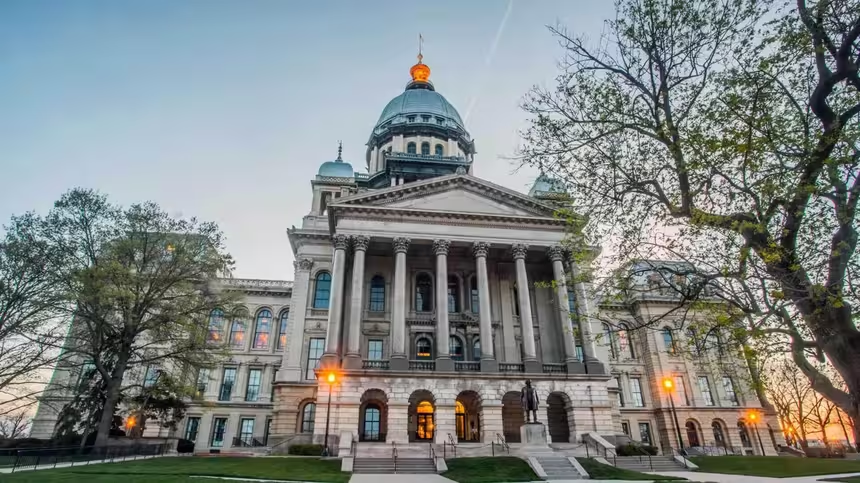
CapitolView
CapitolView is a weekly discussion of politics and government inside the Capitol, and around the state, with the Statehouse press corps. CapitolView is a production of WSIU Public Broadcasting.Providing Support for PBS.org
Learn Moreabout PBS online sponsorship(upbeat music) (adjusting) (upbeat music) (upbeat music) - Thanks for joining us on Capitol View.
I'm Fred Martino.
Legislation is signed to allow the expansion of nuclear power in Illinois, and the state is building facilities for asylum seekers in the Chicago area.
Those stories and much more this week with my guest Peter Hancock of Capitol News Illinois, and Kent Redfield, Emeritus Political Science Professor at the University of Illinois, Springfield.
Gentlemen, thank you so much for joining us today.
- Good to be here.
- Thank you.
- Peter, I wanna start with you.
Capitol News Illinois reports that Governor JB Pritzker has signed legislation allowing new, small-scale nuclear technology in Illinois.
What does that mean and when could this work begin?
- Okay, what it means is that the state is lifting a moratorium that has been in place since the 1980s on the construction of new nuclear reactors in Illinois.
Those of us who are old enough to remember will note that construction of new plants pretty much halted in North America first after the Three Mile Island disaster in Pennsylvania in the late 1970s, and then the Chernobyl meltdown in the former Soviet Union in the 1980s.
There've been no new nuclear power plant construction permits issued pretty much anywhere in North America.
With the concern about climate change and about carbon emissions, the attitude toward nuclear power is now kind of shifting.
And there is this new technology.
There are these smaller, modular, pretty much out of the box ready-to-go nuclear reactors that can go up in a short period of time.
But to give you some perspective, one of the big power plants would put out somewhere around 1000, maybe to 1.2 or 1.5, you know, a megawatt, or gigawatts, you know, thousands of megawatts.
These are more on the scale of about 300 megawatts.
That is about the size of the one coal-fired power turbine at City Water, Light, and Power in Springfield, which only provides part of the city of Springfield's electricity needs.
So these are the kinds of things, they're big enough to run a large auto manufacturing plant, for example.
They might be large enough to supplement other kinds of power plants.
And so I think people in downstate Illinois that are now overly reliant on coal and natural gas are looking at this as a way of increasing reliability while at the same time not adding to the state's carbon footprint.
- Yeah, incredibly important story.
We'll just have to see how it develops over time.
And I really liked your intro there to this, to put it into context, because this, while not often discussed in terms of part of the effort to address climate change, certainly is, is part of a mix around the world.
In fact, just this week's 60 Minutes reporting on a major nuclear plant that is planned for the Western United States.
And of course, for a very long time, France has been a leader in nuclear power in terms of producing the necessary electricity and reducing emissions.
So very important story and we'll just have to see how it develops in Illinois.
So thanks for covering that for us.
Kent, another story that we continue to cover, immigrants continue to arrive in Chicago, straining budgets and services from the city and the state.
Illinois recently announced that $160 million would be used to help out from the Human Services Department budget.
And that is on top of $478 million in state funds already used, according to a state press release.
Illinois is starting to build two new shelter sites.
Tell us about that and your thoughts on how this will play with voters.
- Well, this is a story that seems to change almost daily.
And you know, we're trying to handle this influx of immigrants that are being mostly bused from Texas.
Some of the pressure has been relieved because, you know, the flow has has gone down.
We're being a little more efficient.
Part of the money was in terms of processing.
And then, in terms of the national focus, you know, we're now, the border is now tied up with, and border control is tied up with negotiations on frankly shutting down the government and, you know, aid to Israel and to Ukraine.
And so, you know, the pressure has been released.
Then we had huge environmental issues with one of the sites for these facilities that we're basically to be holding, you know, we've got people that we need to sort out.
Hopefully we're getting them to brick and mortar placements or they've got sponsors.
And the latest development is that the archdiocese of the Catholic church in Chicago has taken initiative in terms of opening up essentially, again, abandoned or unused church property for brick and mortar kinds of sites, and so.
- And Kent, that is truly needed.
I mean, you referenced Congress and the discussion in Congress where there is this effort to tie aid to Ukraine to some kind of an agreement to address the border.
There's a lot of disagreement though on what that agreement would be, on what do you do in terms of limiting folks coming in, seeking asylum and others.
But here's something to kind of really put this into context beyond the opinions on how we deal with this.
It's important to look at the numbers and the New York Times reported on the situation this week, noting that the border patrol encountered more than 10,000 people last Tuesday along the southern border.
That's among the highest daily numbers, 10,000 people in one day.
The Times also noted that agents in the Tucson sector of the border encountered over 55,000 migrants in October, compared with about 23,000 in October of 2022.
So in the fall of this year, just in October, more than double the number from a year ago.
And that kind of gets at my question to you about the political implications of this.
Some would argue are pretty, pretty enormous.
When you look at polling, there is concern about this issue and not just on the southern border, but now Chicago, New York, Denver, around the country where folks are ending up due to these buses, which the City of Chicago is taking on the buses, the bus companies.
- Yeah, absolutely.
And as long as it is the governor of Texas believes that shipping these people on buses to Chicago and other places will help in terms of leveraging, you know, the outcomes that he and the Republican majority in Congress want, it's going to continue.
So Illinois and Chicago's problem is, you know, how do you process and deal with the immigrants that are coming here and you want to be effective and efficient and give aid, but politically, you know, you wanna get it out of the headlines and out of sight.
And so the shift from building tents to more of a brick and mortar strategy really accomplishes both of those things.
- I asked this last week, Kent, to one of our guests, and I want to ask you before we move on, do you think it's imperative for the various states being most affected by this, including Illinois, to get back with the Biden administration to see what can be done, both in terms of aid for the states, but also maybe addressing this movement of people on buses into cities with winter weather like Denver and Chicago and New York City, which seems to be worsening a problem that's already extraordinarily serious?
- Yeah, you know, the governor, congressional delegation have, you know, been to the White House.
That will continue.
And so, you know, it's important to resolve this from a policy standpoint, absolutely.
The short term political goals of the governor and the mayor of Chicago is to handle the situation, but almost of equal importance is to appear that they're handling the situation.
If you're building tents and in the middle of winter, you're calling attention to the program, if you are effectively moving people into temporary and then maybe long-term brick and mortar, then it's not as visible.
And so, you know, you wanna solve the problem, but you also wanna deal with the politics.
And this will continue.
Right now, it looks like we're doing better.
You know, we're down to 700 people at O'Hare Airport and scattered between, you know, any number of police facilities in the City of Chicago was three, four times that, you know, a month ago, so.
- Okay.
- But we're making progress, but this is part of a much bigger issue nationally.
- Absolutely.
We'll continue to follow it.
I wanna move on, Peter, another major issue, a political issue, not only in Illinois, but really all around the country, and that is gun safety.
Capitol News Illinois reports that gun owners face a January 1st deadline to register their assault weapons with Illinois under the state's assault weapons law.
But there's opposition and a lot of questions and confusion about this law.
Tell us more.
- Yeah, you know, it's almost hard to believe that it has been less than one year since the legislature came in during a special session in January of 2023 and passed this bill known as the Assault Weapons Ban or the Protect Illinois Communities Act, PICA, as it's called in court documents.
That was in reaction to a large number of mass shootings around the country with these high capacity, high power rifles and ammunition, most notably the Independence Day massacre at, you know, a parade in Highland Park, Illinois.
And so, over the course of the next year, part of the law was that people who already own these weapons, if you own the attachments that go with them, if you own certain kinds of ammunition, you are allowed to keep it provided that you register those items with the Illinois State Police, and the deadline and the statute to do that is January 1st, coming up in just a couple of weeks.
The problem is Illinois State Police have been kind of hampered in adopting the actual rules and regulations that will spell out how to go about doing that.
The law has been tied up in federal court a number of times.
There were some temporary injunctions that told the state police not to do anything for a while until things got resolved.
And so, now we're kind of at crunch time where they are trying to issue these rules and regulations.
There are still a lot of confusion over the details of it, a lot of questions about it and a lot of pushback from gun rights advocates who don't think the state should be in the business of registering weapons that they consider to be, you know, legal items used for self-defense.
Most recently, this week, there was a lot of action.
A federal judge in East St. Louis, the Southern District of Illinois, held a hearing on a petition to halt the whole legislation rulemaking process in its tracks while additional appeals were going on.
The judge down there did not issue that injunction.
Meanwhile, there have been petitions to, for emergency injunctions, to stop enforcement of the entire law.
This issue has gone all the way to the Seventh Circuit Court of Appeals earlier this year.
I think in November, the Seventh Circuit ruled two to one that the law is constitutional and it can go into effect.
The plaintiffs were then asking for what's called an en banc review.
That means all 14 judges of the Seventh Circuit would review it.
On Monday, we learned that that was rejected.
And so, now we are waiting for the plaintiffs to file what's called a petition for a writ of certiorari, which is a fancy way of saying they want the US Supreme Court to look at the Assault Weapons Ban and decide broadly whether or not this is a violation of the Second Amendment.
That's the stage that we've all been waiting for really since the beginning, since this law was enacted.
I think everybody assumed it would eventually wind up before the US Supreme Court and now, we appear to be just one or two steps away from that.
- That will be interesting.
Well, we'll continue to follow it, and in meantime, bone up on our legal knowledge, 'cause reporting on this, you almost have to be a lawyer.
It's just unbelievable the court challenges and we'll continue to see those, I'm sure.
Well, Kent, wanna get to a new report now.
It examines the power of women in politics and it includes a look at Illinois, one, finding the number of Democratic women serving in the Illinois State Assembly increased by 58% from 2010 to 2021.
Big increase.
Tell us more.
- Well, yeah, this is a study by a research center at Rutgers University and they broadly are looking at the power of women in politics.
The methodology they chose was to do a lot of interviews, pick five states, kind of representative, and then do, in the case of Illinois, interview 41 legislators, ex legislators, lobbyists, you know, all women actors within the political system to kind of get a sense of, you know, how have things changed, what moves the needle.
And they focus on Illinois in terms of kind of telling Illinois's story was this dramatic increase in the number women who were in the General Assembly.
And it's interesting just, you know, because you're reading about Illinois actors that you know, but it makes, you know, a broader point that one size doesn't fit all.
You know, Illinois has a lot more women in the legislature than it did in 2010.
And some of that has to do with demographics.
The suburbs changed, became much more diverse, much more progressive.
You know, the ideology part of that, you know, particularly around reproductive rights, you know, opened up opportunities for, you know, for Democrats to get elected to the legislature.
The Speaker of the House, Mike Madigan, and you can't talk about pretty much anything involving politics in Illinois the last 20, 30 years without talking about Speaker Madigan.
You know, he focused on the suburbs on increasing the number of Democrats in the legislature.
And the way that, it turned out the best way to do that was to find moderate candidates that were women that could speak to the changes and of the electorate within those districts.
And so, you know, it was not the speaker's intention to increase the number of women in the legislature.
It was his intention to decrease the number of Democrats in the legislature.
The final irony of this is that, you know, as we've gone to a more candidate-centered and less party-centered electorial process, got a lot more independence in the ability of candidates to control their own elections, you got a lot of women from the suburbs who were more independent, who really led the charge in terms of ousting the speaker and making it impossible for him to get reelected in, you know, after the 2022 election.
Now, you know, that isn't something you could duplicate in Oklahoma, but it does give you a sense of kind of what are the dynamics that go on.
And now, you know, clearly, you've got a critical mass of Democratic women in the legislature.
Success breeds success.
Republicans have the opposite, you know, problem.
Their, you know, the number of seats that they hold are contracting , their base is getting smaller.
They're on the wrong side of a lot of ideological issues.
And so, it makes it difficult to, you know, talk about exactly how, you know, how we're gonna increase our numbers, let alone how are we going to increase our diversity.
So yeah, certainly it's an interesting study.
- Interesting and something to watch.
Certainly, one might argue an under-reported issue and one that we're seeing nationally take hold in in another way, which is even in very so-called red states, when you talk about abortion rights and when you put it to the voters, the voters are saying loud and clear that abortion rights are definitely a priority.
And so, this is something, nationally as we have more women in office, the issues that move forth in the state legislatures will be affected.
So it's very interesting issue.
We're quickly running out of time 'cause there's so much to talk about this week.
I want to move on now, Peter, to you, with the General Assembly getting ready to meet.
We are gonna be hearing about a lot of pending legislation and that includes a Student Athlete Bill of Rights.
I believe a woman in the General Assembly is putting this forth.
Tell us more.
- It's actually State Senator Kam Buckner who is himself a former student athlete.
He played football, I believe - [Fred] Okay.
- at University of Illinois.
- Women are in support of this as well, right?
- That is my understanding, yeah.
And this kind of, we've seen a lot of movement in this direction in the last few years.
Most recently, we saw the US Supreme Court affirm that student athletes have the right to make money off of their own name, image, and likeness, which is to say that, you know, their own fame is their property, not a university or a sports team's property.
And they can make money off of that.
That sort of flowed out of the fact that there were video games being sold in which, you know, you could buy, you know, the Kansas Jayhawks basketball team or you could buy UCLA football team or whatever.
And it had the names and faces and numbers and statistics of actual players that you, you know, you could use in these sort of fantasy role playing games.
And the players started getting upset about that.
And you know, just the whole economy of college sports, this multi-gazillion dollar industry that is based on student athletes who are actually paid nothing for their services.
And so, the bill coming up in the legislature and we'll see how far it goes, you know, there's a saying around here about, it's only a bill, you know, let's see, you know, what happens to it if and when it actually gets a committee hearing and it starts the process.
But this would recognize a student athlete's bill of rights, which is to say that they have rights guaranteed in federal law, federal statutes.
And so, under state law, it would prohibit universities or colleges, any school that has student athletes from retaliating against a student athlete for exerting their rights or for reporting or filing a complaint for what they believe are violations of student rights.
- Alright, we'll watch it.
Kent, we only have about two minutes left.
I want to get to this final story.
The timing could not be worse.
Voters remain angry about inflation and projections show that Illinois could be facing a major budget deficit next fiscal year.
Nonetheless, it appears that lawmakers are gonna be asked to spend more and tax more for public transit.
What's the latest on this?
- Well, we've got a study that was conducted and recommendations that are now going to the legislature.
The problems are pretty straightforward.
You had a significant disruption of public transit during the pandemic, lots of loss of ridership, changes in workflow, people working at home, you know, all of those problems.
And we're losing Covid money.
So, you know, we need to make the transportation system work.
Federal Covid money we're losing.
You know, and this all is coming to a head probably by 2026.
And so, the legislature's trying to get out ahead of this.
They need more money, they need more writers.
They've got a structure where they have four agencies with 41 board members appointed by 21 elected officials trying to orchestrate all of this.
And so, this needs a major overhaul and more money.
And it's one more headache that whoever is governor in 2027 is gonna have to deal with.
- We will be watching.
There is never a shortage of headaches.
We are out of time.
Thanks to my guest, Peter Hancock of Capitol News Illinois and Kent Redfield, Emeritus Political Science Professor at the University of Illinois, Springfield.
Thank you for joining us at home.
For everyone at WSIU, I'm Fred Martino.
Have a great week.
(upbeat music) (upbeat music) (upbeat music)

- News and Public Affairs

Top journalists deliver compelling original analysis of the hour's headlines.

- News and Public Affairs

FRONTLINE is investigative journalism that questions, explains and changes our world.












Support for PBS provided by:
CapitolView is a local public television program presented by WSIU
CapitolView is a production of WSIU Public Broadcasting.