
Capitol View - December 16, 2022
12/16/2022 | 26m 46sVideo has Closed Captions
Capitol View - December 16, 2022
In this edition of CapitolView, a conversation about a proposed assault weapons ban in Illinois. In addition, Gov. JB Pritzker issued a proclamation enacting the state’s new constitutional amendment guaranteeing the right to organize this week. We’ll discuss all that and more.
Problems playing video? | Closed Captioning Feedback
Problems playing video? | Closed Captioning Feedback
CapitolView is a local public television program presented by WSIU
CapitolView is a production of WSIU Public Broadcasting.
Capitol View - December 16, 2022
12/16/2022 | 26m 46sVideo has Closed Captions
In this edition of CapitolView, a conversation about a proposed assault weapons ban in Illinois. In addition, Gov. JB Pritzker issued a proclamation enacting the state’s new constitutional amendment guaranteeing the right to organize this week. We’ll discuss all that and more.
Problems playing video? | Closed Captioning Feedback
How to Watch CapitolView
CapitolView is available to stream on pbs.org and the free PBS App, available on iPhone, Apple TV, Android TV, Android smartphones, Amazon Fire TV, Amazon Fire Tablet, Roku, Samsung Smart TV, and Vizio.
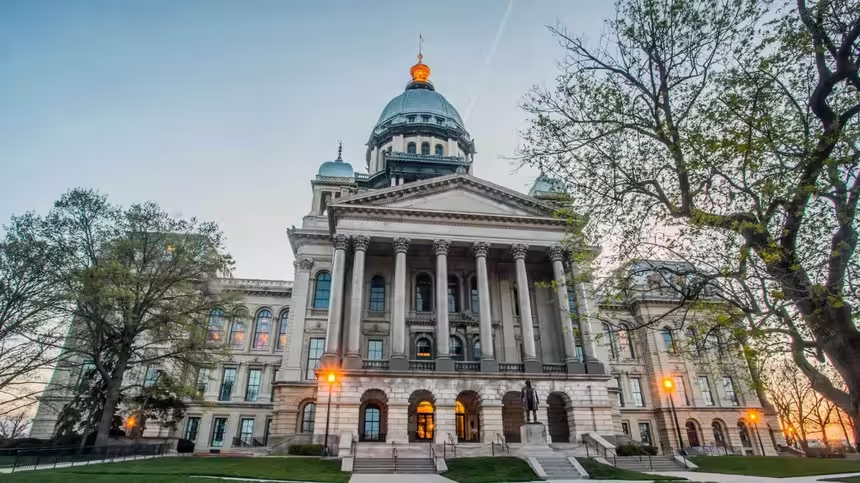
CapitolView
CapitolView is a weekly discussion of politics and government inside the Capitol, and around the state, with the Statehouse press corps. CapitolView is a production of WSIU Public Broadcasting.Providing Support for PBS.org
Learn Moreabout PBS online sponsorship(gentle music) (lively music) - Welcome to "Capitol View," our weekly look at the happenings inside and outside the Illinois State Capitol.
I'm Jennifer Fuller.
Our guests this week are Jeremy Gorner of the Chicago Tribune and Amanda Vinicky of WTTW's "Chicago Tonight."
Thank you both for joining us.
- Thanks for having us.
- Glad to be here.
- A week without a legislative session, but still plenty to talk about happening both inside and outside the political sphere.
We did see this week that there was a hearing on a proposed assault weapons ban for the state of Illinois.
Amanda, I'd like to start with you, and if you could just tell me a little bit about what the bill is and what it seeks to accomplish.
- So this bill was introduced in the wake of the mass shooting over the 4th of July at a patriotic, should have been fun, sort of traditional parade, the first one since COVID in suburban Highland Park.
And this is a measure that would ban assault weapons, that's broadly how it's characterized.
In fact, it bans the future sale of a list of guns that the legislation defines as assault weapons, sort of a loaded term, if you will, that gun owners take umbrage with.
But it's not just the guns, it's also magazines of 10 rounds or more, something that is defined as high capacity in the legislation.
But again, gun owners say, "No, wait a second.
That's a pretty typical size."
And then devices called switches that can turn other guns into a list of these would-be banned guns.
It's, again, the future sales so anybody that owns one of these now would have to register with the state of Illinois.
They wouldn't have to give up those particular firearms, but they would need to let it be known that they own them.
And then it makes a couple of other changes.
For example, extending the time period that law enforcement can withhold a gun from somebody who has gone through the firearm restraining order or red flag law process and by deemed by the court to be a danger either themselves or to others.
So right now that's six months, this would change it up to a year.
And then it would likewise increase the age that you have to be in order to get a firearm owner's identification, or FOID card.
Right now you can get one at the age of 18 with parent sign off for it, and that is something that the alleged shooter in Highland Park did have, despite some previous encounters with police locally.
And so there have been changes to sort of that process, but this would be a bigger change in that you would not be able to get a FOID card and therefore own your own gun or purchase a gun until you are 21.
There would be an exception if you are a member of the military between the ages of 18 and 21.
So it does a lot, it's pretty major legislation and the expectation is that it will pass.
Democrats have super majorities.
You could see some Republicans perhaps getting on board.
But this is by no means an easy sell because there's been a significant and there will be a significant amount of pushback from the gun lobby, from those who own guns for any number of reasons.
And they say they're not just going to stop if this becomes law.
They certainly are already weighing and looking to file lawsuits if the governor does sign this into statute.
- Jeremy, we saw some pretty compelling testimony out of that special hearing earlier this week from witnesses and some victims of the Highland Park and the East Garfield Park shooting, two areas in and around Chicago, very different demographically, but they're both dealing with a mass shooting within the last year.
How important is it, do you think, for those stories to remain at the forefront as lawmakers are considering this legislation?
- Well, it's incredibly important, Jen, because what you're referring to is obviously the shooting in Highland Park and a shooting on the west side of Chicago in East Garfield Park where you had more than a dozen victims in that shooting.
I believe that there were several different shell casings found at that particular crime scene, including from a rifle.
Do we know if it's, obviously the guns weren't recovered, so we don't know what kind of rifle it was.
We don't know if that rifle fits the definition of an assault weapon as, you know, that is described in Representative Morgan's legislation.
But the point is is that Chicago has been dealing with mass shootings for years and years and years.
It's obviously an anomaly in Highland Park.
I mean, this is something, it's an anomaly, really, anywhere in suburban America.
Chicago, it's a regular occurrence unfortunately.
You know, we see shootings routinely where you could have at least four or five victims in one incident.
This incident in East Garfield Park, we saw, you know, we saw one person dead and 13 others wounded.
I mean, we see that too often in Chicago.
And of course, as far as media coverage goes, and as far as these stories getting out there, I know that we in the media over the years have gotten criticized for playing it off, like when it happens in Chicago, like it's almost something too normal and it's not gonna be highlighted as much as if it were to happen in a place like Highland Park.
So yes, it's very important, and it's very important for stories like that to get out there, especially if you have victims from Highland Park and from the west side of Chicago in one hearing talking about a monumental bill like this, as Amanda described, it basically highlights the problem that is going on in Chicago specifically, to put it on equal footing as what's happening in Highland Park, Uvalde, Texas, Newtown, Connecticut, and so on and so forth.
- You mentioned Newtown.
This week was the 10 year anniversary of the Sandy Hook shooting in Newtown, Connecticut that killed all those children in an elementary school as well as teachers and a couple of other people.
Amanda, how important do you think do proponents of this legislation see it as a catalyst for a national conversation on gun laws in the United States?
Is this something that they hope to push further than the State House in Springfield?
- Oh, certainly.
In fact, right now, there is an advocate who was affected by the Highland Park shooting that is there seeking something along these lines, obviously some differences, but broadly, an assault weapons ban at the congressional level, hoping that that gets done before there's adjournment.
That is a very tough obstacle still, however, these activists are holding out hope.
And that's something that critics of this measure say, you know, what is Illinois trying to do?
Already, there are plenty of issues with trafficking from other states with looser gun laws.
You're looking at, for example, Indiana, Wisconsin.
And they're saying, "if Illinois does this, it will," again, by the way, we haven't had a hearing.
We did have a hearing where we heard very emotional testimony from those who were shot and survived both in Highland Park as well as that shooting in East Garfield Park.
But we have not yet heard from the gun owners, those who have gun shops, that will be happening and it will be happening next week.
So, we'll get more of that.
But one of their early criticisms, again, is that even if Illinois goes forward, what is that going to accomplish?
I do think that we can't have this conversation without acknowledging both the difficult realities.
When we talk about how hard this is to get done in Illinois, there have been super majorities of Democrats already.
If you would've asked Governor Pritzker what he thinks about an assault weapons ban, he would've, you know, said sure a couple years ago, but it was not on his priority list.
It wasn't really able to happen.
There just wasn't the political will.
This is sort of a moment because of, unfortunately, all of the gun violence, but we haven't seen that drastically change the political dynamic at the federal level.
There was, in the wake of kind of all of these really headliner, horrific mass shootings, movement at the federal level, but it kind of got as far as it might for quite some time.
And another obstacle is, of course, the US Supreme Court.
There is a Bruen decision that those who are critical of this Illinois measure are citing as something that would perhaps become a national precedent.
And they can't predict, of course, what the Supreme Court justices are going to do.
But nonetheless, plenty of tea leaf reading has gone on based on prior opinions.
And again, this Bruen one, that something like this might have constitutional challenges with the current makeup of the court.
- Jeremy, Amanda mentioned, you know, the fact that there is a super majority still in the Illinois legislature, there's not a need necessarily to negotiate on something like this, but is there a desire, do you see, for proponents of the legislation to hear what the criticisms are?
Is there room for negotiation or changes to be made?
- I think there is a desire, Jen, you know, historically, just because the Democrats have had majorities, you know, in the legislature, there's been varying opinions even among Democrats on what to do about gun control and what to do about gun rights over the years.
There's even been a divide on what the definition of an assault weapon is, which this legislation kind of from Representative Morgan tries to spell it out more, but if there's gonna be debate on what to do about quote, unquote "assault weapons" in Illinois and it's not gonna go smoothly, I mean, you would think that it would be easier in Illinois because of the Democratic super majorities.
And clearly it looks more promising than it has in past years.
But I mean, let's look at, but obviously it's not an easy road.
If you look at what happened on the national level after the mass shooting earlier this year in Uvalde, Texas, Congress, and we all know how divided Congress is, they passed bipartisan legislation on some gun safety measures in light of the Uvalde massacre.
But over the years, there have been countless pieces of gun control legislation that have been brought forth by Democrats, Senator Durbin, and especially, and it's like, you know, Amanda was talking about gun owners and gun shops.
I mean, he and a congressman from the North Shore, Brad Schneider, have repeatedly tried to introduce legislation to increase security at gun shops, for example.
And that has gone nowhere on the federal level.
And that's just among other pieces of legislation that haven't, just because Congress is so divided and there's practically a split in that.
So I mean, it was pretty significant, compared to past years, what they were able to do in the national level largely, even in light of what happened in Uvalde, Texas.
But the thing about it is that if, you know, if something like that can happen on the national level, you would think that in Illinois, it would be easier for there to be some headway considering Democrats have a clear advantage in the legislature.
- Sure.
As Amanda mentioned, there will be more hearings on this legislation and we will have more coverage of it and any other bills that may crop up that deal with gun legislation.
Of course, once the legislative session gets started in January.
We learned late last week about the tragic passing of State Senator Scott Bennett of the Champaign area, who died at the age of 45 of a brain tumor last week.
And of course, we here at "Capitol View" want to send out our sincere condolences to Senator Bennett's family.
We're thinking about you.
But I wonder, Amanda, if you could talk a little bit about even your own coverage and the mark that you think that the Senator had on the legislature and what that will be going forward.
- I mean, one would hope and want to see a bipartisan outpouring of support whenever there is something that sort of puts light into what really matters in life and you put politics aside, but I think you really, really, really saw that.
And that is testimony and testament to who Scott Bennett was.
He was not a showman.
He was, however, very friendly, gregarious, and kind.
You talk to people, just nice to folks on both sides of the aisle.
He really came to be known and sort of stuck his neck out for his beliefs when it came to the Safety Act, something that he got a lot of pushback from, including from members of his own party, constituents on the progressive side that didn't really like what he had to say, but in a sense, that paved the way for some discussions that many Democrats recognize needed to be had.
So he was a family guy first and foremost who certainly loved his family, but did the work of legislating and it really is very, very sad and unfortunately very sudden.
So yeah, he definitely left his mark on the general assembly and will certainly be missed.
- Jeremy, your thoughts?
- Yeah, you know, just kind of like what Amanda said, you know, I mean, I haven't been down in Springfield nearly as long as you both have, but you know, I had some pretty limited interactions with Senator Bennett over the last year, year and a half, and, you know, both very positive.
And, you know, and I'm not just saying that, I mean, especially with these last changes to the Safety Act, you know, just on the fly, trying to get some clarifications on how his bill differed from the new current bill that just passed.
And, you know, just very patient with me, especially at a very chaotic time for him and for other senators in his caucus.
I know, you know, wouldn't be surprised if, obviously, the heat that he had taken with the bill that he had introduced in September, you know, I mean, there were some progressives in the House, House Democrats, who were pretty upset with some of the things that he had proposed, even though Governor Pritzker had actually favored Bennett's proposal when it came to, you know, to some of the changes that they wanted to make for the elimination of cash bail and pretrial provisions.
But even after the latest provisions passed, Senator Peters, Robert Peters, progressive Democrat, you know, who would be more aligned with some of those House Democrats I described who were not happy with Bennett's proposal, even talked about just, you know, expressed just how much of a team player he was and how they really worked on this together to bring it over the finish line as far, you know, so that they could just come to a solution.
And it basically showed that in politics, even if you're on the same side, you're gonna have disagreements every now and then.
And even the governor was saying that, so.
But again, he seemed to be very, Bennett seemed to be very amenable to me.
If I had, you know, if I needed any help clarifying, you know, something in anything that he would propose.
And he's a former prosecutor too, and I used to cover crime, so it was kind of easy for me to understand because of that.
But yeah, I mean it's definitely, you know, a huge loss, especially since he represented more of the moderate wing of Democrats from downstate.
You know, as there's this emergence of more progressives and more diversity of opinions in the Democratic party.
So definitely a huge loss.
- And this is, of course, a tragic loss for the Senate Democrats, but there's some other shuffling on both sides of the aisle and in both parties, in both chambers, I should say, in terms of lawmakers who decided they would not be running again this year, some lawmakers who are deciding to kind of hang things up and move on even after they've won reelection.
Amanda, that shuffling happens after every election, of course.
But how are things shaking out right now?
- You know, I mean, it really is interesting.
You look back at Governor Bruce Rauner who helped really make his name and got a lot of voter support by calling for term limits.
He did not succeed in getting that added to the Illinois Constitution, but it certainly gave him name recognition and momentum early on that propelled his campaign to governor.
But there are some who say, those who have said, you don't need it because of elections.
Now folks can say you don't need it just because there's sort of natural turning and churning that happens in the general assembly, and you just look at membership.
And there are certainly, I wanna say that State Representative Mary Flowers is going to be the longest serving member of the General Assembly.
She's been around for decades.
But other than that, you have people who really are fairly new.
Some of that is just life.
Even if you change an election, a job opportunity happens.
Some of that I think you can look at a bit circumspect in terms of some of the revolving door laws that don't allow a lot of opportunity for those who have positions in government except for, oh wait, if you are an elected member of the General Assembly or a constitutional officer who can go ahead and do whatever.
And so there is some of that.
I think also some of it is just election results and perhaps some Republicans who are saying, do I really wanna be in the super super minority anymore?
It's a lot less, I'm gonna use the word fun, and that sounds flippant, but I think frustrating is perhaps maybe a more accurate way of describing what it can be like to be in the super minority and sort of the lack of getting any movement on policies that you hold near and dear.
So that's all, I think, contributing to some of this turnover.
And yes, the new inauguration will be in early January after all of this lame duck session activity that we've been talking about, including on assault weapons.
- Sure, and Jeremy, I wonder, when you look at the challenges that come from the churn that comes after an election, you lose a lot of institutional knowledge there.
You know, Amanda mentioned Representative Flowers.
There aren't a lot of lawmakers who can say, "Well, we tried this several years ago and it didn't work."
Do you see that the leadership is concerned at all that, you know, we don't have a lot of those longtime legislators anymore?
- Well, yeah, Mike Zaleski leaving, he was so crucial in budget negotiations for the Democrats.
What I'll be interested, you know, he's one example.
What I'll be curious to see too is on the Republican side, much of their leadership, I mean, obviously Jim Durkin's leaving, Tony McCombie's taking over, but also just other Republicans who are in leadership, Avery Bourne, Tim Butler, Dan Brady, Tom Dimmer, they're all gonna be gone.
That's a lot, I mean, that institutional knowledge right there is gone and there's gonna be fresh faces.
And this happens at a time where the House GOP really has admitted that they need to rebrand themselves after this past election.
I mean, you know, Jim Dirken has spoken repeatedly about how they need to become more centrist and, you know, not so far right.
Obviously sentiments echoed by Representative McCombie as well.
And that's what you lose with some of the GOP members I had mentioned who were in leadership, they were obviously, you know, not far right, basically, just the kind of people that Dirken wanted in leadership.
So it's going to be interesting just to see what the new leadership makeup is gonna look like for the GOP, especially just since so much of that institutional knowledge is just gonna be gone.
- Let's take another look at the impact of the election, and Governor JB Pritzker this week signed, well, enacted, I should say, the amendment to the Illinois Constitution that effectively makes Illinois the first right to organize state in the nation.
We hear a lot about states that are right to work.
This means that labor protections are codified in the Illinois constitution.
Amanda, how critical is this amendment and what does the governor have to say about it?
- You know, this is something that Governor JB Pritzker has certainly supported, although not in the same way that this was, like the last attempt at a constitutional amendment, which failed, that was really his baby.
This is something that he supported, but was really the baby of labor unions.
And so, of course, certainly aligned with Democrats.
I think we have a lot of questions about what impact this will have.
will it not have much immediate impact and be more forward looking?
In case, because while Democrats certainly have full control of Illinois government now from the super majorities in the legislature, every constitutional office, and increased majorities on the Illinois Supreme Court, that could change going forward.
And so now in the constitution, is this just going to be sort of protections that would ward off, for example, if a governor is elected with an agenda similar to Rauner's in the future?
Or might we see changes in how contracts are negotiated at the local level?
We really don't know yet because as you noted, Jen, Illinois is sort of a test case out in front for other states, and this is pretty fresh.
- Jeremy, what about the economic impact of this?
There were, of course, businesses and organizations saying this is going to be bad for business, this may drive more companies out of Illinois.
Have we started to see that yet?
Or are there more threats that have come out since that time, of dramatic change?
- I mean, I think it's too early to tell.
I mean, you know, opponents to the amendment have repeatedly talked about how, hey, there's already protections in federal law.
What do you need to put 'em in state law for?
And also that there's the fear that unions are gonna get too much power.
I mean, that just seems like it's a given with an amendment like that.
I don't think that we've seen a wave of that already.
It's already kind of too soon to tell, but at the same time, you know, you would think that it would be normal for pro business to think that way, especially since labor feels optimistic that you're gonna see you workers who've never been, you know, the amendment could apply to workers have never seen before, like independent contractors, agricultural workers, managers.
I mean, so it'll be interesting to see what happens, you know, obviously with agriculture, for example, in rural parts of the state, you know, which obviously has a lot of voters who were opposed to this amendment.
But there hasn't been anything large scale about companies wanting to move to other states.
And they very well could, I mean, if you look at a map, you know, states like Indiana, Kentucky, Wisconsin are right to work states, you know?
So they could very easily just hop over the border and go there.
But I don't think that there's...
I think, you know, there's obviously gonna be legal challenges to this, and that usually precedes any kind of action by companies, I would imagine, to just pack up and leave.
So we'll see what happens.
- Certainly.
Amanda, a short amount of time we've got left, and I wanted to talk to you about new reporting that came out this week regarding Illinois's pension debt.
Now, the liability has been an astronomical number for some time now, well over 100 billion dollars, they're now saying closer to 140 billion dollars.
That's a huge sticker shock for voters, for residents who say, "Oh no, how are we ever going to be able to catch up with this?"
But you talk to some state leaders and they say, "Well, you don't have to pay that money back tomorrow.
The issue is a long-term issue."
Do you see a brighter horizon for this now that you see credit ratings agencies, you know, upgrading the credit ratings and things like that?
What's the overall story here?
- Even in contrast to larger states, I mean, it is a huge number and it is an albatross that will continue to weigh Illinois down.
That said, Illinois has been making the full legally required pension obligation payments and has been in a decent position these past couple of years.
Certainly, it is, I guess it sort of is a middle of the road answer.
We're going to be watching what happens in a more broad sense with the economy.
Part of the reason that the unfunded liability went up again is due to some volatile economic factors that I think is expected to continue going forward.
So with COVID money running out and perhaps a recession hitting, Illinois could soon be returning to having to make some of the more difficult decisions that haven't had to be made at this time with, again, additional Democrats, which can make it sort of more difficult in a way to get everybody on the same page because you've got more folks who have different needs, spending desires that they'll be wanting to satisfy.
So we'll have a huge number, don't let go of it.
- And we'll have to stop it there.
I wanna thank Amanda Vinicky and Jeremy Gorner for joining us this week on "Capitol View."
I'm Jennifer Fuller and we'll catch you next time.
(lively music)

- News and Public Affairs

Top journalists deliver compelling original analysis of the hour's headlines.

- News and Public Affairs

FRONTLINE is investigative journalism that questions, explains and changes our world.












Support for PBS provided by:
CapitolView is a local public television program presented by WSIU
CapitolView is a production of WSIU Public Broadcasting.