
Capitol View - December 19, 2024
12/19/2024 | 26m 35sVideo has Closed Captions
Capitol View - December 19, 2024
Analysis of the week’s top stories with Charlie Wheeler, Emeritus Director of the Public Affairs Reporting Program at the University of Illinois Springfield and John Jackson from the Paul Simon Public Policy Institute at Southern Illinois University Carbondale.
Problems playing video? | Closed Captioning Feedback
Problems playing video? | Closed Captioning Feedback
CapitolView is a local public television program presented by WSIU
CapitolView is a production of WSIU Public Broadcasting.
Capitol View - December 19, 2024
12/19/2024 | 26m 35sVideo has Closed Captions
Analysis of the week’s top stories with Charlie Wheeler, Emeritus Director of the Public Affairs Reporting Program at the University of Illinois Springfield and John Jackson from the Paul Simon Public Policy Institute at Southern Illinois University Carbondale.
Problems playing video? | Closed Captioning Feedback
How to Watch CapitolView
CapitolView is available to stream on pbs.org and the free PBS App, available on iPhone, Apple TV, Android TV, Android smartphones, Amazon Fire TV, Amazon Fire Tablet, Roku, Samsung Smart TV, and Vizio.
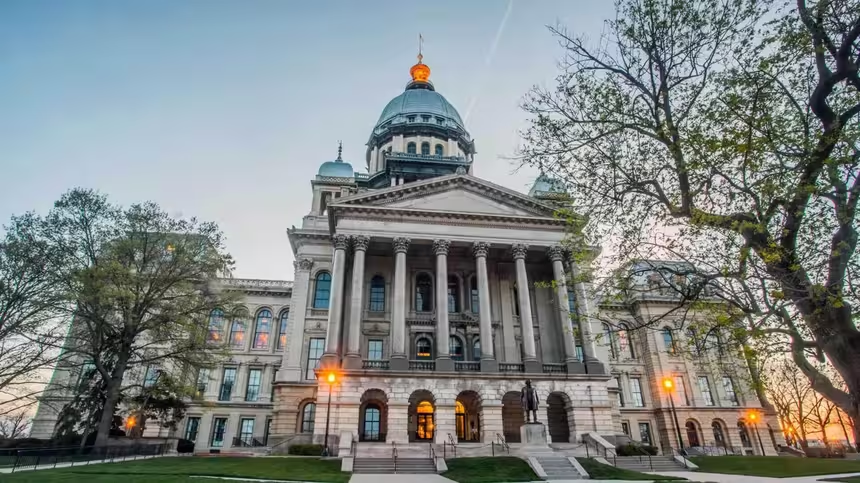
CapitolView
CapitolView is a weekly discussion of politics and government inside the Capitol, and around the state, with the Statehouse press corps. CapitolView is a production of WSIU Public Broadcasting.Providing Support for PBS.org
Learn Moreabout PBS online sponsorship(upbeat music) (dramatic music) - Thanks for joining us on "CapitolView."
I'm Fred Martino.
This week, Illinois agencies look for ways to capture unspent money as the state faces a major deficit.
Chicago's mayor drops a proposed property tax hike and adds spending cuts to earn approval for a new city budget.
And a pending bill aims to help the state's nursing home residents, but there is concern the bill may not get a fair hearing.
Those stories and more this week with Charlie Wheeler, emeritus director of the Public Affairs Reporting program at the University of Illinois Springfield, and John Jackson from the Paul Simon Public Policy Institute at Southern Illinois University Carbondale.
John, when lawmakers gather in Springfield next month, they have a daunting task, as you know, with an estimated budget deficit of more than $3 billion.
And columnist Rich Miller reports public agencies are looking at the state's unused lump sum budget funds.
Tell us more.
- Well, Fred, you could look at this as the preview of the budget wars of 2025 yet to come.
It was kicked off by a Governor's Office of Management and Budget report, which came out on the 1st of November, in which, as you indicated, they estimate a shortfall on the revenue of about 3 billion plus something.
And the problem is they are anticipating downturn on some of the tax revenues related to income taxes.
And that's, of course, national trend kind of projections.
But that has kicked off this real serious discussion about how we're going to do this because there's never a demand for cuts, there's always a demand for more.
Inflation, for example, demands more from the agencies.
And they also have good programs that they wanna support and legislators have good programs that they wanna support.
So the options have been painted as raise taxes, cut the spending, or maybe a bit of both.
I think this example that Rich Miller used was $260 million total squirreled away in lump sum appropriations.
When I was doing university budgets, we used to call this the flex or the flexibility.
And there is some flexibility.
You don't have all those sunk costs quite tied up in this particular bag.
But these are important stories, or important functions for ISBE, Illinois State Board of Election, and all those local schools because they have programs they want to deliver, they have student demands and particularly for this afterschool program that Rich talked about.
And so you can see why legislators would be really reluctant to do those kinds of cuts.
But nevertheless, this is one place they're looking.
I wanna say as a sort of a historical context, this is kind of nickel and dimes.
For example, the one we're talking about is 25 million out of a total of 260 million, but they've got to get to 3.0 or 2 or 3, and that's not even a good start.
And I think the historical context is important here because we had this discussion when I first moved to Illinois, and that is the 1968-69 shift to an income tax that Charlie will remember all of that.
And the governor then talked about getting us into the 20th century.
Well, we haven't gotten into any change of the structural situation since then really, but there have been attempts.
For example, the most recent real attempt was Governor Pritzker's 2000 proposal that we go to a graduated income tax.
And that was roundly talked about and soundly defeated once it got to the people.
The referendum passed in two counties, and that was Cook and Champaign.
A hundred counties voted against.
So the governor got beat, and I'm sure he's not anxious to go back to that.
The one that I always turn to that I think should be a part of the conversation and conclusion is we've long talked about but done nothing about the fact that this is a service economy, and yet we have a very narrow base of taxes on services in this state compared even to surrounding states.
So I would recommend that we reexamine that possibility and that the legislature should take off on that, but I'm not sure they'll take my advice.
- Yeah, it's gonna be very interesting 'cause as you know, John, with inflation being the big story and a big factor in the most recent election, there is little appetite among voters for any kind of tax increase except maybe sin taxes, which was part of what happened last year with additional taxes, for instance, on gambling that were approved.
So we will have to see.
This is gonna be fascinating, but certainly taxing services would bring in a lot of money.
Perhaps an appetite for that if there's also talk of something like what voters approved in November, a cut in property taxes funded by an additional tax on those who make $1 million a year or more in Illinois.
But all of this will be a big part of this show and a big part of public policy discussion in the months to come.
And Charlie, I have to say, one challenge for Illinois, not only deficits with current programs, but costs associated with new programs that come along.
The state is starting a new Early Childhood Department, for example, and "Capitol News Illinois" reports an advisor to Governor Pritzker will lead that agency.
Tell us more.
- Yeah, earlier this week, the governor appointed Teresa Ramos to be the first permanent secretary of the Illinois Department of Early Childhood, which was created last year.
And Ramos has served in Pritzker's office as his deputy governor for education.
Now, her appointment has to be approved by the Senate.
And the notion behind this is that there are a number of programs dealing with early childhood now in other departments, and the thought was if we consolidate all of these programs into a single department, it would be more efficient and it would be easier for parents to access them.
As a matter of fact, when the governor signed the bill last summer he said, and I'm gonna read his quote, he said it should make it easier for new parents to access critical services for their children.
Quote, "It's hard enough juggling all the responsibilities "that fall on the shoulders of parents.
"And on top of that, they shouldn't have to navigate "a complex bureaucracy to get the care "that they and their children deserve."
And under this plan, this new agency would take over Early Childhood Block Grant programs from the State Board of Education, whose mission is not to deal with early childhood, but to deal with the whole gamut of K-12.
It would also take over the Child Care Assistance Program, home visiting programs and early intervention services currently housed in the Department of Human Services.
And again, childhood development is not the major focus of human services.
And lastly, licensing of daycare facilities currently done by the Department of Children and Family Services.
And instead all these functions are gonna be moved into this new department.
And although at the time of the debate in the General Assembly there were questions raised, is this gonna cost us more money in the long run?
Well, initially there was $14 million approved in the current budget that would be basically startup money to use to hire executive staff, opening new office space.
But the notion is that over time, by consolidating all these programs in a single agency, you'll be able to de deliver the services more cheaply in the- - Hm.
Wow.
We'll see how that works out.
Sometimes the promises, but we don't know until we actually see it in action perhaps.
- Yeah, and I've been around long enough to see a lot of these reorganizations.
Sometimes they save money, sometimes they don't.
- Yeah, okay.
Well, we'll be watching.
John, and as we have been reporting, Chicago has been struggling with its budget amid the state challenges.
It finally passed after a couple of attempts.
Mayor Brandon Johnson had originally proposed a property tax increase in the city, but after a bruising political battle, the mayor instead added spending cuts and eliminated that property tax increase.
Tell us more.
- I think Chicago and the mayor are struggling with their projected 2025 budget even more than the state is, and the mayor is running out of options, it seems to me.
He first started out saying that the state of Illinois should pick up the deficit, and that set off a lot of conversation with the state of Illinois, particularly the governor and the people leading the General Assembly, some of which are from Chicago, and that really got nowhere.
So then he turned to the property tax increase, and that became very contentious with the city council.
And so now he's talking about spending cuts.
The problem there is, where will you make those spending cuts?
And that discussion is contentious and time is simply running out for the mayor.
- And they passed the budget.
But even in passing it, there were a lot of, the reason I called it a bruising political battle, there were a lot of criticisms of the mayor and how this was, this handled.
- Yeah, and the mayor's got problems on all fronts, but particularly with the question of increases for the salaries of the teachers, and that's because of his past life where he was an activist and a leader in the teacher's union.
And so that has come back to haunt him in those debates in the city council.
And of course, the thing we haven't mentioned is he's in transition with the transfer of the system from what was the Richard M. Daley system where they went from an elected board to a mayor-appointed board, and now they're slowly, incrementally going back to an elected board and getting away from the mayor appointments.
And I think they're half through.
I think he got half of the elected board in place this round.
So that has been contentious, and all of this has simply sapped his political clout with his colleagues and actually sapped his personal popularity.
- Yeah, very, very challenging.
- If I can add something.
It's just amazing to me who's watched this stuff for more than 50 years that the mayor of Chicago was not able to just tell the city council, "Here's my budget, approve it," and they'd all say, "Yes, sir."
- Yeah.
- 'Cause it was the history, and this guy has absolutely no clout.
And again, I grew up in the days of Richard J. Daley where if there were one or two alderman who would get up and say anything negative, it was amazing.
There were a couple who get up at the start of each city council and say, "God bless Mayor Daley."
So it's a whole new world out there.
- (chuckles) That's for sure.
Well, Charlie, we're gonna move on now.
This is not new, a story like this, but it's certainly something we wanna highlight.
A pending state bill would give Illinois nursing home residents a better chance to sue facilities over retaliation claims.
Advocates say that those claims are rampant in Illinois, but the "Chicago Sun-Times" reports a powerful industry trade group with deep financial ties to Illinois Senate President Don Harmon is lobbying against the legislation.
What's happening?
- Yeah, the Health Care Council of Illinois, which is the group you're referring to, it represents more than 300 licensed nursing homes and skilled nursing facilities in the state.
They argue that there are already laws on the books that residents who feel they've been aggrieved or retaliated against can use, that those are sufficient and we don't need a new set of laws to be in there.
But the residents and their advocates say that the state system comes up short.
And there was a, I'm gonna see if I can quote this here, a report commissioned by the Alliance for Community Services documented 42 state investigations of abuse and retaliation claims, which advocacy say illustrates how widespread the problem is.
Now, the legislation was introduced last spring, and it's, for want of a better term, it kinda got forgotten.
It was sent to the Senate Assignments Committee, which in theory will send the bill to a hearing committee where a, for want of a better term, a policy committee will listen to the arguments for and against and finally decide is this bill worth being considered further, and then they would report it back to the full Senate.
Unfortunately, for the proponents of this particular legislation, the clock, the calendar, is not in their favor.
Usually, and not to get into too much of the nitty-gritty here, but usually for any legislation to pass, not usually, always for a bill, it requires at the minimum five calendar days, three days of action in the first chamber and then three days of action in the second chamber.
And the first day in the second chamber can also occur on the first, or in the last day in the first.
So this bill would have to get out of committee, would have to go to Senate for amendment stage second reading, would have to be passed on another day, then it would have to go to the House, be introduced, go to a committee, go through second reading, and come to the floor and be voted on.
Now, if you- - A lot.
So probably unlikely.
- Pardon?
No.
- Probably unlikely.
- Yeah, because the legislature's coming back now.
They're scheduled to come back on the 4th of January, which is a Saturday.
So this bill could come out on Saturday, it could get a second reading in the Senate on Sunday, it could pass on Monday, be introduced on Monday in the House, get a second reading on Tuesday, and for it to pass they would have to do it on Wednesday before the new legislature comes in at noon.
So I would say the chances of this legislation becoming law in the lame duck session are about as great as me being hired to coach the Chicago Bears.
- However, this- - (chuckles) Okay, that's- - And we'll see it ongoing in the new legislative session.
- That says it all.
Nonetheless, important journalism that anyone should look into by reading the story in the "Chicago Sun-Times."
Very interesting.
John, a follow-up now on a story we have been covering for some time.
Governor Pritzker says that he is open to meeting with President-elect Trump's border czar, but he is vowing to protect undocumented immigrants from deportation.
Tell us more about this.
- Well, the central character here is Tom Holman, who is the new, quote, "border czar" that Trump appointed.
Note that this was the first Trump appointment after he appointed his chief of staff.
So that's how much emphasis Trump is putting on immigration.
This guy is the former head of ICE, and he just exudes that tough guy image that Trump loves so much.
He makes a great television presence of the type that Trump enjoys.
And he was in Chicago recently.
He was invited in by Republican leaders and to a Republican leadership and lots of Republican supporters' Christmas party, and he went out of his way to insult Chicago and insult the state and insult the mayor and the governor.
He said they're gonna start with Chicago because Chicago's such a mess, and they're gonna clean up Chicago first because it's a sanctuary city and they're gonna make an example out of the city of Chicago.
And of course, the mess with the immigrants in Chicago has been at least mostly stimulated by Greg Abbott, the governor of Texas who quite successfully used us as a prop in the drama that he created.
And it was terribly successful for President-elect Trump's campaign.
Holman came in and said, quote, "Your governor sucks "and the mayor of Chicago sucks," and the Republicans stood up and cheered about that.
And it's the kind of fight that Trump just relishes.
Pritzker had earlier said that he's going to try to protect Chicago and Illinois from too much intrusive roundup of illegals.
And that's just spoiling for a fight, and Trump's always ready for a fight.
It's the kind of fight that he loves.
And, as you know, Trump's been leading with immigration ever since he came down those golden stairs on the escalator in Trump Tower now almost 10 years ago, and it has been his number one issue.
It was his best issue then and it's his best issue now, and he's gonna ride it for all it's worth and it's going to continue and it'll be led by this character.
And I think this approach of picking a fight and then relishing the fight is what Trump loves and why Holman is exactly the guy to carry it out.
So in some ways- - And some would argue, John, right, some would argue that this is also in terms of a political issue, and I'd be very clear on that, not talking about it being successful in any other way, but as a political issue, this diverts attention away from other very important matters that are going to be taken up by Congress, whether they be renewing the Trump tax cuts or whether or not the Affordable Care Act subsidies that were provided during the pandemic, the additional subsidies that expire at the end of 2025, whether or not those will be renewed.
So it diverts attention away from those important issues and doesn't allow for maybe, some would argue, the proper dialogue about them.
- Oh, I think that's exactly right.
Trump's a master at diverting attention.
He says, "Look over here, don't look over there.
"There's nothing to see over there," when it comes to, for example, paying the bill for tariffs, which I think is gonna be interesting.
Or, for example, renewing the 2017 tax cuts, which everybody understands now was heavily weighted toward the top end, and he's just gonna pick it up and renew it.
So he does that beautifully, and this is a good case.
So any meeting between the governor or the mayor and this Holman guy it seems to me is unlikely to be very productive because this is the kind of fight that Trump relishes and he does it beautifully and it's been all to his political advantage.
- Yes.
- But it occurs to me that there could be a backlash because I've read stories talking about the dairy industry, the hog industry, how they rely on undocumented people.
There was a quote in "The Wall Street Journal" from a dairy farmer in Wisconsin who said he couldn't remember the last time a U.S. citizen applied for a job with him and- - Yeah, that's another aspect to this, Charlie.
You're absolutely right, and it's a very complex issue.
We could do a whole half hour on immigration.
But I only have about three minutes left, and Charlie, with all of the challenges, I wanted to get to one ray of hope perhaps in Illinois, economic news, a big announcement.
IBM will join a quantum computing park in Chicago.
And as the state aims to be the global quantum computing capital, this is big news.
Tell us more in our final three minutes, Charlie.
- Okay, I'll begin by saying I don't understand quantum computing.
- (laughs) That's okay, right?
- Well, and I saw a quote that it's, "Quantum technology leverages subatomic particles "to make potential enormous advances "in a wide range of computing applications.
"And Google announced its latest quantum chip "performed a computation in less than five minutes "that would take the fastest traditional computers "10 septillion years to calculate."
- Roughly the length of time- - Wow, that tells us how powerful- - That is longer than- - These computers are.
- The age of the universe.
- Yeah.
(chuckles) So, but the bottom line is this could mean jobs, it could mean, you know, an opportunity for Illinois to get on the map in this up-and-coming field.
- Yeah, and the governor said that in announcing IBM going to participate, he said that, "Quantum has potential to open a world of possibilities.
"The work that will take place "at the National Quantum Algorithm Center "and cross Illinois quantum infrastructure "will help us wrestle "with the most pressing questions of the day "in climate change, national security, "healthcare, and beyond."
And he also said that the center will spur economic development by attracting scientists from across the world, getting advanced federal research grants, getting other grants from private investments towards this quantum campus.
So it's really a big thing.
It's like the future.
- Yeah, the future that's starting to happen now.
- Yeah, and as a matter of fact, we're putting in $500 million in state money to help build this campus, including $200 million for a shared cryogenic plant needed to keep the quantum computers cool.
I think they have, to operate efficiently, they have to be close to like absolute zero.
And Cook County's kicking in 175 million in tax breaks over 30 years.
The city is even kicking in some money.
And the state is projecting that the Quantum Park will generate up to $20 billion in economic impact and create thousands of jobs at its site, which long ago was the home of the U.S. Steel's South Works.
And it's been, oh, 30 years since the South Works closed, and that piece of land has sat idle, and this is an opportunity to do something futuristic and bring jobs and economic development to that part of the city.
- Much needed, much needed.
It's nice to end on some ray of hope there.
Gentlemen, I hope you both have a wonderful holiday.
And John, thank you for getting us in the spirit with your Christmas tree.
(Fred and Charlie chuckle) - Thank you, Fred.
Enjoyed meeting with you.
And Charlie.
- Good having you both here.
We are out of time.
"CapitolView" returns January 8th.
We're going to enjoy some holiday time here as well.
For everyone at WSIU, I'm Fred Martino.
Happy holidays.
Have a great week.
(dramatic music)

- News and Public Affairs

Top journalists deliver compelling original analysis of the hour's headlines.

- News and Public Affairs

FRONTLINE is investigative journalism that questions, explains and changes our world.












Support for PBS provided by:
CapitolView is a local public television program presented by WSIU
CapitolView is a production of WSIU Public Broadcasting.