
Capitol View - December 21, 2023
12/21/2023 | 26m 46sVideo has Closed Captions
Capitol View - December 21, 2023
This week, a conversation with Senator Jil Tracy, representing Illinois Senate District 50. Plus: Analysis from our guests John O’Connor of the Associated Press and Charlie Wheeler, emeritus director of the public affairs reporting program at the University of Illinois Springfield.
Problems playing video? | Closed Captioning Feedback
Problems playing video? | Closed Captioning Feedback
CapitolView is a local public television program presented by WSIU
CapitolView is a production of WSIU Public Broadcasting.
Capitol View - December 21, 2023
12/21/2023 | 26m 46sVideo has Closed Captions
This week, a conversation with Senator Jil Tracy, representing Illinois Senate District 50. Plus: Analysis from our guests John O’Connor of the Associated Press and Charlie Wheeler, emeritus director of the public affairs reporting program at the University of Illinois Springfield.
Problems playing video? | Closed Captioning Feedback
How to Watch CapitolView
CapitolView is available to stream on pbs.org and the free PBS App, available on iPhone, Apple TV, Android TV, Android smartphones, Amazon Fire TV, Amazon Fire Tablet, Roku, Samsung Smart TV, and Vizio.
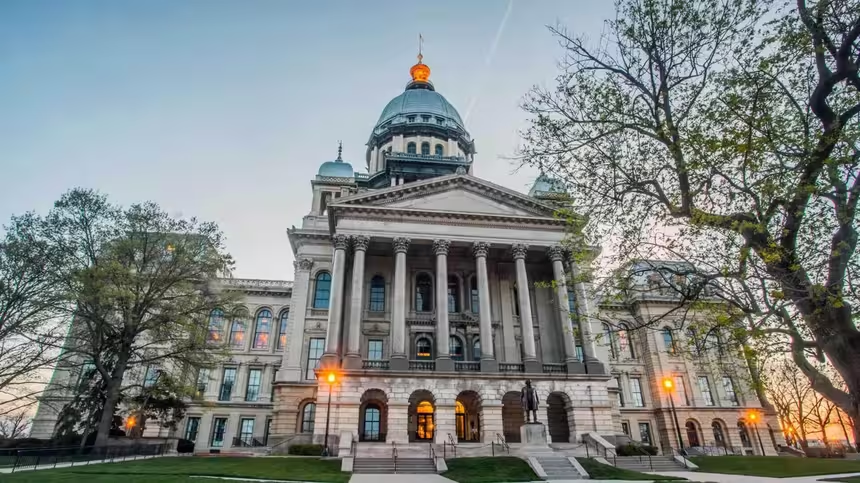
CapitolView
CapitolView is a weekly discussion of politics and government inside the Capitol, and around the state, with the Statehouse press corps. CapitolView is a production of WSIU Public Broadcasting.Providing Support for PBS.org
Learn Moreabout PBS online sponsorship(upbeat music) (dramatic music) - Thanks for joining us on "Capitol View."
I'm Fred Martino.
Illinois is facing some major challenges as we head into the new year.
We'll talk about that and the progress made during 2023.
To begin our discussion, I'm very pleased to welcome Senator Jil Tracy, Illinois Senate District 50 and the Senate Republican Whip.
Senator, thank you so much for being with us today.
- My pleasure.
- Good to have you here.
I wanna start with the progress in 2023, your thoughts on the biggest accomplishments of the year.
- Well, looking back at 2023, the one thing that in my opinion was a highlight is we got the small nuclear bill through that will allow the smaller... Well, lift some moratorium on nuclear permits to be done in Illinois.
And I compliment and applaud Senator Sue Rezin for getting that through the last week of veto session, along with Representative Lance Yednock from LaSalle-Peru area.
The reason I feel like it was so important is when we did the green energy bill, the CEJA bill, whatever you wanna call it, several years back, it's kind of like we pushed our way to the green energy momentum without having a secure, stable grid base.
We're trying to get off fossil fuels.
I think we're perhaps going to fast because we need a solid and stable energy grid to be successful as a state for economic development for our agricultural industry and for our citizens.
And so that we'd had a moratorium for many years and this will allow us to move forward to get that better energy grid.
However, it'll probably be 10 years in the making to even see the first plant be built and permitted and all that.
So that was one of the major accomplishments.
Sadly, I didn't see too much positive happening in Illinois.
We had many bills that affect our employers and our...
So that concerns me.
We saw some successes in our agricultural community after we had done the wind turbine and solar energy sightings and took it out of the control of the counties and put it at the statewide level, which I didn't see as a good positive takeaway from local control.
We did improve that a little bit and gave the counties more oversight on that happening.
So I just saw a lot of bills that employers big and small, and mostly the small ones because it affects them the hardest, have told me are really gonna impact their businesses.
- So let's move to that.
Tell me about the most important issues that you're still working on for 2024 as we look at it.
- Okay, well, my focus when I started in the House in '06 and in the Senate in 2016 has always been making sure our children receive a good education in Illinois.
I see that as the basic state function and the best thing we can do for our children to give them every opportunity possible.
Second thing I work on is economic development.
Once we get our children educated, we would like them to have a job in Illinois, to enjoy the same quality of life I had growing up in deep southern Illinois and now west central Illinois.
So those are the things I work on.
I support infrastructure improvements.
I think it makes us a safer state when we have good infrastructure.
We're a hub of the Midwest and we are, we have rail, river, and interstate infrastructure that always needs improving.
And so I support infrastructure as part of a good base for economic development so that our children and the people that live here have good working jobs to support families.
- Well, I wanna move to a specific issue now that we have been covering quite a bit here, and I know it's on the radar for a lot of legislators.
There is a, I don't have to tell you this, there's a lot of concern about the increasing cost of care for asylum seekers in Chicago.
What would you like to see, Senator?
- Well, Chicago brought this on themselves when they declared themselves a sanctuary city.
I believe in being humane.
All of us for the most part are immigrants in one form or another to United States.
But these expansion of programs and taking in the asylum seekers has put a real strain on other services that we, our Illinois residents, developmentally disabled, the senior citizens, those that need mental health services.
Those are things we have underfunded.
And I would really like us to stay focused on those first.
The rest of Illinois didn't ask to be a sanctuary city, as did Chicago, but this is gonna fall on all Illinois taxpayers and it's going to be a tremendous strain.
We have two silos, if you will.
We have the 55 and older undocumented citizens that get healthcare free, no copays as to this moment.
They cut it off at this point.
But those that got on are on, and Illinois taxpayers pay for that, even though they have copays and the like.
And then there's the asylum seekers that not only are we paying for healthcare, but housing.
And lack of housing is a huge issue.
And I sympathize so much.
Chicago is cold and people are living out in the elements and I don't see that as a humane way.
I mean, it's just been chaos there and how they went about it and declaring themselves a sanctuary city without really focusing on audit means.
And let me add, the definition of asylum seeker is one that wants to get away from political persecution.
I don't think most of the asylum seekers here in Illinois would fit that niche or that definition.
And it's been expanded unofficially, but it does not fit the official definition.
And so many have needed asylum and have sought asylum.
And I don't think this is the same type of category.
And so there again, that needs to be explored and it hasn't.
- Well, some, as you know, have called for more help from the federal government, both in terms of funding for care and also restrictions on entry at the border.
By the time this airs, Congress may have even taken some action because they're looking at doing that as we're taping this program this week.
Your thoughts on this, that the additional help that is needed from the federal government, both in terms of money to help states like Illinois that are already spending hundreds of millions of dollars for care and then the restrictions at the border.
- Well, if you look at Illinois as a whole, we have many undocumented citizens working here.
And our economy very much needs them in many ways.
We have help wanted signs everywhere, and I have urged and asked federal officials who fall over that jurisdiction address it as it should be.
And it hasn't been.
And it's within their bailiwick, their jurisdiction.
State officials can't do it.
Our public aid is maxed and we don't get federal match for what we go and exceed over the federal public aid dollars.
And so there again, it's a strain on Illinois taxpayers.
So I really wish the federal government would take the initiative and once and for all address it.
- Okay, and any comment on thoughts on restrictions in terms of entry at the border?
Lots of proposals, lots of discussion about this.
- You know, I think it should be explored.
I don't fault the Texas or the Arizona states for what they've had to do.
They've been inundated, and got California as well.
It's a strain on their taxpayers and these people aren't vetted.
And fentanyl is a major crisis across this whole country and is killing thousands of people every day.
And much of it's coming over these borders.
And we have no idea who some of these people are that have entered this country.
We just had a word that, you know, terrorists are getting into different countries.
And I think it's a real reason to be concerned.
I don't like to to sound alarm when it's not needed or cry wolf when it's not needed.
But when you have thousands coming over your border without any restriction, it's troublesome.
We need to enforce our borders, that we absolutely do and get a handle on it.
- Okay, we're gonna move on to one final issue that you've already addressed briefly, but this may be a discussion again for the general assembly.
I imagine it will be separate from the hundreds of millions of dollars spent on care for asylum seekers by the state.
Illinois has a recurring program to provide healthcare to some immigrants.
The costs for this are also increasing.
In fact, this delayed, as you know, the passage of a budget in 2023, the controversy over this.
What is the latest on this program and your thoughts on the program, what needs to be done?
- Well, it was not explored adequately when it was begun.
I did not support the program there.
Again, I'm humane.
I understand healthcare is absolutely vital to a healthy state.
We need good workers that are healthy.
However, we have become a magnet.
We're the only state in this nation that has allowed 55 and older undocumented citizens to get total access to healthcare.
And if you need a kidney transplant or any kind of major health thing, if you were living in California or Mexico or anywhere else, why wouldn't you come to Illinois if it's free, no copay, and you're over 55?
The governor put a stall on it, but no copays were added.
What individual with health insurance in this state doesn't have to pay a copay of some sort?
It's just unfair to the rest of the citizens.
And it's going to be exceedingly expensive.
It's gonna put such a strain on the budget.
It was 200 million, 500 million.
Who knows how much it's gonna really cost next year.
And like I say, we just became a magnet, absolutely a magnet for anybody in this country that wanted to come to Illinois and access this premium healthcare policy Is that...
I mean, we're supposed to be in charge of our state budget and are we if we had just allowed this to happen and explode and implode on our budget next year?
It's just not fiscally responsible.
- Senator Jil Tracy from Illinois Senate District 50.
You can watch that entire interview on WSIU's YouTube channel.
We would love to hear from you.
Email us, send us your letters.
The email address is contact@wsiu.org.
More news and analysis now with our guest John O'Connor of the Associated Press.
And Charlie Wheeler, emeritus director of the Public Affairs Reporting Program, University of Illinois Springfield.
Gentlemen, thank you for being with us today.
John, some tough choices ahead as we start for Illinois lawmakers with major deficits projected next fiscal year, and for years after that.
Governor J.B. Pritzker recently addressed this issue.
Where are we and what are the ramifications?
- Well, it's nothing new for Illinois.
We've been in this situation before.
The Governor's Office of Management and Budget, which does a five-year projection each fall says we're okay this year, this fiscal year, which ends June 30th.
We should have about a billion dollar surplus, but it doesn't, it looks a little bleak or after that.
The year after in 2025, they're expecting about $900 million in deficit.
And this is something that Illinois has dealt with in the past.
When Jim Edgar entered office in 1991, there was a billion dollar deficit, and then we thought it was gonna be the end of the world.
Of course, in those days, a billion dollars was real money.
And now the thing that perhaps is a positive for Illinois is that Governor J.B. Pritzker, although a Democrat and although willing to spend money on new programs like many Democrats are has shown the restraint necessary in budgeting in past years.
When he took office, the budget situation was a mess because of a two year stalemate between Democrats and the legislature and the former Republican governor.
And for example, we had overdue bills, past due bills of $17 billion and other mountains of debt.
And he was able to bring those numbers down.
And in fact was reelected in 2022, largely on the idea that, you know, he showed fiscal conservatism.
He said last week in talking to reporters that we have to be careful and any legislature and governor should be careful when dealing with a budget because the economy changes or, you know, we don't know from one day to the next really how the economy's gonna fare.
So it will be...
It could be a tough roe to hoe, but this governor has shown that, you know, he's been able to manage those problems in the past.
- All right, well, we will be watching, of course, as the General Assembly tries to address this really serious issue.
And Charlie, another serious issue as we move to you now, concerns continue over the increasing cost of care for asylum seekers in Chicago with the state and city budgets being strange.
Chicago's mayor is suing bus companies for dropping off immigrants in the city and nearby Rosemont is taking action too.
Rosemont passed a law to fine bus companies, impound the buses and arrest the bus drivers.
Bring us up to date on this, Charlie, and your thoughts on where it is headed, both from a policy standpoint and also the political ramifications as well.
- Okay, well, probably the latest developments in this whole migrant situation is the fact that a little five-year-old boy who is in one of the, I guess it's the largest shelter in Chicago, passed away.
And there's been all kinds of concerns about this particular shelter and the company that is supposed to be providing healthcare there at a contract with the city of a hundred million dollars plus.
And the stories that the migrants tell who are living there, and there's like 2,400 people there.
They talk about there's mold, they talk about dirty bathrooms.
The food is terrible.
They send a picture to a reporter of a ceiling with water dropping down onto cots where they're staying.
And so that's the big issue.
And Mayor Johnson, of course, is blaming the Texas Governor, Governor Abbott for just taking these folks, not giving them any healthcare, anything, just throwing 'em on buses and sending 'em off to Chicago.
And as you indicated, Mayor Johnson decided that, well, we're going to impound these buses and we're going to hold them and fine the drivers and the companies.
And so what happened, and I suppose this would be predictable, the bus companies no longer drop migrants off at the designated landing zone.
Instead, apparently what they've been doing is dropping them off at Amtrak stations and metro stations just outside the city limits and giving them fare cards or paying their fare to say they drop 'em off in Joliet at the station, give 'em train fare into Chicago and let 'em go.
And so now the city has no idea how many are coming or where they're coming from.
So it's really a messed up situation.
- Yeah, and extremely alarming because the numbers continue to grow.
Just on Monday, Charlie, a record one day number of encounters at the border by the border patrol, 12,600 people in one day on Monday.
- Well, and I think to kind of encapsulate what needs to be done, it goes back to, and you mentioned Rosemont and the Mayor Stephens, and he said that, I'm gonna quote here, "It'd be more stable and much cheaper to house arriving families in apartments, which are made for long-term living rather than hotels.
But first he said the migrants need federal work permits to get jobs.
And I think that's the bottom line.
The red tape has to be cut.
So the people who come here and interview show that the migrants want to work, they want to support their families.
In fact, the family of the little boy who died was out on the street earlier that day begging for money.
And so if we give them work permits, the jobs are out there needing to be filled, the employers wanna hire.
And it's this bureaucracy that's blocking what I would consider to be a very viable solution.
- Yeah, extremely serious situation and something we'll continue to watch.
John, I want to touch on one other additional part of this with you.
Some in Chicago have expressed concern about spending on care for asylum seekers.
Of course, a lot of state spending on this as well.
And alderman in Chicago proposed a referendum saying a question should go to voters in the March primary.
Here is the question, should the City of Chicago limit its designation as a sanctuary city by placing spending limits on its public funding?
But the Chicago City Council voted against considering a referendum.
Do you think we're gonna hear more about this?
And what do you make of the increasing tension in Chicago over this?
- Well, I have to think that Governor Abbott, the Republican Texas governor is chuckling.
This is exactly what I have to think he was hoping for by taking migrants who crossover into his state from Mexico and busing them to sanctuary cities such as Chicago, New York, Philadelphia, other places.
And in the debate, when that question got shot down in the city council, Fred Tsao, who's a well-known leader of immigrant rights advocate, said that very thing, don't play into their hands.
And what I think needs to happen is a federal decision, not only the worker permit that Charlie just referred to, but federal coalescence, if you will, on this issue, on the issue of migrants coming into the country and- - Riight.
And we're expecting some kind of action by Congress, possibly, we are taping this on Wednesday, it airs on Thursday.
So I should say that because there are all kinds of ideas on this, including limiting the number of people coming in with the situation already so dire.
But in the absence of federal action, we'll probably see more attempts at local and state action like this.
I wanna move on so that we have time for one more topic before we run out of time now.
Charlie, the US Supreme Court has refused to block the Illinois assault weapons ban.
Do you expect this might provide momentum for additional gun safety legislation?
Or will Illinois lawmakers avoid the issue in an election year?
We have about two minutes.
- Okay, well, first of all, I think that we're not gonna see anything dramatic happening because as you say, it is an election year.
And what that means in part is that the legislature will do little or nothing before the primary.
And the issue is still up in the air.
Well, let me back up and tell you, it's really not up in the air.
Everybody expects that when push comes to shove in the US Supreme Court with its current composition looks at the Illinois ban and it says, well, that doesn't comport with what things were like 250 years ago.
They'll toss it, but there are a couple of issues pending.
One is one that would require when an order of protection is entered against somebody, for example, a domestic abuse case, in theory, the subject to that order is supposed to surrender whatever weapons he has.
And the House has approved legislation to strengthen the law in that respect.
And it's still sitting in the Senate.
That might move.
But other than that, I would not see anything happening in terms of gun control.
- Yeah, very interesting.
And of course, Illinois not alone in this.
A lot of states taking action.
Another issue where states take action because the federal government has done little on additional gun safety legislation, but then it goes to the courts and ultimately ends up in court.
So we certainly have not heard the end of this.
And I think like many, as you expressed, we may see the US Supreme Court eventually striking down this law.
I wanna thank my guests, John O'Connor of the Associated Press, Charlie Wheeler, emeritus director of the Public Affairs Reporting Program, University of Illinois Springfield.
Gentlemen, have a wonderful holiday.
- Thanks and to you.
- Thank you so much, Fred.
And you guys also.
- We will, we're looking forward to the break, that's for sure.
Thank you as well for joining us at home.
Hope you have a wonderful holiday season.
For everyone at WSIU, I'm Fred Martino.
Enjoy it, have a great week.
(dramatic music) (dramatic music continues) (dramatic music continues) (dramatic music continues)

- News and Public Affairs

Top journalists deliver compelling original analysis of the hour's headlines.

- News and Public Affairs

FRONTLINE is investigative journalism that questions, explains and changes our world.












Support for PBS provided by:
CapitolView is a local public television program presented by WSIU
CapitolView is a production of WSIU Public Broadcasting.