
Capitol View - December 5, 2024
12/5/2024 | 26m 46sVideo has Closed Captions
Capitol View - December 5, 2024
Analysis of the week’s top stories with Alex Degman of WBEZ and Amanda Vinicky from WTTW.
Problems playing video? | Closed Captioning Feedback
Problems playing video? | Closed Captioning Feedback
CapitolView is a local public television program presented by WSIU
CapitolView is a production of WSIU Public Broadcasting.
Capitol View - December 5, 2024
12/5/2024 | 26m 46sVideo has Closed Captions
Analysis of the week’s top stories with Alex Degman of WBEZ and Amanda Vinicky from WTTW.
Problems playing video? | Closed Captioning Feedback
How to Watch CapitolView
CapitolView is available to stream on pbs.org and the free PBS App, available on iPhone, Apple TV, Android TV, Android smartphones, Amazon Fire TV, Amazon Fire Tablet, Roku, Samsung Smart TV, and Vizio.
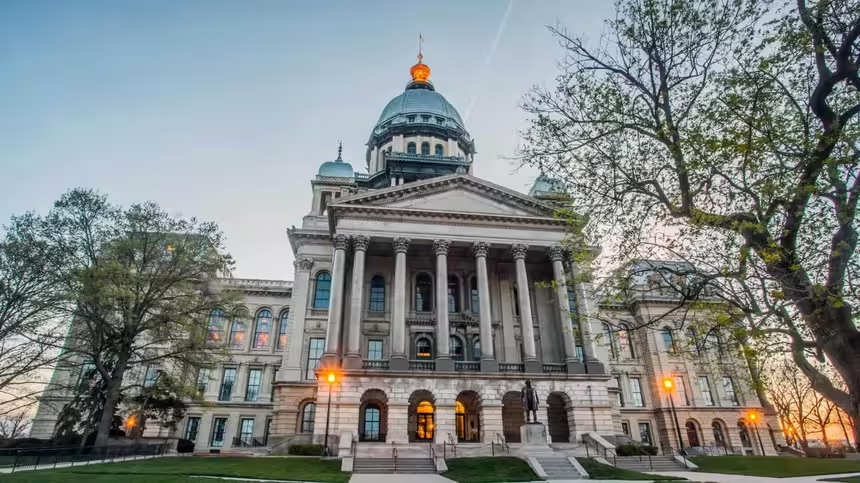
CapitolView
CapitolView is a weekly discussion of politics and government inside the Capitol, and around the state, with the Statehouse press corps. CapitolView is a production of WSIU Public Broadcasting.Providing Support for PBS.org
Learn Moreabout PBS online sponsorship(light music) (dramatic music) - Thanks for joining us on "Capitol View."
I'm Fred Martino.
This week, calls for bipartisan solutions as Illinois faces an estimated budget deficit of more than $3 billion.
Unions call on the assembly to repair the so-called Tier 2 pension system, and Illinois rolls out the beginnings of a plan to modernize professional licensing.
Those stories and more this week with Alex Degman of WBEZ and Amanda Vinicky from WTTW.
Amanda, when the General Assembly meets in January, it will have a daunting task.
You have already done some reporting on this, as the Senate GOP leader called for inclusion in the budget process and a promise the state won't increase taxes: tell us more.
- So we do expect that the legislature is going to return and first have some lame-duck action.
I don't think we're going to see the budget really get underway in these negotiations until a little bit later in the process.
It's gonna be up to Governor J.B. Pritzker first to, you know, introduce his spending plan.
And good luck to that, sir.
He knows that it's coming.
He's got the figures.
But that is a tough hurdle, particularly because you have so many constituency groups this early on, and that's why I think this is worth talking about at this stage, because you have so many demands already coming for the state, despite the recognition that the deficit is at that $3 billion mark.
And so we also have the political dynamic, I think.
We know that in recent weeks the members of the General Assembly, the four caucuses, so House Republicans, House Democrats, Senate Republicans, Senate Democrats chose their leadership.
It's going to be the same leaders of the General Assembly as it has been.
And Republicans have really been feeling pushed out despite a lot of talk about bipartisanship.
You don't really see that play out in the budget.
Part of that you can see when you look at who votes for it and who votes against it.
And Republicans have voted against the budget the past couple of years.
And so they say, when you're looking at a deficit that is so large, you really need to take their concerns, input from all corners, not just on what more needs spending, but on ways that you can sort of recalibrate and what should be prioritized.
So that's the dynamic going in.
How that is going to play out.
I don't know.
We don't really have any indications.
Governor Pritzker has been asked tangentially about the budget.
And says, "I'll be coming up with a plan.
You'll know."
But in being asked for example about the city of Chicago, which itself is facing a deficit and as well as the city schools, he says, "You've gotta do efficiencies.
That's what I have done in the past."
And so we don't know in what areas he might be willing to scale back, if there really is anything like that, because so much of Illinois' budget pressures are already built in.
We know that a pension payment has to be made.
Because of promises through a state formula and just the political dynamic as well, we know that more money needs to go particularly to K-12 education.
So it is certainly going to be something to keep our eyes out on.
And I am afraid that I don't have any sage words for how you can make a up a gap that large.
- We just know there's going to be a lot- - You just know there's gonna be one.
- A lot of dealing and a lot of difficulty.
This is going to be a really hard one.
Well, we move on now.
Another money issue, but a very different one, a very disturbing one.
Alex, an ongoing investigation has found that more state employees have been accused of fraud.
This relates to a federal program designed to help businesses during the COVID-19 pandemic.
Tell us about it.
- Yeah, so we have a situation where nearly 300 state employees are accused of defrauding what's called the personal Paycheck Protection Program.
You might remember that as PPP for short.
That was a program you might remember offered loans for up to thousands of dollars for small businesses that were impacted by COVID-19, if you had to shut down or if you had to pay employees without letting them go to work, that kind of thing.
At least that was the idea when it was rolled out pretty quickly.
Now, we found, or I say we, the Office of the Inspector General, the state has found, so far anyway, that 275 people that worked for 13 different agencies took out $7.2 million in fraudulent loans.
And they were for small businesses, a lot of the times, that either weren't disclosed to the state or these businesses don't exist at all.
Now, it may be kind of confusing, because we're talking about state employees that are getting loans for small businesses.
Like, how does a state employee have a small business?
Well, side hustles, basically.
You can have side businesses.
You can have employment outside of the state as long as it's disclosed.
But a lot of times these businesses either weren't disclosed to the state, meaning that they were operating without the state knowing about it, or they just didn't exist at all.
Most of the fraud that the Inspector General has found so far has come from the Department of Human Services.
And we don't really know why at this point.
But so far, about 100, nearly 100 employees were either going to be disciplined from DHS or they resigned before they could be.
And that could be because they had access to the forms a little bit earlier.
They had more people that they were working with.
They knew a little bit better how to make the system work.
We're not sure.
That's part of the investigation.
But in addition to these folks, the state's also going after some third parties.
So for example, a lot of these employees would make a deal with some third-party operator to get, you know, like a certain percentage of the loan if they get it, if they fill out the forms for them.
So they're going after those two.
But all in all, I think the state is trying to really hammer home the point that this doesn't really have anything to do with state guardrails.
Because like you mentioned, Fred, this was a federal program, and there wasn't anything that the state agencies did that made their employees more likely to engage in fraud necessarily.
But personal Paycheck Protection Program, you know, federally, was rife with fraud.
- Yeah, very interesting.
And something I'm sure we'll continue to be following to see which of these accusations does lead to a penalty in in the long run.
Amanda, as we just discussed, the state faces a budget deficit expected to be more than $3 billion.
And that number, as you already noted, might actually be low.
It does not include the cost to fix the so-called Tier 2 pension system.
You recently reported on this as unions last month rallied at the State Capitol calling for reforms.
- Yes, so this is a call that the labor movement has been making for a couple of years now.
It is getting more pronounced just as time has been growing since really the pensions changed.
So we talk a lot about the unfunded liability that Illinois has one of the worst in the nation of a pension debt built up over the long term; and then an effort to come at that from a legal place, but not in which you didn't reduce the benefits that cannot be taken down for those who are already in the system.
Illinois changed the benefits available to anybody hired after 2011, and that's what's known as Tier 2.
The issue being that a lot of the critics, labor movement, people who received those Tier 2 pensions say that the state went too far, that these benefits got lowered to the point that they are no longer equal to what employees would be receiving if they were getting Social Security instead of a state pension.
Because in this case it's an either/or.
And so the labor movement is saying you need to change that.
We need sweeter benefits.
They say it is a issue that could be illegal at this point, that the benefits, again, are so low that it breaches that contract that they have to be the equivalent to Social Security.
And also, that it's causing problems with recruiting.
You don't hear a lot of pushback on this, that something needs to be done to adjust the Tier 2 pension levels.
The issue being one, again, how are you gonna pay for it?
And two, what are those benefits going to look like?
The proposal that the unions have been rallying for really does ramp up those benefits.
It's not quite the same as Tier 1 in that it doesn't have compounded annual bumps in pensions, but it would call for automatic 3% or cost-of-living adjustment increases once somebody begins to get those payouts.
So it is something that I think we're going to continue to hear about, whether it will be this session is, I think one of the questions.
You have again people saying that this could become a legal problem, a hindrance for Illinois.
But then again, when you have a $3 billion pension and there really isn't any court case that is calling this out at this point, no need for a very deadline-driven legislature and politicians to act, this might not be the year.
- Yeah, I think that certainly is a good analysis, one that I think we all are expecting with so many other issues to take on.
But we shall see.
Alex, speaking of employment, Illinois is rolling out the first phase of a plan to modernize professional licensing.
We've talked about this on the program before.
What's the update?
- Yes, the Illinois Department of Financial & Professional Regulation, IDFPR, they have been under a lot of pressure over the last couple of years to modernize its licensing system.
Because if you can imagine the spread, people who are applying to be nurses, doctors, they're still filling out applications by hand.
They're mailing them in.
And then once they mail them in, there's really not a good way for them to call and get updates or information about where they are in the process.
They don't know if their money was taken.
It's a big mess.
And add to that the sheer number of professions.
This was a problem before, but add to that the sheer number of professions that IDFPR licenses, and the lack of people to go through all these applications.
It created quite literally a perfect storm.
So lawmakers saw this after hearing the pleas from people, like, we can't get our licenses renewed on time.
We don't know what's happening.
Lawmakers passed a bill and they said: You have this much time to get it done.
And they didn't get it done in that time.
But they're still working on it.
That's what we're talking about now.
But they did announce a while back that they selected a vendor for the pilot program.
The pilot program is called the Comprehensive Online Regulatory Environment, or CORE for short.
And we talked about it a little bit back in October, but there's still a ways to go before this is fully rolled out.
Because right now, out of the roughly 300 professions that IDFPR licenses, and there are over a million people working in those professions, right now there are only three that can get licensed through this program because it's a long-term rollout.
IDFPR says this is gonna take at least a couple of years.
They gotta scale it up.
So right now they're starting with three professions: nail technicians, music therapists, and clinicals psychologists.
They're basically testing it out right now.
And really what they're hoping to do is basically finally put an end to this, what has essentially become a nightmare for IDFPR, but even still with guardrails in place with deadlines, with deadlines in place.
This is just a very long and tedious process, and we're only just at the start of it.
- Yeah.
Well, we gotta start somewhere.
At least it is moving along now.
Amanda, speaking of moving along, there's gonna be a lot of news from Washington in the new year as the cabinet is formed for the Trump administration.
We're already hearing a lot of news on this.
And you recently reported on how Illinois US Senators Dick Durbin and Tammy Duckworth described some of the people President-elect Trump plans to nominate.
- You know, I don't think it's particularly surprising that they're not thrilled with some of his appointees.
But, you know, using some pretty harsh language, calling them disqualified, disastrous, in particular, this was comments that were made about, for example, Matt Gaetz before he decided to drop the nomination, but also, for example, somebody else who's getting a lot of attention, and that is Pete Hegseth to serve as Secretary of Defense.
So these are just some of the comments that Duckworth and Durbin have made.
And it is relevant, because of course they are members of the US Senate, which has powers to confirm appointees, to have their say in cabinet picks: maybe, maybe, maybe.
This is of course something that we're still watching play out in Washington, to see whether the Senate is going to take that role or give President-elect Trump more leeway to sort of choose whoever he wants by going the recess route.
So we are watching how Democrats handle all of this.
Of course, there is disappointment in that party with how the elections turned out, that there's going to be complete GOP control, not only losing the White House, but of course also losing the House, not holding the Senate.
So we are watching to see how far Democrats strike out, and whether they're going to really leave some of this to be a fight for Republicans to make with some of the more controversial appointments that Trump has announced.
- Let me ask you, Amanda, you know, we've heard on online and there have even been some fairly lengthy commentaries written about this in certain publications, that some Democrats are kind of holding back a little bit due to the results of the election.
What's your sense in terms of our federal representation from Illinois as to the so-called resistance as it was called in the first Trump administration.
Is there, do you think, gonna be more restraint for fear of ramifications including, you know, the federal funding that is so important to so many programs in Illinois?
- You know, it's a new landscape.
It is clear that the President-elect is vocal, that he believes that he can use some of the tools of government and some of his bully pulpit to seek sort of retribution against those who he believes speaks out against him, and particularly against states that try to defy his plans, that he's already talking about holding back funding.
And that's something that we already saw occur in his first administration.
I don't think that you're going to have, for example, the mayor of Chicago, the governor of the state of Illinois, very out-there Democrats who have Progressive constituencies and also heartfelt beliefs, just abide by some of that.
They do perhaps need to, again, pick their battles somewhat carefully, and figure out what legal justifications they might have.
So there's all of that dynamic.
I also think you're watching a dynamic play out in which Illinois only has three Republicans as part of its delegation to Washington, DC.
However, some of them do have tight relationships with Trump.
They're not aligned in many ways with Pritzker's desires for the state, but how much weight will they carry in terms of trying to bring funding to the state.
Or will they even try in some of those areas?
- Yeah, we will be watching.
It should be very interesting, to say the least, over the next four years.
Alex, also looking ahead to next year, ComEd is raising electric rates by more than $10 a month.
And the reason may surprise some people.
This was in a recent story on your station's website, wbez.org.
- Yeah, and I really appreciate that story, because it actually did teach me a lot about how power grids work.
Because a lot of times when you're talking about raising rates to offset future demand, a lot of that has to do with the grid and who's running the grid.
And ComEd, the grid that they're on, is run by PJM Interconnection; and that grid covers Northern Illinois, parts of 12, 13 other states in Washington, DC.
Southern and Central Illinois are on MISO, which is a different grid.
AMERIND and CWLP and the other operators down here use that grid.
So every year what happens is the grid operators hold an auction to make sure that there's enough power in the future to meet demand.
And looking ahead to Illinois' future, we've got a lot of data centers that are expected to come online, quantum computing campuses.
The United States as a whole, and Illinois in particular is trying to become a leader in the AI space.
And this is all coming together to create a much larger demand than we see today.
So prices have to go up now to ensure that the grid operator can buy enough power in the future to make sure that lights stay on, essentially.
And this isn't unique to the PJM grid, but its territory does include both Chicago and Washington, DC.
And Chicago is the number three market for data centers in the country.
And DC, Northern Virginia is number one.
Even though Chicago is number three, Northern Virginia just puts out just immensely...
The demand in Northern Virginia is immensely more than it is in Chicago, but that's the grid that we're on.
When you look at that plus the stuff that we have going on in the State House, the Climate and Equitable Jobs Act, a lot of people are concerned that we're taking, I keep saying we as though I'm the state of Illinois, but people are talking about whether it's wise for the state of Illinois to take legacy power generators like coal power and natural gas power offline, or plan to take them offline, before there are enough renewable energy projects or renewable energy projects in the pipeline to kind of offset that.
- Yeah, and to be clear, Alex, that's not only important in terms of keeping electric bills low for consumers, but also for businesses, because that has been one of the, you know, plays that Illinois has tried to use in terms of keeping and attracting businesses, is, you know, fairly reasonable utility rates.
- Yeah, that's true.
And I can speak for myself living in Springfield with City Water, Light & Power, I mean, my per kilowatt hour rates here is lower than I think I've ever seen it really anywhere else.
So this doesn't actually affect me per se, but it does affect a lot of people in Illinois.
And there is definitely a lot of concern that rates are going to necessarily increase everywhere as more technology comes online that needs to suck up more power.
So as it stands with ComEd right now, most of their service territory has an average bill of about $100 a month.
So when you add this to it, you know, 10.50 a month on average for all of ComEd's customers, that's, you know, an average household may not feel that (audio cuts out).
- It's not just the money.
I mean, it's also just upkeep, availability of power.
You've seen in other states, there would be, you know, brownouts or blackouts.
And so this is something that I think is short term, but further looking at grid maintenance and power supply are going to be ongoing discussions that really the United States as a whole needs to take seriously.
- Yeah, absolutely.
Something we will be watching.
And something we're always watching, Amanda, our final story this week.
It is a story that was covered at "Capitol News Illinois."
It says that the next school reform push could involve testing and accountability in the state.
Tell us more.
- I think that you have two major school pushes.
The first is going to be the funding question again, so sort of circling back to where we began the program.
And then of course is a question of money, money, money.
And as I had noted, there really are calls from organizations to put more into really the last major round of reform.
And that was a new formula that tries to send more state dollars to the districts that very clearly need it the most, and to bring them to a point where they believe students are being educated; there's enough dollars for students to be educated well, really is the most base.
Then you have these calls.
So this is a group, sort of a coalition of education experts that previously had put out what was, but it kept your name, Vision 2020, get it?
(laughs) Now they're going Vision 2030.
And so looking some years out.
But it is of course going to rely on funding.
But also some other changes that can figure...
If right now a lot is based in terms of how you judge how well schools and districts are performing based off of standardized testing, this looks to say: Hey, wait a second.
We have a bunch of different standardized tests.
So you can't really see how a student performs from one year to the next as they go from grade school say to high school.
We want there to be a uniform way so that you can track a student and really see how they're progressing.
Also, there's a giant gap between when students take the test and when you actually get the results, when those are made public.
And that doesn't help to serve the students or their teachers very well, because they have this entire time that they could be perhaps addressing where your students aren't meeting the standardized grade mark.
And it's too late.
By then they're already off with a new teacher and into a new grade.
And also, changing how Illinois really calibrates how well students are doing so that there is a similar baseline to other states.
So it doesn't seem as if Illinois students are learning less and performing worse than say students that go to schools in Indiana, Wisconsin, or Michigan, when that may or may not in fact be the case.
We're not judging from the same platform.
So those are some of the changes that are suggested by this organization.
As I noted, some of those things cost money, but not everything.
So that is maybe an area that the General Assembly could move toward and accomplish something during the session without it carrying a major price tag.
- Yeah, and as you know, Amanda, there's often a lot of pushback on standardized testing, because there's also so many other things that, you know, folks who are performing oversight with schools have to look at in terms of opportunities for students, graduation rates.
There's just a lot there.
And it can't all be completely evaluated based on, you know, a standardized test, filling in very often those maddening little dots on a scan sheet.
- It's been a while since I've had to do one of those, thank goodness.
So luckily for me (laughs).
But yeah, I mean, there's certainly I think an ongoing debate over how much standardized tests should be factored into things, given, as you noted, so much else that goes into educating the student and what each student is going into the school day with.
- Yeah, and as someone who's taught college students for many, many years, seeing the need that they, you know, have lots of instruction and opportunity to succeed in learning how to write, which often is not evaluated very well on a standardized test which is multiple choice.
Amanda and Alex, thank you so much for being with us this week.
Always good to have both of you with us.
And happy holidays to both of you.
- Same to you.
- You as well.
- Thank you for joining us at home.
For everyone at WSIU, I'm Fred Martino.
Have a great week.
(dramatic music) (dramatic music continues) (dramatic music continues) (dramatic music continues) (dramatic music continues)

- News and Public Affairs

Top journalists deliver compelling original analysis of the hour's headlines.

- News and Public Affairs

FRONTLINE is investigative journalism that questions, explains and changes our world.












Support for PBS provided by:
CapitolView is a local public television program presented by WSIU
CapitolView is a production of WSIU Public Broadcasting.