
Capitol View - December 7, 2023
12/7/2023 | 26m 46sVideo has Closed Captions
Capitol View - December 7, 2023
Join us for the latest news affecting Illinois and the General Assembly with our guests Jason Piscia, Director of the Public Affairs Reporting Program, University of Illinois Springfield and John Jackson from the Paul Simon Public Policy Institute at Southern Illinois University Carbondale.
Problems playing video? | Closed Captioning Feedback
Problems playing video? | Closed Captioning Feedback
CapitolView is a local public television program presented by WSIU
CapitolView is a production of WSIU Public Broadcasting.
Capitol View - December 7, 2023
12/7/2023 | 26m 46sVideo has Closed Captions
Join us for the latest news affecting Illinois and the General Assembly with our guests Jason Piscia, Director of the Public Affairs Reporting Program, University of Illinois Springfield and John Jackson from the Paul Simon Public Policy Institute at Southern Illinois University Carbondale.
Problems playing video? | Closed Captioning Feedback
How to Watch CapitolView
CapitolView is available to stream on pbs.org and the free PBS App, available on iPhone, Apple TV, Android TV, Android smartphones, Amazon Fire TV, Amazon Fire Tablet, Roku, Samsung Smart TV, and Vizio.
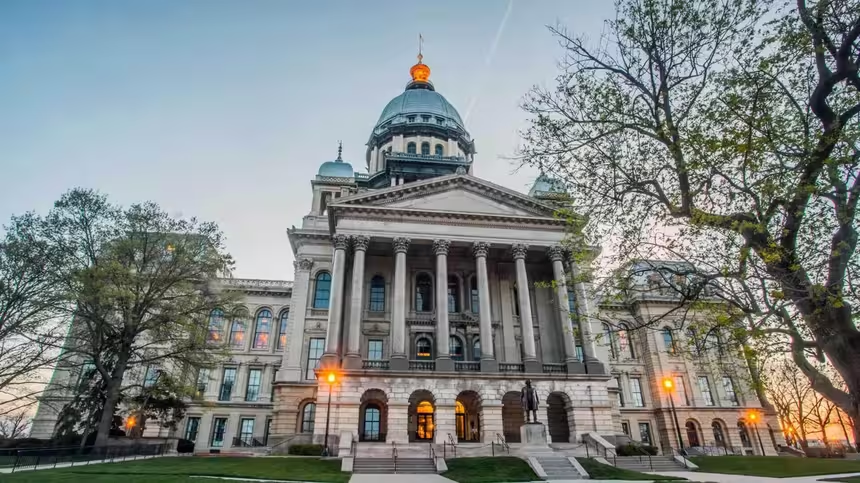
CapitolView
CapitolView is a weekly discussion of politics and government inside the Capitol, and around the state, with the Statehouse press corps. CapitolView is a production of WSIU Public Broadcasting.Providing Support for PBS.org
Learn Moreabout PBS online sponsorship(gentle music) (camera beeping) (gentle music continues) (dramatic music) - Thanks for joining us on Capitol View, I'm Fred Martino.
A number of Illinois congressional representatives voted against expelling representative George Santos, And next fiscal year, Illinois is facing a projected budget deficit in the hundreds of millions of dollars.
Covering those big stories and much more, Jason Piscia, Director of the Public Affairs Reporting Program at the University of Illinois Springfield and John Jackson from the Paul Simon Public Policy Institute at Southern Illinois University Carbondale.
And we begin in Congress where Illinois Republicans, Mary Miller and Mike Bost voted against expelling representative George Santos.
Santos, of course, was expelled.
He is charged with federal felonies, including allegations of fraud and campaign finance violations.
On the Democratic side, Illinois representative Jonathan Jackson didn't vote yes or no to expelling Santos, he voted present.
In a statement to the Chicago Sun Times Representative Jackson said Santos deserves his day in court, I would like a reaction from both of you and do you think there will be political ramifications for these representatives who declined a chance to vote to expel the former representative George Santos?
Jason, let me begin with you.
- I think the short answer is, at least in my view, no.
I think the George Santos chapter in Congress is, thankfully, over, it was definitely a side show, I'll use the nice version of that word.
And I don't think there'll be any lasting leftover voter consternation about how their representatives voted on this one way or the other.
This was, you know, a year of chaos with him.
The media, the national media especially enjoyed it.
The New York based media enjoyed it.
But, you know, in the end, I think on the Republican side, those votes went as as expected.
Mary Miller has always sort of been on the far right.
Representative Bost is trying to establish his far right credentials as he, you know, has a pretty challenging primary battle coming up here against Darren Bailey.
So, yeah, I don't think there'll be any lasting things to go along with this.
I think the people are more interested in, you know, whether the government will keep running.
- Okay, John, what are your thoughts?
- Fred, we live in the 12th District with Mike Bost and, of course, the 15th district's not far away.
So I wanna add evidence to that argument Jason made.
That is, both of these members voted against certifying the results of the 2020 election.
The only two Republicans and, certainly, no Democrats voted that way from Illinois.
And if anything, they got rewarded for that.
And this was voting against certifying the results duly submitted by all 50 states and that Vice President Pence said had to be accepted.
And that, of course, has led to everything that's come.
So if they weren't going to pay a price for that, these are two ruby red districts and they're not gonna pay a price here.
On Representative Jackson, I think that's a family thing.
He has an older brother, Jesse Jackson Jr. who got into difficulty and left the Congress and it's a very blue district.
And I think there was a little family history there that he was basically reflecting.
- Okay, well we will continue to see how this all plays out.
Representative, former representative Santos now out of Congress, but certainly continuing to make noise and some speculation that Republicans who did vote yes to expel Santos wanted to try to ensure this wouldn't become fodder for the 2024 election.
We are gonna move now to spending, and the continuing influx of migrants in Chicago is putting a strain on budgets.
Last week, we reported that Illinois is moving $160 million from the human services budget to care for migrants.
Since then, another 2 million was needed for food assistance In New York, spending is in the billions.
That's billions with a B in New York City.
And the State of New York expects to spend nearly $2 billion over the next two fiscal years.
New York even has an online tracker for spending.
I would like to hear both of your thoughts about the peril for Democrats on this, both in Illinois and at the national level as we come on the air to do this, this week.
In fact, we learned that in Chicago, Chicago was planning a city shelter for migrants and the state stopped that due to contamination on site.
The news just keeps coming on this Jason, and it's not good news.
- Yeah, and there's definitely some political peril for Democrats on this and I think it's just the way the Republicans want it to happen.
I think when, you know, Republican governors started putting asylum seekers on buses and shipping them to places like Illinois that are led by Democrats, this was one of the side effects that I'm sure Republicans were hoping to see, Democrats sort of wringing their hands on what to do about this.
You know, Democrats, you know, in Illinois are compassionate to what's happening, they want to help.
How to get that help and what that help looks like is controversial and it's expensive.
And, you know, we're seeing with what happened this week with Brighton Park being, you know, deemed a place not suitable from a safety standpoint to put these asylum seekers, there's some real friction coming to the surface between the City of Chicago, the mayor's office and the governor's office, two powerful Democrats in the state.
So I think this is just playing into the hands of what the Republicans want.
They wanna see Democrats fighting over this and just gives the Republicans more political fodder to play with as the elections get closer.
- John, your thoughts on this?
- Fred, it's definitely not good politics for all the reasons that Jason just cited.
Immigration at the national level and at the state level is an effective issue that the Republicans will use in 2024.
However, I would assert firmly it is good government and sometimes you have to do good government.
Disregard for a moment how they got here, these people are here, they're human beings.
As the governor pointed out, Chicago's facing winter.
You can't survive winter on the streets in Chicago.
They've overwhelmed the police stations and all of that's got to be solved, and it's a governmental problem.
Government has to do something to take care of those people and has to do something that will work for the neighborhoods particularly.
And this is the kind of plan that the governor and the state have come up with.
It's going to be very expensive.
It'll be unpopular in some quarters and it's got to be done.
I would add one of the thought, and that is that Congress has had this for generations.
We're living with the Reagan administration law on this.
George W. Bush tried to solve the problem.
The right wing of his party rose up and rebelled against the solution he worked out.
John Boehner and Barack Obama had an agreement.
Again, the right wing rose up.
And what's going on today in Washington reflects that argument, it's been a great issue for some members of the Congress, and they wanna keep it as an issue, and they don't wanna solve the problem.
- Well John, we've gotta move on, but I have to ask you this, this fall, as you probably know, we reported on Governor J.B. Pritzker writing a strongly worded letter to President Biden about the need for action, the need for help.
Do you think more needs to be done here urgently, with my introduction to this part of the show, that we're now talking about hundreds of millions of dollars when the state budget is already under enormous stress?
In New York, billions of dollars.
Regardless of who is at fault for this, does there need to be some strong effort to go after this on the federal level?
- Well, absolutely, and that's the debate going on right now, the question of Ukraine funding and the whole Israeli funding package being tied to immigration illustrates how divisive that is.
I think Democrats ought to accept some kind of immigration package and add it to what they want for Ukraine, and what they want for the Israelis.
So this is an opportunity for them to compromise.
Legislative process will not work without compromise and both sides should compromise on this.
- Okay, well as I said, the stress on the budget from migrant care comes as Illinois faces a budget deficit next fiscal year.
It was projected at $900 million just about, it's been brought down slightly this week.
But when the $900 million figure came out, columnist Rich Miller wrote in the Chicago Sun Times that Illinois may need to tighten its belt.
Jason, thoughts on this and what it could mean for the General Assembly?
- Sure, if you look at the history of the state's general fund, which is the fund that pays for most state services, it's clear that state spending has grown exponentially in recent years compared to previous years.
Just looking at a few figures, I noticed, you know, this past budget, the general fund expects to spend $49.1 billion.
If we go back, it crossed the $30 billion threshold in fiscal '13, it took until fiscal '21 for it to hit 40, so that's eight years.
And now, you know, in three to four years we're already almost from 40 to $50 billion.
So at that rate we're seeing spending increase at very high levels.
So that said, there were these projections that came out that are predicting a budget deficit going into next year.
But again, you have to take those with a grain of salt as well, these are, you know, financial analysts that are looking at these numbers, but they're just predictions, and prognostications at this point.
All it takes is a few strong months of revenue to change those numbers all around again and change the equation.
They're definitely something to pay attention to, but I'll, you know, have probably a better... Everyone will have a better view of what the situation's gonna be once we get through the holiday season, to see what spending was there.
And as we're going into the budget, you know, assembly process here in the first part of next year, - I appreciate your work looking at the big picture.
So you said about 10 years ago the state budget 30 billion and now almost 50 billion, correct?
- Correct, yeah, it took eight years to get from 30 to 40 and, like I said, - Yeah.
Another three or four to get to 50.
- So yeah, I mean there it is in a nutshell, if you will.
Certainly, there is more revenue today, but maybe that revenue not keeping up with the expenses.
And the projections are there for a reason, a dire warning, and one that we'll continue to watch on this show.
And, certainly, we depend on journalists to keep people informed.
Well, with budgets tight, this might get even more attention, the Illinois State Police has launched an online form where you can report allegations of corruption, John, tell us about this.
- Well, Illinois has an unfortunate history of too much corruption for too long.
And this is just one of many steps that are being taken to try to fight not only the reputation but the reality.
I think it's notable that most of the Illinois cases of corruption over the last 20 or 30 years have come at the local level, to the lesser extent at the state representative level, but mostly city councils, townships, that sort of thing.
And it's an enormous amount of money in some cases.
The classic case is the city treasurer in Dixon, Illinois, she had $53.7 million that she embezzled from a very small city.
And in the retrospect, I and others looked back and said, "How could they not miss that much money?"
But the offices that were parallel to her were not checking on her.
And she was fueling a lifestyle that included race horses, and a lot of stuff that ordinary people can't afford.
And nobody seemed to have found it for many, many years.
And this is state police trying to contribute to the transparency and trying to contribute to possibilities that citizens can figure there's something going wrong and that they ought to blow the whistle.
- Yeah, and I saw in the press release from the Illinois State Police that they had about 80 investigations, I believe it was.
So, you know, last week, John, we reported on Cook County letting people go to an online portal to see how their property tax money is being used.
This is kind of the reverse of the online transparency picture, where the state police is asking individuals report to us online something that needs to be investigated.
So as we often say in journalism, transparency is part of the key.
And today, to make it easy, that involves the internet, make it easy, and that's what they're trying to do.
- Seems like a very practical step and it may yield some results, so - We'll see.
- People need to pay attention.
- Meantime, we have some interesting labor news.
Temporary staffing agencies are going to court.
They are seeking to block a new state labor law.
Jason, tell us more about that.
- Sure so, you know, this has to do with, you know, these temporary work agencies that will, you know, put people into temporary positions.
It affects, you know, sort of blue collar industries like warehousing and, you know, distribution facilities, not clerical jobs, but there's been a law on the books for a while that has, you know, required them to treat temp workers fairly.
But there was an update to that law this past spring that got signed into law.
One of the biggest changes of that amendment was after 90 days of someone working in a temp job, that worker is entitled to the same pay and benefits as, you know, someone who would be hired full-time at that firm.
And that's in response to, you know, many of these companies that use temporary labor, are using temporary workers as a way to save money, they can, you know, pay these workers less and not have to pay them benefits because they're on a temporary basis.
But they're there for more than three months, so the thought is that they're, you know, they're abusing that right by calling them temporary after so long.
As expected, the temporary agencies don't like this law.
So they filed suit to try to stop it.
They're worried about the increased costs.
And there's also another part of the law that allows, you know, "interested parties" that, you know, pay attention to labor issues and temporary labor issues to sue temporary agencies that seem to be abusing this law.
So these agencies are concerned about the legal ramifications, the financial ramifications, and they're, you know, sort of putting their foot on the ground with this lawsuit to try to stop it, we'll have to see where it goes.
- It will be interesting to see where it goes, particularly with our labor shortage, which is incredibly difficult for many businesses.
It will be fascinating to see.
And, you know, as we often say on this program, legislators can approve laws, but they're often and, it seems, increasingly challenged in court.
We now move to the Illinois Supreme Court, which ruled that there is an exception to the state's biometric privacy law.
John, tell us about that exception.
- Well, Illinois has a very strong law of trying to protect workers' rights especially.
In this case, two nurses sued their hospitals because the hospitals required the use of fingerprint access to where the drugs and the medicines are stored.
And they said that was an invasion of their privacy, and that the data collected could be misused.
The Supreme Court, I think, quite rightly ruled that there is a clear exception for healthcare workers and hospitals because of the nature of what they do, and because of the HIPAA act both.
And, basically, unanimously ruled, the Supreme Court of Illinois unanimously ruled that the hospitals had the right to do what they were doing in controlling access, and taking care of their patients by doing so.
So basically, the hospital association won.
I'd have to say this looks like a fairly narrow ruling though, because the law couldn't be more clear.
There are gonna be other lawsuits about this because it's such a pioneering law.
- So you expect other lawsuits on this, whether they be from employees or other parties.
In the case of, you know, I often think about this when traveling that now, you know, your picture is taken as you're getting on a plane and this sort of thing.
- Yeah, all kinds of things, you can use identification by your eyeball and how it's shaped by looking into a camera to gain access.
And all kinds of ways in which technology is invasive to privacy and we all understand that.
Many of us know about George Orwell, "1984" and that's been a long time ago.
And we've come way past that now with the technology.
But still, there have been a number of cases and it's right for the public to be regarding their own privacy and worrying about it.
But it's also true that places like hospitals have to have some controls.
- Absolutely, absolutely.
Well, we have a couple of minutes left in the show and we do have another court case that I wanted to get to that has been in the news.
It involves another exception, interestingly.
This one, this exception is to the state's Freedom of Information Act, it cannot be used to get firearm owners' identification cards.
Jason, tell us about this.
- Sure, you know, it was 2011 when the legislature passed this amendment to the Freedom of Information Act that said, you know, you can't get information on who has applied for a firearm identification card, or who has one, or who's lost one.
All that stuff is off limits.
And that law came about after some media organizations began filing FOIA requests to try to get that information for, perhaps, a story, or investigation they were working on.
The law was passed and, you know, some people would argue that makes sense, you know, there shouldn't be... You shouldn't be able to know, you know, who has guns and who doesn't in a community.
There's sort of an unintended side effect of this, however.
There were a couple of plaintiffs in Madison County who had their FOID cards revoked, and they were trying to figure out why.
They didn't have the paperwork that indicated why their FOID cards were revoked.
So they used the Freedom of Information Act to try to get that information about themselves.
Citing that law that was passed, they said, "No, you can't have this information, "even if it's about yourself."
So that case wound its way through the Supreme Court and got to where we are now to where the court ruled that... it upheld the law, which basically said that those records, even though they are yours and it's about you, you can't have those either.
The court did note there are, you know, other ways to get the information.
You just go directly to the state police and use other means, but the Freedom of Information Act is not the path to make that happen.
And I, you know, on the face that makes sense as well because the Freedom of Information Act makes that information public, it just doesn't necessarily have to go to the person who requested it.
People can FOIA what's been FOIA-ed and get that information out as well.
So they have other ways to get the information just not through FOIA.
- Yeah and, of course, Illinois has some of the strongest firearms laws in the country.
And there are other laws that deal with firearms that we'll be talking about in the year ahead that are being challenged in court.
John, before we go, we just have about two minutes as we look ahead to 2024 and looking at your peaceful Christmas tree in the background, I am reminded the peace just a few weeks after that will end on the national level, if we can call it peace, it's not really peace now either.
In terms of the tumult of the 2024 election with folks voting in Iowa, unbelievably, in the presidential primary just a few weeks after the holidays with guns and gun laws as not only a state issue across the country, but a national issue, do you expect this to be continued to be used as a political weapon in campaigns?
- Absolutely, it will be front and center, and it's already on the agenda.
And the fights are going on all over the place, particularly because the Supreme Court ruling.
So the Supreme Court created some of this.
And basically, there's the old you can't shout fire in a crowded theater and thereby cause a panic.
And that's relevant here.
The Supreme Court of the United States is going to have to go back and revisit what kinds of restrictions states, and local governments can put on gun owners, and they're going to have to sort out some of the mess that they've already made.
We need some national standards and they're going to have to ultimately try to revisit this.
It will be very much a part of the 2024 campaign.
- Yep and a good way to end, to remind folks that when they do plan to vote, that whoever is president will nominate folks to the Supreme Court when vacancies occur.
Well, thanks to my guests, Jason Piscia, Director of the Public Affairs Reporting Program at the University of Illinois Springfield and John Jackson from the Paul Simon Public Policy Institute at Southern Illinois University Carbondale.
Thank you for joining us at home.
For everyone at WSIU, I'm Fred Martino, have a great week.
(dramatic music)

- News and Public Affairs

Top journalists deliver compelling original analysis of the hour's headlines.

- News and Public Affairs

FRONTLINE is investigative journalism that questions, explains and changes our world.












Support for PBS provided by:
CapitolView is a local public television program presented by WSIU
CapitolView is a production of WSIU Public Broadcasting.