
Capitol View - December 9, 2022
12/9/2022 | 26m 46sVideo has Closed Captions
Capitol View - December 9, 2022
Illinois lawmakers begin looking to 2023, now that they’ve completed both the November Election and Veto Session. We explore the legislation still on the table, as well as changes in power with expert political watchers.
Problems playing video? | Closed Captioning Feedback
Problems playing video? | Closed Captioning Feedback
CapitolView is a local public television program presented by WSIU
CapitolView is a production of WSIU Public Broadcasting.
Capitol View - December 9, 2022
12/9/2022 | 26m 46sVideo has Closed Captions
Illinois lawmakers begin looking to 2023, now that they’ve completed both the November Election and Veto Session. We explore the legislation still on the table, as well as changes in power with expert political watchers.
Problems playing video? | Closed Captioning Feedback
How to Watch CapitolView
CapitolView is available to stream on pbs.org and the free PBS App, available on iPhone, Apple TV, Android TV, Android smartphones, Amazon Fire TV, Amazon Fire Tablet, Roku, Samsung Smart TV, and Vizio.
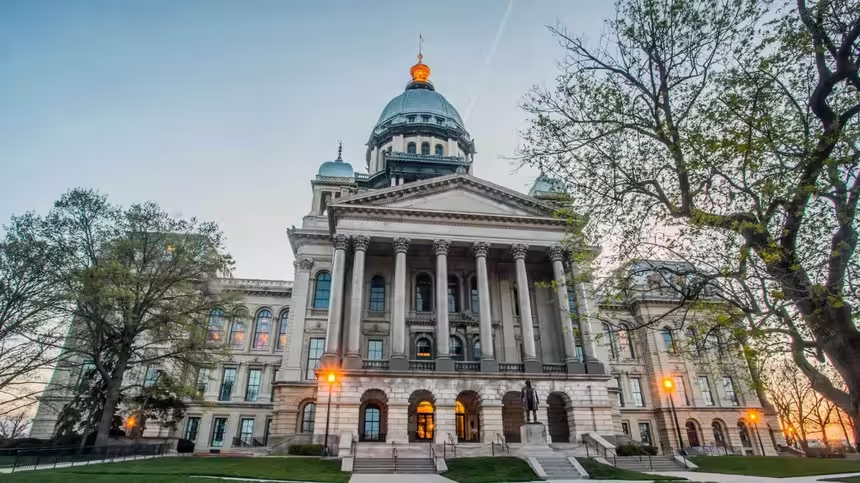
CapitolView
CapitolView is a weekly discussion of politics and government inside the Capitol, and around the state, with the Statehouse press corps. CapitolView is a production of WSIU Public Broadcasting.Providing Support for PBS.org
Learn Moreabout PBS online sponsorship(upbeat piano music) (upbeat orchestra music) - Welcome to Capitol View, our weekly look at the happenings inside and outside the Illinois State Capitol.
I'm Jack Tichener sitting in for Jennifer Fuller this week.
Our guests are Jerry Nowicki of Capitol News Illinois and Jason Piscia, the director of the UIS Public Affairs Reporting Program.
Gentlemen, thanks very much for joining us.
- Thanks for having us.
- Thanks for having us.
- Big week just wrapped up at the Illinois General Assembly with the fall veto session coming to a close.
Lawmakers finished their veto session by updating and clarifying some aspects of the controversial Safety Act.
Let's talk about some of the changes they made.
There were some clarifications in what it means to have cash bail or eliminating cash bail, perhaps the most controversial aspect of the whole thing.
Will it be enough to assuage the many critics of the Safety Act?
- I'll say, I don't know if it's about criticism at this point.
It's just, sort of, it's gonna take effect less than a month, now, and now the conversation, sort of, shifts to observing how it's working and what changes might be needed in the future.
I think the governor even said at a news conference yesterday, he said that we're gonna listen to the Supreme Court and the task force that's been working on implementation of this.
We're gonna listen to state's attorneys to see how this is going as it moves forward.
It certainly wasn't enough to assuage the Republicans if you listen to them in floor debate.
They said we didn't have too much of a role as we would've liked in crafting this legislation.
"No role," Most of them said, but there was some acknowledgement that it did do more.
It's closer to what Republicans would've wanted, even if it's still far away from what they would've wanted prior to these amendments having taken place.
- We can talk more about their involvement or lack thereof in a moment, but specifically, what were some of the key changes that were made to the Safety Act?
- Yeah, as you know, there were a lot of open questions on what this intent of the Safety Act was when the bill was originally passed.
That gave fire to the Republicans to, sort of, fill in the blanks with some of their own theories on what would happen, and we heard a lot of those theories come up during the election campaign as ways to maybe try to frighten the electorate on what the safety Act was gonna do.
So Democrats went back, proposed these amendments, the amendment clarifies the rules that the judges must follow when they are considering whether a defendant presents a danger to the public, which is one of the main issues of the law.
If the defendant poses a threat to the public, the the judge does have the discretion to keep that person in jail awaiting trial.
It also adds several offenses that allow a judge to detain that person, and I think, maybe, one of the biggest questions that got cleared up was what was gonna happen to the people already in county jails on January 1st.
Listening to some Republicans who were, sort of, filling in the blanks of what wasn't, sort of, set out in stone or set out very clearly in the law was were the jail door's gonna fling open and everyone was gonna hit the streets on January 1st.
That was never the intent.
The amendment goes in and sets up a process by which people in jail can apply to become part of the system to have their bail reversed and give them an outlet to get out of jail.
So there's some deadlines in there depending on the severity of the crime they're charged with to have hearings within a week or two months or three months.
So I think a lot of how these revisions will work and assuaging the worries that the people have about the elimination of cash bail.
We'll see it in these first three months with how these initial hearings get handled.
- There was also a question about what would happen to people who were being cited for trespassing, whether police officers could actually make sure that the people moved off of the property where the problem was being caused.
How was that handled?
- Yeah, there was a level of interpretation there that maybe there was some concern that it could be interpreted that the officers don't have that authority.
Well, now it's very, very clear that they do.
There's still a presumption of pretrial release in which the officers for cases below class A misdemeanors, sort of, presume that the first option is to cite them to be taken into court, but they still, now, have the ability.
They probably did have the ability before, but now it's crystal clear in language that it says they may remove the person if they continue to break the law, which if you're a trespasser and you're trespassing, you're breaking law until you're off of that property.
So the police can remove them, and they can also remove them to alleviate anything that they believe in their discretion to be a threat to public safety, and that's the initial officer arrest part of it.
What Jason was referring to was the circumstances when it enters the court process and when judges can revoke pre-trial release.
- What's the impact on the legal system as a whole?
We hear from many sectors out there that it's already overstressed, and this adds another overlay of complication to getting people moved through the system, particularly with public defenders.
- It's, I'd say-- - Yeah.
Go ahead, Jerry.
- Okay, it's one of those things that's gonna have to be studied, because certainly, the public defenders will be there for the first hearing, which is a new change under this law.
So that's going to create more circumstances where public offenders have to be in certain places, and a lot of the smaller counties maybe just contract with a local attorney that's handling that stuff.
So it's gonna be a big change there, and then the other side of the coin is for these individuals that are now being cited and released rather than having an initial bail hearing, the bill is designed to usher those people, those low level, non-violent offenders, out of the system.
They don't want them clogging up the courts.
So they wanna spend more time on the cases where someone's liberty is on the line even though they haven't been convicted of a crime.
They're simply just charged, and they're awaiting trial.
They wanna have the public defenders in that circumstance, and they wanna have a more robust hearing if someone's going to lose their freedom.
- As I've said, go ahead.
- And I will add that the bill that the amendment that got passed last week does create a new sort of a public defender grant program to train and hire lawyers to help out public defenders.
It remains to be seen how effective that'll be and if it'll actually fill the need and fill the demand with this increased workload, but we'll see.
- And there was no money allocated for that.
So it's gonna be up to future lawmakers to decide whether that money actually gets there.
- And, Jerry, you pointed out quite rightly at the beginning of the discussion that there will be some tweaking that can be foreseen down the road, and that's not unusual when you're passing a major piece of legislation.
You come back whenever you need to with trailer bills.
So I imagine there may be some more work down the line for lawmakers on this.
- Yeah, I would think so.
- One of the things that came out, and we touched upon this a little bit earlier, was how House and Senate Republicans were very concerned that they were not part of the discussion process and what went into this amendment.
Governor Pritzker, though, put it this way, when he talked to me last week, about the Safety Act.
He said, "Well, we did have Republican state's attorneys "at the table, and they gave us an awful lot of input "into what needed to be done."
What does this say about the overall balance of power in Springfield, gentlemen, with Democrats solidly in the super majority and, for now, Republicans solidly in the super minority?
- Yeah, I'd say that it's, sort of, in the general assembly.
A lot of the the discussion is between the liberal democratic members and the more moderate ones.
I think the GOP sometimes can have a voice or get the ideas heard in certain circumstances, but the general democratic approach with this Safety Act stuff was there was such a level of hyperbole in the election season that it didn't really benefit the discussions to have Republicans in them at this time.
Rightly or wrongly, I think that was their approach.
- There was a lot of talk about other things that might have worked their way into the legislative agenda during the veto session but didn't, including a potential assault weapons ban.
That did not come up for a vote.
Governor Pritzker said last week, he expects Representative Bob Morgan's bill banning assault weapons and high capacity magazines and other things to come up for a vote, possibly as early as the lame duck session in January, but certainly, in the regular session that starts after the new general assembly is sworn in.
- Yeah, it'll be interesting to see the timing of that.
You mentioned in our earlier conversation here about Republicans having a seat at the table.
When we talk about gun rights and gun laws and things like that, that debate in Illinois, historically, is not just a Republican and Democrat thing.
That issue falls along regional lines as well.
So this is where we'll see suburban Republicans often coming onto the side of wanting some gun control.
Current House Republican leader, Jim Durkin, has spoken in the past about his support of an assault weapons ban and others as well, and when Democrats had a larger presence in downstate Illinois, they, sort of, went with their regional ties as well and would tend to be more supportive of upholding the rights in the Second Amendment.
So again, it's a matter of timing.
Governor Pritzker said this week, he definitely would like to see some sort of assault weapon ban or some sort of gun control happen in the first half of the year here.
So that would be the spring session or earlier.
I think there's probably some motivation to get it done during this, what we call the lame duck session during these few days after the first of the year where the current general assembly, which includes a lot of outgoing members who are gonna leave, because they lost their elections or they're retiring.
They may be more willing to do a more politically risky vote about something controversial like a weapons ban, and all the focus on that will probably be during that lame duck session, and if we wait till when the spring session starts a little later in January, you would think that other issues would start to, sort of, fill the attention spans of everybody.
So it might be a good opportunity to get moving on this now and then work on the details later.
- Certainly a lot of political fault lines on that issue.
You're right on that.
There was bipartisan agreement last week on paying off the remaining amount of balance on the Unemployment Insurance Trust Fund earlier than expected.
We ended up borrowing something like four and a half billion dollars from the US Treasury to keep people afloat because of the covid pandemic situation.
Jerry, Capitol News Illinois covered this in great detail.
What are some of the takeaways for people to know about?
- The main thing was that as long as there was a negative balance in that fund, the rates for employers were going to rise indefinitely, and that would probably have coincided with some level of cuts to benefits for people claiming unemployment.
Now they have this proposal that's passed has bypassed cuts entirely.
There will be no benefit cuts.
There will be a level of adjustment for the level of wages, which are taxable, under this.
It's gonna go up for a few years, but that's aimed at bringing the trust fund to a point of solvency so that it essentially alleviates the upward pressure on employer taxes moving forward.
It's just a super complex formula with a whole number of factors that go into it, but as far as the trust fund balance goes, the money that will be allocated by the general assembly for all intents and purposes now, so there's still action required in the House, I believe, to finalize this, but it's gonna be 1.8 billion dollars that goes into the formula, which the employers, the Illinois Retail Merchants Association, said will save employers from 915 million dollars in tax increases over the next five years or so.
- And that was interesting.
This was what was called, in the old days, the agreed bill process where you had organized labor, you had the Merchants Association, all those folks there at the table getting their input into the discussion.
- Right, and so then if the thinking there is the labor interests don't wanna see these benefit cuts, these employers don't wanna see an added 915 million dollars in tax increases.
Let's get to the table.
Let's get something done, and the fact that the state has 1.8 billion dollars to give to this is really a news item in and of itself.
Illinois is running a surplus.
There have been a number of just weird economic factors amid the pandemic that have, sort of, persisted, and for state governments, it's just a weird level of revenue performance that's been happening in recent years that the state has benefited from and better fiscal decisions, too, certainly than the Rauner years, probably the Queen and Blagojevich years as well.
- Some big changes in the leadership and the House Republicans and the Senate Republicans.
There are new leaders there.
Tony McCombie of Savannah in the House and John Kernan from Downers Grove to lead their respective caucuses.
What messages do you read into this move with a shift to new leadership on the House Republican and Senate Republican side after not a great outcome for Republicans in the November midterms, Jason?
- Yeah, on the House side of it, we talked to current House Republican leader, Jim Durkin, who mentioned he went into the election with a goal of hoping that 48 Republicans would grab seats in the house.
They were at 45.
He thought they could grab an extra three.
They actually ended up losing five.
They're down to 40 now.
So he, sort of, saw that as his time to exit.
Tony McCombie comes from Savannah, which is in the northwestern corner of the state.
She's the first woman to lead a caucus in the House, which is significant.
So I think that's a signal, there, that the Republicans are trying to bring in more of a moderate view.
Not saying that Jim Durkin wasn't moderate.
He was, sort of, the poster boy for moderation in the Republican party, and then for the Senate, John Kernan, Republican from Downers Grove, also seen as more moderate than the past president.
For example, he was one of the those suburban Republicans we talked about that had supported an assault weapon ban in the past.
So that's, sort of, setting a tone there.
I think as we talked about in the fall after the election, Republicans around the country have realized that the far right views of the party, sort of, brought on by Donald Trump and others and the Darren Baileys of the world, that those messages aren't resonating with Republicans, especially the ones or voters in general and especially in Illinois, and they're just coming up short from a math standpoint.
So Republicans have to find a way to make that tent bigger and bring in more people and not be not so hardcore on those right wing issues that sometimes get people excited and bring some drama to the whole debate.
- Jerry, McCombie told me a couple of days ago on Illinois Lawmakers that one of the things she needs to do in the House is to have their members find a sense of unity in their caucus and craft a message that people can trust Republicans again and stay away from the extremes.
How do you read it?
- Yeah, I think that's going to be a challenge, certainly, 'cause there are as the downstate districts are drawn more red and the redder districts get redder because of redistricting, it creates a sort of environment for the more conservative voices to be elevated in primaries, which also elevated Darren Bailey, who you wouldn't necessarily characterize the same way as you would Tony McCombie certainly, but I think what's interesting to me is particularly in the Senate with Senator Kernan, they actually had gained a seat this election cycle, which was news in and of itself, but Kernan has been a guy who's shown a knack for getting a seat at the table with Democrats on a lot of things where other of his colleagues might not have, and I think that's partly because he's never been one to stand up in a news conference and spout the type of hyperbole that you often see in politics.
He's just a general guy who reads a bill and says, this is how we can improve that.
So maybe this is an attempt to say, hey, we got this guy, here, who's worked with Democrats.
He voted for the Climate and Equitable Jobs Act energy reform.
He was their lead voice in ethics reform.
He's been at that table.
He is with some of the other ones.
He voted for healthcare with Democrats.
So I don't know if it's that the entire caucus is moderating it itself, but they've elevated a man who gets that seat at the table.
- And Jason, we just saw in the last couple of days, the departure of two Republicans, long-term Republicans, often seen as moderates in their party, who've decided to step down, Representative Tim Butler of Springfield and, more recently, Senator Jason Barickman of Bloomington.
How are you reading the tea leaves on their decisions to find something else to do in life?
- Yeah, we heard Tim Butler of Springfield is gonna go take a job with the Illinois Railroad Association, and Jason Barickman hasn't said, yet, what he plans to do next but did voice a desire to spend more time with his young children.
He's a guy in his mid to late forties and has worked in government a long time and wanted to move on.
Like you said, both of those lawmakers have some moderate Republican bonafides behind them.
Barickman has, in the past, and he was the lone Republican vote when it came to approving same sex marriage in Illinois.
He also was approving of the legalization of recreational use of marijuana, and Tim Butler, also known for being very moderate, he, sort of, comes from that old school where republicans, Democrats can fight about issues on the floor, but then, they can actually get together at the end of the day and have a positive social relationship with some people across the aisle, where we don't see that so much today.
We, more today, is Republicans and Democrats just at their throats and out and out hating each other in some cases.
- Well, he certainly had a role model with Ray LaHood on that and earlier, Bob Michael.
No question about that.
Before we go, want to ask about the kind of a sea change at the Illinois State Supreme Court as a result of the midterm elections.
A lot of changes there.
What's your take on it, Jerry?
- Yeah, there's a lot of historic firsts that the court is seeing, partially because of appointments and partially because of the recent elections.
So it'll have a majority female court for the first time in its history, and that's by a five to two margin after Justice Mary Kay O'Brien and Elizabeth Rochford, two Democrats, each one there respective elections, and then it's also going to be a five to two Democratic majority on the court, which doesn't have too much bearing on the decisions, to be honest.
If you look at all the decisions, there are very few of them that are decided on partisan lines and the new chief Justice, Mary Jane Theis, who's been on the court since 2010, told me in an interview recently that partisanship has zero bearing on how they all rule, and then the other thing, there will be three black justices, the highest amount that have ever been on the court.
That's Justice Neville, who's been on the court for a few years, Lisa Holder White, a recent appointment, and Joy Cunningham is also a recent appointment, and then the other side of the coin is four of the justices will all have served for less than one year, and that's a majority of the court.
So a lot of turnover, a lot of interesting things to watch for that institution.
- Jason, about a a minute left or so.
Although politics shouldn't enter into it, a lot of people watch the Supreme Court's make up, particularly for issues like the future of pension benefits in the state.
- Yeah, if you do look at the stats, many of the Supreme Court's decisions are blowouts, seven to zero and really not close, or six to one, but yeah, I think the reason political types get so excited about the political makeup of the court is are those big issues like pensions or the occasional gun control bill that might go all the way up to the Supreme Court.
So the political people like to have that sort of fail safe in there to make sure that their people are on the court and will vote their way when it comes down to it.
- And we're gonna have to leave it right there.
Jason and Jerry, thank you so much for taking time out for this episode of Capitol View.
(upbeat orchestra music)

- News and Public Affairs

Top journalists deliver compelling original analysis of the hour's headlines.

- News and Public Affairs

FRONTLINE is investigative journalism that questions, explains and changes our world.












Support for PBS provided by:
CapitolView is a local public television program presented by WSIU
CapitolView is a production of WSIU Public Broadcasting.