
Capitol View - February 15, 2024
2/15/2024 | 26m 46sVideo has Closed Captions
Capitol View - February 15, 2024
Fred Martino speaks with News Literacy Project Civic Engagement Director, Alee Quick. Plus: Analysis of the week’s top stories from the Illinois General Assembly with guests Mawa Iqbal of WBEZ and John Jackson from the Paul Simon Public Policy Institute.
Problems playing video? | Closed Captioning Feedback
Problems playing video? | Closed Captioning Feedback
CapitolView is a local public television program presented by WSIU
CapitolView is a production of WSIU Public Broadcasting.
Capitol View - February 15, 2024
2/15/2024 | 26m 46sVideo has Closed Captions
Fred Martino speaks with News Literacy Project Civic Engagement Director, Alee Quick. Plus: Analysis of the week’s top stories from the Illinois General Assembly with guests Mawa Iqbal of WBEZ and John Jackson from the Paul Simon Public Policy Institute.
Problems playing video? | Closed Captioning Feedback
How to Watch CapitolView
CapitolView is available to stream on pbs.org and the free PBS App, available on iPhone, Apple TV, Android TV, Android smartphones, Amazon Fire TV, Amazon Fire Tablet, Roku, Samsung Smart TV, and Vizio.
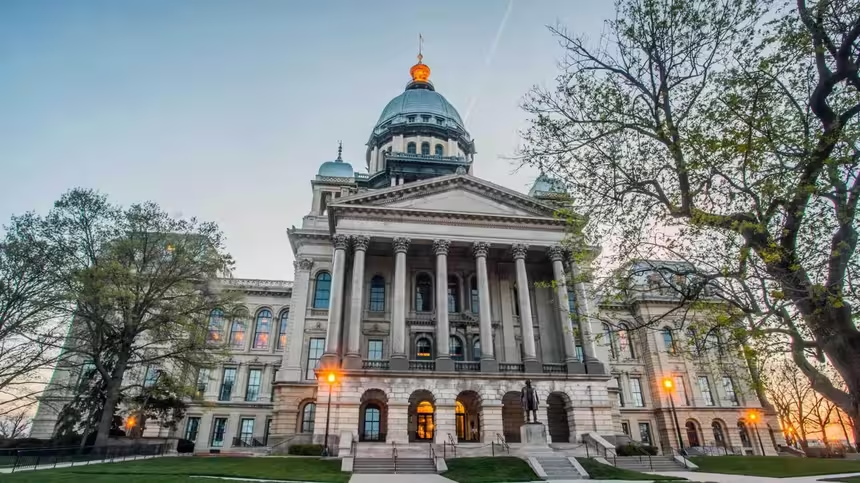
CapitolView
CapitolView is a weekly discussion of politics and government inside the Capitol, and around the state, with the Statehouse press corps. CapitolView is a production of WSIU Public Broadcasting.Providing Support for PBS.org
Learn Moreabout PBS online sponsorship(lively music) (electronic beeps) (whooshing graphic) (lively music) - Thanks for joining us on "CapitolView."
I'm Fred Martino.
We continue our discussion with Alee Quick.
She is the Director of Civic Engagement for the News Literacy Project.
Alee, I want to ask you, we had talked in this conversation about social media.
I want to ask you about something else that we've been dealing with for a lot longer.
I can remember its beginning, because at the time, many years ago, was before I got into public media, and this became a huge issue.
And it's news organizations, organizations that call themselves news organizations, now this is particularly, though not exclusively, cable TV networks.
And they confuse the public by labeling opinion programming as news.
So this adds to this whole news literacy dilemma that we have.
Give me your thoughts on that.
- So one of the things that my organization teaches about is how to spot the difference between news, opinion, advertising, and all these different kinds of content that we might find on a news site, right?
Or on TV or on the radio or in a newspaper, what have you.
Even if things are not labeled necessarily opinion, at the top of a page or whatever, there are ways that you can tell.
There are, you know, some really basic things.
We talk about, you know, aside from using the phrase opinion or the word opinion to label content, sometimes you might see something like analysis or perspective, something like that.
These are all words that journalists use to indicate, like, I've done some of my own interpretation here.
And so what you're seeing may not be, you know, what's considered a straight news story.
It might have some opinion in there.
- Or maybe there are things that are supposed to be facts, but they're not attributed to anyone constantly.
That's another one that I see all the time.
- And that could be an indication that something is somebody's opinion, the author's opinion, rather than, yeah, if it's not being cited anywhere.
And, you know, we think that opinion journalism like certainly has a place in quality journalism.
It's a really important part of the journalistic tradition.
And so you know, again, it's important that as more opinion is kind of making its way into news programs and, you know, we're finding news in different ways, right?
It's important for us as news consumers to understand, again, for without that opinion label, what are some of the signs?
- Yeah, yeah.
- Yeah.
- Very important.
So another dynamic that has occurred in recent years has worsened the problem.
We've seen public officials who spread falsehoods, sometimes repeatedly.
Sometimes even after being confronted, they continue to spread falsehoods.
Even a former congressman, George Santos, whose stated background was full of falsehoods.
Thoughts on this.
- I think that the George Santos thing in particular shows the importance of local journalism.
There were local journalists who dug into his background and were able to kind of break that story and tell us like, hey, some red flags here.
- Yeah.
- So for me, you know, and from a news literacy perspective, the important and interesting thing about that is, again, that importance of local investigative, strong watchdog journalism.
And, you know, that's part of what makes our work kind of difficult.
And I think really important right now is that a lot of local newsrooms are facing hard times.
That, you know, there isn't as much political local journalism as there once was.
- And even newsrooms disappearing all over the country as well.
- Exactly.
Yeah.
So I think that in particular shows the importance of having that like strong watchdog press, to look into these things for us.
- Well we are once again, as you know, in a presidential election year.
And the News Literacy Project website points out that foreign adversaries, quote, "actively engaged in spreading false information to sow confusion and division during the 2020 campaign."
Let's talk about the threat as we now are in another presidential election year.
- Yeah, the more we look into, you know, any kind of misinformation, whether it's about an election or anything else, again, we spot these common trends and tropes in misinformation that are gonna be used again and again.
So a lot of the same things we saw in 2020, we expect to see in 2024.
We expect AI to be an additional challenge this time around, of course, as the technology has improved since 2020.
So that will be something to look out for.
My organization is planning a bunch of events in the coming year to kind of prepare people to kind of give people the tools and the toolbox and make sure they're ready before their primary and before, you know, the election in November, just to make sure, you know.
We're not endorsing any candidate or encouraging people to vote one way or another.
We just really want people to know how to find reliable election information so that, you know, they can make, you know, the best choice for themselves.
- And in addition to those great resources, what we talked about earlier about the fact that news literacy education works.
You have some data on that, you know it works.
Let's talk about that.
- Yeah, and I think part of what showing that it works is the growing movement state by state to include this in curriculum, and Illinois is one of those states where media literacy is now a requirement in public school.
So for us, that's really exciting.
I don't want to try to recite numbers and get them wrong but we know it works and these skills are really important.
And for teachers who are looking to incorporate this into their classroom, for adults who want to find information and feel confused about what's accurate and how to know, you know, we're just one of many places people can turn, at the News Literacy Project, to find those tools, so.
- And I said, News Literacy Project, do a search, you'll find it, but I believe it's NewsLit.org, right?
- That's right!
NewsLit.org.
- See, I went to the website a few times.
(laughing) - Yeah.
(chuckling) Well, you know, our event in Carbondale that is coming up, February 21st, and we'll have all the information for you coming up, is gonna deal with another part of restoring journalism and that is creating a space for diverse voices.
This is all part of the, you know, getting all of the information out there as well.
As a reporter, I know, before working for the News Literacy Project, as a reporter, you wrote a column on gender issues.
Let's talk about that.
- Yeah, so I had a column that for a time would just kind of feature women in the community doing interesting and cool things.
And I also wrote about, you know, larger questions of gender at the national and local level of, you know, some trends and things like that.
But you know, part of what we're dealing with in news right now and in a lot of industries is that trust is declining in some, you know, traditional journalism for example as well as other institutions.
And we think that, with greater representation comes more trust.
And there has been a long history, a long legacy of marginalized people not seeing themselves represented in news coverage, whether that be women or gender non-conforming people, people of color, et cetera.
So we think it's an important part of news literacy, going forward, to make sure that, you know, to encourage newsrooms to, you know, represent the communities that they serve.
We think this really benefits trust from communities, you know, of their local newsrooms who are covering them, right?
So for us, that's really important.
- Absolutely, and important for journalism to give the full picture of our world.
Yet it is harder and harder to do that because as we've addressed, there are fewer and fewer journalists.
There are even newsrooms that are shutting down.
This has been such a concern around the country, that in Illinois, a task force was assembled by the governor's office recently.
And the task force issued a report asking for legislative efforts, including state tax credits, to help stem the layoffs and the closures in journalism.
How do you see this situation, and maybe some solutions, as we close?
- I think that, you know, tax credits are one part of many different potential solutions.
A couple of weeks ago, we had a panel discussion in DC at the National Press Club that we hosted as part of our National News Literacy Week where we invited people who are working in solutions to the local news crisis.
And it was a fascinating discussion that talked about everything from business model, to that tax credit, to, you know, whether there should be, you know, legal, not legal, but legislative solutions.
And, you know, the conclusion that that panel came to, that I have to agree with is that it's a little bit of everything.
That it's going to take a lot.
That, you know, the problem has kind of evolved over years and there's not one quick fix.
But thankfully, there are a lot of really smart people who are working on this solution, including people who are starting their own newsrooms, which is what our event is going to talk about, is one of these new, you know, national newsrooms that's looking to confront that.
So there's a lot of really exciting solutions out there.
One of which is, you know, the future of nonprofit journalism.
- Yeah, and of course we're in this boat.
You know, for full disclosure, of course we are, at WSIU, dependent on donations from the public.
And it's very interesting because in the commercial world, while that had never been a tradition, it is now very commonplace that there is philanthropic support even to commercial newsrooms.
And a whole organization, Report for America, which I was a part of in a previous public media job where we received a Report for America grant to hire a journalist.
So there's reason for hope here too, right?
- Oh yeah, yeah.
There are a lot of organizations like that that are really trying some innovative things.
And, you know, we just need the money to do it, right?
- We need the money.
And thank you for being with us today to start this conversation.
- Thank so much for having me.
- My guest was Alee Quick.
She is the Director of Civic Engagement for the News Literacy Project.
Alee and I will be co-moderating an event, February 21st at the Carbondale Public Library.
We hope you'll join us 5:00 to 7:00 in the evening.
The first 35 guests will get a free dinner.
The event includes a screening of the film, "Breaking The News," which looks at journalists increasing coverage of women's and LGBTQ-plus issues.
We look forward to talking with you about the issues in the film and more.
February 21st, 5:00 PM, at the Carbondale Public Library.
And you can watch my entire conversation with Alee Quick on the WSIU YouTube channel.
Subscribe to WSIU on YouTube so you never miss a local program.
More news and analysis now.
Welcome to my guests, Mawa Iqbal of WBEZ, and John Jackson from the Paul Simon Public Policy Institute at Southern Illinois University, Carbondale.
Mawa, the "Chicago Sun-Times" recently reported on legislation that would make Illinois the 11th state to adopt right to die legislation.
Tell us more about that.
- Yeah, so this is a pretty controversial effort that's been brought up a couple of times before in the Illinois legislature, but this time around it would basically allow adults who are terminally ill with the prognosis of six months or less, who are also mentally capable, and are a resident of Illinois, to ingest medication that would allow them to pass.
They would self-administer, so doctors and physicians won't have to do this if they don't want to.
There was, of course, a concern that came up, the doctors would be forced to this.
And doctors will have to inform them about all end of life care options like hospice before they would be allowed to do this.
So there's a lot of different requirements.
But the other thing too is that patients would have to give two verbal requests in addition to a written request to take the medication.
So it's, like I mentioned earlier, a very controversial effort.
Of course, a lot of religious groups like the Archdiocese of Chicago have criticized it very heavily.
They say it's another form of a self-assisted suicide and they argue that terminal diagnosis aren't always fatal.
But there are groups like the ACLU who praise this bill.
They say that it will give people who are suffering, people who have these terminal illnesses and are paying a lot of money in hospital bills, to end their lives in a dignified way if they want to, so.
- Okay.
Well we will watch that.
And Mawa, welcome to the "CapitolView" team.
- Thank you!
Thank you for having me.
- John, an update now on a story that we covered last week.
The General Assembly may vote on legislation that would create a board to review the cost and affordability of prescription drugs.
A column by a doctor at the University of Chicago says that this is a good idea.
What did you learn about it?
- Well, this is House Bill 4472 and it could wind up setting maximum cost limits on drugs that people have prescribed to them.
And this doctor, it's a very interesting column, he's at the University of Chicago and he has a very big and diverse practice there around him at that part of Chicago.
Dr. Anthony Douglas gave this report from the frontlines, as it were.
He talked about a mother of three that he saw recently.
She came to see him because she's severely diabetic.
Her blood sugar was way too high.
And she told him she wasn't taking her meds because she couldn't afford them.
He actually interviewed then his own father, who was taking Jardiance, and found that his father was paying $660 a month for this one drug.
And his position is that almost 30% of Illinois people are cutting their pills in half or not taking them all, according to one recent study, not taking them at all.
This is a long and familiar fight over drug costs in this country.
Eight states have now passed such a bill.
And interestingly, Canada, Mexico, Germany and France all have such regulations.
Dr. Douglas maintains that the drug companies are using American consumers to subsidize the cost of drugs in these other nations.
And that we are supporting the R&D, for example, and propping up their profit margins.
This is especially hard on people who don't qualify for Medicare or don't have private insurance.
They have to pay the full price.
And he points out that drug companies are spending a ton of money on advertising.
I watch a certain amount of television news and amusement, and you see tons of drug company ads.
It's always about some strange name drug that you ought to be taking if you've got these kind of symptoms, and ask your doctor.
- Well- - Yeah, and of course in addition to advertising, other forms of marketing, even for drugs which are in very high demand.
I was in the doctor's office recently and saw a drug rep come in, in order to speak with a doctor and give the doctor samples of Ozempic, this drug that is, you know, incredibly popular that many people are taking to control their weight.
And this is a huge issue.
It's gonna be interesting to see if this can pass in the General Assembly.
As you point out, a number of other states taking action on this and a major problem for people around the country.
I'm glad you mentioned not just private insurance but Medicare.
Because one of the, some would argue, under-reported stories of the last few years is that during this current administration, the Biden administration, legislation was passed for people on the Medicare prescription plan, Part D, that would limit out-of-pocket costs.
phased in over time.
So very important legislation.
And we often, you know, it gets lost in the shuffle of the election and the horse race stuff.
- Let me just add that question of whether it can pass either the Congress and especially General Assembly in all 50 states is always a problem because Big Pharma, as it's called, gives tons of money to political candidates.
- (laughing) Yes, as folks do in many different industries.
We thank you, John.
We need to move on to Mawa.
And a bill backed by Illinois Governor J.
B. Pritzker would require a lawyer for children under 18 during interrogations.
What did you learn about this?
- Yeah, so this kind of came out of, actually an investigation that we did last year.
It was my colleague Chip Mitchell, who is a criminal justice reporter up in Chicago.
And through his investigation reporting, they found that in suburban Waukegan, there was a police officer, a detective, who brought this teenager, and he was a 15-year-old, and he brought him in on suspicion of a shooting that happened where a store clerk was injured.
And they interrogated him for almost an hour without an attorney or a parent present.
And they basically extracted a false confession out of him.
So, he stayed in juvenile detention for two nights before his family was able to prove that he actually wasn't even in town during the shooting incident, that he was actually away at a basketball tournament.
So this bill would basically just require that any time there is a minor that's being interrogated by the police, they would have legal representation.
- Yeah, and it's- - Very- - Yeah.
- Very important.
And I imagine there's some people watching this who didn't know that that wasn't already required.
- Yeah, it's pretty, it's surprising, right?
Like it's one of those things you would think is already a requirement, but it was sort of practiced unevenly, right?
So, obviously the supporters say that it's good to have an attorney present to prevent situations like this, but actually a lot of police chief, sheriff, prosecution, lobbying groups have been really, really rallying against this bill and have done so for the past couple of years because their thinking is that, you know, if we do have lawyers present or if we require lawyers present, then that would, you know, make it harder for people to want to come forward and confess.
- Okay, we'll watch that one very carefully.
About five minutes left, John.
Some shocking misdeeds by a Carlinville funeral home director have prompted some legislative proposals.
Tell us more.
- I think this comes under the category of, quote, "there ought to be a law," which people say fairly often.
This is the misdeeds of this Carlinville funeral home director and it's a "Capitol News" story by Beth Hundsdorfer.
She found that at least 80 families had received the wrong remains of their loved ones or the wrong ashes were returned to them.
Camp Butler National Cemetery actually exhumed five graves and removed the cremated remains because they found they were buried under the wrong name.
And in short, this funeral home simply wasn't keeping adequate records.
Senator Doris Turner, a Democrat of Springfield, has introduced this bill mandating that funeral directors should put a unique identifier on each body.
Now one would think that's already pretty self-obvious that it ought to be being done, and it requires that there must be a maintaining of a chain of custody of the remains.
That's kinda like the chain of evidence that we see in cop shows, for example.
You have to wonder why is this not already a law?
The funeral home directors interviewed pointed out, while it's not a law, it is well understood to be a best practice for funeral home directors.
This guy lost his funeral home director license.
But while it's best practice, it is not law.
And this bill would codify it into law and make it a requirement by legal definition.
This is kinda like what lawyers went through and what medical doctors went through when they were becoming a respected profession.
More and more things that were once practices, finally get encoded into the statutes.
- All right, we'll watch that one.
We got about two minutes left.
I'm sorry we don't have more time, Mawa, but I want to wrap up with a story you wrote recently for WBEZ about the Illinois plan to revamp how reading is taught.
Tell us about that.
- Yeah, so the long and short of it is basically that last spring, lawmakers passed this requirement for the Illinois State Board of Education to come up with a literacy plan to sort of, yeah, basically revamp how literacy is taught in Illinois.
And the main difference is that they want to move away from what's known as balanced literacy, which is like fostering this general love of reading and this idea that kids will just learn how to read if they read.
And being more systematic about it, being more, (stuttering) using more of a methodology for it.
So like creating a foundation of skills and then building on top of those skills and in order.
And they really emphasize phonics in this plan as well.
So it's, you know, the idea of sounding out words and oral language as sort of the basis and then trying to build language on top of that.
So, it's pretty exciting.
And it comes as, you know, reading scores in the state are, not super low but still haven't bounced back from pre-pandemic levels.
- An important issue and a great story.
Folks can read it at WBEZ.org.
Mawa, John, thank you both for being with us today.
- Glad to be here.
- Thank you.
Thank you so much.
- Thank you for being with us at home.
A program note, coming up next Thursday night at 7:00, WSIU will rebroadcast the "Illinois State of the State and Budget Address."
And we will have special programming the next two Thursdays as well.
On February 29th, a rebroadcast of the documentary, "History Reborn: The Restoration of the Illinois Old State Capitol," and on March 7th, our first "Meet the Candidates" interviews for the primary election.
"CapitolView" returns on March 14th.
For everyone at WSIU, I'm Fred Martino.
Have a great week.
(lively music) (lively music continuing) (lively music continuing) (lively music continuing) (lively music continuing) (lively music continuing) (lively music continuing) (lively music continuing)

- News and Public Affairs

Top journalists deliver compelling original analysis of the hour's headlines.

- News and Public Affairs

FRONTLINE is investigative journalism that questions, explains and changes our world.












Support for PBS provided by:
CapitolView is a local public television program presented by WSIU
CapitolView is a production of WSIU Public Broadcasting.