
Capitol View - February 24, 2023
2/24/2023 | 26m 46sVideo has Closed Captions
Capitol View - February 24, 2023
In the days following Gov. JB Pritzker’s Budget/State of the State Address, lawmakers are putting forward their own proposals on how to spend the state’s tax monies next year. Plus, a hearing is set before the Illinois Supreme Court for the controversial SAFE-T Act… and problems in some human service agencies are making headlines across Illinois.
Problems playing video? | Closed Captioning Feedback
Problems playing video? | Closed Captioning Feedback
CapitolView is a local public television program presented by WSIU
CapitolView is a production of WSIU Public Broadcasting.
Capitol View - February 24, 2023
2/24/2023 | 26m 46sVideo has Closed Captions
In the days following Gov. JB Pritzker’s Budget/State of the State Address, lawmakers are putting forward their own proposals on how to spend the state’s tax monies next year. Plus, a hearing is set before the Illinois Supreme Court for the controversial SAFE-T Act… and problems in some human service agencies are making headlines across Illinois.
Problems playing video? | Closed Captioning Feedback
How to Watch CapitolView
CapitolView is available to stream on pbs.org and the free PBS App, available on iPhone, Apple TV, Android TV, Android smartphones, Amazon Fire TV, Amazon Fire Tablet, Roku, Samsung Smart TV, and Vizio.
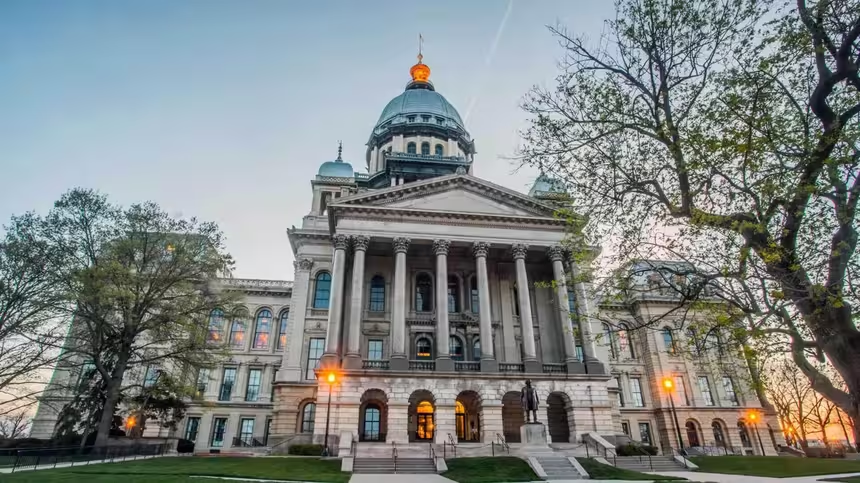
CapitolView
CapitolView is a weekly discussion of politics and government inside the Capitol, and around the state, with the Statehouse press corps. CapitolView is a production of WSIU Public Broadcasting.Providing Support for PBS.org
Learn Moreabout PBS online sponsorship(soft upbeat music) (dramatic music) - Welcome to another edition of "Capitol View", our look at the inside and outside happenings of the Illinois State Capitol.
I'm Jennifer Fuller.
Our guests this week are Dan Petrella of the Chicago Tribune and Hannah Meisel of Capitol News Illinois.
Thank you both for joining us this week.
- Thanks for having us.
- Glad to be back.
- You know, we want to take a break from our conversation about the assault weapons ban, but as we do that, we have to bring back up the Safety Act, which is another controversial piece of legislation that has to do with law enforcement and the courts.
The Illinois Supreme Court has now set a hearing date for the Safety Act.
Dan, bring us up to speed, what is being challenged within the act and what will this hearing take a closer look at?
- Sure, what this is really focusing on is the portion of the very large criminal justice overhaul that has to do with the abolishment of cash bail in the state of Illinois.
And back in late December, a judge in Kankakee County ruled that the provision that was supposed to abolish cash bail starting on January 1st violated the Constitution by sort of overreaching into the operations of the judicial branch.
It was put on hold in the counties that had sued over the issue.
And then sort of at the 11th hour, the Illinois Supreme Court put a statewide because there was confusion about where it was going to be enforced, where it wasn't going to be enforced.
So now the Attorney General's office representing the state and the county prosecutors who are arguing over this in court will go before the state's high court next month to sort of start arguing their cases before the justices.
And hopefully we will get some clarity in the next few months about how this is all gonna move forward.
- Certainly, and people should of course be aware that the ruling won't come down right away after the arguments are heard.
It will take a few weeks, perhaps a few months before we hear exactly what the Illinois Supreme Court will have to say.
In the meantime, lawmakers were probably already working on additional changes to the criminal justice system, additional reforms.
Hannah, does this slow them down in any way?
Do they need to wait and see what the ruling is on the Safety Act?
- There are so many different parts of the criminal justice system.
I would say no.
Cashless bail is kind of its own silo.
Certainly these things do interact when you're talking on the level of court fees because a lot's unsaid in a lot of the debate over the pretrial fairness as it's known or the cashless bail provision is that not having the money from bail will significantly reduce the kind of operating budgets of these state's attorney's offices in jails.
And that is an issue that I don't think was adequately dealt with.
And I think that it went unsaid because folks who were against PFA went with a lot more salient arguments, arguments that are a lot more visceral and claiming that people will be let out of jail on January 1st when cashless bail went into effect, of course, one, obviously it was put on hold, as Dan said, but two, demonstrably untrue.
That would never have happened.
But folks who run these county systems, they have to protect their fiefdoms, state's attorneys, sheriffs, they are elected officials.
And with any elected official, that comes the responsibility of overseeing jobs and jobs in regions especially in the state that have been kind of left behind as our economy has modernized in the last two decades.
If you lose out on that money and that money is not replaced, then you also are losing out on jobs and job security for you as an elected official.
Anyway, but to go back to your original question, Jen, no.
I think folks are always especially progressive in Illinois, kind of block of lawmakers who have increased in their numbers over the last several cycles.
They have a lot of reforms on their mind and on so do conservatives.
You saw in the last decade even Bruce Rauner, Republican one term Governor Bruce Rauner, he was on board for some level of criminal justice reform, but through the lens of a libertarian saying that it's not actually worth the money, for example, that it takes to House someone in a prison for a year if they have committed low level offenses.
And they could instead just be they gone through an alternative justice program and kind of been able to reform their lives and then be a contributing member of society.
It makes no sense to pay that astronomical figure, I don't have it off the top of my head right now, but it costs a lot of money to House people in prisons.
And so there was a movement, especially in the last decade among kind of more libertarian-minded Republicans.
And I think that those kind of things have gone away in the last two years just because other things have taken their place, and some folks view that as diametrically opposed with other types of criminal justice, but it's not.
And I think that you might see that coming back this year.
- We'll certainly keep an eye on that as the legislation continues to make it make its way through committees and onto the floor for full votes.
And one other thing that we wanted to talk about that's developed over the last week, Governor JB Pritzker gave his state of the state and budget address last week.
And in it included several proposals that were expected.
Lots of talk about early childhood education, preschool perhaps for all children, depending on what the legislature decides to do with his proposal.
Dan, outside of that, was that the biggest proposal, the thing you think that he'll kind of hang his hat on this year?
Or were there others that you think were worth mentioning?
- Well it definitely seems to be, I mean, he's spent the past week since the speech going around to different parts of the state promoting those programs.
There are some other interesting proposals in there maybe that don't cost quite as much money or grab as much attention, but a hotline for people who are coming to Illinois to seek abortion services, to help them find resources to do that.
Another initiative to help with food deserts.
I forget the figure off the top of my head.
I wanna say it's somewhere in the neighborhood of $20 million, $25 million to help get grocery stores in areas where they have left.
There is also some additional money for higher education, what the administration is saying is the biggest increase in higher ed funding in close to two decades, and more money for MAP grants that they're saying will get just about everybody who qualifies who wants to go to community college able to do that tuition-free.
Which I would note is a sort of not quite achieving the campaign talking point that he had stated a lot about, making college tuition free for everyone who earns at or below median income.
And I think we sort of saw the same thing with the early childhood program where he talked in his second inaugural address about making preschool available to anyone who wants to send their kid to preschool.
So to me, one of the most interesting things was the way, when you get down to the dollars and cents of things, it doesn't quite match up to the rhetoric that you hear on the campaign trail.
- The Governor spends a lot of time responding to critics who say this is an additional expense, this is more money being spent and we need to cut our spending.
But you know, Dan, he really says this is an investment.
This will save money in the long run.
Can you talk a little bit about those points and the things that he's trying to let people know?
- Sure.
He points to some studies that say somewhere in the neighborhood of every dollar that's invested in early childhood education ends up saving the state or producing for the state $7 in future income, so that it will grow the economy, it will help people get better jobs, a more qualified workforce.
I think another point that he would make and that they have made several times is that they've been very conservative in their budget estimates over the past several years.
Revenue has come in above what they've projected just about every year maybe, with the exception of the height of the pandemic.
They've stocked a lot of that away into sort of one time things, paying down debts, building up the rainy day fund, and now even projecting for a mild recession later in the year, they feel that they have enough cushion in the budget to increase spending in some of these key areas.
I'd also note that the amount that he's proposing this year is higher than what they approved in the budget last spring, but actually will be slightly lower than what the final numbers for the current year will end up being based on some additional appropriations they've made throughout the year.
- Certainly those supplemental appropriations always kind of change that number as you get closer to the end of the year.
Now Hannah, we're hearing a lot of conversation in the intervening days the budget is just a jumping off point, but what are you hearing in terms of reaction from legislative leaders, from partisan leaders in terms of what they liked and what they really didn't like in that budget address?
- Yeah, I think the budget framework that the Governor gave was, you know, Democrats liked a lot of it.
Of course, Republicans, it's about what you expect.
I've been hearing behind the scenes a lot of them are excited about some of the things.
I mean, truly, childcare in this country pre-K makes us competitive as a nation, starting a kid off on the right foot.
Childcare, I mean, every person who has a family in this country knows how difficult it is.
Certainly the two of you as parents know how difficult it is to make sure that your kid has somewhere safe and encouraging to go when either you, as a two person Household, certainly as a single parent, it is so difficult to balance both work and childcare.
It is impossible at this point too.
We're facing a childcare crisis in this country.
The numbers just do not add up.
You might be paying astronomical figures for your child's daycare, but it's not like the daycare's making money.
They run on a very, very thin margin.
And the people that they employ, they could frankly earn more going to a McDonald's and baking, some McDonald's are I've seen offering 15, $17 an hour starting out, and a childcare worker just makes so little.
Anyway, Democrats, I think they would like to see more in some programs, for example, there were a few progressives who, the week before the budget address, they had introduced a child tax credit for Illinois of course, on the federal level, you know, COVID era, there was this child tax credit and it was let expire by the Biden administration when he couldn't come to an agreement with Senate Democrats last year.
Hugely popular thing.
Some studies indicated that, gosh, I forget the exact figure, but millions of children in this country pulled out of poverty due to that child tax credit on the federal level.
The child tax credit on state level was not something that was included in the Governor's budget address.
I think that there might be some folks who might push very hard for that.
Certainly a lot of progressive agenda items that...
I think progressives see government spending as so many missed opportunities when a program is introduced and then the money that's imagined for it has to be negotiated back.
And then the program is not as successful as it could have been had it had the full appropriation that was estimated in the first place.
Politics intervened, that is the reality we lived in.
And then the program doesn't do as well as they thought.
And then just because of the environment, the political churn, that program is then pointed to as a failure and then it might be cut.
It's a political liability.
- Hannah's talking a lot about the negotiation, the seat at the table that Republicans are really hoping to have.
We've seen some movement in the Illinois legislature with some Republicans being named co-chairs, not just a minority spokesperson, but a co-chair of some key committees.
But they're really saying "we'd really like a seat at the table.
We want more of a voice in the negotiation, particularly when it comes to the budget".
Do you think that changes this year at all?
- I think it'll be interesting to see.
It kind of reminds me of back at the first year of Governor Pritzker's term where there was a lot of talk about bipartisanship.
They were able to get Republican votes on his first budget and the infrastructure, it's sort of a similar sort of honeymoon period for the two new Republican leaders in the legislature, representative Tony McCombie in the House and Senator John Curran in the Senate.
I think that it's hard to make the case that you should have a bigger seat at the table when you have a smaller number of members in the House, for example, than any time in modern history since the Cutback Amendment.
But I think the Democrats, at least at this point, are interested in going through the motions of talking about bipartisanship.
We'll see whether that translates to Republican ideas actually being incorporated into the budget, into other discussions, Republican legislators being able to move their bills forward.
I think democrats often will point to the fact that even if they are not at the table where budgets are being negotiated, arguments that Republican lawmakers make in committees or in debate or just in conversations that are incorporated into the ideas that become part of the final package.
But I guess I'm gonna wait and see whether this very, very large Democratic majority, particularly in the House, really does give Republicans more of a voice.
- What about kind of coming together?
We have two new leaders for the Republican party in the House and the Senate.
How are they working to bring their parties together so that their voice is perhaps louder when they're speaking a little more in unison?
- I think we've only seen the beginning of that.
They're still getting their feet under them, both John Curran and Tony McCombie.
It's gonna be a struggle, like Dan said, in the House certainly, they have the fewest number of Republicans in the last 40 plus years.
In the Senate, it's around the lowest, although I will note it gets a little bit lost.
Republicans actually gained a seat, netted one seat in November.
Anyway, I think both of them as leaders are fundamentally different people than the folks who preceded them.
And I think that there's a lot of excitement, not just within their own caucuses, but frankly within Democrats because especially longtime House Republican leader Jim Durkin, especially toward the end, he did not make things easy for Democrats.
He was out there kind of banging his chest especially in the last few years about cashless bail.
He himself is a former prosecutor, very passionate.
He stoked the fires.
I guess we don't even say new, but House speaker Chris Welch, they were really at each other's throats after a very brief honeymoon period two years ago.
They did not get along.
It seems like the relationship between Chris Welch and Tony McCombie is a lot better from what I'm hearing, actually sitting down together once a week.
And I also hear that Tony McCombie is sitting down with the Governor.
That is just not something that we saw.
And again, it could just be a honeymoon period.
But I will say that watching Springfield for a long time as I have, I do think women leaders operate differently.
And it'll be really interesting to see how this plays out.
And John Curran, also very well respected.
And to your earlier question, Jen, how are Republicans' reaction to the budget?
Both of them, they say we should not be adding new spending, but they're not saying it in a way where like the House is burning down, because they can also accept the fiscal reality that because of especially increased consumer spending over the last few years even with COVID, actually due to COVID, we have been seeing tax receipts that are way above anyone's expectations.
And so it's nice for Republicans to operate within a world where money isn't so tight because they also have things that they wanna bring back to their districts, because that's what they're elected to do is help their own districts.
- Let's look a little bit at what the legislature is working on, rather than their reactions to what the Governor presented last week.
Now just a few things that they need to keep an eye on.
A new ruling is calling on the Illinois Department of Corrections to really live up to a consent decree that was already in place when it comes to healthcare in Illinois prisons.
Dan, how important is this new ruling, and what kind of challenges does the IDOC face in terms of making sure that the prison population is cared for adequately?
- Yeah, when this issue came up back in the late summer, early fall, Governor Pritzker pointed the fact that it's difficult to hire a medical personnel for prisons.
They had submitted a plan to the Federal Monitor that they said at the time back in August that hadn't really gotten a response.
But I think this also speaks to sort of the larger issue of some of the problems that the Governor has had throughout his administration managing social service programs, things like the Veterans Homes and the Developmental Center down in the Choate developmental Center, problems at DCFS.
These large very bureaucratic state agencies that have very difficult jobs have been sort of a challenge for this administration as they have been for many previous administrations.
IDOC has a big job taking care of lots of people, many of whom have lots of different health problems.
And I think that it's not good for anyone for the administration to have to be taken to federal court to try and force their hand to take care of these people in a more adequate way.
- Certainly.
And you mentioned DCFS, yet another that the courts are telling the state that it has to live up to the promises that it's been made or the orders that have already been put in place.
Dan mentioned the Choate Developmental and Rehabilitation Center down in Anna, Illinois in Southern Illinois.
And Hannah, some work that one of your colleagues, Beth Hundsdorfer, who partnered with Molly Parker of the Lee Enterprises Midwest Bureau in ProPublica, have found some very disturbing stories coming out of the Choate Center.
And now we're hearing more calls for investigation at a statewide level, perhaps additional criminal charges.
There have been some staff members at the Center that have faced criminal charges, but can you bring us up to speed on what's happening at the state level there?
- I mean, the state seems to be, especially the Department of Human Services, which oversees Choate, they seem to be caught in a state of paralysis.
The things that Beth and Molly have uncovered are just unspeakable abuse of these residents.
It's just awful to read.
And really the most salient thing that has been offered by the Governor is, well, maybe we should, you know, I'm still looking at shutting it down.
Well shutting down this large center that takes care of folks who, yes, in some cases, maybe some of them would be better off at group homes.
Our group home system in Illinois is also not a very healthy system for other reasons, but a lot of these folks, they thrive the most in this sort of setting, and taking that away, folks who have lived there for years and years and years, telling them that they have to go move somewhere else and their family that maybe is based around the Anna area would have to drive hours and hours to go see them now?
That is not a good solution.
I think a lot of people would note, of course, like I was talking about earlier, it's jobs.
They're really solid government jobs that pay well, they're union-protected.
And so currently as we speak, actually, Republicans are holding a press conference about what they see as the Governor's lack of response to the crisis at Choate.
I mean I will note that a lot of the things Beth and Molly have uncovered happened in the past in prior administrations.
But as the saying goes in Springfield, Governors own.
And so Governor Pritzker, he is the Governor who's been in charge while these things have been revealed to the public.
And there are still ongoing policies that need to be addressed.
And I think for the most part, at least publicly, you've not seen a whole ton of movement to actually fix these issues.
- Certainly.
One bit of information as we move on to yet another topic that's happened around Illinois this week, a lot of eyes are on the race for Chicago's mayor.
And while that may not have a big impact on a statewide level, the leader of the state's largest city certainly has entree to the Governor's office and with the legislative leaders.
Now we also saw in the last week a person who may be considered a frontrunner in the GOP race for president next year visit the state of Illinois.
Florida Governor Ron DeSantis was in Chicago talking about the crime rate, talking about public safety, things like that.
I wonder, Dan, if you could talk about the impact that a visit like that has both on the Chicago Mayor's race, but also on what we're watching in terms of state and national politics.
- Yeah, it's really interesting.
His visit to West Suburban Elmhurst Knights of Columbus Hall, it was an event that was in conjunction with the Chicago Fraternal Order of Police, which had endorsed former CPS CEO Paul Vallas in the mayor's race.
Vallas had to distance himself from DeSantis, who is not popular with democratic voters in Chicago.
And you also saw this interesting dynamic where Governor Pritzker kind of took some not so veiled shots at Governor DeSantis during his state of the state speech, and then a few days later, here DeSantis is in Illinois taking shots back at Pritzker.
And there's the interest on everyone's part of scene.
This is sort of maybe a 2024 presidential preview.
And I think as much as the Governor has tried to demure on that subject and throw his support behind President Biden, he hasn't really helped that case by continuing to sort of dip his toe in the waters of these national issues.
- Those issues continue to evolve and we continue to keep an eye on them.
I'd like to thank Dan Petrella and Hannah Meisel for taking the time this week.
And thank you for joining us on "Capitol View".
You can find us online at wsiu.org and at the WSIU Public Television YouTube channel.
I'm Jennifer Fuller, thanks for joining us.
(dramatic music)

- News and Public Affairs

Top journalists deliver compelling original analysis of the hour's headlines.

- News and Public Affairs

FRONTLINE is investigative journalism that questions, explains and changes our world.












Support for PBS provided by:
CapitolView is a local public television program presented by WSIU
CapitolView is a production of WSIU Public Broadcasting.