
Capitol View | February 5, 2026
2/6/2026 | 26m 46sVideo has Closed Captions
Jeff Williams host this week’s top stories with analysis from Hannah Meisel and Jason Piscia.
Jeff Williams host this week’s top stories with analysis from Hannah Meisel of Capitol News Illinois and Jason Piscia from the University of Illinois, Springfield.
Problems playing video? | Closed Captioning Feedback
Problems playing video? | Closed Captioning Feedback
CapitolView is a local public television program presented by WSIU
CapitolView is a production of WSIU Public Broadcasting.
Capitol View | February 5, 2026
2/6/2026 | 26m 46sVideo has Closed Captions
Jeff Williams host this week’s top stories with analysis from Hannah Meisel of Capitol News Illinois and Jason Piscia from the University of Illinois, Springfield.
Problems playing video? | Closed Captioning Feedback
How to Watch CapitolView
CapitolView is available to stream on pbs.org and the free PBS App, available on iPhone, Apple TV, Android TV, Android smartphones, Amazon Fire TV, Amazon Fire Tablet, Roku, Samsung Smart TV, and Vizio.
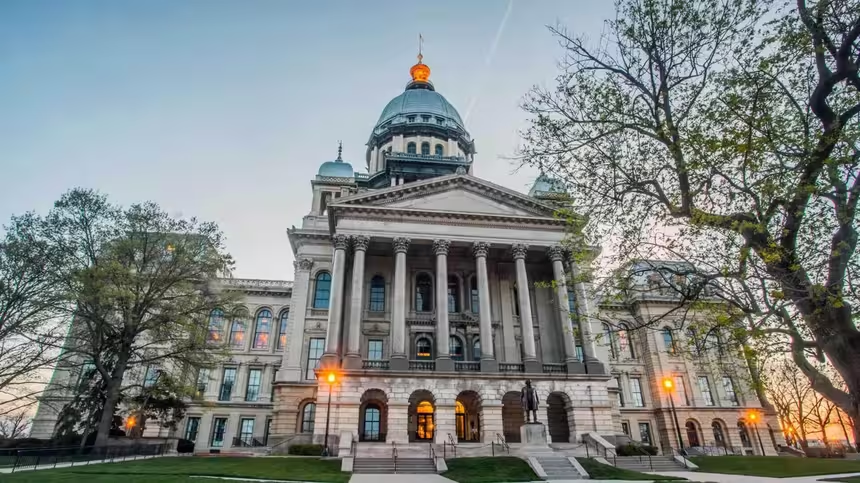
CapitolView
CapitolView is a weekly discussion of politics and government inside the Capitol, and around the state, with the Statehouse press corps. CapitolView is a production of WSIU Public Broadcasting.Providing Support for PBS.org
Learn Moreabout PBS online sponsorship[MUSIC] >> Welcome to Capitol View on Siue.
I'm Jeff Williams sitting in this week as we take a look at what's making news around the state in Illinois politics.
A first generation Mexican American woman from Chicago recounted her story during a public hearing in Washington, D.C., this week of being shot five times by Customs and Border Patrol agents last October in Chicago as part of the federal immigration and enforcement effort.
Also, governor JB Pritzker is dusting off his plan to shore up the state's pension system.
We'll take a closer look at those stories and probably some more this week on Capitol View to help us lead our discussion.
Our Hannah Meisel, statehouse and Chicago reporter for Capitol News, Illinois, and Jason Piscia, director of the public affairs reporting program at the University of Illinois, Springfield.
Welcome back to the program.
>> Good to be here.
>> As you mentioned, um, Mario Martinez testified on Tuesday during a public hearing in Washington about her experience last October when when she was shot in her community by Border Patrol agents as part of of Operation Midway Blitz.
She has been labeled a domestic terrorist by federal officials, yet all charges were dropped against her.
I guess in some ways, it's a narrative that is becoming familiar, surrounding the enforcement efforts in Illinois and in Minnesota and other states.
Um, Governor Pritzker's accountability commission has held its second hearing late last week and issued its its first report documenting misconduct by federal immigration enforcement.
What do stories like Martinez's say about this enforcement effort that admittedly, does have legitimate goal of arresting violent criminals, and those that are here illegally are Or under false pretenses.
But overall, what is this?
What does this say about this enforcement effort, do you think?
>> Well, I mean, I think a lot of Americans, um, especially in the wake of, uh, the two fatal shootings in Minneapolis, uh, in January, um, Alex and Renee.
Good.
Uh, two US citizens who were shot to death in their car and on a sidewalk, um, as they were trying to, you know, basically record, um, uh, federal immigration agents, uh, you know, carrying out their, uh, deportation duties.
But, you know, I think a lot of Americans, um, have, if they weren't already, um, very concerned or, you know, outright against the immigration, um, efforts by the Trump administration.
I think a lot of Americans have woken up to, um, just kind of how our.
not in control.
Uh, these two agencies are, um, you know, Customs and Border Patrol, uh, specifically, has been known as the more, um, you know, aggressive, uh, uh, you know, wing of the Department of Homeland Security.
You know, it's kind of counter, uh, agency is Immigration and Customs Enforcement, ice.
I, you know, want to remind viewers that it's not normal for Customs and Border Patrol to be on the interior of the nation.
Um, you know, for much of their, uh, it's, um, you know, modern life, it's been at the US southern border specifically.
And that's why, you know, it's kind of developed a more aggressive, um, approach, uh, in training its agents because at the border, you know, it's more, um, it's a lot more black and white if you see people, uh, trying to cross the border.
You know, it's a lot more, um, uh, it's a lot easier to assume, um, that they might be undocumented, that they might be coming across the border without permission.
Uh, whereas Ice has been, you know, since its inception in, um, you know, 20 years ago, it has been in cities in the interior of the country and has, uh, you know, used a lot more discretion.
And that's why we haven't seen people who have been in the nation for 30 years, um, you know, setting up their own businesses, paying taxes, uh, being deported at this level.
Um, but the Trump administration has turned a lot of, you know, immigration enforcement on its head and has, you know, interpreted, uh, you know, changed long standing norms, uh, and told um, officials to go after undocumented immigrants no matter how long they've been in the country.
No longer, you know, basically to interpret any of them as criminals.
And, you know, I think that the two shootings in January got a lot of attention, um, much more than, uh, Miramar Martinez in Chicago on October 4th for a lot of reasons.
You know, I think that Minneapolis, um, has been, you know, unique, uh, for a lot of reasons.
And, you know, frankly, I think also that those two victims were white.
Miramar Martinez.
Uh, though she is a US citizen, frankly, uh, she is part of, um, a community.
I think that also at the time, you know, attention was split, whereas, uh, in January, kind of all eyes were on Minneapolis.
Um, you know, but I think it's been really, really interesting to see, um, you know, Americans opinions, uh, shifting.
And if you were kind of nonplussed by the whole thing before, I think a lot of people are growing a lot more concerned, you know, as to, um, the Illinois Accountability Commission, again, this is something that, uh, the governor had called for in the fall, uh, to kind of give a backward looking, um, investigation on, you know, what, uh, possible human rights abuses occurred during Operation Midway Blitz, which began in September and, you know, tapered down in mid-November in the Chicago area.
However, uh, you know, officials say it's not over.
It's just maybe, uh, at a lull right now.
Um, you know, the commission had its second meeting, um, on Friday as we're taping this on Wednesday, February 4th.
Um, you know, they have a couple more meetings, um, in their future.
But, you know, one of the things that I found really interesting, a colleague, to be clear, I was not there.
Our colleague covered it.
But in reading her coverage, um, one of the witnesses that testified, um, said that since 2005, there have been 5000 Customs and Border Patrol agents who have been arrested.
Um, you know, this.
You know, a lot of the arrest have occurred in their personal lives and their downtime.
Um, but I think that's another kind of data point that a lot of people are concerned about, the caliber of people who are, um, being recruited to ice into Border Patrol, uh, to agencies that, of course, their budgets have exploded under the Trump administration, uh, with Stephen Miller's goal to deport something like 3000 people a day.
Um, and, um, you know, it's also been reported over and over again that the training time, uh, for these agents has been cut from something like six months to just six weeks.
And so, you know, there's definitely a lot of concern about, you know, who just who is being recruited.
Uh, and the training that they're being given.
And, um, you know, what, things could go wrong because clearly we've now seen several incidents that can go wrong.
And one thing, one more thing I would like to, uh, say about Miramar Martinez's case.
You know, the, uh, federal prosecutors brought charges against her after, you know, uh, they alleged that she was boxing in agents with her car.
And, you know, she says she was merely following them and recording as she is legally allowed to do.
Um, but after she was shot five times, um, you know, in this altercation, um, she was charged.
And then eventually, maybe a month later, a judge dismissed her case without prejudice or with prejudice, rather meaning that the feds cannot refile the charges.
Uh, she was labeled a domestic terrorist.
She asked during her testimony in Washington, D.C., on Tuesday of this week.
Uh, just for an apology, uh, and, you know, to be to set the record straight, um, but one major thing about her case that, um, her lawyers have tried to, um, do, and her lawyer and I spoke last week, and he.
What?
Uh, I was kind of mind blown by is that the feds had asked that, um, evidence in her case about DHS internal policy, about what happens during, you know, after a shooting, um, that was part of the case, and that was kind of placed, um, for lack of a better term, under seal for lawyers eyes only.
And, um, it would really help her lawyer says for this information to be made public because right now, only people within DHS and, you know, this very small group of people who are working on Miramar Martinez's case are privy to that information.
But if it were made public, then the entire country would know, um, about what what DHS internal policy is on shootings, and it would help shed a lot more light on what happened in Alex Paradis case, in Rene Goode's case, and a handful of other cases that have gone on, uh, you know, shooting of, uh, people, you know, for the most part, who have, um, survived.
But Miramar Martinez shot five times.
She'll always have those scars.
>> I want to I want to shift the focus on this just a little.
Jason.
We heard about, uh, the we've seen the role that that, uh, what we may refer to as citizen journalism, what cell phone videos are playing and getting the this story out.
We've you know, we've seen the federal agencies taking to social media to to produce their perspective on, on, on, on what is happening.
As someone who trains, uh, journalists at the graduate level to report on, on government and to report on public affairs.
Gosh, what kind of teachable moment has this entire experience become?
And I guess maybe also, is it changing or has it changed the way that we as the as the media report on these kind of events?
>> Yeah, it's a it's a tough situation to be in for journalists and especially for young journalists.
I think, uh, at the beginning of our careers, journalists can be a little bit timid and want to fit in and want to make your sources happy.
So they'll continue to give you information.
Uh, but, you know, situations like this have really caused us all to think about how we should approach the situation and sort of turn it on its head.
Uh, we, uh, you know, we're worried about, uh, uh, you know, the what we see.
You know, we're we're we see videos of Alex pretty and what happened in Minnesota.
And, you know, we have the administration trying to tell us, you know, something different than what our eyes are seeing.
So, you know, we encourage journalists I know we encourage journalists to, you know, listen to your sources and look for the other side and make sure you're getting all sides of the story.
But sometimes, you know one side.
You're very doubtful that there is a truth and veracity in what's being said.
Uh, so, you know, I tell my students to, you know, trust your own gut, look for other ways to confirm information.
If it seems like what people are telling you aren't true.
Uh, and then the other side of it is just what rights press have to begin with.
We saw stories this past week and weekend about Don lemon getting arrested while covering, uh, a rally in Minnesota and brought up a lot of issues of press freedom and what right reporters have to do their jobs to document what government is doing, and hold government officials accountable for what they're doing.
Um, and it's, uh, you know, like I said, it's very easy for young journalists to become intimidated by what's going on and willing to step back and listen to what the authorities say.
But I encourage my students to know their rights.
And if they're not sure what their rights are, you know, know how you can get a hold of a lawyer or an editor or a superior to help you, uh, define what those rights are.
So we can all know that that you are allowed to be there to record what's going on.
And journalism isn't a crime.
>> Yeah, yeah, yeah, I know personally, just watching it as a old school journalist, I was always taught, you know, you are you as a reporter are not the story and not to insert yourself in the story and just to kind of see this happen and how this is kind of turned things in.
The focus around is, is just a little bit troubling, but I guess also kind of part of the reality that that we, that we live in.
>> It's like it's an ongoing, you know, we're we're developing this this advice as we go along.
Journalism really hasn't seen anything like this in modern times.
And, uh, we have to adapt and get students ready even though they're right here.
You know, my students are here in Springfield and, you know, not facing, uh, the kind of adversity journalists are seeing in Minnesota and elsewhere in Chicago.
Uh, they have to be ready for wherever they go because, uh, the political divide is is tough and it's intense, and, uh, we have to cover it.
>> Well, let's not also forget that, you know, in 2016, when he was running in in 2017, the early months of the first Trump administration, the president, uh, himself labeled journalists, you know, the enemy of the people.
And so we've been living in a different dynamic for a decade.
And, you know, frankly, I don't think that, uh, newsrooms have quite figured out how to manage this dynamic because it's ever changing.
And, um, it's but we we do need to make every effort to, you know, figure it out and to, uh, you know, build public trust and, you know, public trust.
Frankly, uh, a lot of, um, in journalistic institutions lost public trust over many decades for, you know, good reasons.
And we need to figure out ways to rebuild that public trust or reach, uh, to readers, listeners who, uh, were never, you know, engaged in the first place.
>> Sure, sure.
I want to take this opportunity to kind of shift our focus a little bit.
Um, there is a legislative session going on.
The governor this week, uh, dropped or dusted off, you could say, his 2024 plan to reform and fully fund the state's pension system by, by 2048.
I think it's about, what, 48% or so funded now.
Um, there's also concern over the what is known as the state's tier two pension system, and that it's providing adequate benefits and compliance with with Social Security requirements.
This plan didn't go anywhere in 2024.
It hasn't.
I don't think the General Assembly has even taken up any significant pension reform in the intervening in the intervening time.
Um, we're into a new session.
But why?
Why now?
Is there is there an added importance is why we're focusing potentially focusing on this now?
Is this something that may actually get some get some traction this session?
>> Well, I think, um, lawmakers are facing another tough budget year.
And the governor, uh, is trying to, you know, shore up, um, basically, uh, confidence with, uh, Wall Street.
Uh, you know, one of the first things that he did as governor back in 2019, I think it was like March of 2019, a couple of months after he'd been sworn in, was Flyte in New York and um meet with several credit rating agencies.
And you know he touts at every possible, you know, time, um, when he's talking about, um, Illinois's finances, uh, that the state has had, I think, 9 or 10 credit rating, uh, upgrades since then, you know, across the three major credit rating agencies.
Um, you know, pensions are a big thing that this, that these credit rating agencies pay attention to, uh, Illinois is, you know, far and away the state with, um, you know, pensions in the worst shape despite, um, the progress we've made.
You know, Illinois is just such an outlier at, um, its unfunded pension liabilities.
Uh, so the governor bringing back this idea.
Not a surprise.
I don't necessarily think it's added urgency.
Uh, you know, when you talk about the tier two pensions, basically, um, you know, back in 2010, um, when Illinois was kind of struggling, um, to make its way out of the Great Recession.
And, um, you know, Illinois's unfunded pension liabilities were creeping up to $100 billion.
Uh, lawmaker, you know, Democrats really was a kind of a bipartisan effort, um, created this new, uh, pension system that any public employee, um, including teachers, including university employees, including municipal workers, um, hired after January 1st, 2011, would receive basically less generous pension benefits.
Um, to kind of counterbalance, um, the really generous pension benefits that had been, uh, you know, a perk of the trade off of being a public employee, that you're not paid particularly well during your career, but the promises that you're going to have a very secure retirement, um, you know, they also raise the retirement age.
But the concern is that, you know, not a lot of people are retiring yet under this tier two system, unless they kind of had a second career, uh, and joined, you know, the, uh, public workforce.
Um, and then, you know, at this point would have, uh, spent the last 14 years of their career or so, uh, until retirement.
Um, the concern is that these benefits are so, um, there's so much smaller that they might, um, come they might actually be less generous than Social Security benefits.
Uh, when you are a public employee, you can't also pay into Social Security and claim that at the end, uh, of your career.
And so if you, um, are getting less generous benefits than Social Security, um, the worries that you're going to violate this, uh, safe harbor, um, uh, kind of stipulation, Um, again, not a lot of people are retiring yet.
Uh, I think that there's going to need to be a lawsuit to really, really force the state's hand on this.
Um, but it is a worry when we, uh, think about, um, you know, getting Illinois's budget, uh, out of balance yet again.
You know, we I remember being a young reporter and, um, living through the state's two year budget impasse.
You know, we've come a long way since then.
Um, but still, there is a lot of, um, concerns that remain.
And another recession could really set us a lot, you know, very much backward.
>> Yeah.
Jason, the I think the Senate's in a couple of days this this week, um, the Senate and the House both haven't yet met.
And I think that doesn't happen until the week after next getting ready for the governor's state budget address on, on on February 18th.
What?
Anything of substantive, substantial moving right now?
Or is do you think budgets probably going to be the main priority of, of this session, at least until we get to the primary?
>> Yeah, as we've talked about, you know, pensions remains on people's minds and definitely the budget.
The governor gives his budget address in two weeks time, uh, where he'll set out his spending priorities for the year ahead and hope that the legislature listens to those.
Uh, but, yeah, you're right.
Until then, I don't think the House and the Senate have been in Springfield on the same day.
Yet this year.
I think that happens, uh, the week the budget address, uh, the Senate's like I said in this week, I think the House was in next week.
Uh, but it's it's been not much happening.
There was a some hearings that were scheduled for this week in the Senate.
I know some of them have already been canceled.
And, uh, you know, they'll probably go home early like they usually do.
Um, you know, there's talk about, uh, it's normally this is not unheard of.
It's normally rather quiet in the weeks before a primary election.
Everyone's busy, worried about getting reelected or getting their friends re-elected.
So, um, they most of the lawmakers will be not in Springfield during that time.
Um, but yeah, there's lots of issues to deal with.
Pensions, bears, stadium, we don't know where that's going to go.
Um, and the budget is, again, the big one.
>> Yeah.
And I think there was, um, well, one of the, uh, one of the state reporting agencies was out with a look at some of the January revenue numbers.
Is that still kind of a kind of a mixed bag for the state, at least in terms of of of this fiscal year and how what impact that may have on on putting together the FY 27 budget?
>> Yeah.
The Commission on Government Forecasting Accountability put out their monthly report to show that state revenue dipped about 3% in January compared to the previous January.
Uh, and the main reason for it's pretty simple, you know, federal dollars coming into Illinois have slowed down.
Um, this is three months in a row now that federal funding has been down.
In January, it dropped pretty dramatically, about 35% compared to the same month the previous year.
Um, you know, the commission says, you know, this time around might be timing.
You know, federal payments maybe haven't come in yet, but it's still something that has everyone's attention.
Um, you know, overall, if you look at the whole year, the revenue is actually up about 3.5%.
Uh, normally that'd be good news, but because the federal money is so uncertain, uh, it doesn't help ease the pressure on the people putting together the budget.
Um, so, you know, on top of all that, you know, the President Trump and his administration have been threatening to cut off federal funds to Illinois and other blue states.
And, you know, whether he can legally do that or actually will it'll still tied up in courts.
But even that threat makes it tough for lawmakers to plan.
>> Well, we've got about 2.5 minutes or so.
Uh, this week.
So what what are each of you looking at are going to be following.
Paying attention to the next week or weeks ahead.
>> Uh, you know, the primaries coming up so fast.
Um, I wanted to highlight my colleagues.
Good work.
Um, there in the middle of, uh, interviewing each candidate, uh, each Republican candidate vying for the, uh, their party's nomination to be governor.
Um, so they'll have interviews out on that, you know, not not too long, far from now, but they've just completed a series of interviews of the three state lawmakers and one uh county official who are vying to be Illinois's comptroller.
Uh, so there are individual podcast interviews with each of them.
And then a long kind of analysis on our website, Capitol news, Illinois.
>> Com Jason.
>> Yeah.
Um, also along with the election, you know, watch your calendars.
Early voting actually begins this week, begins on Friday.
So if you're anxious to drown out all the noise for the next couple of months, you can just vote and get it over with.
If you want.
Um, but yeah.
And I think, uh, that goes along with, uh, we saw that Governor Pritzker, uh, finally dropped his money bomb on, uh, his lieutenant governor, Juliana Stratton, in the Senate race, uh, donated about $5 million to her political action committee that supports her.
Uh, so she's going to be able to get on TV now pretty consistently, uh, her main rival and sort of perhaps the considered the frontrunner in that Democratic primary for U.S.
Senate is a U.S.
rep, Raja Krishnamoorthi, who's had a very large fundraising advantage, uh, from the beginning and has been on TV, I think, now for six months.
Um, so it'd be nice to see some of these other candidates sort of get their voices out there and begin to hear what they stand for and begin to hopefully shrink the group of undecideds that's in this, in this race that has made it hard to detect or predict what's going to happen.
>> Yeah.
>> And there's there's already been two televised debates between the, uh, three main frontrunners on the Democratic side.
Um, and, you know, I also want to mention, I feel like I've mentioned on the show before, but it's a very, very unusual, uh, year.
You know, in my 13 years watching Illinois government and politics, I've never seen so many congressional seats open.
Um, so it's there's a lot of really interesting stuff happening at the primary level, uh, in all those races, too.
>> All right.
We're out of time.
My thanks to Hannah Meisel, Capitol News, Illinois, and Jason Piscia with the public affairs reporting program at the University of Illinois, Springfield.
I'm Jeff Williams.
Thank you for joining us this week on Capitol View.
Have a good week.
[MUSIC]

- News and Public Affairs

Top journalists deliver compelling original analysis of the hour's headlines.

- News and Public Affairs

FRONTLINE is investigative journalism that questions, explains and changes our world.












Support for PBS provided by:
CapitolView is a local public television program presented by WSIU
CapitolView is a production of WSIU Public Broadcasting.