
Capitol View - February 8, 2024
2/8/2024 | 26m 46sVideo has Closed Captions
Capitol View - February 8, 2024
Fred Martino speaks with News Literacy Project Civic Engagement Director, Alee Quick. Plus: Analysis of the week’s top stories from the Illinois General Assembly with guests Peter Hancock of Capitol News Illinois and Charlie Wheeler, emeritus director of the Public Affairs Reporting Program, University of Illinois Springfield.
Problems playing video? | Closed Captioning Feedback
Problems playing video? | Closed Captioning Feedback
CapitolView is a local public television program presented by WSIU
CapitolView is a production of WSIU Public Broadcasting.
Capitol View - February 8, 2024
2/8/2024 | 26m 46sVideo has Closed Captions
Fred Martino speaks with News Literacy Project Civic Engagement Director, Alee Quick. Plus: Analysis of the week’s top stories from the Illinois General Assembly with guests Peter Hancock of Capitol News Illinois and Charlie Wheeler, emeritus director of the Public Affairs Reporting Program, University of Illinois Springfield.
Problems playing video? | Closed Captioning Feedback
How to Watch CapitolView
CapitolView is available to stream on pbs.org and the free PBS App, available on iPhone, Apple TV, Android TV, Android smartphones, Amazon Fire TV, Amazon Fire Tablet, Roku, Samsung Smart TV, and Vizio.
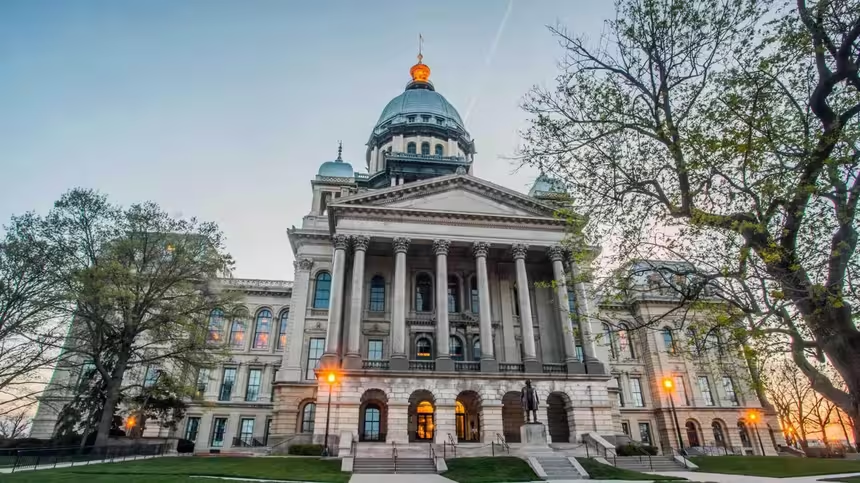
CapitolView
CapitolView is a weekly discussion of politics and government inside the Capitol, and around the state, with the Statehouse press corps. CapitolView is a production of WSIU Public Broadcasting.Providing Support for PBS.org
Learn Moreabout PBS online sponsorship(upbeat music) (camera beeps) (dramatic music) - Thanks for joining us on "CapitolView".
I'm Fred Martino.
Our system of government depends on an informed electorate, but increasingly, voters are not only lacking information, they're being given false information, sometimes by elected officials and those running for office.
Combined with a massive decline in journalism, some say it is no exaggeration to call this an extraordinary crisis.
Making matters worse, the public is often ill-equipped to even determine the validity of information.
Consider this.
Many young people who've grown up with the internet lack basic skills.
A Stanford History Education Group 2019 study found that young people, while digital natives, are just as vulnerable as older adults.
96% did not consider why ties between a climate change website and the fossil fuel industry might lessen the site's credibility.
And about seven in 10 could not tell the difference between news and sponsored content, yes, that's advertising, on a news site homepage.
My guest works to address this challenge.
Alee Quick is Director of Civic Engagement for the News Literacy Project.
Alee, thank you so much for being with us today.
- Thanks for having me.
- That information was on your website, so it's part of the kind of talking points for your organization, and powerful they are.
I was surprised at those numbers, even though I had heard a lot about a lack of media literacy or news literacy.
You know, to start off with, I thought it would be good to ask you a general question, kind of something that I know you must face all the time when you tell people what you do.
Why is this issue so important?
- Yeah, I mean, it's important, and you addressed some of this in your opening, for democracy.
In a democracy, we all need to be kind of on the same page.
We need to start from a foundation of facts if we are going to self govern appropriately.
And what that means is, you know, we should disagree on issues of policy, that is the heart and soul of American democracy, but if we disagree about facts, then it makes it really, really hard to know how we are going to face some of the problems that government is supposed to handle, right?
And when government is in the hands of the people, you know, we need everyone to know how to find reliable, credible information, so that, again, we're talking about policy, disagreeing about policy perhaps, and solutions, but starting from the same place of facts.
- That is such a great, succinct answer, and that notion of facts, so important, because as I was thinking about it in your answer, it's hard enough when the facts are correct, because often, facts are presented without context or it's just some of the facts, but we're living in a time where there are outright falsehoods repeated over and over again.
And this is not normal.
This is not a normal time.
- Mm-hm.
Right, I mean, what my organization does is we try to give people the tools.
When they are encountering falsehoods, as you've said, they can have the skills to think for themselves, to decide what information is safe to share, safe to act on.
And we are in a climate right now, it's the most complicated information landscape any of us have ever seen.
You addressed, you know, children and young people being digital natives in your opening, yet they still struggle with some of these things that some of us who maybe aren't digital natives also struggle with, which is just separating fact from fiction.
It's not that straightforward these days, because anybody can post anything they want on social media, for example.
Falsehoods are everywhere on the internet.
And, you know, things are changing all the time.
So, we try to teach people these really foundational skills so they can evaluate for themselves, you know, what's reliable, what's safe to share.
- So, let's get into the nitty gritty of that.
As I said, your group is the News Literacy Project, that's the name, and you have a great website.
If people search News Literacy Project, they'll come to it.
How did it start?
And let's talk about some of the activities that you do that advance this notion of news literacy.
- Sure.
So, we were founded in 2008 by a Pulitzer Prize winning journalist named Alan Miller.
He previously wrote for the LA Times.
Basically, he went and talked to his daughter's middle school class and told them, you know, what journalists do, and kind of had this career day moment where he was telling these kids, like, "Here's what I do as a journalist, and here's what journalists do, and here's what journalism is."
And he realized that, you know, this is not part of curriculum in many public schools, that journalism is so central to civics, right?
To this governance, this democracy idea we kind of opened talking about, yet many of us, unless we are journalists or we know our love of journalists, we don't know how it works.
And therefore, you know, why should we trust journalists if we don't know what they do, if we don't know who they are, if we don't know the ethics that they operate with, or any of these things?
So, the News Literacy Project Alan founded to kind of answer those questions, to help people understand, what is news?
Why is news so central to American democracy?
Why are they, you know, considered watchdogs, journalists?
So that's the founding story.
For most of our existence, we focused on creating resources for teachers to use in classrooms.
So, what we started with and kind of our bread and butter is creating lessons, resources, you know, handouts that teachers can use.
We have newsletters that kind of have, you know, relevant current examples that teachers can use in their classrooms.
We also have a virtual classroom that has all these lessons.
It's called Checkology.
And it's basically subject matter experts or working journalists themselves explaining concepts.
Recent lessons include understanding data, science journalism.
One is called Info Zones, where it talks about the difference between news, opinion, advertising, even propaganda, how to tell the difference among those things.
So, that's a lot of what we offer.
My job as director of civic engagement is to take some of that and bring it to adults and independent learners, to people outside of middle school, high school classrooms.
So, we work with a lot of civic partners to reach their membership, to, you know, we host public events, where anyone can come and learn a new literacy skill.
So yeah, we're doing- - And if teachers are watching, it's fascinating to me that this is how this started, because I can recall many years ago, speaking to young people, and in this case, we're talking about college students, and being surprised to hear that many of them did not draw a distinction between a blog and the New York Times, or you know, something that they saw on social media and NPR, National Public Radio was what it was called.
Now they just use NPR, of course.
We have a NPR station here.
Speaking of NPR, this is another thing that I noticed from your website, a recent NPR/PBS Marist poll.
And this is very interesting that many people recognize this is a problem.
This poll found that six in 10 people said that it is hard to identify false information on social media.
Give us a sense of how social media has worsened this problem, because falsehoods spread so quickly and so widely.
- The thing about social media is that anyone can publish on social media.
So, news organizations use social media to reach people, and they, you know, follow standards of journalism, ethics, you know, things like that, and so the information that they're sharing on social media is fine, right?
At the same time, any person can post whatever they want on social media.
And so that is great, you know, for so many reasons, and I would never say that that's a bad thing.
But we need to, for all of us, you know, consumers of that information and that content, to be able to, again, have those skills to decide for ourselves what's safe to share, what's safe to act on, what's credible and accurate.
And, you know, social media, not a bad thing.
Sharing information is a great thing.
- It just requires us to be sophisticated news consumers- - Yeah, discerning.
- Basically.
- Discerning, yeah.
- Yeah, exactly.
So that's what we need.
- It's true.
And as I mentioned earlier, it also gets to, in some cases, you know, it's not that the information is false.
Sometimes there is information on social media that is not false, but it may be out of context, or it may be one fact in a collection of facts.
And so I love the way you put this, though, that it isn't to say that all social media is bad.
It isn't to say that news on the internet is a bad thing.
Because actually, used well, it can be such a valuable thing, because you can pull information from various sources and not only get facts from different credible places, but also get different perspectives on those facts.
So, understanding the diversity of opinion.
At the same time, the advance in technology does raise some major concerns.
One of the scariest things I've seen recently are so-called deepfakes.
For folks who've been watching this, they may have seen a story about this on PBS or on another network.
Deepfakes are, for those of you who are not familiar with this term, videos that use the voices of public figures that are manipulated to say things that they did not say, or in a way that they did not say them, slowing it down, speeding it up.
How concerned are you about this development?
- Yeah, certainly, AI is presenting some challenges, one of which is the issue of deepfakes.
So, part of what we teach, we have a website called RumorGuard, rumorguard.org, where we take things like deepfakes, examples of falsehoods that, you know, are kind of going viral at the moment, and use these as a teachable moment to remember these lessons like you're talking about, context, things like that.
So we have five factors on which every claim or every deepfake video or, you know, fact checked piece of content that we use to evaluate.
And what we're trying to do is show patterns of misinformation.
And right now, we know that deepfakes, that using AI to create falsehoods, is a pattern that we're seeing.
It's a trend in misinformation right now.
So, what we talk about is, you know, although AI is changing things really fast, there are tools that we can use.
And some of them are really simple tools.
It doesn't have to be really high tech.
One of them is context.
Something we talk about a lot is sourcing as well.
So, these deepfake videos that you might find online, typically, you'll see them on social media, right?
And what you can do, the first thing is look for the source of it, of a video like that.
Is it being shared by a news organization that uses journalistic standards, or is it being shared by a page I've never heard of before?
If it's a page I've never heard of before, that should be a flag, right?
To do a little deeper investigation, look into that source.
What is this page that's sharing this?
That's just the first step of, you know, determining whether something like that could be a deepfake, is looking at who shared it, where did it come from?
And then, you know, we can go even deeper from there, yeah.
- Deeper and deeper.
It's so important, and so many of these are designed to look like news sites, so many of these places on the internet.
So, we will continue our discussion.
Alee and I, by the way, will be co-moderating an event on February 21st at the Carbondale Public Library.
For those of you who are in Southern Illinois, you can join us from five to seven in the evening, and the first 35 guests will get a free dinner.
The event includes a screening of the film, "Breaking the News", which looks at journalists' increasing coverage of women's and LGBTQ plus issues.
We look forward to talking with you about the issues in the film and much more on February 21st at 5:00 PM at the Carbondale Public Library.
And we'll have part two of my conversation with Alee Quick next week on "CapitolView".
More news and analysis now.
It's estimated a healthcare program for some immigrants will cost Illinois 3/4 of a billion dollars in the current fiscal year, and there are efforts to increase the minimum wage for workers who earn tips in the state.
We're gonna look at those stories and much more with our guests, Peter Hancock of Capitol News Illinois and Charlie Wheeler, Emeritus Director of the Public Affairs Reporting Program at the University of Illinois Springfield.
Peter, Capitol News Illinois reported on an immigrant healthcare program that was estimated to cost over $1 billion in the current fiscal year.
The report says that cost saving measures have reduced that projection, but it is still a very big number, $773 million.
Tell us more.
- Well, that's still too much, because the budget was only for about 550 million, I think.
So, there's still some more savings to go.
But essentially what they've done is there's a group, it's called the Special Eligibility Group.
If you would otherwise be eligible for Medicaid, you meet all of the qualifications except for your citizenship status, then you can get into this special program, which is Medicaid-like insurance.
And so it turned out to be a lot more expensive than people thought it was going to be when they first implemented it.
So, what they have done is they've moved those patients into managed care, like all the other Medicaid patients.
And that means that an insurance company gets paid a flat per person fee to manage all of your healthcare for a month or for a year, whatever.
So, they've put 'em in a managed care system, and they're going to charge copays, just like you and I when we go to the doctor, they might charge you 25 or 50 or $75 depending on the type of doctor.
Those measures are expected to reduce the total cost down to, like you said, about $770 million, which is still more than budgeted.
But I think the administration is saying that they are making progress.
It was a subject of discussion this week at a joint legislative committee that oversees administrative rulemaking, and Republicans were still pretty angry about this, because there are some providers out there who aren't charging the copay.
Basically, they're foregoing that revenue voluntarily.
And it's causing some consternation that people didn't know that the charging of the copay was going to be voluntary on the provider's part.
- Sure, and context is everything.
We're going into a session with the general assembly, where it's estimated that the next fiscal year, we're looking at a potential deficit approaching a billion dollars, and subsequent years, as well, with very large deficits.
Where do you think all this is going, briefly, Peter?
- Well, they may have to take another look at the way we're paying down the unfunded liability in the pension system.
We're on what is often called the Edgar ramp, because former Governor Edgar pushed through a bill where the amount the state pays in keeps ramping up every year until it plateaus at some point, until we get the pension debt paid off.
There are other ways to amortize that cost.
They may might start looking at that.
There are also laws about having to increase funding for K through 12 education each year by at least $350 million.
So, those deficit projections are based on the assumption that the state will continue to comply with what is current law regarding, you know, the paying off of pension debts and education costs and things like that.
So, they may have to go back and take a look at those measures, or they may have to come up with some additional revenue somewhere.
- Very interesting.
We'll be watching as usual.
Charlie, while that immigrant healthcare program continues, and it's expected there will be additional money discussed for immigration relief programs in Chicago, another state program ended in December.
It's the 75% tax credit for private schools.
The Chicago Sun Times reports that some Democrats in Chicago are joining Republicans for legislation to restore the credit for five years.
And a lot of families very, very upset about this.
Charlie, what did you learn?
- Well, this is a program that was enacted back in 2017, and it was part of the deal with former Governor Bruce Rauner that was intended to break the budget impasse.
And the Democrats wanted a new funding formula called the Evidence-Based Funding Formula, and they wanted additional money for it.
And Rauner's demand was, well, we have to have a choice.
We have to allow people to choose where to send their kids.
And the final, I guess, the final agreement was that this program would run for five years.
It would provide tax credits for people who would donate money to a special organization that then would give out scholarships to kids going to private schools.
And when the program sunset at the end of the fall legislative session, there was an effort made to keep it going, but because in the fall session it would've required an extraordinary majority, that bill was never called.
Under the bill that's being proposed now by some Democrats and quite a few Republicans, the new legislation would extend the programs for five more years, and it would reduce the tax credit amount and individual giving cap from 1 million to 500,000.
And it would steer more money to low income students and shrink it to a cost of only 50 million.
- Do you think this has any chance, Charlie?
- Oh, man, I learned 50 years ago, never predict.
- Don't predict.
- I would say it's gonna be very difficult because you have the teacher's unions, you have some of the other unions adamantly opposed to it.
- Yeah, yeah.
So, union influence there.
We will watch this.
I only have a couple of minutes left, and I wanna get to a couple of more stories, so I'm gonna move on, Peter, to you.
This week, some Illinois legislators touted the One Fair Wage For All Act.
The legislation would boost pay for the more than 200,000 service industry workers across Illinois who make less than the standard minimum wage.
You'll remember Chicago is phasing out its lower minimum wage for workers who receive tips.
Tell us about what this is all about, and again, your prediction on could this pass for tipped workers, giving them the standard minimum wage that other workers receive?
- Well, I belong to the same school of thought that Charlie does, which is I stopped making predictions a long time ago.
But basically, back in 2019, the state passed a bill to raise the minimum wage, and this was a negotiated deal between employers, between the restaurant industry, and, you know, workers and labor unions as well.
The base minimum wage would go up to $15 an hour.
The minimum wage for tipped workers, waiters, waitresses, other kinds of personal service employees, would go up to $9 an hour.
And then there's another special minimum wage for, like, teenagers who only work a summer job or something.
We are now in, I think, year four of that.
Tipped workers, the minimum wage right now is $8.40 an hour.
But I think part of what you're seeing is that we live in an age now where customers are being asked to tip at more and more kinds of places, and I think maybe tipped workers, a lot of them, you know, if you work in a place where you don't earn very much, you know, a lot of tips, then you're probably not making that $15 an hour that's considered a living wage.
- There is already opposition, as you know, to this, Peter, going statewide.
It would seem that the most likely scenario, if this were to gain any traction, would be something like the Chicago law, which is phased in over a period of years.
- Undoubtedly, that will be one of the things that's on the bargaining table.
How far it gets, I can't really tell you.
- We'll just see.
Two minutes left.
Charlie, labor issues, the war in Israel, the immigration crisis, just a few of the issues at the heart of protests now around the country.
We've learned a judge in Chicago has denied a permit for an unrelated protest the day before the summer's Democratic National Convention in Chicago.
However, due to a technicality, Chicago was forced on appeal Monday to allow a different group to march to the sidewalk right in front of the United Center during the Democratic National Convention.
So already, it's not until August, we're hearing a lot of concern.
What do you expect, and how should Chicago and Illinois handle this challenge for the Democratic National Convention?
- I'll start by saying what they don't wanna do is what happened in 1968 with the Democratic National Convention.
I was in the Peace Corps in Panama at that time.
I came home in February.
I got hired by the Sun Times in April of '69.
And I talked to reporters who had the tar beat out of them by Chicago cops.
As a matter of fact, a national commission studied the events and said it was a police riot.
- This is a volatile time as well.
Quickly, Charlie, what do you think should happen here?
We know now that there's gonna be at least one group protesting.
- Probably more.
Another one of the groups who had their permit denied said, "Well, we're gonna march anyway."
I think the smart thing is to try and impress upon the police that you don't beat the heck outta people who are exercising their First Amendment rights.
- Yeah, yeah.
It's gonna be interesting to see where all this goes.
We are out of time.
Thank you to my guests, Peter Hancock, Capitol News Illinois.
Charlie Wheeler is Emeritus Director of the Public Affairs Reporting Program at the University of Illinois Springfield.
Thank you so much for being with us at home.
I'm Fred Martino.
Have a great week.
(dramatic music) (dramatic music continues)

- News and Public Affairs

Top journalists deliver compelling original analysis of the hour's headlines.

- News and Public Affairs

FRONTLINE is investigative journalism that questions, explains and changes our world.












Support for PBS provided by:
CapitolView is a local public television program presented by WSIU
CapitolView is a production of WSIU Public Broadcasting.