
Capitol View - January 11, 2024
1/11/2024 | 27m 18sVideo has Closed Captions
Capitol View - January 11, 2024
This week, part one of our conversation with Senator Terri Bryant, representing Illinois Senate District 58. We’ll talk with her about priorities for the next session. Plus: most Illinois assault weapons owners have not registered their guns, as required by a new state law. That story and much more from our guests Alex Degman of WBEZ and Hannah Meisel of Capitol News Illinois.
Problems playing video? | Closed Captioning Feedback
Problems playing video? | Closed Captioning Feedback
CapitolView is a local public television program presented by WSIU
CapitolView is a production of WSIU Public Broadcasting.
Capitol View - January 11, 2024
1/11/2024 | 27m 18sVideo has Closed Captions
This week, part one of our conversation with Senator Terri Bryant, representing Illinois Senate District 58. We’ll talk with her about priorities for the next session. Plus: most Illinois assault weapons owners have not registered their guns, as required by a new state law. That story and much more from our guests Alex Degman of WBEZ and Hannah Meisel of Capitol News Illinois.
Problems playing video? | Closed Captioning Feedback
How to Watch CapitolView
CapitolView is available to stream on pbs.org and the free PBS App, available on iPhone, Apple TV, Android TV, Android smartphones, Amazon Fire TV, Amazon Fire Tablet, Roku, Samsung Smart TV, and Vizio.
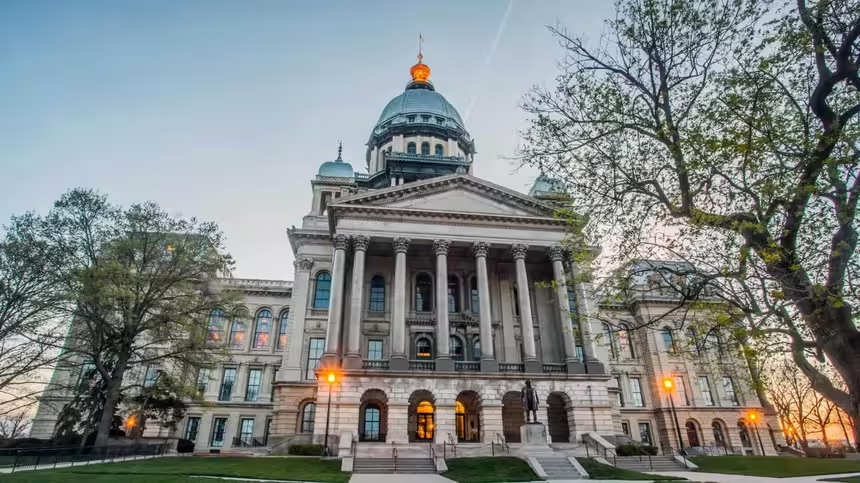
CapitolView
CapitolView is a weekly discussion of politics and government inside the Capitol, and around the state, with the Statehouse press corps. CapitolView is a production of WSIU Public Broadcasting.Providing Support for PBS.org
Learn Moreabout PBS online sponsorship(gentle music) (camera lens beeps) (authoritative music) - Thanks for joining us on "Capital View."
I'm Fred Martino.
This week we begin with a look back at the legislative work completed last year and a look ahead to the next meeting of the Illinois General Assembly.
I am very pleased to welcome Senator Terri Bryant of Illinois Senate District 58.
Senator, thank you so much for being with us today.
- Well, thank you, Fred, for having me.
It's a pleasure to be here.
It's been a little while since I've been on WSIU TV, so thank you for having me.
- Well, it is great to have you with us.
And I wanna start with kind of a big question, but just I do this very often to try to get reflections on 2023, your thoughts on the biggest accomplishments of the year.
- Well, so I think there are several.
On a personal note, first of all, this is my first time as serving in leadership.
So this past year I was appointed as the assistant minority leader.
I think that's good for the 58th Senate district, because gives us a louder voice.
Quite often leaders are approached more often, and there's a little bit more weight to the things that they say.
So I think that's good for we in Southern Illinois.
So, on a personal note, that was true.
You know that my wheelhouse, if you will, or my history has been the Illinois Department of Corrections.
And so I would say, really over the last three years, but in particular this past year, we saw a real change with the Prison Review Board.
Senator McClure, Senator Plummer, and I served on the Executive Appointments committee, and multiple times we saw real problems at the Prison Review Board.
One being that it was a 14 member board, and at one time I think there were only five people appointed to that board.
And so it was almost impossible for them to function.
At one time, there were multiple members that we were hoping were not gonna get confirmed.
In one case, there was an appointee who actually was voting to release someone from prison while that Prison Review Board member had served time in that same prison.
So you can see that there were, and there were a multitude problem of problems beyond that.
I serve in a super duper minority, and so quite often we're confronted with the fact that we don't have the votes to do some of the things that we would like to do, but what we do have is a really strong voice.
And so because of that, and I was in the forefront of this particular issue with the Prison Review Board, we were able to keep three individuals from being confirmed.
That's nearly impossible for a minority party.
We also were able to get the governor to make better appointments to the board.
And I think we've seen a move in a direction that is certainly more victim-related rather than being what I would term very soft on crime, very soft on criminals, and taking a little bit harder look at victims.
So I'm super proud of that.
- All right, well, tell us about some of the most important issues that you're still working on for 2024.
- So we were just asked, actually, we Republicans were just asked to give a priority list to the Democrat leadership.
And so it's pretty easy to, 'cause I've already thought this through a lot.
I have one particular bill that has not been filed yet, so I don't have a bill number for it.
But the genesis of this bill actually started in the house.
I was not aware of it.
It's called Faith's Bill.
Senator, or, I'm sorry, Representative Amy Elik has been working with a victim in the house.
It has to do with 18 year olds who are still in high school, who have sexual relations with a teacher or a school employee.
Presently, if someone is like 17 or under, and that happens, there is actually a felony charge.
But if this student is 18 or older, the school employee might be fired, but there's actually no ability to charge that individual with a crime.
Amy Elik, Representative Elik has been working on that in the house.
It was brought to my attention by an educator in Benton, but also I have what's called the Youth Advisory Council.
So it's high schoolers from all over the district I meet with twice a year.
They determine during our Youth Advisory Council what issue is most important to them.
We split them up in five different groups, then they debate with each other and they choose one bill that they would like to see me carry in the next cycle.
This is the bill.
And so it is my intention to have a bill that mirrors, right now, if you work in the Department of Corrections, Department of Human Services, if you're a doctor, if you're an attorney, you cannot have sexual relations with those who you have custodial care or responsibility over.
I don't care if a student is 18, 19, or 20 years old, they're still students.
And that educator has the ability to lower grades, to create disciplinary issues.
And that can have an effect on scholarship money, on all kinds of things in that person's future, I think it warrants a felony charge.
And so I'm gonna be working with the house members who are already running this in conjunction with victims and in conjunction with my youth advisory council.
That's my number one priority for this next year.
- Okay, very interesting, and interesting to hear that that was something that students identified as a priority that you work with.
As you know, Senator, there is a lot of concern about the increasing cost of care for asylum seekers in Chicago.
What would you like to see in regard to this?
- Well, I think the first thing that has to happen, because immigration is a federal issue.
And that being said, I think we saw very good results regardless of where an individual is on the issue of President Trump, the Remain in Mexico policy worked in order to curb the crossings at the border.
As WSIU, you know that there is a huge number of immigrants in the Carbondale area that are Pakistani and Indian and many other cultures, many other nationalities who are waiting in line for 30, 50, I even heard 90 years one time for someone to get a green card because of our federal policies.
So it isn't just a matter of those who are coming across the southern border, or even the northern border for that fact.
It's a terrible federal policy that we are having in place right now.
So first thing to do would be to close the border in a way that allows us to sort out the claims of asylum seekers first.
But what has happened in Illinois with the policies that we have here in Illinois is we have out a welcome mat all over the world that says, "Come to Illinois."
Because here they can actually get free medical care, just as an example.
For instance, if you are a naturalized citizen of Illinois, which one of my best friends is a Nicaraguan naturalized citizen now.
If she needed to get Medicaid in Illinois, she would fall under a managed care system.
So your doctor has to be pre-approved, hospital pre-approved, and your procedure pre-approved.
But right now, asylum seekers fall under a different method, right?
So those Medicaid recipients are under fee for service, no pre-approval for the doctor, no pre-approval for the hospital, 100% paid for.
And that is for ages 42 and above, and it's also for those who fall under All Kids.
And so right now, regardless of what's happening at the border or who is being shipped to Illinois from another state, the welcome mat is open.
I mean, it's out there.
The welcome mat is out and the come to Illinois sign is up, and we're gonna see a real problem with our budget in fiscal 2024.
And that policy is a big part of what we're gonna see as a problem with our budget.
- Yeah, absolutely.
And certainly the other issue is the hundreds of millions of dollars for care for asylum seekers.
Some have asked around the country, not just the Chicago mayor, but in Denver, in New York City, have asked the federal government to step up to spend more for these expenses.
Are you, in your view, looking at this?
Are you seeing enough action to get that done?
- Well, so again, because it's the federal government's responsibility to maintain the border, it is their responsibility to fund those needs.
But to play devil's advocate here in this, it's still taxpayer money.
So whether you take it out of the left pocket or the right pocket, it's still taxpayer money.
And so the problem has to be addressed, and there are some issues that you can't just keep throwing money at.
And this is one of those.
- Okay.
In regard to to budget and money issue, you said hundreds of millions.
But in fiscal 2023, Illinois budget had, I think it was $250 million budgeted for this program.
We spent over 900 million.
And in fiscal 2024, the Pritzker administration acknowledged that 250 million wasn't enough.
So in this year's budget, there's just over 500 million just in that Medicaid issue.
But we were anticipating 1.1 billion, now we're thinking that it might be as much as $2 billion in spending.
So while we had a so-called $200 million surplus in this year's budget, if you have a $1.5 billion hole, there's no surplus.
You gotta find that money somewhere.
And the governors already went in and taken money away from DCFS to throw at this problem, DCFS for god's sake of all the places to sweep money from.
That's a place not to sweep it from.
So this is gonna be an ongoing issue.
- Absolutely.
And certainly on a previous episode of this program, we also noted that the city of Chicago now is using money that was allocated for COVID relief to deal with care for asylum seekers.
You've already noted that in the next fiscal year, there is projected to be a massive budget deficit, hundreds of millions of dollars.
In addition to the asylum issue and the ongoing medical care issue, which is separate.
What else do you think should be done in the next session of the general assembly to deal with this budget deficit?
- Well, first let me give you one more deficit issue that we're gonna have, and then I think I can address both of those possibly.
We think that we might have as much as a $200 million deficit in school funding.
And that is because as the asylum seekers come into Illinois, they have to be, they have to be allowed to be in schools, they're allowed to be in schools.
So our local school districts are gonna be footing the bill for that.
And you know where the money comes from for that.
It's in property taxes.
So I think not only are we talking about an issue with the state budget, but we're also talking about what are these, I represent more than 50 school districts in the 58th Senate district, public school districts.
Where's that money gonna come from?
Because they don't have it now and it seems that it's only gonna get worse as we move forward.
So to address the issues, I'm not somebody who believes that we should be throwing money at things.
Number one is Governor Pritzker said that on the issue of asylum seekers, that he was gonna come back to the committee known as JCAR, which is the committee that makes rules.
Whenever we pass laws, each agency has to come up with rules for how that would be implemented.
And they have to go to JCAR to get approval for those rules or to get emergency rules approved.
The governor said that he was gonna go to JCAR, and he was gonna actually implement this managed care aspect rather than fee for service.
And he was also gonna put some means testing in there.
So how much money is this person making so that there would be like a copay for instance.
That hasn't happened.
And so, first, I think Governor Pritzker has to do the things that he promised the legislature and those who voted for the budget, he promised them that he was gonna do, because he hasn't done that yet.
So I would say, let's start with that.
- Senator Terri Bryant.
You can watch that entire interview on WSIU TV's YouTube channel.
And we'd like to hear from you, email us anytime.
The address is contact@wsiu.org.
Analysis now, and we welcome Alex Degman of WBEZ and Hannah Meisel of Capital News Illinois.
Alex, upfront this week, as we've reported a new Illinois law banning assault weapons is being challenged in court.
The US Supreme Court denied one request to review the ban, but the court could take up another challenge later this year.
The law allows current owners to keep the guns with a requirement, registration.
But the Chicago Sun Times reports, it appears most Illinois owners of assault weapons have not registered the guns as required by law.
Tell us more.
- Well, one of the biggest components of the Protect Illinois Communities Act that went into effect January 1st is this online registry.
In order to keep your assault style rifles and attachments that you had before January 1st, by law you're required to do this, but the Sun Times reported that as of the first week, I think it was roughly between 1 and 2% of FOID cardholders, about 29,000 or so, registered 69,000 items.
And that's a lot.
There are a lot more guns than that in Illinois that haven't been registered.
So people are just not doing this.
And it's basically because they don't want to.
They're mad for a couple of reasons.
And one of those is that they still aren't sure what the final rules are going to be surrounding this registry.
They're still hammering that out in the Joint Committee on Administrative Rules.
They're governed under emergency rules right now, but the final rules are likely to be a little bit different.
They're concerned about a few things like, for example, how much latitude should state police get to define an assault weapon?
They say copycat manufacturers could come up with entirely new weapons that mimic AR-15s, but they're actually not.
So they would skirt the law.
How do you deal with that?
And then there's the constitutional aspect, the Supreme Court, you mentioned the state court case with Dan Caulkins earlier this week, but they also declined to issue a stay last month on Second Amendment grounds, so the law took effect.
And that could still come up, because there are a number of federal lawsuits that are in the works right now that are challenging the law on Second Amendment grounds.
- It's fascinating.
There have even been some comments by candidates in Republican primary battles, mentioning the registration requirement and saying publicly they will not comply and challenging their opponents to do the same.
So this is truly something, and again, like so many laws today, we are going to have to wait for the courts to get involved to really drive home the point in terms of paying attention.
And it'll be fascinating as time goes on to see if more assault weapon owners comply with the registration requirements.
So thank you for updating us on that.
It was a great story in the Chicago Sun-Times, your partner there at WBEZ.
Hannah, you recently reported a story about former house speaker Michael Madigan.
His bribery and racketeering trial was set to begin, ironically, April 1st, but that has been delayed.
- That's right.
Six month delay till October the 8th.
It's very rarely that you on three days into the year you watch your plan for the year kind of blow up in front of you.
But that's what happened when I was in the federal courtroom last week watching US District Judge John Blakey say, "Yes, we will wait."
This is because of a matter that the US Supreme Court is looking at that deals with the same federal bribery statutes, basically asking, does a quid pro quo agreement need to be in place for it to count as bribery, for that to be illegal.
And so the court is expected to hear that case this upcoming spring and is expected to rule on it by summer.
Really interesting kind of issues there.
And you know, the judge said, basically, "We don't wanna do this twice.
Defense team, you're right, we don't want to have to do this all over."
'Cause on this current schedule, we would've probably reached a verdict around June and then a few weeks later the court would've ruled.
This was also very interesting because House Speaker Mike Madigan, who's been out of power for nearly three years now, he appeared in public for the first time since I can remember.
And I wanna say that he appeared in a local public event in the summer of 2021, and that's basically the last time I've seen him do anything publicly.
Of course, he was indicted in March of 2022 and has not been required to show up for court since then.
And, in fact, last week, he wasn't required to show up in court.
He had the option to appear via a video conference.
But a guy who famously eschewed cell phones and emails, guess it's not surprising that he chose to just show up for court.
- All right, well we'll keep watching that one, very interesting.
And it could, of course, depending on the rulings, have an effect on other cases down the line.
Alex, a new director has been named for the Illinois Department of Children and Family Services.
You reported on efforts to fix what the headline calls, "Decades of systemic issues."
- Yeah, and the appointment of the new director is another step in a long line of things that DCFS is doing to try to right the ship as it were.
I mean, this agency has been around since the 1960s, and people have been shouting about systemic problems there since the 1980s when the ACLU of Illinois filed suits, and basically alleging that kids that are under the care of the state are not getting taken care of.
And that led to the Federal Consent Decree in the '90s, which, depending on who you talk to, the state has not been in compliance with it since then.
The systemic issues continued through the 2000s, and they finally hit a head in about 2009 when Governor Pat Quinn tried to cut the budget, and the federal court had to step in and say, "No, you can't do that, because if you do, you're not gonna be able to pay for the things required as part of the Consent Decree."
And then that started about a decade of either steady funding or slightly declining funding.
And in there you include a budget impasse and the state lost a bunch of shelter capacity.
And it was just not a very good situation.
It's still not, but when you had governor JB Pritzker come in, that's when he appointed Mark Smith, who was the director for four and a half years.
There was finally some stability in that role in addition to consistently increasing funding.
You look at the funding levels from fiscal year '19 to fiscal year '24 where we are now, and they've doubled, the funding levels have doubled, staffing levels, especially among frontline staff workers, are increasing.
I think in the doldrums in fiscal year '19, there were about 2,600 employees, and now the head count is between 3400 and 3500.
They are making some pretty significant strides to right the ship.
But there are still a lot of problems that Mark Smith had to deal with during his tenure.
You might remember quite famously that he was held in contempt of court a dozen times or more, because there were children with developmental issues and kids that were in need that were languishing in settings that were not appropriate for them.
- Yeah, just, - Those issues.
Those are part of the issues.
But then the new director, Heidi Miller, comes from the Illinois Department of Juvenile Justice, and talking to people about her, they're really optimistic.
She comes from IDJJ where she spearheaded a plan to change the way youth who are incarcerated are cared for, going from the big institutionalized settings to smaller, more intimate settings, I suppose.
And then people say that she is willing to think outside the box.
She's a collaborative thinker.
And people complain that DCFS is one of those, "This is the way we've always done it" agencies.
But combined with the technological upgrades they're getting and the new director and the steady funding, advocates are hopeful that things are gonna continue to go in the right direction at DCFS.
- All right, well thanks for that update.
We will be watching and another reminder of the importance of journalism in oversights on an agency there.
Hannah, finally, Capital News Illinois reported on a new state program designed to help with a shortage of substance abuse counselors.
Got a couple of minutes left, tell us about that.
- Yes, I'd like to give credit to our post-graduate fellow Dilpreet Raju who pursued this story.
That's one of his interests.
And basically, in the last five years in Illinois, we've had record overdose deaths.
I think this is an issue we have not heard more about for a confluence of reasons.
You know, COVID of course was the big story, but if that wouldn't have happened, maybe we would've paid more attention to this continuing epidemic of overdose deaths.
The last year that data is available, more than 3000 people died of an opioid involved overdose in Illinois.
Whereas, in that year, nearly 2000 people were killed by firearms.
It is the leading cause of death in Illinois.
This is a $3 million program.
It's a partnership with the Department of Human Services because Illinois' behavioral health, health counselor workforce is aging while new entrants are declining.
And this is a dire need that they have.
And, of course, Alex had mentioned, the effect of the budget impasse still has on the Department of Children and Family Services wherein we've lost so much capacity in shelters and other places where kids can go, same thing in this area.
You can't just snap your fingers and build back up the workforce.
So that's what this program aims to do.
It gives stipends up to $7,500 for internships, $1,000 bonus if you join after you're certified a state approved place that does this drug and alcohol counseling.
And so people are hopeful that this program will make a dent.
And I wouldn't be surprised if it's extended beyond its June deadline to expire.
- Will be very interesting to see.
That is, of course, a huge national problem, not just a problem in Illinois and certainly worth watching.
The shortage in all behavioral health, not just substance abuse is a national crisis and something that we will continue to follow here.
Hannah Meisel of Capital News Illinois, Alex Degman of WBEZ, thank you both for being with us.
- Pleasure.
- Thank you - And thank you at home as well.
This program is only possible because of your support.
We appreciate you and your donations to keep Public Media strong in Illinois and the region.
For all of us at WSIU, I'm Fred Martino, have a great week.
(authoritative music)

- News and Public Affairs

Top journalists deliver compelling original analysis of the hour's headlines.

- News and Public Affairs

FRONTLINE is investigative journalism that questions, explains and changes our world.












Support for PBS provided by:
CapitolView is a local public television program presented by WSIU
CapitolView is a production of WSIU Public Broadcasting.