
Capitol View - January 18, 2024
1/18/2024 | 26m 46sVideo has Closed Captions
Capitol View - January 18, 2024
This week, part two of our conversation Senator Terri Bryant, representing Illinois Senate District 58. Plus: Analysis from our guests Brenden Moore of Lee Enterprises and John Jackson from the Paul Simon Public Policy Institute at Southern Illinois University Carbondale.
Problems playing video? | Closed Captioning Feedback
Problems playing video? | Closed Captioning Feedback
CapitolView is a local public television program presented by WSIU
CapitolView is a production of WSIU Public Broadcasting.
Capitol View - January 18, 2024
1/18/2024 | 26m 46sVideo has Closed Captions
This week, part two of our conversation Senator Terri Bryant, representing Illinois Senate District 58. Plus: Analysis from our guests Brenden Moore of Lee Enterprises and John Jackson from the Paul Simon Public Policy Institute at Southern Illinois University Carbondale.
Problems playing video? | Closed Captioning Feedback
How to Watch CapitolView
CapitolView is available to stream on pbs.org and the free PBS App, available on iPhone, Apple TV, Android TV, Android smartphones, Amazon Fire TV, Amazon Fire Tablet, Roku, Samsung Smart TV, and Vizio.
CapitolView
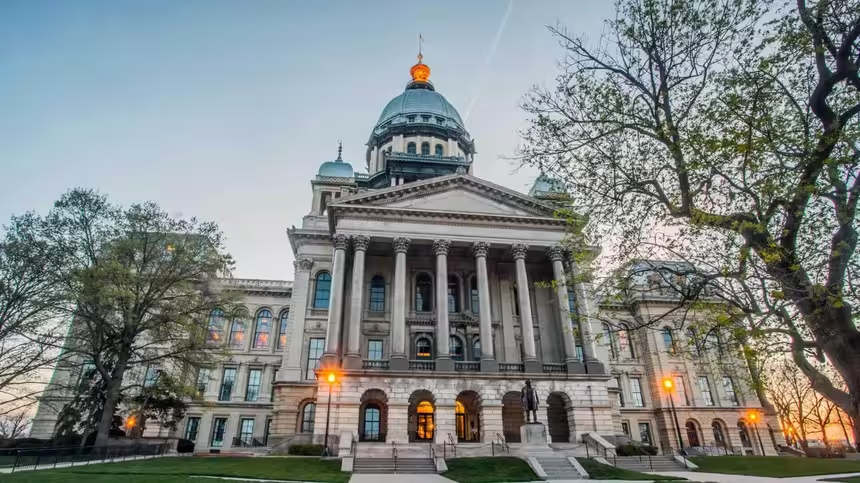
CapitolView is a weekly discussion of politics and government inside the Capitol, and around the state, with the Statehouse press corps. CapitolView is a production of WSIU Public Broadcasting.Providing Support for PBS.org
Learn Moreabout PBS online sponsorship(bright music) (camera beeping) (triumphant music) - Thanks for joining us on "Capitol View."
We are speaking this week with Senator Terry Bryant.
She is from Illinois Senate District 58.
Senator, we're gonna begin this portion of our conversation today with an issue that has been discussed for quite some time.
Republicans have been calling for state ethics reforms.
What would you like to see in this regard?
- So we had a package of bills that addressed this.
Those bills were never called.
In fact, I think I might have jotted down a couple bill numbers, but Senate Bill 4013 and Senate Bill 4012 were a part of that package.
They dealt mostly with the ability to lobby after you get out of office.
I think really I am not one of those individuals who thinks all lobbyists are terrible.
I personally think that there are a lot of really good lobbyists who are experts on issues.
I'm the minority spokesperson for energy, and you know, I told you my wheelhouse is Department of Corrections, so coming into energy, I had to find some lobbyists that know a lot more about energy than I do to kind of check me out on some things, right?
But we've tried to address the revolving door issue, but right now the revolving door issue, even with some changes, is so weak that you could be a lobbyist six months after leaving office, and it really should be a minimum of one year, because quite often if you are allowed to become a lobbyist six months after you've left office, you're still seeing bills that either you filed or someone that you're very close to has filed, and so I think first of all, we've gotta fix that revolving door that has to do with lobbyists.
And then actually the bill numbers that I gave you, I think had to do with the RICO Act, but we had some on the revolving door issue.
You know, everyone's familiar with the Federal RICO Act, but we also have a state version of that RICO Act.
And the two bill numbers that I gave you, 4013 and 4012, address the ability for state's attorneys and grand juries to be able to investigate and indict on RICO.
So if there is a legislator or a government official who is engaged in bribery or in any of the things that we've seen in recent years, right now you have to wait for the feds to do wiretaps to actually indict that person.
I don't think that we should have to wait for the federal government to step in.
It's a national embarrassment for us that we have to wait for the feds to step in.
We should have that ability statewide.
And I'm gonna back up just a little bit, because if you think about the fact that when Speaker Madigan was in place and his daughter Lisa was the Attorney General, you actually had a father-daughter situation where the Attorney General would've had to indict her own father, where we should be able to have the ability to convene a grand jury or for state's attorneys to engage in that, and I think that does away with a lot of what we've seen as far as ethics violations go.
- Okay.
I wanna move on to another issue, very important in your district with Southern Illinois University Carbondale.
Higher education received a major funding increase this year.
What are your thoughts about that increase and how that money is being spent?
- Yeah, that's a really good question.
So I am a member of the Higher Education Working Group, bipartisan, bicameral.
They've accomplished a lot of really good things, such as something called the AIM HIGH Program, so that is for students who go to Illinois high schools and go to Illinois public universities and colleges.
We're finally seeing some high higher ed entities really start to have buy-in with the AIM HIGH, and that's keeping students here in Illinois.
So it's taken a couple years for that really to take off and for some of the universities to really get engaged.
SIU has, from the beginning, has tried to engage with AIM HIGH, and they're doing a super good job of making that possible for individuals.
So I think the higher ed working group, because it's bipartisan and bicameral, I think we're gonna see some movement maybe on a funding formula for universities that would be really similar to what we have for pre-K through 12.
Like to see that happen.
I think that gives benchmarks for where a college or university has to reach in order to get better funding.
We did have an increase in the funding.
Some of it was MAP grant, that's all good stuff.
But as somebody who's very blue collar and worked really hard all my life, I know that sometimes those who are in the support staff are the ones who get left behind.
I would really like to see us use the money first to make sure that we keep good students here in Illinois.
We draw those students back from other states, but that support staff, they took pay freezes or really minimal raises while administrators were getting raises in the past, maybe not as much as they would like to get, but a lot of the support staff really got kicked to the curb.
So I'd like to see some of those dollars used for support staff.
I think that's a good use of money because that support staff is what keeps the wheels of higher education functioning.
And we do spend a lot of time trying to make sure that we get good professors, good instructors, but sometimes we leave that support staff, and they never catch up, 'cause you always get percentage raises, so it seems like they never catch up.
I hope that our public universities and colleges remember that those folks really bit the bullet for many years and now they make it up.
- Okay.
Just a few minutes left and I don't wanna run out of time without asking hopefully two more questions.
One, as you know, last year there was some success in getting licensing reforms for certain professions.
What else, if anything, would you like to see?
- Well, we, so we have to have better reciprocity between ourselves and other states.
I understand that some states have different laws in regard, especially where medical is concerned.
The two biggest areas that we have problems are in medical, in an education.
So if you're a teacher in Illinois, a lot of Illinois teachers went to Missouri.
They went, because Missouri has better laws for reciprocity.
Their pensions are better than ours are.
You have to work longer here to get that pension, but reciprocity is hard.
So if you are a Missouri teacher or an Indiana teacher or a Kentucky teacher, Wisconsin, you name the state, it's difficult to come to Illinois.
One, because our laws on reciprocity are very strict.
Two is because IDFPR, our regulating agency, they're slow.
I mean super slow.
Like to the point that if you have, say, a physical therapist who could be licensed in multiple states and has a job here waiting in Illinois, but it can take three months, six months, nine months to get them licensed.
And you know, the hospital's waiting for them.
They're waiting, they can't wait for a job for six months.
- Yeah, I know that's an issue for nurses as well.
- Oh- - The nurses who move to Illinois, the Illinois does not participate in the compact that most states participate in, so you can't get your Illinois license with reciprocity, as you described, for teachers either.
- Yes, that's right.
Yeah, and you can see- - So I know there's been work on trying to change that, but it has never gone anywhere.
- So the nurse compact, we've made really some strides with that.
- Yeah.
- I think we'll do more of the reciprocity issue, but IDFPR, that agency, the legislature continues to pile on things that people have to be licensed for.
We have a load of requirements in Illinois that other states don't have.
We haven't always given our agencies the money, and again, I don't just wanna throw money at agencies, but they have to have the ability to have good computer access.
I mean, good grief, when I came into the legislature in 2014, we had agencies still using DOS, right?
So it's crazy the computer systems that we're making them use.
And so I think if we're gonna have money that is given to agencies, IDFPR is one that we need to bring them into this century.
- Okay.
Time for one more question and it is related to licensing.
What else do you think Illinois needs to do to attract and retain jobs in the state?
- Just so jobs right now, just getting employees is a national problem right now.
And I just heard a really good presentation recently of a national speaker who said, who talked about this being a national problem.
One, is because we're all getting older, and so we have a generational issue with that.
So we're gonna have to be making some transitions to the fact that we might not get the same personal service that we have become accustomed to.
I'm 60, I don't mind saying that, 'cause I'll get my senior discount, (Fred laughs) but we might not be able to have all of those things that we've become accustomed to having, so we might have a little more self-service kind of things.
But to make Illinois a more business-friendly state, good grief, we have to get rid of some of the rules that we have for businesses.
I know everybody thinks minimum wage increase is awesome for people, but it's not awesome for businesses, and it is killing them and it's causing an increase in our inflation, all of those kind of things.
But I think more than anything, when we're talking about this question, it's economic development, and we have piecemealed economic development in Illinois for many years.
What I mean is you have to look at it holistically.
In the city of Cairo, in Senator Fowler's district, they're do trying to do a little bit better job of, when you're looking at do we wanna have the Cairo Port District?
What does that mean?
It isn't just bringing people into work.
You also have to have housing.
You have to have daycare.
You have to have good schools.
You have to have public safety.
- I think you've- - People wanna know when they lay their head down at night, they're safe.
- Yeah, I think you've set- - Holistic view, right?
- Yeah, I think you set us up for a whole separate program on that with that issue, because that is a big one, and certainly something we've talked about before.
Senator Terri Bryant of Illinois Senate District 58, thank you for being with us.
- Thanks for having me.
- And we would love to hear from you.
Email us with your story ideas, interview ideas and comments.
The address is contact@wsiu.org.
More news and analysis now with our guest, John Jackson of the Paul Simon Public Policy Institute at Southern Illinois University Carbondale, and Brenden Moore is the State House reporter for Lee Enterprises.
Gentlemen, thank you so much for being with us.
- Glad to be here.
- Always a pleasure, Fred.
- All right, John, I wanna start with you.
As you know, if Iowa is any indication, it appears the 2024 presidential race will once again be Trump versus Biden.
Illinois Governor JB Pritzker was in Iowa this week to push President Biden's message.
And on ABC's "This Week," Pritzker said that the presidential race will come down to independents.
The governor did not seem surprised when he was asked about the fact that Trump did not sign a loyalty oath for the Illinois ballot in which candidates pledge not to advocate the overthrow of the governments.
Your thoughts on that and on the race ahead?
- Well, for starters, I think the race is probably over.
It'd be very, very unusual now if circumstances were to produce anyone but Biden versus Trump.
And I think the one caveat there is whether or not there is a health scare from one or the other, or both for that matter, before the National Conventions.
But going forward, I see no real option likely for either of the two remaining candidates that challenge Trump.
I think the governor is right.
The independents will be a crucial block here.
They are the undecideds, primarily.
That includes pure Independents, Democrats who lean independent, and Republicans who lead in lean independent, they can still go over.
And the reason that's important is the base is going to be solid for both of these candidates.
There's no doubt about it.
There is the remaining question on the base, however, which one will turn out better?
For the Democrats, that includes Black voters, it includes young voters, it includes Hispanic voters, all of whom right now are not showing enough signs of enthusiasm for Biden.
On the Trump side, that includes rural voters, it includes those who are from the evangelical churches, and it includes those who are less well-informed, frankly.
And if they don't turn out for Trump, then he won't do the magic that he did in '16.
So turnout is absolutely crucial.
Now as to the governor's comment about Trump not obeying the Illinois law and flouting it, and basically there's no consequence to it, it used to have been a possible scandal, but there are no sanctions on Trump flouting either law or convention, so it really doesn't matter.
He'll be on the ballot in Illinois.
I think without any question.
And as usual- - Yeah, and I'm sure you saw many of the entrance polls in Iowa, voters were asked about, would a conviction affect your thoughts on President Trump's ability to once again hold the highest office in the land?
And one poll after another, they all had about the same results that two thirds of the folks questioned said, nope, conviction wouldn't matter.
He's still qualified to be president.
- Well, those are the earmarks of a cult, and the person that is charismatic in one definition of that term, and I just think that indicates how strong and how much Trump has come to dominate and define the Republican party.
- Yep.
It's a moment where a poll was, I think, extremely important to put this into perspective and to understand where we are right now in this country and understand the views of the folks who are going into votes.
We need to move on, Brenden, and we move to an interesting story now that you broke, a story that proves even if you're elected and you get legislation passed, sometimes nothing happens.
- Yeah, Fred, that's probably the best way to sum it up.
So basically the story I wrote was about this law that was passed and signed by Governor Blagojevich back in 2004 that created a registry for arsonists.
So basically if you're convicted of arson or found not guilty by reason of insanity, you would have to register, and you'd be put into a database akin to a sex offender registry.
This came to the legislature from a group of survivors from one of the worst school fires in American history that a bunch of 'em became firefighters.
And they said, you know, we found that these guys tend to do it more than once.
So, you know, it would be a good tool for law enforcement and good for the community to know, you know, who's living among them if they've been convicted of arson.
So basically these arsonists would have to register where they live, where they work, where they go to school with their local law enforcement agency, that they would turn it over to the state police who would put it into a database, and the state police would turn it over to the office of the state fire marshal who would disclose it publicly on their website.
The problem is that the legislature made it subject to appropriation, which is a popular word here in Springfield.
There's a lot of great ideas that often are just waiting to be funded, and there hasn't been a lot of money to go around in Illinois in the past couple of decades.
So, this is one of those items that was subject to appropriation.
The legislature, at least according to the state police, never appropriated the money for the state police to build out this database.
So 20 years have gone by, and literally, I mean, there is an arsonist registry, it's on the fire marshal's website, but it is just a blank space with no names, and so it's just an example of how you can have a really good idea in the legislature.
It passed with no opposition.
- Yeah.
- There was a press release when it went out, everyone was saying it's a great idea, but in terms of implementing it, it just shows that there are some challenges which could be understandable.
- and it makes you wonder, what else is out there?
(Brenden laughs) Are there other laws that have been passed and for one reason or another, a funding deficit, an enforcement deficit, or what have you, oversight, that nothing has been done.
So very important journalism, great story, and I'm glad you did it.
- Yeah.
Yeah, no, and I mean there are so many examples of this, and I think that, you know, this is something that we could look at as, you know, for example with the registry for assault weapons, how is that gonna turn out?
- Yep.
- As the state police try to build up that registry?
So absolutely.
- Yep.
Yep.
You gotta have the money and you gotta have the oversight.
Well, we move on now, John, to another interesting story.
Illinois lawmakers quietly scaled back a popular tax credit and now a former governor wants that tax credit back.
This story, I thought, John, was interesting on many levels.
- This is a great story.
This is vintage Pat Quinn, and it tells us that Pat Quinn hasn't retired from politics yet.
Pat Quinn was always the guide fly.
He was always the outsider.
He was always finding something that he could get exercised over and get the voters exercised over.
Probably his best accomplishment in terms of long-term impact was the cutback amendment where he got the size of the Illinois House literally reduced by one third and changed from cumulative voting.
That was a Pat Quinn operation.
Problem was when he gotta be governor, you can't continue to be an outsider, although even then he tried at times.
So this was a popular addition that would adjust the standard deduction for dependents and its growth with the change in the inflation index.
They knew what they were doing when they made that change because they decided they needed that revenue.
And the revenue is not inconsequential in terms of the balanced budget that the Democrats were pushing.
So there's no doubt what somebody was fairly well-informed about this, but they didn't wanna make a big production out of it, - Yeah, and it didn't make- - Although, along comes Pat Quinn to make a production of it.
- And it didn't make news when this occurred.
- Yeah.
Right.
- So it was discovered after the fact and now this tax credit will not be increased with inflation.
So we'll have to watch and see where this all goes.
But the state, of course, in some financial trouble.
So it's gonna be, it doesn't seem as likely that this would be restored, but we'll have to see.
- I think it's very unlikely they're gonna go back and take this out of it.
- Yeah.
Yeah.
No one even wanted to take credit for whose idea this was.
- Yeah, or blame.
(laughs) - (laughs) That was another interesting thing.
The story, it was like, who did this basically?
- Mm-hmm.
- And I think it's really emblematic of sometimes really important things happening that we don't always know about.
- Yeah.
- So, very interesting.
Just a few minutes left, so I do need to move on, Brenden, to something else here to wrap up.
During his Iowa victory speech on Monday, former President Trump said that the country should eliminate voting by mail, falsely stating that it leads to voter fraud.
Meantime, a new Illinois proposal calls for expanding vote by mail.
Tell us about that.
- Yeah, so there's a proposal out there from State Representative of Carol Ammons that would basically allow any election authority, so usually a county, but sometimes there are some cities that do it as well, that would allow them to make early voting, or absentee voting vote-by-mail a default setting.
So basically, even if you haven't applied for a vote-by-mail ballot, you're gonna be sent a vote-by-mail ballot, or every registered voter is gonna be sent a vote-by-mail ballot.
So this is done in, I believe it's done in about eight states.
It's very popular on the west coast.
I think like Washington, Oregon, you know, California is basically all vote-by-mail, and the idea is to increase voter participation.
A lot of those states have, are known for being higher voter participation states, and it would kind of continue a trend in Illinois of expanding different forms of voting.
Illinois, you know, for instance, has no-excuse absentee voting.
So you can request a vote-by-mail ballot no matter what.
You just don't wanna go out to the polls or go out early, or whatever it is.
You can get a vote-by-mail ballot now in Illinois.
So this is kind of keep expanding that.
Lawmakers are looking at several different ways to expand access to voting.
They had a subject matter hearing last week talk about, you know, increasing accessibility.
And so, you know, this is just one part of the discussion.
I don't know if this bill in particular will pass, but it might get roped into a larger elections bill if they do this session.
- Yes.
I important to make people aware of this, because unlike some things that are kind of a question mark in terms of public policy, there is a lot of research about expanding options for different ways for people to vote.
And the research in a nutshell says, if you expand options, it increases voter participation.
- Right.
- So it does increase turnout.
It does work.
- And I think we saw that during the pandemic, that a lot of people got comfortable with vote-by-mail, and you know, are more open to it.
And so I think in the future we're gonna see that's gonna be one of the lasting impacts of that in states like Illinois, where they're gonna wanna expand options, and you know, I think the pandemic kind of exacerbated that.
- Absolutely.
Brenden and John, thank you both for being with us.
- Glad to do it.
- Thank you, Fred.
- And thank you at home as well.
For all of us at WSIU, I'm Fred Martino.
Have a great week.
(triumphant music) (triumphant music continues) (triumphant music continues) (triumphant music continues) (triumphant music continues)

- News and Public Affairs

Top journalists deliver compelling original analysis of the hour's headlines.

- News and Public Affairs

FRONTLINE is investigative journalism that questions, explains and changes our world.












Support for PBS provided by:
CapitolView is a local public television program presented by WSIU
CapitolView is a production of WSIU Public Broadcasting.