
Capitol View - January 20, 2023
1/20/2023 | 26m 46sVideo has Closed Captions
Capitol View - January 20, 2023
This week on CapitolView, a week after signing an assault weapons ban into law, Illinois Governor JB Pritzker and others face lawsuits in state and federal court claiming the ban is unconstitutional. This issue, and all the week’s news in politics from Illinois.
Problems playing video? | Closed Captioning Feedback
Problems playing video? | Closed Captioning Feedback
CapitolView is a local public television program presented by WSIU
CapitolView is a production of WSIU Public Broadcasting.
Capitol View - January 20, 2023
1/20/2023 | 26m 46sVideo has Closed Captions
This week on CapitolView, a week after signing an assault weapons ban into law, Illinois Governor JB Pritzker and others face lawsuits in state and federal court claiming the ban is unconstitutional. This issue, and all the week’s news in politics from Illinois.
Problems playing video? | Closed Captioning Feedback
How to Watch CapitolView
CapitolView is available to stream on pbs.org and the free PBS App, available on iPhone, Apple TV, Android TV, Android smartphones, Amazon Fire TV, Amazon Fire Tablet, Roku, Samsung Smart TV, and Vizio.
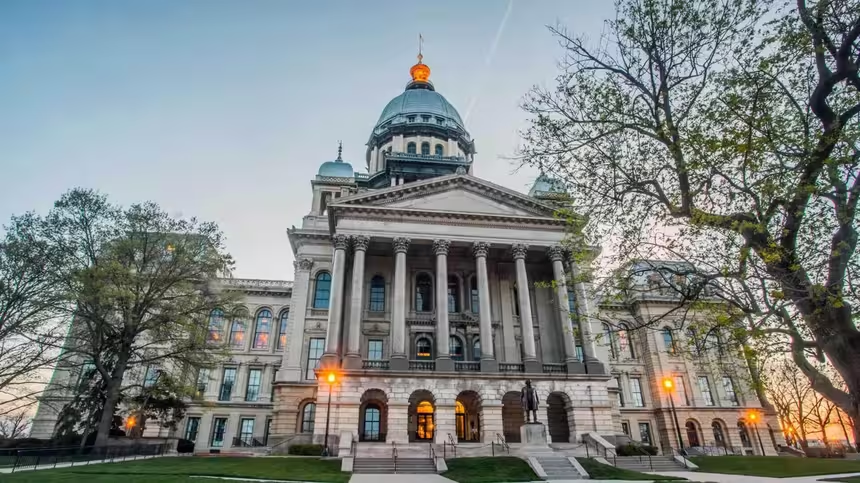
CapitolView
CapitolView is a weekly discussion of politics and government inside the Capitol, and around the state, with the Statehouse press corps. CapitolView is a production of WSIU Public Broadcasting.Providing Support for PBS.org
Learn Moreabout PBS online sponsorship(gentle music) - Welcome to "Capitol View," our weekly look at the happenings inside and outside the Illinois State Capitol.
I'm Jennifer Fuller.
Our guests this week are Peter Hancock of Capitol News Illinois, and Kent Redfield, an Emeritus Political Science professor from the University of Illinois Springfield.
Gentlemen, I appreciate the time.
Let's get right to the big topics this week.
And the one that is taking up quite a bit of headline, space, and airtime is the assault weapons ban.
As we expected, lawsuits filed, both at the state level and the federal level.
Peter, I know you've been handling a lot of this coverage.
Can you tell us where we stand right now?
- Well, the governor's signed the bill on January 10th, and it went into effect immediately, and it effectively bans ordinary citizens who are not law enforcement, not military, from purchasing, or manufacturing, or selling a long laundry list of weapons that include things like AK-47s, AR-15s, and the Smith & Wesson M&P 16, I think, which was the kind of weapon that the alleged gunman at the Highland Park massacre used.
And we knew it was gonna happen.
The law took immediate effect and it's almost hard to keep up with all of the different lawsuits.
There's one in Crawford County down in southeast Illinois.
There's one in I think Effingham County, and then there was one filed a federal suit in the Southern District of Illinois by the Illinois State Rifle Association along with some gun owners, gun retailers, and other gun rights advocacy groups.
And so we're just gonna have to see how this plays out.
I think both cases are headed to the state and federal Supreme Courts, and it's kind of interesting because the legal landscape of gun regulations has really been changing over the years.
I looked up one of the first cases the US Supreme Court decided, it was US v. Miller.
Two guys, Jack Miller and Frank Layton were a couple of washed up Oklahoma bank robbers in the 1930s, and they were arrested for transporting a sawed-off double-barrel shotgun across state line from Oklahoma into Arkansas.
And they claimed that the law, the National Firearms Act violated their Second Amendment right.
District court threw out the charges.
Went to the US Supreme Court, and this was when there were a lot of pretty heavy thinkers on the US Supreme Court.
And the rule then was that there was no reasonable relationship between possessing a sawed-off shotgun and a well-regulated militia.
They really focused on the well-regulated militia part of the Second Amendment.
And for many years that was really the only case the US Supreme Court had ever decided on a Second Amendment issue.
That was 1938.
70 years later in the case of Heller versus District of Columbia, they kind of reversed course and said, no, there is an individual right, it's not a collective societal right, an individual right to keep and bear arms.
And they threw out a DC ordinance that prohibited the possession of handguns within the district.
So, and then as recently as just last summer, there was a case involving the New York State Rifle Association challenging a law in New York that said you had to show proper cause for wanting to carry a concealed handgun.
And in that case, it was written by Justice Clarence Thomas, was saying that gun regulations have to be consistent with our national traditions of firearms regulations and you can't outlaw or regulate the use of commonly used weapons.
And so in these filings that you're seeing, in Illinois now they're all using these terms, that these are commonly used weapons, that there's no historical tradition of limiting the public's right to have them.
They're really relying on that sort of line of thinking.
I don't, just kind of speculation you have to think that the Illinois Supreme Court is now a five to two majority Democrats, but the US Supreme Court is much more conservative.
And so just, if I were a betting person I would say the federal case probably has more likelihood of success than the state level cases.
But we'll wait and see.
- Kent, Peter mentions the fact that this moved through very quickly and we've had discussions about this.
It moved through very quickly in the lame-duck session before the New General Assembly was sworn in earlier this month.
Is this a risk that you think the lawmakers were willing to take?
There were obviously going to be legal challenges, but do you think the speed with which the bill moved is going to be a problem for it, as it's being challenged now?
- I don't know necessarily that there are procedural things that are gonna be the hang up.
This is really gonna fall on the broader constitutional questions.
I think the way that it was passed by an overwhelming democratic majority, lame-duck immediate effective date, is if you wanna look for a sign of how have things changed in Illinois, when Illinois adopted a concealed carry law, it was the last state in the nation to do that.
And Speaker Madigan put downstate representative, Jay Hoffman as the head of the negotiations on that.
Now, we are now the ninth state in the post federal assault weapons ban era that has a state assault weapons ban.
And this was done with overwhelming democratic majority.
There aren't a lot of downstate democrats left in relative terms.
And so, it's indicative of how the politics have certainly changed in Illinois in really, less than a couple of decades.
There could be ... it's always messy about whether something's unconstitutionally vague when you say, magazines with 10 rounds or 15 rounds, sounds pretty straightforward.
How guns relate to magazines and how magazines operate, often you can, things are a lot more complicated than what plain language would suggest.
And so there's a lot to pick and choose from.
I mean, and you've got a law that has extension of the time that you can have a restraining order in terms of domestic violence, in terms of the red flag laws that we have that kind of preemptively take guns away from people through after a court proceeding.
So there's a lot in this.
And then the lawsuit in that Tom DeVore is doing in Effingham that we may get a ruling tomorrow, apparently applies to 86 people, whereas, the one in Crawford County could be involve a much larger group of people.
And so it will depend on whether you get temporary restraining orders or the court refuses to issue temporary restraining orders.
And then how broadly those are drawn, it will have an impact on whether you can start selling automatic weapons, which has really been the most obvious and clearest example of what's happened since the law went into effect is that those guns have come off the shelves in gun stores 'cause they just don't wanna take the risk of endangering their firearms licenses.
- Certainly there's a lot of questions that remain, and Kent you bring up the fact that we're talking about temporary restraining orders to prevent the law from being in effect.
And, then there's the question of well, then what is the law at this point?
So a lot of questions to be answered there.
One other thing that remains in the air if the law remains in place, is that there are numerous county leaders, whether they're sheriffs, prosecutors, and others that have pledged not to enforce the law.
And so there's some question about is it going to be a piecemeal approach at least until there's some definitive answer from whether it's the state Supreme Court, or the US Supreme Court on how this law will shake out.
And Peter, how does this make things difficult not just on a local level but with the state police and other statewide agencies?
- Well, I would take those threats with a grain of salt.
I mean, if there is a shooting involving one of these weapons in their jurisdiction, they recover that weapon, they tie it to a suspect.
I don't think the police are gonna pass up the chance to look up the serial number to see whether or not it's registered.
And I don't think there's a prosecutor who will give up the chance to add an additional charge onto a horrific crime like that.
They say they're not going to enforce it.
I think what they really mean is they're not gonna go knocking door to door trying to find people with these weapons and make sure they get registered or whatever.
The law really doesn't ask them to do that.
It's basically if you don't get your weapon registered and it ends up being used in a crime, you're gonna have some questions to answer and you might face additional charges.
- Kent, given the political makeup of both the state and federal Supreme Courts, what do you expect, and how long do you think this could drag out?
- Well, at the federal level court is consolidating cases that there are lots of things that are percolating up, and they're gonna have to pick some cases to give you guidelines in terms of exactly where the line is with concealed carrying, where the line is with prohibiting firearms in public places.
How far can you go with banning particular types of weapons?
What do you do with auxiliary sorts of things?
There's a provision in this law that outlaws a device that you would put on a handgun that goes, the vernaculars kind of switches, and then these things will make it so you can fire a handgun much more rapidly.
And so, is that a weapon in under the second Amendment in terms of facilitating the more rapid fire of a handgun?
There's a lot that needs to be penciled in here, or figured out from the court level.
At the state, we have a Second Amendment provision, but it really is a federal case.
The state, if you're not directly challenging the constitution, it's gonna go through the appellate.
If you're finding something unconstitutional it goes directly to the state Supreme Court.
So Illinois can be more expedited.
Well, the tradition at the federal level is to let things go through the appellate courts kind of see if you've got disagreements between different federal appellate court jurisdictions, try to not get out ahead of things, let stuff percolate up, and then kind of try to get everybody on the same page.
Now they haven't, frankly, haven't followed that in the last year with a couple of areas of the law.
And so it's a great period of uncertainty in terms of how quickly, how broadly, and so the possibility for chaos or at at a minimum kind of uncertainty, I think is pretty high.
- Certainly, well, let's get to other topics that are making some news this week.
And of course we should say in our discussion of these court cases, as we record this there is still the possibility that new information could come out before we get to air.
So of course we'll cover that in the next week here on Capitol View.
Governor J.B. Pritzker meanwhile is in Switzerland.
He's meeting with world leaders at the World Economic Forum.
It's not unheard of, but it is unusual for a state leader to be meeting with global leaders on world economic policies.
Peter, what are you getting from what the governor is saying as well as what others are saying about his visit there?
- Well, he is saying that he's promoting Illinois, Illinois businesses, and the Illinois economy to a global stage, which is a legitimate thing for a governor to do, but it does conjure up all of the speculation that we've been hearing for a long time about him possibly running for governor.
And this is certainly a way to elevate his profile on both the national and the global stage.
So there are going to be a lot of questions about that.
What he has said is that he will not challenge Joe Biden for reelection, and if Joe Biden runs, then he will support Joe Biden.
And Joe Biden has certainly given no indication that he plans to drop out.
I did hear, someone reminded me recently that the last president who passed up a chance to run for reelection was LBJ back in 1968.
So presidents just don't give up that chance, but he is getting on in years, and I think there are a lot of Democrats who would like to see him step aside.
I've spoken to Democratic voters who say they sort of assumed that this was part of the deal when Joe Biden ran in 2018 or 2020, Gee, that he would be a caretaker.
His job was to defeat Donald Trump, sit in the office for four years, hopefully, don't mess anything up too bad.
And then a new generation would come on.
Democrats have been very slow to let a new generation come in.
I think it was interesting that Hakeem Jeffries, the congressman from New York who is now the democratic leader in the US House is the first house democratic leader born after the end of World War II.
So democrats have been a little slow to let the next generation come in.
So there might be some pressure privately in rooms that we don't get to listen in on where democrats want Joe Biden to step aside.
And that would certainly open the door for people like J.B. Pritzker, California Governor, Gavin Newsom, we've seen Cory Booker and Amy Klobuchar, and a whole list of younger democrats who would like to start moving up.
- Perhaps even Vice President Kamala Harris.
Now, Kent, what is this visit that Governor Pritzker is making to Switzerland and the people that he's talking to doing for the state of Illinois?
We've talked a little bit about his political aspirations, but what about his job as taking care of the state and boosting the state?
- Well he's, obviously trying to boost Illinois's presence in terms of the national economy.
He's got an issue that the democrats have been pushing in Illinois that plays very well nationally and internationally, which is Illinois's efforts in terms of the green economy, and electrical vehicles, green buildings, and so this is, he can, nobody cares frankly about what the governor of Wyoming is doing with the energy even though they're trying to ban electrical cars apparently by 2025 or '35.
But if Illinois were a state, I mean a nation, it would be one of the leading economies internationally.
We're a big deal, as is California and Texas and New York, Florida, I mean, we're ... And so the international markets are important.
You need to promote Illinois.
Jim Thompson, if you were around, he spent a lot of time promoting Illinois internationally, setting up foreign trade offices in Europe.
And so this is, it's a legitimate role for the governor to be trying to boost Illinois' presence because we are a player internationally, we're an important producer, we're an important market agriculturally, manufacturing, and all of those things.
But in terms of his ambitions, the things that he said, when he says, here's what we've done for the last four years, well, we're green energy, and we're doing assault weapons, and reproductive rights, Gee, those just happen to be some issues that the core, that the primary core of the Democratic Party particularly the progressive part of the Democratic Party, really care about.
And so, while he's not anybody's first choice, he's in a position where he can keep doing what he's doing.
He doesn't have to stake out new territory.
If you're ambitious as a governor or senator but you've not played much in terms of the green economy and environmental issues, then you have to go out, and say, well here's what I would do, here's how you can kind of see how I'm credible.
Whereas, Pritzker can eat people leaves.
He can just roll out, look at what we've done for the last four years.
So it may come to nothing, but it does reson ... his political ambitions and his policy ambitions certainly are not in conflict in terms of his engagement with the world stage here.
- Kent, I wanna stick with you for just a minute as we get to another topic that came out this week.
It's been nearly a year and a half since the court vacated the Shakman decrees, which were put in place decades ago, 40 years ago to keep politics out of state hiring.
And now we're seeing a little bit more added onto this with state leaders reaching a settlement to have some of the money that was spent on a special master to keep an eye on these things returned to the state.
And it comes to the tune of about a half a million dollars.
Now, for people who are unfamiliar with Shakman, this is really something that got to the patronage issues that were going on decades ago, but what does this settlement or this decision mean in your mind?
- Well, it really closes the chapter in terms of, Illinois was the quintessential of jobs, political patronage, political machine state over the course of starting in the '60s you started to get the Supreme Court making rulings on patronage being an infringement of the right to association, of the right to free speech in terms of hiring and firing and promoting people on the basis of their political affiliation.
And so, the Elrod decision, which was Sheriff Elrod of Cook County, said you can't fire people just because they're of the opposite party when you take office.
We had the retain decision was the other side of that against Jim Thompson and the state of Illinois, saying that you can't hire, promote, or transfer people primarily on the basis of your political affiliation.
Shakman decree, this was a federal lawsuit that came out of Cook County.
And it originally applied primarily to Cook County, but it did eventually get extended to state government.
It's a consent decree saying you're not gonna do certain things, you're gonna take certain kinds of remedial action.
And even recently under the Quinn administration we had action brought and remediation involving some hiring that was done at the Department of Transportation that was under the Shakman decree.
What happens with these when you get monitoring and regulation, it can turn into a self perpetuating cottage industry.
And that was certainly the point that the state was making.
We're way past things like public employee union, civil service, there are all kinds of things that limit patronage, and clinical machines the way they existed back in the '70s and earlier are dead.
So this is closing that chapter in terms of, there's always a need to monitor hiring to make sure that you're not extending things in terms of political favors.
It still goes on.
Absolutely it does.
But the need for the systematic, having essentially a bureaucracy to monitor what's going on, there are plenty of ways to get remediation or remedy under existing laws and in Supreme Court actions.
- You mentioned that it is perhaps closing a chapter on what many would call political corruption in Illinois, but there's certainly plenty more examples of corruption both at the state level and even at the local level in some cases.
Do people need to look to the Shakman decrees, to Rutan and others and say, maybe we need more regulation, less regulation.
What does the state need to do to move past its checkered past?
- Well, I mean, just quickly, we need more transparency.
We need to make certain things illegal just so there's not a gray area.
I mean, we've got a gift ban because we didn't wanna look at every kind of relationship.
We just said, if it's a contractor with, then you just can't give gifts, you can't give contributions.
So, there are all those things you can do to harden the target.
Primarily you need to change the culture.
I mean, people don't rob banks because there are guards and bars, but most people don't rob banks because they think it's wrong, and you need to have the same attitudes about political corruption.
We got a ways to go.
- One of the ways that they can do that, as you mentioned is to pass new laws or get more regulation in place at the state level.
Peter, as we open a new session of the Illinois General Assembly, do you expect bills like that, or what do you expect from this spring session?
- No, I don't see the Democratic majority going any further down that road.
As far as I can see, and we're just now at the very beginning of the session, this is gonna be a budget session.
The governor's gonna give his budget address in February.
This is where the big battle is going to be.
And the question is, how does Illinois brace itself for the possibility or even the likelihood of a recession, which is becoming more and more likely it seems with every passing minute.
We're recording this on Thursday, the day that the US is supposed to hit the debt limit.
And there is not yet an agreement on raising the debt limit which has to do with borrowing money to pay bills you've already incurred.
And that could really, really affect the US economy and the global economy, and it would affect all state governments including Illinois.
- Lots of things to keep track of.
We will continue to do that right here on "Capitol View."
Peter and Kent, I'd like to thank you for your time this week, and thank you for joining us on "Capitol View."
You can find all of our episodes online at wsiu.org and at our YouTube channel.
Until next time, I'm Jennifer Fuller, thanks for dropping in.
(upbeat music)

- News and Public Affairs

Top journalists deliver compelling original analysis of the hour's headlines.

- News and Public Affairs

FRONTLINE is investigative journalism that questions, explains and changes our world.












Support for PBS provided by:
CapitolView is a local public television program presented by WSIU
CapitolView is a production of WSIU Public Broadcasting.