
Capitol View - January 25, 2024
1/25/2024 | 26m 46sVideo has Closed Captions
Capitol View - January 25, 2024
This week, a conversation with Teresa Parks of the Illinois Guardianship and Advocacy Commission, which protects the rights and promotes the welfare of persons with disabilities. Plus: Analysis from our guests Andew Adams at Capitol News Illinois and Jason Piscia, Director of the Public Affairs Reporting Program at the University of Illinois Springfield.
Problems playing video? | Closed Captioning Feedback
Problems playing video? | Closed Captioning Feedback
CapitolView is a local public television program presented by WSIU
CapitolView is a production of WSIU Public Broadcasting.
Capitol View - January 25, 2024
1/25/2024 | 26m 46sVideo has Closed Captions
This week, a conversation with Teresa Parks of the Illinois Guardianship and Advocacy Commission, which protects the rights and promotes the welfare of persons with disabilities. Plus: Analysis from our guests Andew Adams at Capitol News Illinois and Jason Piscia, Director of the Public Affairs Reporting Program at the University of Illinois Springfield.
Problems playing video? | Closed Captioning Feedback
How to Watch CapitolView
CapitolView is available to stream on pbs.org and the free PBS App, available on iPhone, Apple TV, Android TV, Android smartphones, Amazon Fire TV, Amazon Fire Tablet, Roku, Samsung Smart TV, and Vizio.
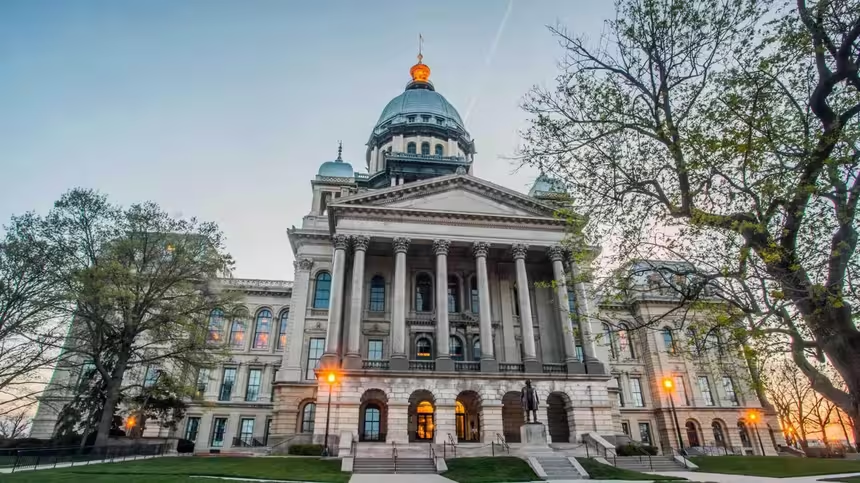
CapitolView
CapitolView is a weekly discussion of politics and government inside the Capitol, and around the state, with the Statehouse press corps. CapitolView is a production of WSIU Public Broadcasting.Providing Support for PBS.org
Learn Moreabout PBS online sponsorship(slow dramatic music) (camera beeping) (moves into intense dramatic music) - Thanks for joining us on "Capitol View", I'm Fred Martino.
Upfront this week, the Illinois Guardianship and Advocacy Commission is an executive state agency created to safeguard the rights of people with disabilities.
I'm very pleased to welcome Deputy Director Teresa Parks.
Teresa, thank you for being with us.
- Thank you, Fred.
It's great to be here.
- Good to have you here.
And to start off with, I wanna get to the basics.
Tell us more about the goals of the Illinois Guardianship and Advocacy Commission.
- Yes, Fred, let me start out with just a very general overview of the work that we do.
As you said, we are a state agency and we have a statewide presence.
We have offices across the state, including offices in central Illinois, Springfield, Peoria, Champaign, as well as offices downstate in Alton and Anna.
And we have offices, of course, in the northern part of the state.
All of our work, all of our programs support people with disabilities in different and unique ways.
We have a program called the Office of State Guardian that serves as guardian of last resort for adults with disabilities.
And by last resort, I mean we don't get appointed guardian unless the court determines someone needs a guardian somewhere in the state and there's no one else willing, available, or appropriate to serve as that individual's guardian.
We are guardian for about 5,000 individuals across the state of Illinois.
We also make available on our agency website information about guardianship and the guardianship process.
We have an intake number where people can call and ask questions about adult guardianship and we put forth a guardian training module for newly appointed guardians so that they can better understand their role.
And really, that's a requirement now in the state of Illinois based on legislation that we initiated, that newly appointed guardians get some kind of training so that they better understand their role.
We also have a program called the Legal Advocacy Service that provides legal advice and representation for both children and adults with disabilities, most often in the mental health arena.
We also have a program called the Human Rights Authority that investigates allegations of rights violations committed against people with disabilities by disability service providers.
And then we have a special education initiative, an advocacy initiative, which is really a collaboration between two of our other programs, the Human Rights Authority and the Legal Advocacy Service.
And we provide Illinois families with a resource to turn to for special education issues.
So that's a very brief overview, but we can discuss anything in more detail.
- We'll get into the specifics on all of those areas in our remaining time.
You gave a little bit of information about this next question, but I want to get an example, some more specifics to tell us about the conditions that would cause a guardian to be appointed for an individual.
- Yes.
If someone does not have an advanced directive, like a power of attorney, and they are having difficulty managing their life and they're having problems making safe and sound decisions on an ongoing basis, we're all allowed to make mistakes, but these would be individuals who just regularly put themselves in harm's way, substantial harm's way.
It may be possible that a guardian might be warranted, but just so your listeners know, a guardianship is a legal process.
It's not something that happens overnight.
It involves some paperwork, petitioning, a physician's report confirming that the individual has a condition that requires guardianship.
And then ultimately, all of this is reviewed in a court and it's up to a judge to determine if someone needs a guardian, the type of guardianship, and then the person most appropriate to serve as an individual's guardian.
And on our agency website, we actually have a booklet called "A Guide to Adult Guardianship in Illinois" that provides an outline of the process.
And also, there's a private organization out there for guardians called the Illinois Guardianship Association.
And they have a booklet called "A Family Guide to Adult Guardianship" to help families review the process and the kinds of things they need to know about guardianship.
- Is a family member required to start the process with you, or can it be someone who's just aware of the situation?
A neighbor, a friend?
- Yes.
Anybody can initiate a petition from guardianship.
And we do not assist with the process.
We can provide education and information, but many times families can initiate it on their own.
Some families seek out the assistance of an attorney, especially if there's something complicated about the situation.
There are attorneys who specialize in this kind of work, but ultimately, yes, it goes before the judge.
It's a legal process.
- I understand.
I wanna move to another issue now that you touched on.
Give us some examples of disability providers that the Human Rights Authority might investigate.
- Great question.
First of all, the authority, in order to investigate a complaint, a complaint must meet three criteria.
It must involve a person with a disability, any type of disability, any age.
Secondly, the complaint must involve a disability service provider, any service provider, in whole or part, that provides services to people with disabilities.
Thirdly, the complaint must involve a disability right.
And that's a right that's grounded in statute, regulations, or maybe the service provider's own policy.
We go into all kinds of settings.
Just to give you some examples: state operated facilities, hospitals, including hospital behavioral health units, group homes, vocational programs, community mental health providers, nursing homes, special education programs, and even jails because sometimes unfortunately, people with disabilities interface with the criminal justice system and they do have some protections in those kinds of settings.
What's unique about the authority is that it is comprised of nine regional boards across the state, and these boards are made up of volunteers, family members of people with disabilities, people with disabilities themselves, service providers, and they come together with the help of a staff person from our agency and they work through these complaints and do the investigations.
And I just wanna mention that because we're often looking for people to serve on those regional boards and if someone out there might be interested in this kind of volunteer opportunity, it's very unique, but it's very fulfilling.
We'd like to hear from them.
We have an online application that people can access and fill out.
- All right, well there is some good news here.
Help is available and I wanna get into this now.
How can the legal advocacy service help individuals?
- Our legal advocacy service is primarily comprised of attorneys and we do have a couple of paralegals that work in that division.
And mostly what they do is they are appointed by the courts to represent individuals in mental health proceedings, such as an individual is being subject to involuntary commitment to a mental health facility or court ordered treatment, usually psychotropic medication treatment.
Our attorneys represent those individuals to ensure their due process protections during those proceedings.
Our attorneys in that program also help with questions about mental health rights and laws.
So if anyone out there has some questions about mental health rights, we're a resource in that program and our attorneys also assist people with setting up advanced directives.
There's a unique type of advanced directive here Illinois called the "Mental Health Treatment Declaration", which is a power of attorneys specifically designed for mental health services.
- All right, well to wrap up, you mentioned this, you have a special education initiative.
Tell us about that.
- Yes.
Our special education initiative is fairly new.
It's comprised of five staff, and what we do, we're available to answer questions about special education laws and rights.
We also do training for organizations and groups.
We also post on our website some online training that people can access about special-ed rights and laws.
And we do advocacy.
We can also assist with what is called IEP meetings.
These are special planning meetings for students with disabilities.
We can provide remote assistance, if our schedule allows, and our attorney and paralegal can assist with some mediation and due process cases.
These are the processes available to students with disabilities if they have complaints about the services that they use.
- Such important information.
And of course, folks can find out a whole lot more about these various initiatives online at your website.
Teresa Parks is the Deputy Director of the Illinois Guardianship and Advocacy Commission.
Teresa, thank you so much for being with us today.
- Thank you, Fred.
It's great to be here - And we'd love to hear from you.
Send us your letters.
The email address is contact@wsiu.org.
More news and analysis now with our guest, Andrew Adams of "Capital News Illinois" and Jason Piscia, he is Director of the Public Affairs Reporting Program at the University of Illinois Springfield.
Gentlemen, thank you for joining us.
Andrew, Illinois has spent more than $500 million to help immigrants arriving in Chicago.
And now it appears that there will be a discussion of more funding during the session.
"Capitol News Illinois" looked at a number of issues being raised as more than 34,000 immigrants have arrived in Chicago from Texas alone.
Tell us some more about this.
- For sure.
So obviously, how to support these people has been a top-of-mind issue for local leaders within the Chicago land area and also state leaders.
Like you said, the state's already spent over $500 million.
That's through a variety of means, 470-odd million through various agencies and another 160 million through this kind of comprehensive plan that Governor Pritzker rolled out in November.
Now that money goes to helping fund caseworkers, helping fund shelters, helping put on legal clinics, but that money will run out eventually.
Those services can be expensive.
So, there have been discussions in Springfield about what to do next, what to do for the coming year.
House speaker Chris Welch last week formed what he's calling a working group, an informal group of lawmakers who can meet with advocates and draft legislation.
That's something he's done for other controversial political topics.
The Abortion Rights Working Group comes to mind.
Now I'm interested in what that working group will put together for a couple of reasons, chief among them is one of its members, representative Jehan Gordon-Booth, Democrat from Peoria, who is the house's chief budget negotiator.
So if there is a large spending package, either through this year's projected surplus or through next year's standard budget, Representative Gordon-Booth is on a shortlist of people who would likely be at the decision-making table for any of those kind of financial decisions.
- It's really something, Andrew.
Yesterday I was reading a story in the "Chicago Sun Times" and they reported that the city of Chicago only budgeted $150 million for this crisis, and they're going through about $40 million a month.
We have not independently confirmed those numbers, but that was in the story.
That gives you an understanding of why, I would imagine, it's likely this is gonna be discussed extensively, I would imagine, during the session.
- Yes, and the relationship between the city and state becomes contentious at times.
This week, Mayor Brandon Johnson, the mayor of Chicago, said that Chicago has carried the entire weight of this crisis, even though the state funds many of the services and has given at least $115 million over the past 18 months to the city specifically for this.
I know they just rolled out a new plan, a new approach to the situation, one that shifts focus away from offering these migrants shelters and more towards either hotel living or connecting them with family or rental assistance.
And the state has already shown some, some issue with this, with Pritzker saying he was deeply concerned by this approach.
- And of course, the governor writing another letter with some other governors this week, expressing to the Congress that a border bill needs to be passed to have relief.
I wanna move on to another aspect of this that I found very interesting this week, Jason.
Chicago and New York City have both sued bus companies dropping off immigrants from Chicago or in Chicago.
It turns out that filing the lawsuits will not be the only expense.
Now a bus company is suing Chicago so that it, it appears the city will have to fight a lawsuit as well.
Bring us up to date on this.
- Sure.
Earlier this month in January here, as you know, a lot of the 35,000 or so migrants that have made their way to Chicago are getting here via bus, buses that have been hired by the state of Texas to transport those migrants here.
The city of Chicago to deal with the influx has put in several rules and regulations on where these buses need to drop off migrants, what time of day they can do it.
There has to be associated paperwork that goes along with it.
They just can't drop them in the middle of nowhere at three o'clock in the morning and say, "I'm good."
The one bus company, Wynne Transportation, filed a lawsuit against the city earlier this month saying that these rules and this treatment of migrants violates various aspects of the US Constitution.
They filed this in federal court, of course.
They're arguing that the federal government has regulation over immigration in this country.
And the city of Chicago cannot in, essentially make its own immigration laws and regulate how these migrants are brought into the country.
They're also claiming that the way the migrants have been treated violates their rights as humans, calling it an inhumane operation, that some experts said in this story that they're a little bit nefarious on that claim, just based on the fact that no migrants are named in the lawsuit as plaintiffs.
It's just this bus company going up against the city.
I guess if they were truly worried about human rights violations that they would get some migrants in on the lawsuit as well.
It'll be interesting to see where this goes.
A lot of the constitutional claims in here, if you read through the lawsuit, I found it interesting that some of the cases that the plaintiffs use to bolster their case related to interstate shipping of products, including apples and beer, whether you can compare those things to transporting migrants across state lines, I guess the court will have to check on that.
- Okay.
Very interesting.
And again, something we'll continue to watch as it develops.
An issue for Illinois, many other states, and the entire nation as well.
Andrew, while Illinois is spending hundreds of millions of dollars on this immigration crisis, it is making cuts to a program for some of the state's most vulnerable citizens.
A story from WCIA says that the Department of Human Services is planning to cut the number of hours it covers to care for the developmentally disabled by nearly 9%.
Tell us more.
- So this is, just to get the kind of facts out there to make sure we know what we're talking about.
This is a reallocation of how DHS, the Department of Human Services, spends its money.
They reimburse providers for giving care to people with intellectual and developmental disabilities at a number of facilities throughout the state, all of them supported on some level by DHS.
Now, like you said, this is about an 8.7% cut in the number of hours that they will reimburse for.
And just from what I've seen, that's about $90 million overall in savings from the state.
Now, this has been a long time coming.
It was initially announced last January, January 2023, but its rollout has been delayed several times since then.
And it came to a bit of a head in the past few days here because it was met with vocal opposition from some Senate Republicans at the State House, notably Senator Chapin Rose, Republican from Mahomet.
And you know, those criticisms are mostly along the lines of it being what they view as a cynical or even a hypocritical move from the governor's administration, particularly contrasted against the increase in the wages the state will reimburse for these direct service providers, the care workers that are working on the ground in these facilities.
Last year, the state upped their pay by 2.50 an hour, that's $2.50 an hour, and now they're cutting the number of hours they'll reimburse for.
So, this has led to the opposition from Senate Republicans in particular, and it'll be interesting to see if this becomes one of those things that the State House that kind of catches fire and becomes hot political topic.
- Okay, another thing to watch.
Jason, we move now from Illinois cuts to additional spending by the state.
Illinois is investing heavily in companies that make products for electric vehicles.
The governor's office announced another $122 million for a tax credit for a German firm making copper and copper alloy components found in electric vehicles and other products.
What did you find out from an article on this by "Capital News Illinois"?
- Yeah, as you know, the state of Illinois is all in on renewable energy projects and products, electric cars and everything that goes along with that, solar energy.
And they have been working very hard to bring companies that build components and deal with these issues to Illinois to help build our economy here in this state.
There was an announcement a few days ago, Wieland Rolled Products North America, will get looks like $122 million in subsidies over the next 30 years to expand their operation here.
As you mentioned, that's a firm that makes copper parts, many of which are used in electric vehicles, which, as you know, is another goal of the state to get more electric vehicles on the road over the next several years.
Again, this is more of the state's investment into this issue, very important for, as we worry about climate change and the supply of our coal reserves and everything else related to that.
- Yeah, I found this story really interesting, Jason, because this story said that this company was making an investment of about $500 million.
In addition to this 122 million over 30 years, there were additional incentives and that the total was over 200 million from the states.
So, not quite half of this $500 million investment.
A lot of money that we're talking about here and this is not the only one, as you point out.
There are other companies that are getting subsidies and tax credits.
- Yeah, and as you mentioned in this particular case, this total of 230 or so million over the life of this deal, this will go to modernize this company's facility in East Alton that produces these products and also will retain 800 jobs that the company and the state claim.
- Yeah.
- And like you said, this is not the only deal that this is happening.
And in not all cases there's, you know, there isn't always big state subsidies on the line either.
- Yeah.
- I think Andrew had a story this week that looked at a solar company that's expanding in Illinois as well.
- Yeah, what did you find out, Andrew?
- Yeah, so Nexamp, they say they're the largest provider of community solar power in the country, has opened up a second headquarters in Chicago.
And it's coming along with what they say is gonna be $2 billion of investment in the state.
They're hoping to make Illinois their largest solar market, which aligns with the Pritzker administration's climate goals quite closely.
- Certainly I'm sure the state hoping for lots of offshoot economic development from this and certainly income tax revenue as well.
We will see as this all develops.
Andrew, we just have a couple of minutes left, but I didn't wanna miss this story.
The Biden administration has been really successful reducing prescription drug prices through legislation.
And now Illinois may try to do that.
Lawmakers have introduced a bill to create a state prescription drug price oversight board.
Tell me about that.
- Of course.
The bill from Representative Syed and David Koehler would create a five member board that would have oversight over particularly pricey drugs, both name brand and generic.
Now, this would be new for us and advocates say that it would be beneficial, particularly for folks like seniors who have a lot of medication, but it is not the first.
We would not be the first state in the country to try something like this.
Eight other states have similar oversight boards, to varying levels of success with different nuances in some of the details.
So it'll be interesting to see where this goes and if it can pick up a win.
- Yep.
We'll be watching.
Andrew Adams of "Capital News Illinois", Jason Piscia, he is Director of the Public Affairs Reporting Program at the University of Illinois Springfield.
Gentlemen, thanks for being here.
- Thank you.
- Thanks.
- Thank you for joining us at home.
For everyone at WSIU, I'm Fred Martino.
Have a great week.
(slow dramatic music)

- News and Public Affairs

Top journalists deliver compelling original analysis of the hour's headlines.

- News and Public Affairs

FRONTLINE is investigative journalism that questions, explains and changes our world.












Support for PBS provided by:
CapitolView is a local public television program presented by WSIU
CapitolView is a production of WSIU Public Broadcasting.